Chatbase vs Tidio: Which AI Chatbot Actually Wins for Your Business in 2026?
One is an AI librarian trained on your documents. The other is a full customer support team in a box. Here's how to choose the right AI chatbot platform for your business.
Choose Chatbase
If you need a fast, affordable AI chatbot trained on your documents — PDFs, help articles, URLs — for FAQ automation, internal knowledge bases, or SaaS in-app support. Ideal when live human agents are not required.
Choose Tidio
If you run an e-commerce store, need live chat alongside AI, want proactive visitor engagement via automated Flows, or require a unified inbox across website, email, WhatsApp, and social channels.
| Feature | Chatbase | Tidio |
|---|---|---|
| Best For | AI knowledge-base Q&A, SaaS docs, internal bots | E-commerce, live chat + AI, omnichannel support |
| Starting Price | $40/mo (Hobby) | $29/mo (Starter) |
| Key Strength | Deep document training + 90+ language auto-coverage | Live chat + Lyro AI + visual Flows + unified inbox |
| Live Agent Inbox | Not included | Full inbox with typing preview |
Choosing between Chatbase and Tidio is not about finding the "better" tool — it's about matching the right platform to how your business actually handles customer communication. These two AI chatbot platforms solve fundamentally different problems, even though they occupy the same category on comparison sites.
In this in-depth Chatbase vs Tidio comparison, we break down architecture, pricing, AI capabilities, integrations, and real-world use cases to help you choose the best AI chatbot platform for your needs. After hands-on testing of both platforms, the distinction is clear: Chatbase is your AI librarian — it knows your documents deeply and answers from them. Tidio is your front desk — it combines live agents, AI, and automation into one complete support operation.
What Is Chatbase?
Chatbase is an AI-first chatbot builder founded in 2021 and relaunched in 2023 by Yasser Elsaid. The platform lets you train a GPT-powered chatbot on your own data — PDFs, website URLs, Notion pages, custom Q&A pairs — and deploy it as an AI agent that answers questions directly from that content. The entire value proposition centers on one thing: turning your existing documents into an intelligent, conversational AI layer.
The growth story is notable: Chatbase is 100% bootstrapped with zero venture capital funding, yet crossed $8M ARR in December 2025 with just an 18-person team (11 engineers). The platform now serves over 10,000 paying customers across 140+ countries, with a 92% customer retention rate. Notable enterprise clients include IHG and Miele.
How Chatbase Works
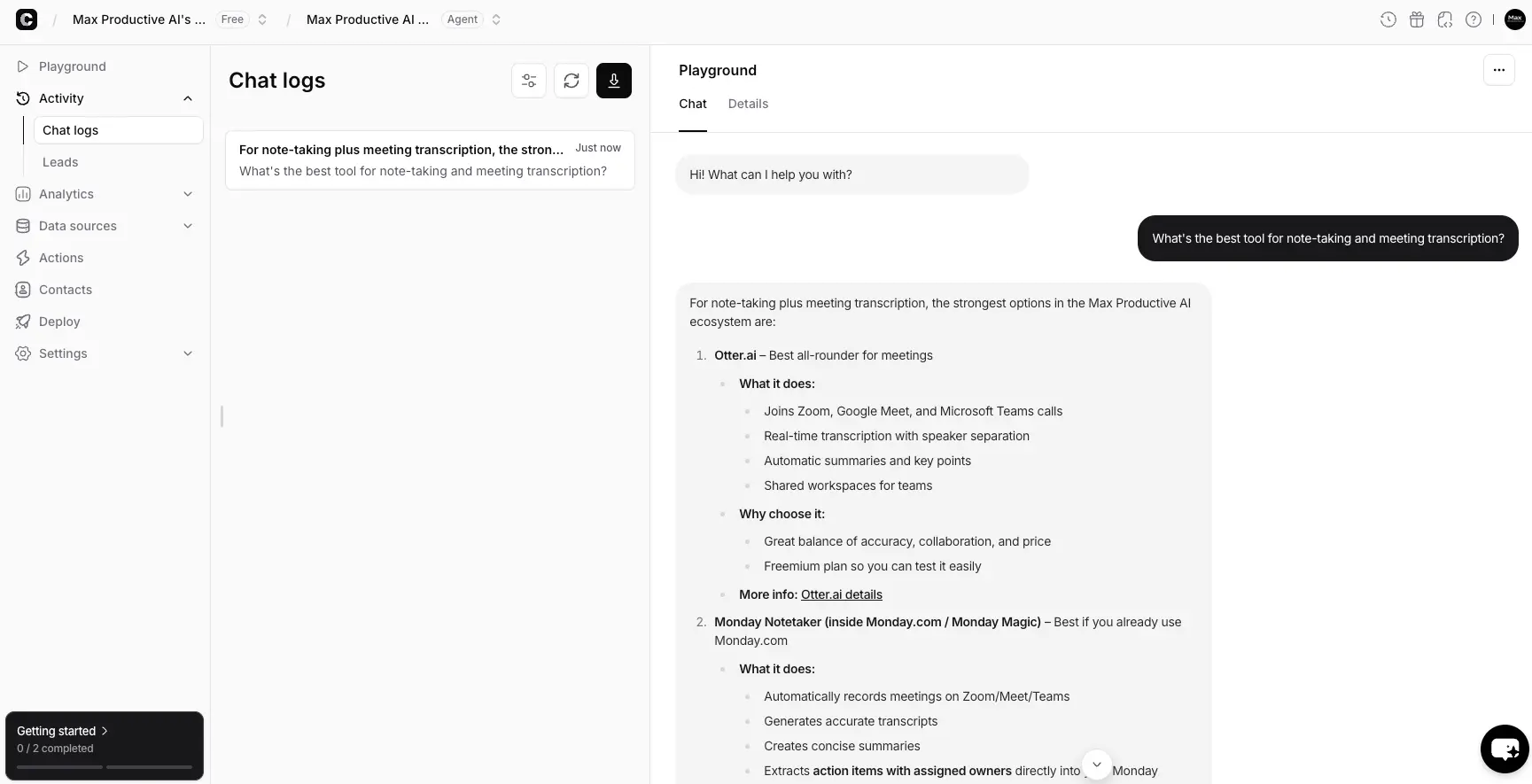
Setup takes roughly 10 minutes. You upload your training sources — PDFs, .txt files, website URLs (auto-crawled), Notion pages, or custom Q&A pairs — and Chatbase creates an AI agent trained specifically on that content. You choose which AI model powers your bot (GPT-4o, GPT-4 Turbo, or Claude), customize the persona, tone, and system prompt, then embed the widget on your website or deploy it to WhatsApp, Slack, Facebook Messenger, or Instagram.
What makes Chatbase particularly compelling for technical teams is AI Actions (launched December 2024). These turn the chatbot from a passive Q&A tool into an active agent that executes tasks via external APIs — booking appointments through Cal.com or Calendly, checking order statuses via Stripe, logging CRM data, or triggering Zapier and Make workflows. For SaaS companies, this means the bot can do things like reset passwords, check account status, or submit bug reports programmatically.
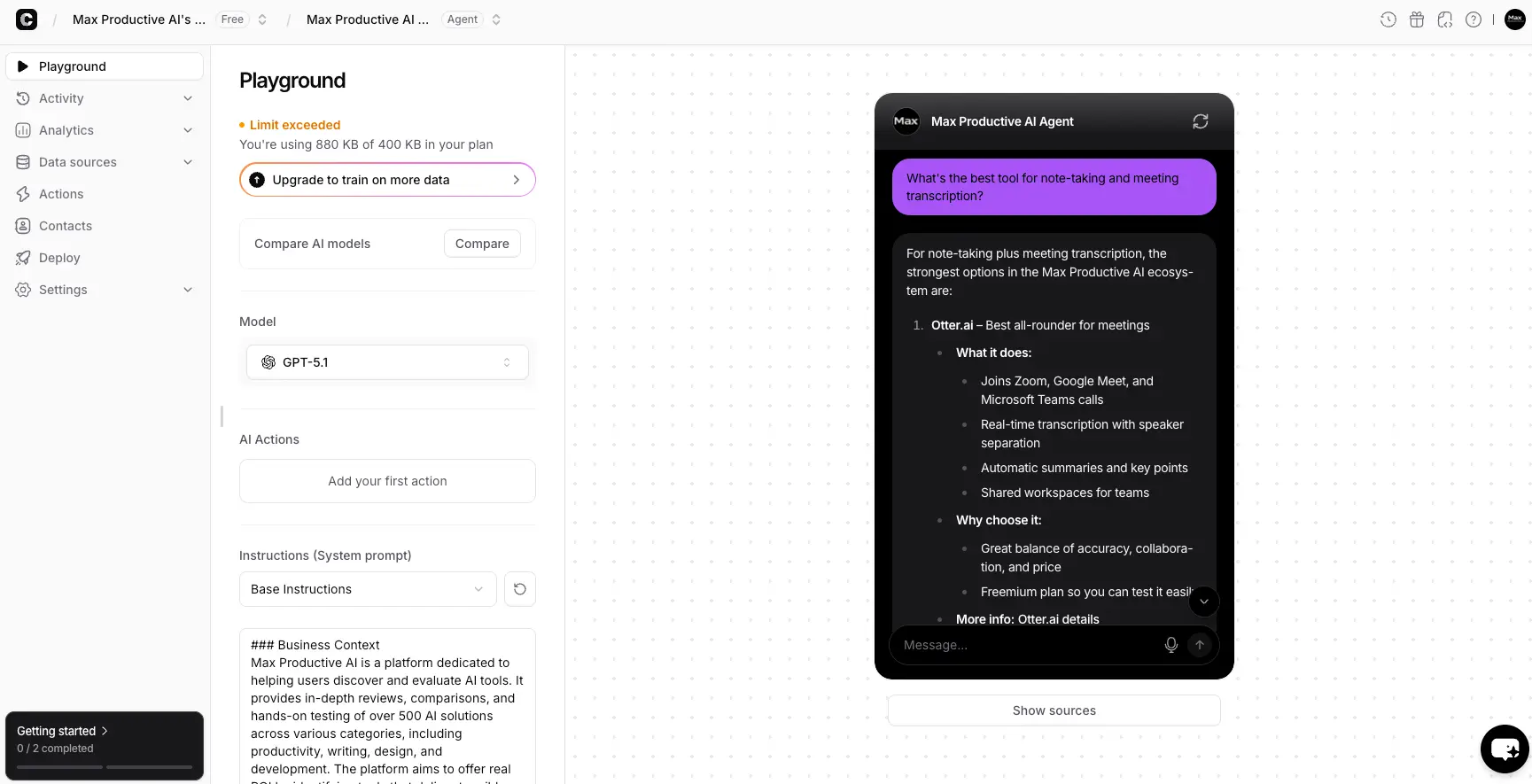
One of Chatbase's quiet strengths is multilingual coverage. Because it routes through GPT-4o or Claude, the bot automatically detects the language a user types in and responds in that same language — covering 90+ languages without any manual translation setup. A Spanish-speaking visitor receives a Spanish response even if all training documents are in English.
What Is Tidio?
Tidio is a full-stack customer support platform that combines live chat, an AI chatbot agent (Lyro), a visual no-code automation builder (Flows), a help desk ticketing system, and a unified inbox — all in one dashboard. While Chatbase is a specialist, Tidio is a complete support operation serving over 300,000 businesses globally, with notable clients including Stanley, Jaguar, ADT Security, and Glovo.
Tidio holds the #4 position in the live chat market with 5.61% market share and over 44,000 active detected domains. Its customer base skews heavily toward e-commerce: WooCommerce (17.77%), Shopify (16.25%), and Wix Stores (16.11%) make up the largest segments. This e-commerce DNA shapes nearly every feature the platform offers.

Lyro AI: Tidio's Conversational AI Agent
Lyro is Tidio's conversational AI agent, trained on your content — website pages, FAQ documents, CSV files, or Zendesk articles — that automatically responds to customer questions across live chat, email, WhatsApp, Instagram, and Messenger. According to Tidio, Lyro resolves up to 67–70% of routine customer queries without human involvement, and real-world results back this up: UK car repair company Axioma achieved an 89% AI resolution rate with Lyro.
What sets Lyro apart from standalone chatbots like Chatbase is context-aware conversation. Lyro maintains the full thread without repeating questions or losing track mid-conversation. When it encounters a query with low confidence, it automatically redirects the customer to a human agent and passes the full conversation history — so the agent picks up without the customer needing to repeat themselves. Beyond answering, Lyro can perform actions: check Shopify order statuses, update customer data, recommend products from your live catalog, and qualify leads.
Tidio also includes Lyro Copilot, an agent-assist feature that appears in the live agent's chat window and suggests pre-drafted replies pulled from the same knowledge base Lyro uses. Agents review, edit, and send in one click — speeding up human responses without removing control.
Flows: Tidio's Visual Automation Builder
Tidio's Flows builder is a visual drag-and-drop automation system that lets you create proactive engagement sequences with zero code. The structure follows a Trigger → Conditions → Actions pattern: triggers fire on first visit, chat icon click, specific page URL, time on page, cart abandonment (Shopify), keyword/intent detection, or returning visitor — then route through conditional logic (by language, location, page visited, visitor type) to execute actions like sending messages, collecting contact info, updating fields, or routing to specific departments.
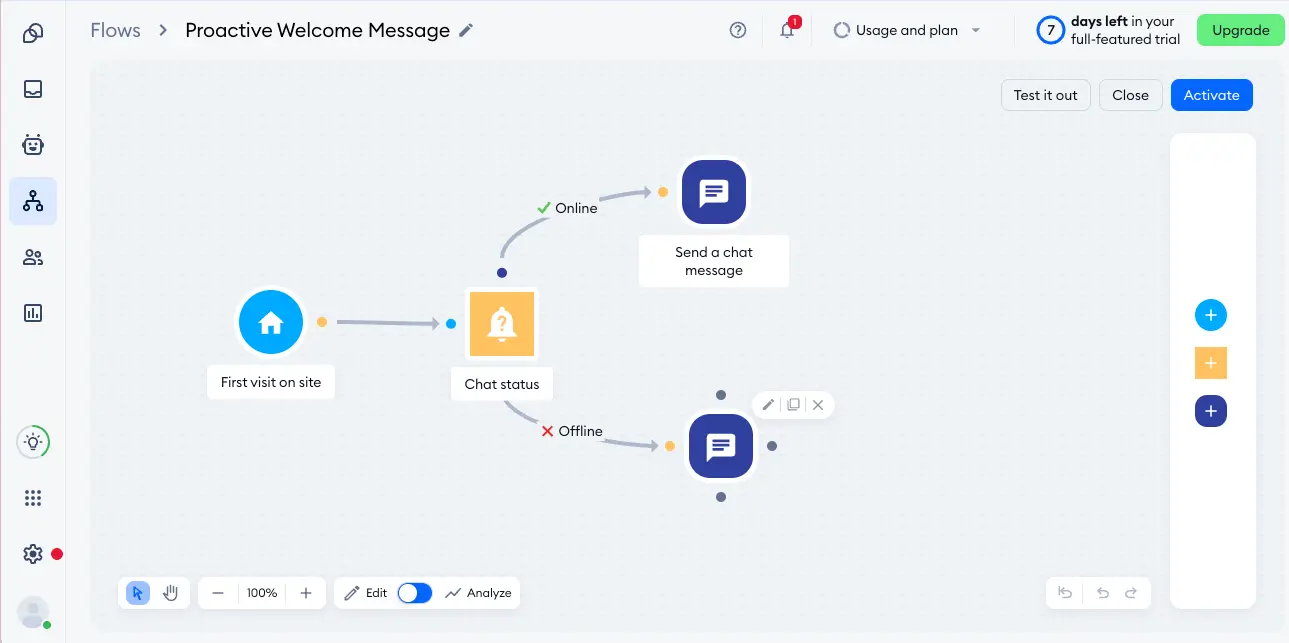
The key distinction: Flows are proactive by design — they reach out first. Lyro answers questions when asked. The best results come from combining both: a Flow greets a new visitor, qualifies their intent, and routes the conversation to either Lyro for automated answers or a human agent for high-value interactions.
Core Architecture: The Fundamental Difference
Understanding the architectural difference between Chatbase and Tidio is the single most important step in making the right choice. These platforms are built for fundamentally different workflows.
| Dimension | Chatbase | Tidio |
|---|---|---|
| Core Identity | AI knowledge-base chatbot builder | Full-stack customer support platform |
| Primary Value | Train on your data → deploy as AI agent | Live chat + AI + automation + help desk |
| Live Agent Inbox | Not included | Full inbox with typing preview |
| AI Agent | GPT-4o / Claude (user-selectable) | Lyro AI (proprietary, trained on your content) |
| Automation Builder | AI Actions (API calls) | Visual drag-and-drop Flows builder |
| Help Desk Ticketing | Not included | Included |
| AI-to-Human Handoff | Basic escalation button (no context passed) | Automatic with full conversation history |
| Omnichannel Inbox | Not available | Website + email + WhatsApp + Instagram + Messenger |
| E-commerce Integrations | None native (requires API/Zapier) | Shopify, WooCommerce, BigCommerce (native) |
| Desktop / Mobile Apps | SaaS web app only | Desktop (Mac, Windows, Linux) + iOS + Android |
Feature-by-Feature Comparison
AI Capabilities
| Feature | Chatbase | Tidio | Winner |
|---|---|---|---|
| AI model selection | GPT-4o, GPT-4 Turbo, Claude (user choice) | Proprietary Lyro AI | Chatbase |
| Knowledge base training | PDFs, URLs, Notion, Q&A pairs, text | Website crawl, FAQ docs, CSV, Zendesk import | Chatbase |
| Multilingual support | 90+ languages, auto-detection, zero setup | Widget multi-language; manual translation per language | Chatbase |
| AI resolution rate | Not published | Up to 67–70% (89% in published case study) | Tidio |
| Context-aware conversation | Basic thread continuity | Full context maintained, no repetition | Tidio |
| Agent assist (AI helps humans) | Not available | Lyro Copilot suggests replies to agents | Tidio |
| AI Actions (task execution) | REST API, Cal.com, Calendly, Stripe, Slack | Shopify order lookup, product recommendations | Chatbase |
Customer Support & Communication
| Feature | Chatbase | Tidio | Winner |
|---|---|---|---|
| Live chat inbox | Not available | Full real-time inbox with typing preview | Tidio |
| AI-to-human handoff | Basic escalation button → email | Auto-routes on low confidence with full context | Tidio |
| Unified inbox | Not available | Chat + email + WhatsApp + Instagram + Messenger | Tidio |
| Help desk ticketing | Not available | Built-in ticket management | Tidio |
| Proactive engagement | Not available (bot waits for user) | Visual Flows: greet, qualify, route automatically | Tidio |
| E-commerce support | No native integrations | Shopify/WooCommerce order data in chat window | Tidio |
Integrations & Deployment
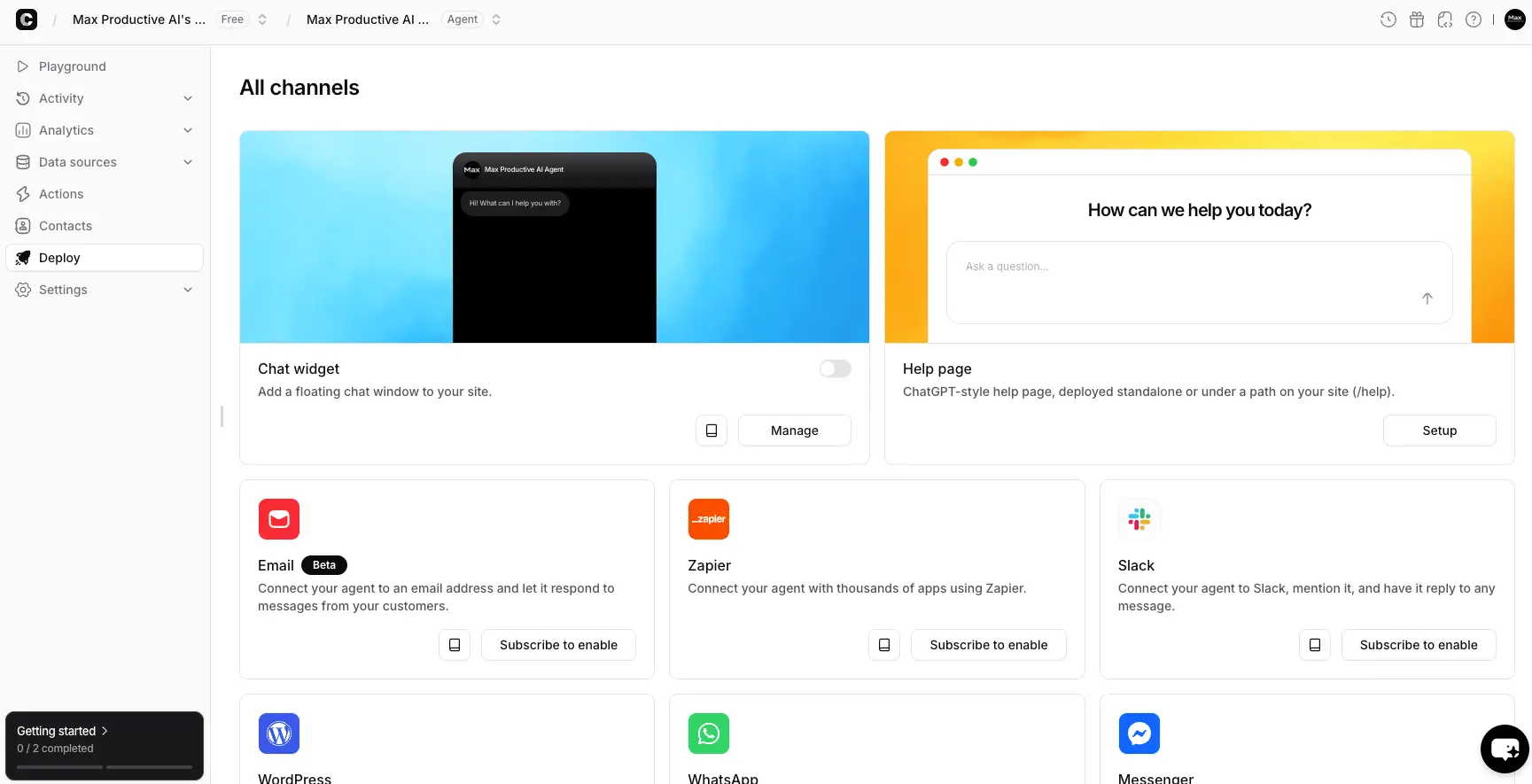
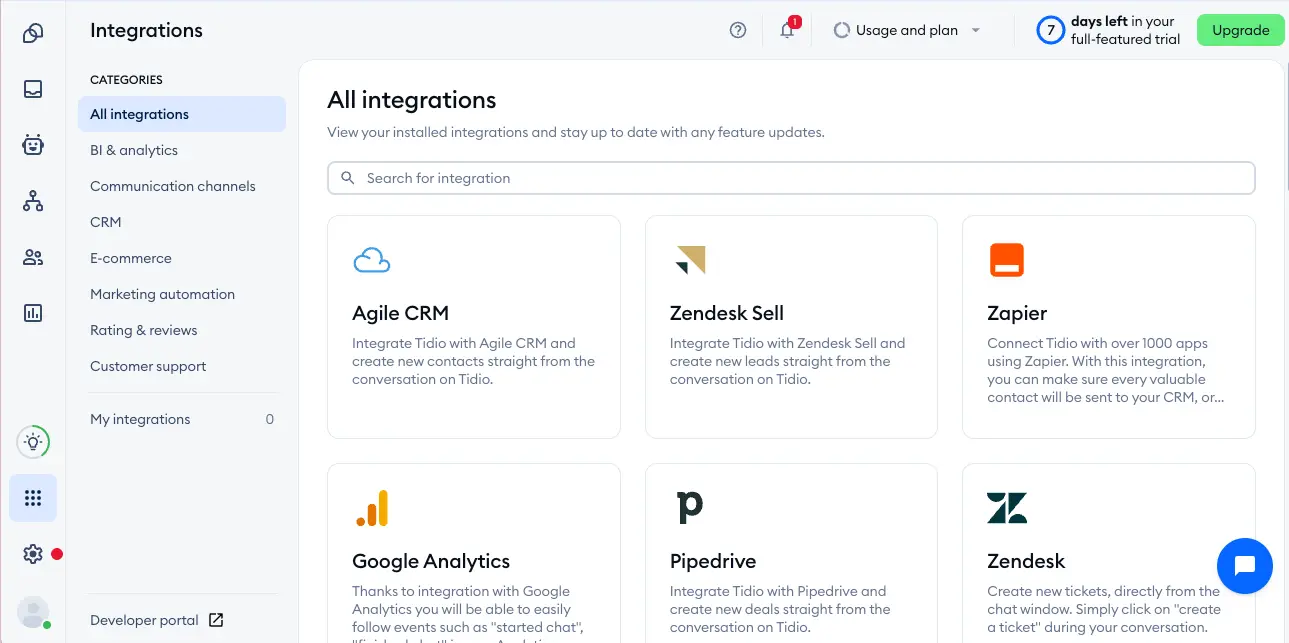
| Feature | Chatbase | Tidio | Winner |
|---|---|---|---|
| Total integrations | ~15 (API-first approach) | 120+ native integrations | Tidio |
| E-commerce platforms | None native | Shopify, WooCommerce, BigCommerce, Wix, PrestaShop | Tidio |
| CRM connections | Via Zapier/Make only | HubSpot, Pipedrive, Agile CRM (native) | Tidio |
| REST API | Full API access | Available | Tie |
| Messaging channels | WhatsApp, Messenger, Instagram, Slack | WhatsApp, Messenger, Instagram, email | Tie |
| Slack deployment | Supported (great for internal bots) | Not a primary channel | Chatbase |
Pricing Comparison (March 2026)
Chatbase Pricing
| Plan | Monthly | Annual | Message Credits/Mo | Team Members |
|---|---|---|---|---|
| Free | $0 | $0 | 50 | 1 |
| Hobby | $40/mo | $32/mo | 1,500 | 2 |
| Standard | $150/mo | $120/mo | 10,000 | 3 |
| Pro | $500/mo | $400/mo | 40,000 | 5 |
| Enterprise | Custom | Custom | Custom | Custom |
How message credits work: Each AI-generated response consumes credits. The number of credits used depends on which AI model you select — more advanced models consume more credits per response. Credits renew monthly on the 1st and do not roll over. Your chatbot stops responding once credits are exhausted unless you enable auto-recharge ($14 per 1,000 credits).
Tidio Pricing
| Plan | Monthly | Annual | Billable Conversations/Mo | Agent Seats |
|---|---|---|---|---|
| Free | $0 | $0 | 50 | Up to 10 |
| Starter | $29/mo | ~$24/mo | 100 | Up to 10 |
| Growth | $59–$349/mo | ~$49/mo+ | 250–2,000 | Up to 10 |
| Plus | $749/mo | Custom | Custom | Custom |
| Premium | From $2,999/mo | Custom | Unlimited | Unlimited |
How billable conversations work: Tidio bills by conversations (not seats). A conversation is any live chat, ticket, email, or social channel exchange — regardless of how many messages it contains. All self-service plans include up to 10 agent seats at no additional per-seat cost, which is a notable advantage for growing teams.
Pricing Reality Check: Side-by-Side
| Scenario | Chatbase | Tidio |
|---|---|---|
| Testing / evaluation | $0 (50 credits, bot deleted after 14 days inactive) | $0 (50 conversations + 7-day full trial) |
| Pure AI chatbot, no live agents | $40/mo (Hobby) | ~$98/mo (Growth + Lyro add-on) |
| AI + live chat + help desk | Not available in-platform | ~$98/mo (Growth + Lyro) |
| AI + white-label branding | ~$248/mo (Standard + add-ons) | $749/mo (Plus plan) |
| Team of 10 agents | $500/mo (Pro, max 5 seats) | $29–$59/mo (up to 10 seats included) |
Pros and Cons
Chatbase
Pros
- Fastest deployment — functional AI bot in approximately 10 minutes
- Trains on dense document libraries (PDFs, URLs, Notion, Q&A pairs)
- User-selectable AI models: GPT-4o, GPT-4 Turbo, or Claude per chatbot
- AI Actions execute real tasks via API (book, track, charge, log)
- 90+ language auto-coverage with zero manual translation setup
- Lower entry cost for pure-AI use cases ($40/mo Hobby)
- Full REST API for developer-led integrations and custom channels
- Conversation logs with sentiment analysis and topic filtering
- SOC 2 Type II and GDPR compliant
- 100% bootstrapped — lean, focused product development
Cons
- No native live chat agent inbox — AI-only, no human handoff within the platform
- Credit consumption can be unpredictable depending on AI model choice
- Add-on costs (branding removal, custom domain) can inflate real pricing
- Data storage cap (up to 33 MB on paid plans) limits large knowledge bases
- No native e-commerce integrations (Shopify, WooCommerce)
- Free plan agents deleted after 14 days of inactivity
- No proactive engagement — bot waits for the user to initiate
- No desktop or mobile agent apps
- Some users report accuracy issues with answers from poorly structured documents
Tidio
Pros
- Complete support platform — live chat + Lyro AI + Flows + ticketing in one
- Lyro AI resolves up to 67–70% of routine queries autonomously
- Lyro Copilot assists human agents with AI-suggested replies
- Visual Flows builder for proactive automation with zero code
- Native Shopify and WooCommerce integration with order data in chat
- Unified inbox: website + email + WhatsApp + Instagram + Messenger
- Up to 10 agent seats included on all self-service plans
- Desktop apps (Mac, Windows, Linux) and mobile apps (iOS, Android)
- 120+ native integrations (HubSpot, Mailchimp, Klaviyo, Google Analytics)
- 300,000+ businesses — large ecosystem, templates, and case studies
Cons
- Lyro AI conversations require a separate paid add-on (~$39/mo+)
- Free plan's 50 Lyro conversations are one-time, not monthly
- Conversation limits on lower plans can be reached quickly
- More than 10 agent seats requires Plus plan ($749/mo) — a significant jump
- Analytics may not be deep enough for data-driven teams on lower plans
- Chatbot messages are not auto-translated — each language requires manual setup
- Admin panel available in only 6 languages
- Lyro can struggle with multi-step or complex technical queries
- "Powered by Tidio" branding visible unless you pay extra or upgrade to Plus
Real-World Use Cases & Results
When Chatbase Wins
Chatbase excels in scenarios where deep knowledge-base Q&A is the primary requirement and live human agents are not part of the workflow. Internal HR or IT helpdesks benefit from training the bot on policies, manuals, and SOPs, then deploying it to Slack or an intranet. SaaS companies embed Chatbase inside their product to answer API documentation, troubleshooting, and feature FAQ questions instantly. Legal, medical, and compliance teams use Chatbase's large-document AI capabilities to surface answers from dense, technical content. Agencies build branded bots for multiple clients using the white-label add-ons.
The common thread: Chatbase is the strongest choice when you already have a large body of documented knowledge and want to make it conversationally accessible — without needing live chat, omnichannel support, or proactive visitor engagement.
When Tidio Wins
Tidio excels where customer-facing communication involves both AI and human agents working together, especially in e-commerce environments. Published case studies demonstrate measurable results: eyewear brand eye-oo attributed €177,000 in revenue to Tidio with 25% higher sales from cart recovery campaigns. Procosmet reported a 5x increase in lead generation and 27% higher conversions. UK car repair company Axioma achieved an 89% AI resolution rate with Lyro.
Tidio's sweet spot is Shopify and WooCommerce stores needing abandoned cart recovery, service businesses wanting proactive visitor engagement, teams requiring a unified inbox for all support channels, and companies where non-technical staff need to create and manage automations with the visual Flows builder.
Who Should Choose Each Tool?
Choose Chatbase If You Are:
- Building an AI-powered FAQ or documentation bot trained on your existing content
- A SaaS company embedding a support agent inside your product or help center
- Deploying an internal HR, IT, or knowledge-base bot to Slack or an intranet
- A developer or technical team wanting REST API access and AI model flexibility
- Serving a global audience and need 90+ language auto-detection without configuration
- On a tight budget and only need AI Q&A — no live agents or help desk required
- An agency building branded chatbots for multiple clients
Choose Tidio If You Are:
- Running a Shopify or WooCommerce store and need order data, cart recovery, and product recommendations in chat
- A team that includes live chat agents handling escalations alongside AI
- Need a unified inbox managing website chat, email, WhatsApp, and Instagram in one place
- Focused on proactive visitor engagement and lead generation via automated Flows
- A growing team that needs to add agents without increasing costs (up to 10 seats included)
- A service business (real estate, repairs, consulting) wanting proactive engagement + AI + agent escalation
- A non-technical team that needs visual, drag-and-drop automation with no code
Quick Decision Guide: Which Tool Wins Per Scenario
| Scenario | Better Choice |
|---|---|
| Shopify / WooCommerce store | Tidio |
| Internal HR / IT helpdesk on Slack | Chatbase |
| SaaS in-app documentation bot | Chatbase |
| Live chat + AI hybrid support | Tidio |
| Multilingual bot (90+ languages, zero setup) | Chatbase |
| Abandoned cart recovery | Tidio |
| Proactive visitor engagement | Tidio |
| Dense document Q&A (legal, medical, compliance) | Chatbase |
| Unified inbox (chat + email + WhatsApp + social) | Tidio |
| Budget under $50/mo, AI-only | Chatbase |
| Team of 5–10 agents | Tidio |
| Developer-led API integration | Chatbase |
| Lead generation with proactive Flows | Tidio |
Can You Use Chatbase and Tidio Together?
Yes — and for many businesses this combination makes strategic sense. The tools are complementary, not competing. A common setup uses Tidio for front-line live chat, proactive visitor engagement (Flows), and agent management, while Chatbase powers deep knowledge-base Q&A on a separate page, inside the product, or through an internal Slack channel.
The typical combined workflow: a customer arriving at your website first interacts with a Tidio Flow (triggered on first visit), gets their intent qualified, and either receives help from a live agent or Lyro AI. If the question is deeply technical — requiring answers from product documentation, API references, or large internal knowledge bases — they're referred to a Chatbase-powered documentation bot. This dual-tool approach is particularly relevant for SaaS companies serving both external customers (live support via Tidio) and internal teams (IT/HR knowledge bot via Chatbase on Slack).
Exploring Other Options?
If neither Chatbase nor Tidio is the perfect fit, the AI chatbot space has strong alternatives worth exploring. Freshdesk (with Freddy AI) offers a mature, enterprise-grade help desk with built-in AI for teams needing structured ticket management and a broader IT service desk. CustomGPT AI provides similar "train on your data" functionality to Chatbase with a different pricing structure and strong enterprise features. Browse our complete AI customer support bots directory to compare more options.
Final Verdict: Chatbase vs Tidio
| AI knowledge-base depth | Chatbase |
| AI model flexibility | Chatbase |
| Multilingual auto-detection | Chatbase |
| Deployment speed | Chatbase |
| API / developer flexibility | Chatbase |
| Live chat support | Tidio |
| AI-to-human handoff | Tidio |
| Proactive engagement (Flows) | Tidio |
| E-commerce integration | Tidio |
| Omnichannel unified inbox | Tidio |
| Integration ecosystem | Tidio (120+ native) |
| Lowest entry price (AI-only) | Chatbase ($40/mo) |
| Agent seat value | Tidio (10 seats included) |
| Lead generation | Tidio |
| Internal / Slack bots | Chatbase |
| Help desk ticketing | Tidio |
| User ratings | Tidio (4.7/5 vs 4.3/5) |
| Community & resources | Tidio |
Bottom line: Chatbase and Tidio are not direct competitors — they serve different business needs:
- Chatbase = AI Librarian: Train it on your documents, deploy it as a Q&A bot, let it answer questions from your knowledge base in 90+ languages. Best for SaaS documentation, internal helpdesks, and businesses that need AI-only automation without live agents.
- Tidio = Full Support Team: Live chat + Lyro AI + visual Flows + unified inbox + help desk — all in one platform. Best for e-commerce stores, service businesses, and any team where human agents and AI need to work side by side.
If you only need an AI-powered knowledge bot, Chatbase is faster and cheaper. If you need a complete customer support platform with live agents, proactive engagement, and omnichannel coverage, Tidio is the more complete solution.
Frequently Asked Questions
Learn more about other AI customer support bots in our comprehensive directory. For deeper analysis, read our full Chatbase review and Tidio review, or explore alternatives like Freshdesk and CustomGPT AI.