
Google Gemini 3 Released: The Complete Guide to Features, Benchmarks, and Availability
Updated: November 18, 2025

Reading Time: 12 minutes | This article covers the official Google Gemini 3 release with verified information from Google's official announcements and technical documentation.
Google has officially released Gemini 3, marking a significant milestone in artificial intelligence development. Announced on November 18, 2025, this latest iteration represents Google's most intelligent AI model to date, combining state-of-the-art reasoning capabilities with advanced multimodal understanding and agentic functionality.
The release comes alongside several groundbreaking announcements, including Gemini 3 Deep Think mode, Google Antigravity (a new agentic development platform), and immediate integration across Google's entire product ecosystem. With performance benchmarks that top industry leaderboards and capabilities that span from complex coding to creative content generation, Gemini 3 positions Google at the forefront of the AI race.
Key Highlights: Gemini 3 Pro scores 1501 Elo on LMArena (top leaderboard position), achieves 91.9% on GPQA Diamond, 76.2% on SWE-bench Verified, and introduces revolutionary Deep Think mode with 41% accuracy on Humanity's Last Exam. Available now in preview at $2/million input tokens.
What is Google Gemini 3?
Gemini 3 is Google's third-generation multimodal AI model, designed to "bring any idea to life" through a combination of advanced reasoning, coding capabilities, and comprehensive understanding across text, images, video, audio, and code. Built on the foundation of Gemini 2.5's success—which dominated LMArena for over six months—Gemini 3 takes a significant leap forward in both intelligence and practical application.
According to Sundar Pichai, Google's CEO, "Gemini 3 is our most intelligent model that combines all of Gemini's capabilities together." This represents not just an incremental improvement but a fundamental advancement in how AI understands context, intent, and nuance. The model demonstrates what Google calls "reading the room"—going beyond simple text and image processing to grasp deeper meaning and subtle cues.
The release strategy is comprehensive, with Gemini 3 launching simultaneously across multiple platforms including the Gemini app, AI Mode in Search, Google AI Studio, Vertex AI, and the newly announced Google Antigravity development platform. This marks the first time Google has shipped a Gemini model in Search on day one, signaling their confidence in the technology's readiness.
Three Core Capabilities: Learn, Build, and Plan Anything
Google has structured Gemini 3's capabilities around three fundamental use cases that demonstrate the model's versatility and power.
Learn Anything
Gemini 3 excels at multimodal learning with its 1 million-token context window and state-of-the-art vision understanding. The model can seamlessly synthesize information across multiple formats, making it particularly powerful for educational applications. For example, it can decipher and translate handwritten recipes in different languages to create a shareable family cookbook, or analyze academic papers and video lectures to generate interactive flashcards and visualizations.
The model's spatial understanding capabilities extend to practical applications like analyzing pickleball match videos to identify improvement areas and generate personalized training plans. This combination of visual reasoning and contextual understanding represents a significant advancement over previous models.
Build Anything
For developers, Gemini 3 represents what Google calls their best "vibe coding and agentic coding model" ever built. The term "vibe coding" refers to the ability to translate high-level natural language descriptions into fully functional, interactive applications with minimal prompting. Gemini 3 tops the WebDev Arena leaderboard with an impressive 1487 Elo rating, demonstrating superior frontend development capabilities.
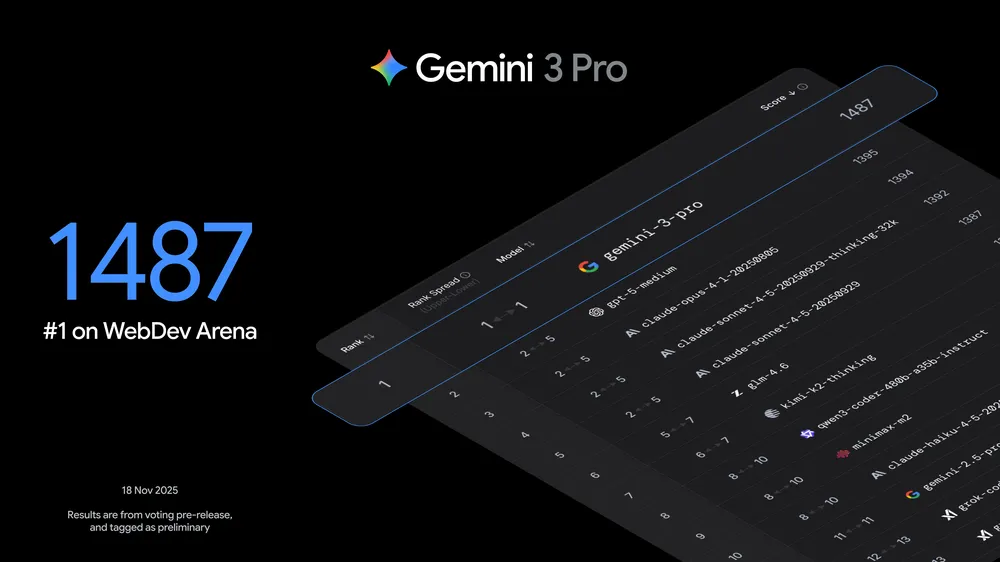
The model achieves 76.2% on SWE-bench Verified, a benchmark measuring coding agent capabilities, and 54.2% on Terminal-Bench 2.0, which tests a model's ability to operate a computer via terminal. These scores represent substantial improvements over Gemini 2.5 Pro and position Gemini 3 competitively against other frontier models like GPT-5.1 and Claude Sonnet 4.5.
Plan Anything
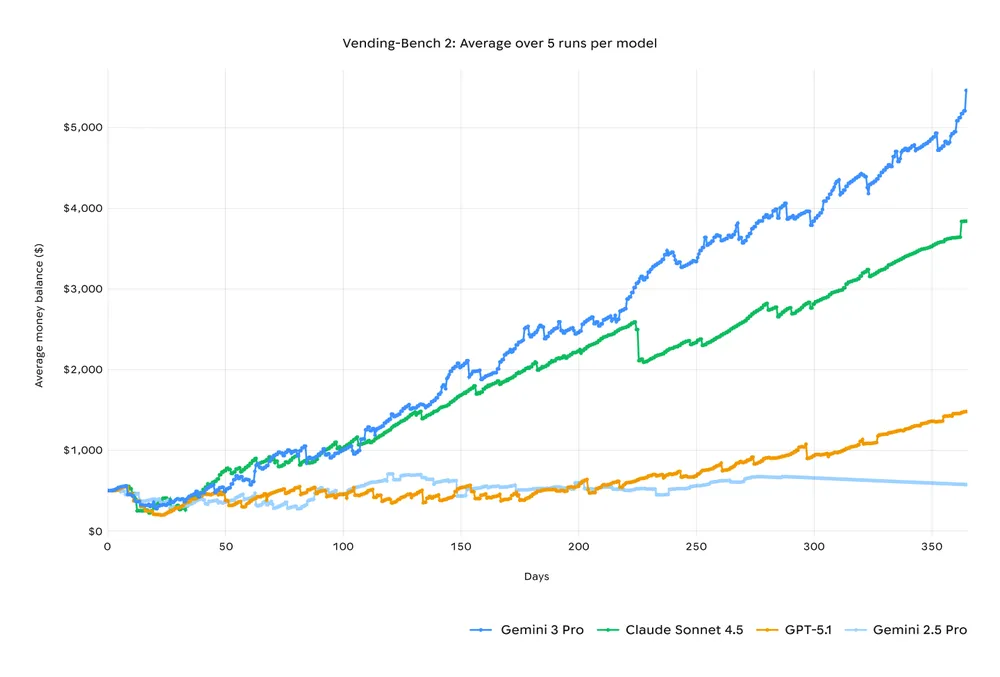
Long-horizon planning represents one of Gemini 3's most significant advancements. The model demonstrates this through its performance on Vending-Bench 2, where it maintains consistent tool usage and decision-making for a full simulated year of vending machine business operation. This capability translates to real-world applications like booking local services, organizing complex workflows, and managing multi-step tasks from start to finish.
Google AI Ultra subscribers can access these agentic capabilities through Gemini Agent in the Gemini app, with plans to expand to more Google products soon.
Gemini 3 Performance Benchmarks: Breaking Records
Gemini 3 Pro sets new standards across virtually every major AI benchmark, demonstrating significant improvements over its predecessor and competitive advantages against other frontier models.
Reasoning and Academic Performance
- LMArena Leaderboard: 1501 Elo (top position globally)
- Humanity's Last Exam: 37.5% without tools (PhD-level reasoning)
- GPQA Diamond: 91.9% (scientific knowledge)
- AIME 2025: 95% without tools, 100% with code execution
- MathArena Apex: 23.4% (new state-of-the-art for challenging math problems)
Multimodal and Visual Reasoning
- MMMU-Pro: 81% (multimodal understanding and reasoning)
- Video-MMMU: 87.6% (video understanding)
- ScreenSpot-Pro: 72.7% (screen understanding)
- CharXiv Reasoning: 81.4% (information synthesis from complex charts)
- SimpleQA Verified: 72.1% (factual accuracy)
Coding and Development
- WebDev Arena: 1487 Elo (#1 ranking)
- SWE-bench Verified: 76.2% (agentic coding)
- Terminal-Bench 2.0: 54.2% (terminal operations)
- LiveCodeBench Pro: 2,439 Elo rating

The comprehensive benchmark table below shows Gemini 3 Pro's performance compared to Gemini 2.5 Pro, Claude Sonnet 4.5, and GPT-5.1 across multiple evaluation metrics:

Gemini 3 Deep Think: Enhanced Reasoning Mode
Google is introducing Gemini 3 Deep Think, an enhanced reasoning mode that pushes the model's capabilities even further. This specialized mode is designed for complex problems requiring extended reasoning and deeper analysis, similar to OpenAI's o1 model approach but with Google's unique multimodal advantages.
Deep Think Performance Metrics
Gemini 3 Deep Think demonstrates substantial improvements over the base Gemini 3 Pro model:
- Humanity's Last Exam: 41.0% (compared to 37.5% in standard mode)
- GPQA Diamond: 93.8% (compared to 91.9% in standard mode)
- ARC-AGI-2: 45.1% with code execution on ARC Prize Verified

The ARC-AGI-2 score is particularly noteworthy, as this benchmark specifically tests a model's ability to solve novel challenges that require genuine reasoning rather than pattern matching. Gemini 3 Deep Think's 45.1% score represents unprecedented performance on this evaluation, demonstrating its ability to tackle problems it has never encountered during training.
Availability and Access
Google is taking extra precautions with Deep Think mode, conducting additional safety evaluations and gathering input from safety testers before making it available to Google AI Ultra subscribers in the coming weeks. This measured approach reflects Google's commitment to responsible AI deployment, particularly for their most powerful reasoning capabilities.
Introducing Google Antigravity: Agent-First Development Platform
Alongside Gemini 3, Google unveiled Google Antigravity, a revolutionary agentic development platform that reimagines how developers interact with AI. This new platform enables developers to operate at a higher, task-oriented level rather than managing implementation details line by line.
How Antigravity Works
Google Antigravity transforms AI assistance from a tool in the developer's toolkit into an active partner. While maintaining a familiar AI IDE experience at its core, the platform elevates agents to a dedicated surface with direct access to the editor, terminal, and browser. This architecture allows agents to autonomously plan and execute complex, end-to-end software tasks while validating their own code.
The platform is tightly integrated with multiple models beyond Gemini 3 Pro, including the Gemini 2.5 Computer Use model for browser control and Nano Banana (Gemini 2.5 Image), Google's top-rated image editing model. This multi-model approach enables sophisticated workflows that span coding, testing, and visual design.
Real-World Applications
In demonstration, Google Antigravity can independently plan, code, and validate complete applications. For example, when tasked with creating a flight tracker app, the agent breaks down the requirements, implements the necessary functionality, and validates execution through browser-based computer use—all with minimal human intervention.
The platform is available now for download at no charge for MacOS, Windows, and Linux users, representing Google's commitment to making advanced AI development tools accessible to the broader developer community. This positions Google Antigravity as a direct competitor to other AI-powered development environments while leveraging Google's unique model capabilities.
Gemini 3 Pricing and Availability
Google has structured Gemini 3's availability across multiple tiers to serve different user segments, from casual users to enterprise customers and developers.
API Pricing
For developers accessing Gemini 3 Pro through the Gemini API:
- Input tokens: $2 per million tokens (for prompts ≤200k tokens)
- Output tokens: $12 per million tokens (for prompts ≤200k tokens)
- Free tier: Available with rate limits in Google AI Studio
This pricing structure makes Gemini 3 Pro highly competitive with other frontier models while offering superior performance on many benchmarks. The free tier in AI Studio allows developers to experiment and prototype without immediate cost, lowering the barrier to entry for AI development.
Consumer Access
- Gemini App: Available to all users immediately
- AI Mode in Search: Rolling out to Google AI Pro and Ultra subscribers
- Gemini Agent: Available to Google AI Ultra subscribers for agentic workflows
- Gemini 3 Deep Think: Coming to Ultra subscribers in the coming weeks
Developer Platforms
Gemini 3 Pro is immediately available through multiple development platforms:
- Google AI Studio: Free with rate limits, integrated Build mode
- Vertex AI: Enterprise-grade deployment with full support
- Google Antigravity: Free download, agentic development platform
- Gemini CLI: Command-line interface for agentic coding
- Third-party integrations: Cursor, GitHub Copilot, JetBrains, Manus, Replit, Cline
This multi-platform approach ensures that developers can integrate Gemini 3 into their existing workflows regardless of their preferred development environment. The breadth of integrations, particularly with popular IDEs like Cursor and JetBrains, demonstrates Google's commitment to meeting developers where they already work.
Gemini 3 Platform Integrations and Ecosystem
Google's strategy with Gemini 3 extends beyond standalone model access to comprehensive integration across their product ecosystem and third-party platforms. This approach represents a significant shift from previous releases, where model availability gradually expanded over time.
Google Product Integration
For the first time, Google is launching a Gemini model across multiple products simultaneously:
- Search: AI Mode now uses Gemini 3 for complex reasoning and dynamic generative UI experiences, including immersive visual layouts and interactive simulations generated on-the-fly
- Gemini App: Full access to Gemini 3 Pro across mobile and desktop, with Canvas feature integration
- Gmail and Workspace: Integration planned for email organization and productivity features
- Android Studio: Built-in support for mobile app development with AI assistance
The AI Mode in Search integration is particularly noteworthy, as it enables entirely new ways to interact with information. Rather than simply presenting search results, Gemini 3 can generate interactive tools, visualizations, and educational content tailored to specific queries. For example, asking about how RNA polymerase works triggers a fully interactive, visual explanation rather than static text and images.
Third-Party Developer Tools
Beyond Google's own platforms, Gemini 3 is available through an extensive network of developer tools, reflecting industry-wide recognition of the model's capabilities. Partners have provided early feedback highlighting specific strengths:
Cline's Head of AI, Nik Pash: "Gemini 3 Pro handles complex, long-horizon tasks across entire codebases, maintaining context through multi-file refactors, debugging sessions, and feature implementations. It uses long context far more effectively than Gemini 2.5 Pro and has solved problems that stumped other leading models."
Madhav Jha, Cofounder and CTO at Emergent: "Gemini 3's remarkable prompt adherence supercharges our fullstack app development platform, especially in UI/frontend workflows. We're seeing incredible results when incorporating Gemini 3's multi-step tool calling into our agentic code development setup."
These integrations span across Cursor, GitHub Copilot, JetBrains IDEs, Manus, Replit, and Cline, ensuring that developers can access Gemini 3's capabilities within their preferred development environments without friction.
How to Get Started with Gemini 3
Whether you're a casual user, professional developer, or enterprise customer, multiple pathways exist to begin using Gemini 3 immediately.
For General Users
- Visit gemini.google.com or download the Gemini mobile app
- Sign in with your Google account (free access available)
- Start chatting with Gemini 3 Pro for learning, creativity, and problem-solving
- Consider upgrading to Google AI Ultra for access to Gemini Agent and upcoming Deep Think mode
For Developers
- Google AI Studio: Visit ai.google.dev to access free tier with rate limits
- Vertex AI: For enterprise deployment, visit cloud.google.com/vertex-ai
- Google Antigravity: Download the agentic development platform from the official website
- IDE Integration: Install Gemini 3 support in Cursor, VS Code, or JetBrains
- CLI Access: Use Gemini CLI for command-line agentic coding workflows
API Quick Start
Developers can integrate Gemini 3 Pro into applications immediately using the Gemini API. The API includes new features specifically for Gemini 3, including a thinking level parameter for leveraging the model's reasoning capabilities and more granular media resolution controls for multimodal inputs.
Google provides comprehensive documentation including a Developer Guide for technical implementation details and a Prompting Guide for optimizing interactions with Gemini 3 Pro. These resources are essential for developers looking to maximize the model's capabilities in production applications.
Gemini 3 in the Competitive AI Landscape
The release of Gemini 3 comes at a particularly dynamic moment in the AI industry, with major announcements from competitors creating an intensely competitive environment. Understanding how Gemini 3 positions itself against alternatives helps contextualize its significance.
Comparison with Leading Models
Recent releases from OpenAI and Anthropic have raised the bar for frontier AI models. OpenAI's GPT-5.1, launched in September 2025, introduced purpose-built agentic coding capabilities, while Anthropic's Claude Sonnet 4.5, released two weeks later, claimed "state-of-the-art coding performance" that impressed partners like Cursor.
Against this backdrop, Gemini 3 distinguishes itself through several key advantages:
- Multimodal integration: Unlike competitors focused primarily on text and static images, Gemini 3's native multimodality extends to video, audio, and code with a 1 million-token context window
- Ecosystem integration: Deep integration across Google's product suite provides capabilities that competitors cannot match, particularly for search, productivity, and mobile applications
- Long-horizon planning: Superior performance on Vending-Bench 2 demonstrates capabilities for managing extended, complex workflows that go beyond single-turn interactions
- Hardware optimization: Google's custom Trillium TPU chips provide significant advantages in speed and efficiency, with 4x more performance than previous generation TPUs
The benchmark comparisons reveal that while no single model dominates every category, Gemini 3 leads in several critical areas including multimodal reasoning (81% on MMMU-Pro), long-context performance (77% on MRCR v2 at 128k tokens), and spatial reasoning (72.7% on ScreenSpot-Pro). These strengths make it particularly well-suited for applications requiring comprehensive understanding across multiple modalities and extended contexts.
Strategic Positioning
Google's approach with Gemini 3 reflects a broader strategy beyond pure benchmark competition. By launching simultaneously across consumer products, developer tools, and enterprise platforms, Google aims to make Gemini 3 the most accessible and integrated frontier model. This differs from competitors who primarily distribute through API access and select partnerships.
The introduction of Google Antigravity as a free, downloadable agentic development platform represents a particularly bold move, directly competing with platforms like Cursor and Replit while leveraging Google's unique model capabilities. This platform play could prove strategically significant if it attracts a substantial developer community.
Enterprise Considerations for Gemini 3
For organizations evaluating Gemini 3 for production deployment, several factors beyond raw performance metrics warrant careful consideration.
Security and Safety
Google emphasizes that Gemini 3 represents their "most secure model yet," having undergone "the most comprehensive set of safety evaluations of any Google AI model to date." Key security improvements include:
- Reduced sycophancy: The model is less likely to simply agree with users, providing more honest and accurate responses
- Improved prompt injection resistance: Better protection against attempts to manipulate the model through adversarial prompting
- Enhanced misuse protection: Stronger safeguards against cyberattack applications and other harmful uses
Google has partnered with world-leading experts, provided early access to bodies like the UK AISI (AI Safety Institute), and obtained independent assessments from organizations including Apollo, Vaultis, and Dreadnode. The detailed model card provides comprehensive information about evaluations and limitations.
Enterprise Features in Vertex AI
Organizations deploying through Vertex AI gain access to enterprise-grade capabilities beyond the base model:
- Data residency controls: Options for geographic data storage and processing
- VPC integration: Secure deployment within existing cloud infrastructure
- Monitoring and logging: Comprehensive observability for production AI applications
- Fine-tuning capabilities: Ability to customize the model for specific organizational needs
- Enterprise support: Dedicated support channels and SLA guarantees
For organizations already using Google Cloud, Google's Gemini Enterprise platform provides additional integration points and management capabilities that simplify deployment at scale.
Cost Considerations
While Gemini 3 Pro's pricing of $2/$12 per million tokens (input/output) is competitive, organizations should evaluate total cost of ownership including:
- Context window usage: The 1 million-token context window enables powerful applications but requires careful management of input sizes
- Multimodal processing: Image and video inputs may have different cost implications than text-only interactions
- Deep Think mode: When available, the enhanced reasoning mode may have different pricing
- Fine-tuning costs: Custom model training for specialized applications
Organizations should conduct proof-of-concept evaluations using the free tier in Google AI Studio before committing to production deployment, particularly for applications with high volume or complex multimodal requirements.
Practical Developer Use Cases for Gemini 3
Beyond benchmarks and technical specifications, understanding concrete use cases helps developers identify opportunities for integrating Gemini 3 into their applications and workflows.
Code Generation and Agentic Development
Gemini 3's exceptional performance on coding benchmarks translates to practical capabilities that accelerate development:
- Zero-shot UI generation: Create fully functional, interactive web interfaces from natural language descriptions without examples
- Multi-file refactoring: Maintain context across entire codebases for complex architectural changes
- Terminal operations: Execute complex command-line workflows with 54.2% success rate on Terminal-Bench 2.0
- Bug fixing and debugging: Analyze error logs and propose solutions with understanding of entire system context
The integration with Google Antigravity enables particularly powerful workflows where agents can autonomously plan, code, test, and validate applications with minimal human intervention. This shifts the developer role from writing code to architectural planning and quality assurance.
Multimodal Applications
Gemini 3's native multimodal capabilities enable entirely new categories of applications:
- Document understanding: Extract and reason about information from complex documents including PDFs, spreadsheets, and presentations
- Video analysis: Process hours of video content with high-frame-rate understanding and long-context recall
- Visual reasoning: Analyze UI screenshots, design mockups, and technical diagrams with spatial understanding
- Audio processing: Transcribe, analyze, and reason about audio content within unified conversations
The 1 million-token context window is particularly valuable for these applications, as it allows processing of extensive multimodal content without artificial segmentation or loss of context between chunks.
Enterprise Automation
The long-horizon planning capabilities demonstrated on Vending-Bench 2 translate to practical business process automation:
- Workflow orchestration: Manage complex, multi-step business processes over extended time periods
- Data analysis pipelines: Autonomously extract insights from diverse data sources and generate reports
- Customer service automation: Handle complex support interactions requiring multiple tools and knowledge sources
- Research synthesis: Process extensive literature, extract key findings, and generate comprehensive summaries
The key differentiator is Gemini 3's ability to maintain consistent decision-making and tool usage over extended interactions, avoiding the "drift" that affects many AI models in long-running workflows.
Technical Details and API Features
For developers implementing Gemini 3 in production applications, several technical capabilities and API features deserve attention.
New API Features
Google has introduced several new capabilities specifically for Gemini 3:
- Thinking level parameter: Control over how much reasoning depth the model applies, enabling optimization of latency vs. accuracy trade-offs
- Granular media resolution: Fine-grained control over visual processing fidelity based on application requirements
- Client-side bash tool: Enables the model to propose shell commands as part of agentic workflows (early access)
- Server-side bash tool: Hosted execution environment for multi-language code generation and prototyping
- Structured outputs with grounding: Combine Google Search grounding and URL context with structured JSON outputs
Model Configuration
Developers can optimize Gemini 3's behavior for specific use cases through various configuration options:
- Temperature: Set to 1.0 by default for best reasoning results; lower values may impact reasoning capability
- Context window: Support for up to 1 million tokens enables processing of extensive documents and conversations
- Multimodal resolution: Configurable visual processing quality allows optimization of cost vs. fidelity
- Tool use: Enhanced capabilities for multi-step tool calling in agentic workflows
Best Practices
Google's documentation includes several recommendations for optimal results with Gemini 3:
- Preserve thinking signatures: In multi-turn conversations, maintain the model's internal reasoning traces for consistency
- Leverage long context: Take advantage of the 1 million-token window by providing comprehensive context rather than summarizing
- Use structured outputs: For production applications requiring specific formats, combine with grounding for factual accuracy
- Monitor temperature effects: Be aware that lowering temperature below 1.0 may significantly impact reasoning quality
Frequently Asked Questions
Google Gemini 3 was officially released on November 18, 2025, with immediate availability across the Gemini app, Google AI Studio, Vertex AI, and various developer platforms. This marks the first time Google has launched a Gemini model across multiple products on day one.
Gemini 3 Pro is priced at $2 per million input tokens and $12 per million output tokens for prompts of 200k tokens or less. A free tier with rate limits is available through Google AI Studio for experimentation and development. Consumer access through the Gemini app is included in standard Google accounts, with enhanced features for Google AI Pro and Ultra subscribers.
Gemini 3 Deep Think is an enhanced reasoning mode that pushes the model's capabilities further for complex problems. It achieves 41% on Humanity's Last Exam (compared to 37.5% in standard mode) and 93.8% on GPQA Diamond. Deep Think mode is currently undergoing additional safety evaluations and will be available to Google AI Ultra subscribers in the coming weeks.
Gemini 3 leads in several key benchmarks including multimodal reasoning (81% on MMMU-Pro vs. 68% for competitors), long-context performance (77% on MRCR v2), and long-horizon planning ($5,478 on Vending-Bench 2 vs. $3,839 for Claude). While Claude Sonnet 4.5 leads slightly on SWE-bench Verified (77.2% vs. 76.2%), Gemini 3's native multimodality and 1 million-token context window provide unique advantages. Benchmark comparisons show competitive performance across most metrics, with each model having specific strengths.
Google Antigravity is a new agentic development platform that enables developers to operate at a higher, task-oriented level. It provides agents with direct access to the editor, terminal, and browser, allowing autonomous planning and execution of complex software tasks. The platform is available as a free download for MacOS, Windows, and Linux, and integrates Gemini 3 Pro, Gemini 2.5 Computer Use, and Nano Banana (Gemini 2.5 Image).
Yes, Gemini 3 is available for free with certain limitations. The Gemini app provides free access for general users, while developers can use Google AI Studio with rate limits at no cost. This allows experimentation and prototype development without immediate financial commitment. For production applications or higher volume usage, paid tiers through the Gemini API or Vertex AI are recommended.
Gemini 3 is integrated across a wide range of developer tools including Google AI Studio, Vertex AI, Google Antigravity, Gemini CLI, Android Studio, Cursor, GitHub Copilot, JetBrains IDEs, Manus, Replit, and Cline. This comprehensive integration allows developers to use Gemini 3 within their existing workflows regardless of their preferred development environment.
Gemini 3 supports a 1 million-token context window, enabling processing of extremely long documents, extensive codebases, hours of video content, and extended conversations without losing context. This is particularly valuable for applications requiring comprehensive understanding of large amounts of information across multiple modalities.
Yes, Gemini 3 is available for enterprise deployment through Vertex AI and Gemini Enterprise. Enterprise customers gain access to additional features including data residency controls, VPC integration, comprehensive monitoring and logging, fine-tuning capabilities, and dedicated support with SLA guarantees. Organizations can evaluate the model using the free tier before committing to production deployment.
Gemini 3 has undergone the most comprehensive set of safety evaluations of any Google AI model to date. The model shows reduced sycophancy, increased resistance to prompt injections, and improved protection against misuse. Google has partnered with world-leading experts, provided early access to safety organizations like the UK AISI, and obtained independent assessments from Apollo, Vaultis, Dreadnode, and others. Detailed information is available in the Gemini 3 model card.
Limitations and Considerations
While Gemini 3 represents a significant advancement in AI capabilities, understanding its limitations is essential for setting appropriate expectations and designing effective applications.
Known Limitations
- Mathematical reasoning: Despite leading performance on MathArena Apex (23.4%), this still represents less than one quarter of problems solved, indicating substantial room for improvement on the most challenging mathematical tasks
- Novel problem solving: The 45.1% score on ARC-AGI-2 in Deep Think mode, while unprecedented, shows that genuine reasoning on completely novel problems remains challenging
- Factual accuracy: The 72.1% SimpleQA Verified score, while strong, indicates that roughly one in four factual queries may receive incorrect or incomplete answers
- Consistency: As with all large language models, output quality can vary between attempts, particularly for complex creative tasks
Best Use Cases vs. Limitations
Gemini 3 excels at tasks involving:
- Multimodal understanding and reasoning across text, images, video, and audio
- Complex code generation and refactoring with long-context awareness
- Long-horizon planning and task execution with consistent tool use
- Document analysis and information extraction from diverse sources
- Creative content generation with nuanced understanding of intent
Applications should be designed with awareness that the model may struggle with:
- Extremely specialized domain knowledge requiring years of expert training
- Tasks requiring absolute factual precision without verification
- Problems genuinely outside the model's training distribution
- Real-time processing requirements with strict latency constraints
Responsible Deployment
Organizations deploying Gemini 3 should implement appropriate safeguards including output verification for critical applications, human oversight for consequential decisions, clear disclosure of AI involvement, monitoring for unexpected behaviors, and regular evaluation of model performance in production contexts.
What's Next: The Gemini 3 Roadmap
Google has indicated that the November 18 release represents "just the start of the Gemini 3 era," with several additional developments planned.
Confirmed Upcoming Releases
- Gemini 3 Deep Think mode: Coming to Google AI Ultra subscribers in the coming weeks after additional safety evaluations
- Additional Gemini 3 series models: Google plans to release more models in the Gemini 3 family, likely including variants optimized for different use cases (speed, cost, specialized capabilities)
- Expanded Google product integration: Gemini Agent capabilities will expand to more Google products beyond the initial Gemini app release
- Gemini CLI general availability: The command-line interface for agentic coding workflows
Potential Future Developments
Based on Google's historical patterns and the broader AI landscape, several developments seem likely:
- Gemini 3 Flash: A smaller, faster variant optimized for lower latency and cost
- Gemini 3 Ultra: A larger variant optimized for maximum performance
- Specialized variants: Models fine-tuned for specific domains or modalities
- Extended multimodal capabilities: Further improvements in video processing, spatial understanding, and cross-modal reasoning
- Enhanced tool use: More sophisticated integration with external tools and services
Google's commitment to the "Gemini 3 era" suggests sustained investment in expanding capabilities, improving performance, and deepening integrations across their product ecosystem. The simultaneous launch across multiple platforms indicates a more aggressive commercialization strategy than previous Gemini releases.
Conclusion: Gemini 3 Sets New Standards for AI Capabilities
Google Gemini 3's release on November 18, 2025, represents a watershed moment in artificial intelligence development. By achieving state-of-the-art performance across virtually every major benchmark, introducing revolutionary capabilities like Deep Think mode and Google Antigravity, and launching simultaneously across Google's entire product ecosystem, Gemini 3 establishes new standards for what frontier AI models can achieve.
The model's combination of advanced reasoning (1501 Elo on LMArena), superior multimodal understanding (81% on MMMU-Pro), exceptional coding capabilities (1487 Elo on WebDev Arena), and unprecedented long-horizon planning (leading Vending-Bench 2) creates a comprehensive platform for both consumer and enterprise applications. The 1 million-token context window and native multimodal processing enable entirely new categories of applications that were previously impossible or impractical.
For developers, Gemini 3's integration across Google AI Studio, Vertex AI, Google Antigravity, and major third-party platforms ensures accessibility regardless of existing workflows. The competitive pricing at $2/$12 per million tokens, combined with a generous free tier, lowers barriers to experimentation and adoption. Early feedback from partners demonstrates real-world effectiveness in complex, production environments.
The introduction of Google Antigravity as a free, agentic development platform represents a particularly bold strategic move, potentially reshaping how developers interact with AI assistance. By elevating agents from tools to active partners with direct access to editors, terminals, and browsers, Google is betting on a fundamentally different development paradigm.
While limitations remain—particularly in extremely specialized domains and novel problem-solving—Gemini 3's capabilities span a remarkably broad range of practical applications. The comprehensive safety evaluations and partnerships with independent assessment organizations demonstrate Google's commitment to responsible deployment of increasingly powerful AI systems.
As Google continues to expand the Gemini 3 series with additional variants and capabilities, and as developers build applications leveraging these new possibilities, the full impact of this release will become clearer. For now, Gemini 3 represents the most comprehensive and capable AI model Google has ever produced, setting the stage for the next era of artificial intelligence applications.
Try Google Gemini 3 Today
Experience the power of Google's most intelligent AI model for learning, building, and planning anything.
Access Gemini 3 FreeFree tier available • No credit card required • Start in seconds
Build with Gemini 3 API
Integrate state-of-the-art AI capabilities into your applications with competitive pricing and comprehensive developer tools.
Explore API DocsSources: Information in this article is based on official announcements from Google, including blog posts from Sundar Pichai (CEO, Google and Alphabet), Demis Hassabis (CEO, Google DeepMind), Koray Kavukcuoglu (CTO, Google DeepMind), and Logan Kilpatrick (Product Lead, Google AI Studio). Benchmark data sourced from official Google documentation and verified third-party evaluation platforms. Last updated November 18, 2025.