Anara review
Anara is an AI research workspace that answers from your own papers and links every claim to the passage it came from. We tested it on the Free plan with two studies on AI and productivity. If you need sources you can check, start here.
Free plan, no credit card. Paid plans from $8 a month, billed yearly.
This review contains affiliate links. We may earn a commission at no extra cost to you.
Verdict: answers you can check in one click, even on the free plan
As of October 2026, Anara is the research assistant we'd suggest to students, academics and analysts who need answers they can defend. In our Free-plan test it compared two studies on AI and productivity, backed its findings with 23 citations, and opened the source PDF at the right passage when we clicked one. The headline figures we checked matched the papers. The trade-off is volume. Free runs on an unquantified daily allowance and stops at 120 pages per file. Regular literature work will likely need Plus at $8 a month or Pro at $16, billed yearly.
What we like
- Citations open the exact passage
- Answers stay inside your evidence
- A Free plan you can test properly
Best for. Students, academics and analysts who work from a set of papers and need every claim tied to a passage they can show a supervisor, client or reviewer.
Try Anara freeWhat we don't
- The Free allowance isn't quantified
- 120 pages per file on Free
- Model choice and OCR start on Pro
Not for you if. You want a free tool for casual reading or you mainly need to discover papers. Gemini Notebook (formerly NotebookLM) is free with large limits, and SciSpace puts more weight on literature search and writing tools.
Compare alternativesHow we tested Anara
- Method
- Hands-on research test, October 2026
- Access
- Anara's Free plan, on a Mac
- Scope
- Two working papers on AI and productivity, compared in one cited table
- Not tested
- Paid plans, Views, Deep Search, connectors, sharing, mobile and Word apps
For this Anara AI review, we gave the tool a real research question: does generative AI really improve workplace productivity? First we asked it in a new chat with no files. Then we created a folder, added two freely available working papers, and asked Anara to compare them in a table, cite the papers for every number and use nothing else. We opened a citation in the source PDF and checked the headline figures against the two papers ourselves. Plan prices and limits come from Anara's pricing page, help docs and changelog, and user opinion from public reviews.
We stayed on the Free plan, so we didn't choose models, run Deep Search, build a View (Anara's extraction tables) or connect Zotero. We explored the library and the notes features without testing them in depth. Both papers are the free working-paper versions, not the final journal articles, and the numbers quoted below belong to those versions.
What changed since our last review
- By October 2026
- List prices dropped after our February review. Plus now costs $8 and Pro $16 a month on yearly billing, down from $10 and $20. See the plans
- September 2026
- Anara launched an iPhone and iPad app and a Microsoft Word add-in, and rebuilt its PDF reader.
- August 2026
- One usage meter replaced the daily word and upload counts. Paid plans now reset weekly, and Max comes in two sizes.
- July 2026
- Views turns a folder into a table of cited answers, and Anara arrived on the Mac with a new look.
Anara
Our rating: 4.2 / 5
Free plan. Paid plans from $8 a month, billed yearly.
Try Anara freeOr compare PDF.ai for quick questions about a single PDF.
What is Anara?
Anara is an AI research workspace for students, academics and researchers in industry. You add papers and other sources to a library, ask questions about one file or a whole folder, and each answer links its claims to the exact passages they came from. It launched in 2023 as Unriddle and took the Anara name in March 2025.
It has grown well beyond chatting with a PDF. Since April 2026 Anara has added a research agent that searches your library, the web and academic databases. It also gained Views, which turn a folder into a cited table, a notes editor with thousands of citation styles, and apps for Mac, iPhone, iPad and Microsoft Word. Anara says its literature search covers over 300 million academic papers.
Its closest rival is Gemini Notebook, the new name for Google's NotebookLM, which also answers from your sources and is free. Anara focuses on the research work around the answer: academic search, Zotero and Mendeley import, citation styles, BibTeX and RIS export, and extraction tables with a source behind every cell. General chatbots such as ChatGPT or Claude can read papers too. Anara is built so that checking the source is the normal next step, which is what a supervisor or a client will expect from you.
Anara hands-on: two AI productivity studies, one cited comparison
These screenshots come from our Free-plan test on October 14, 2026, in the order we took them. Tap or click any image to open it full size.
The question, asked with no files
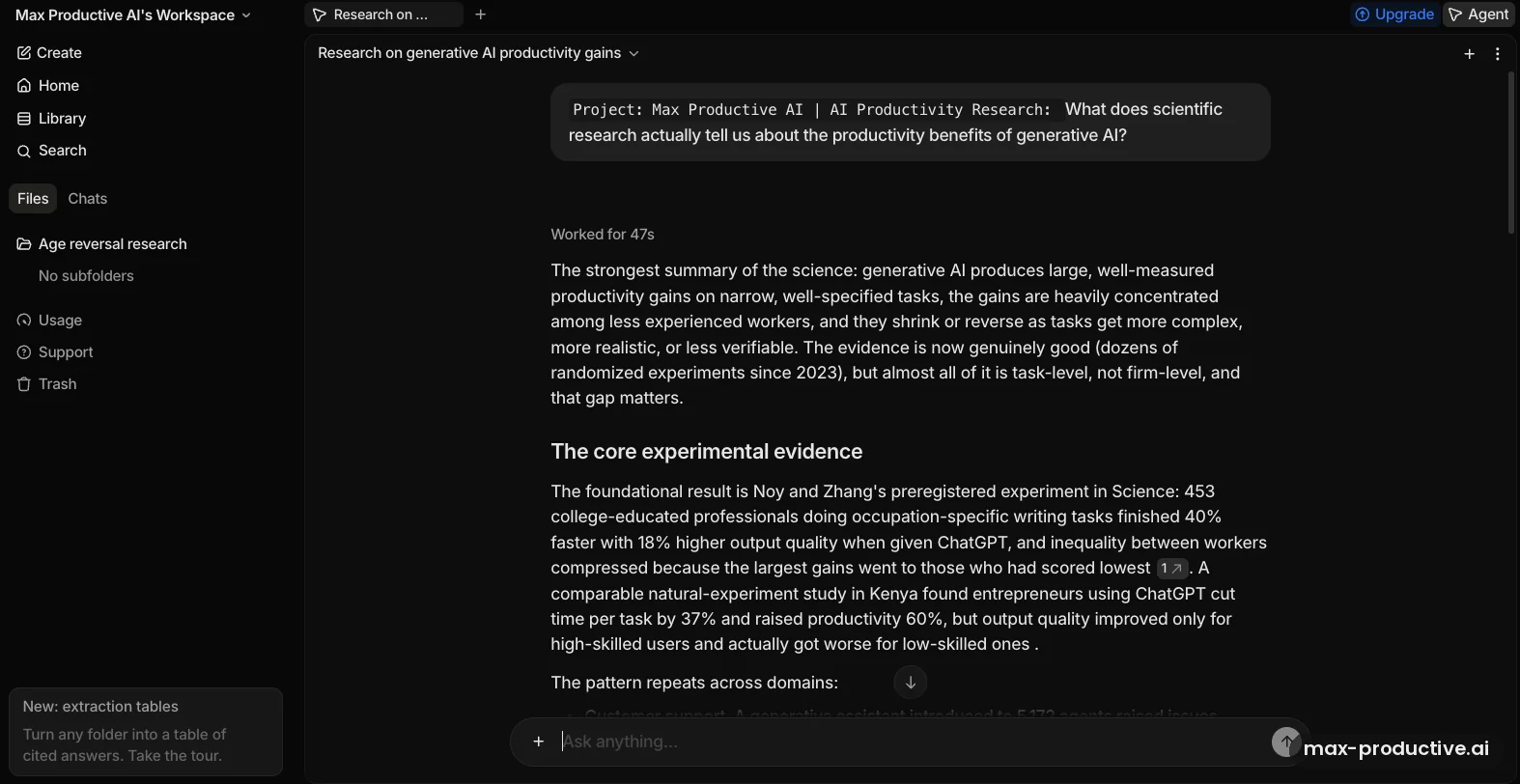
We started in a new chat with no documents: what does scientific research actually tell us about the productivity benefits of generative AI? Anara named the chat, worked for 47 seconds and came back with a structured answer and linked web sources. Its summary was measured: large gains on narrow, well-defined tasks, mostly for less experienced workers, with far less evidence at company level.
One detail matters for the rest of the test. This answer quotes the published Science version of Noy and Zhang's study: 453 professionals, 40% faster, 18% better quality. The working paper we uploaded next, dated March 2023, reports 444 professionals and a 37% time saving. Both are correct for their version. We didn't check the other studies in this answer.
A research folder with two papers
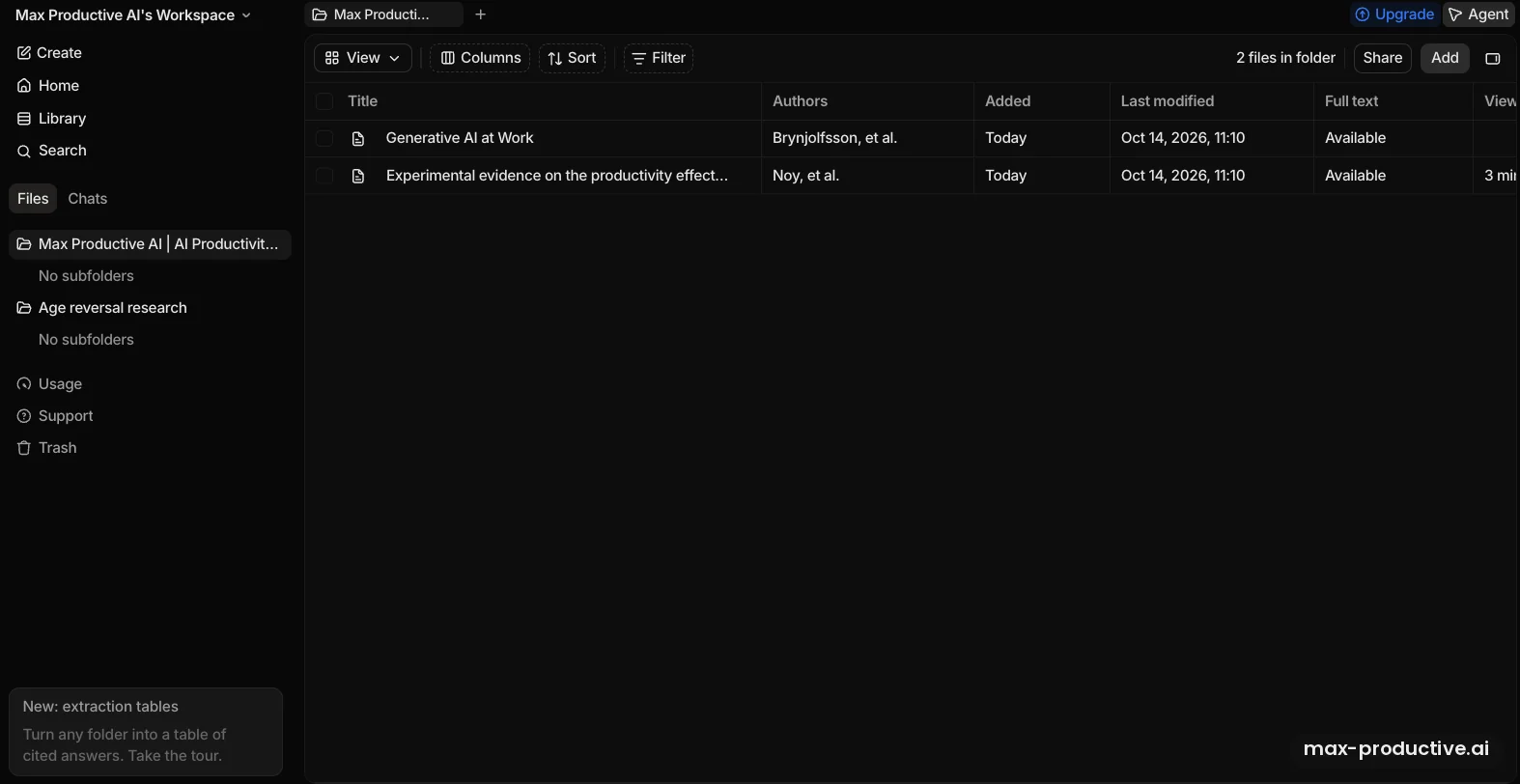
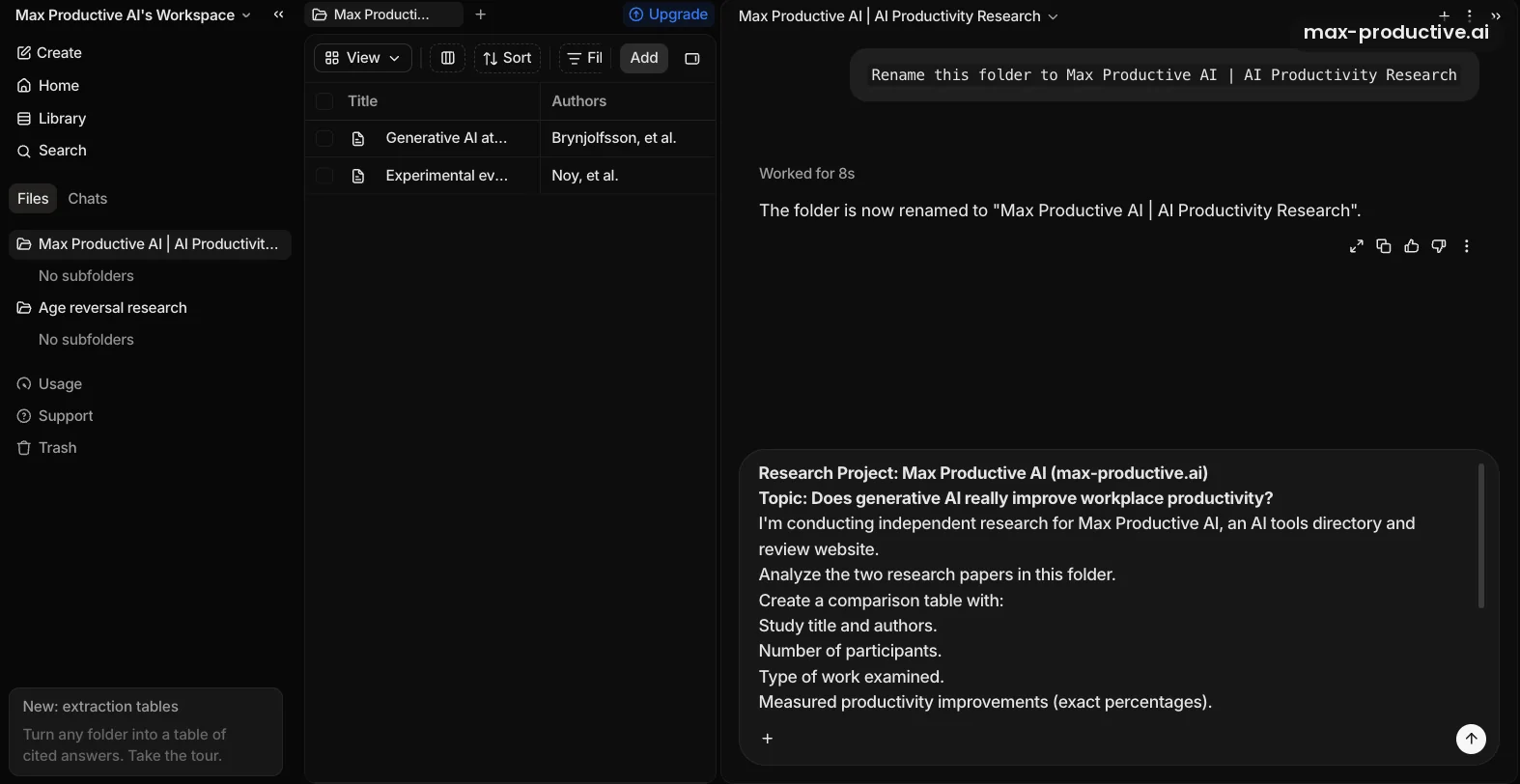
Next we made a research folder, added two freely available papers and named it "Max Productive AI | AI Productivity Research". They were "Experimental Evidence on the Productivity Effects of Generative Artificial Intelligence" by Noy and Zhang (MIT, 2023) and "Generative AI at Work" by Brynjolfsson, Li and Raymond (2023). The library picked up the authors, and the Full text column reads Available for both. That means Anara extracted readable text from each file.
Both files fit the Free plan's 120-page limit: the Noy and Zhang working paper has 15 pages and the Brynjolfsson paper 57. A thesis or a long report would need Plus (600 pages) or Pro (10,000). The folder toolbar also has a View button, which is where Anara's docs say you create Views, its extraction tables. We didn't try it.
Working with the agent
Anara's agent can act on your workspace, not only answer questions. We had asked it in plain English to rename the folder, and eight seconds later it was done. The split view keeps the files on the left and the chat on the right, so you can see what the agent is working from.
Then we wrote the real prompt. We asked for a comparison table with title and authors, number of participants, type of work, productivity gains as exact percentages, main findings and limitations, followed by a short conclusion. Two instructions mattered most: cite the papers for every number, and use only these two documents. Our advice: always state that boundary in the prompt. Anara's own help docs say the same, and suggest switching off web search for answers that should come from your files.
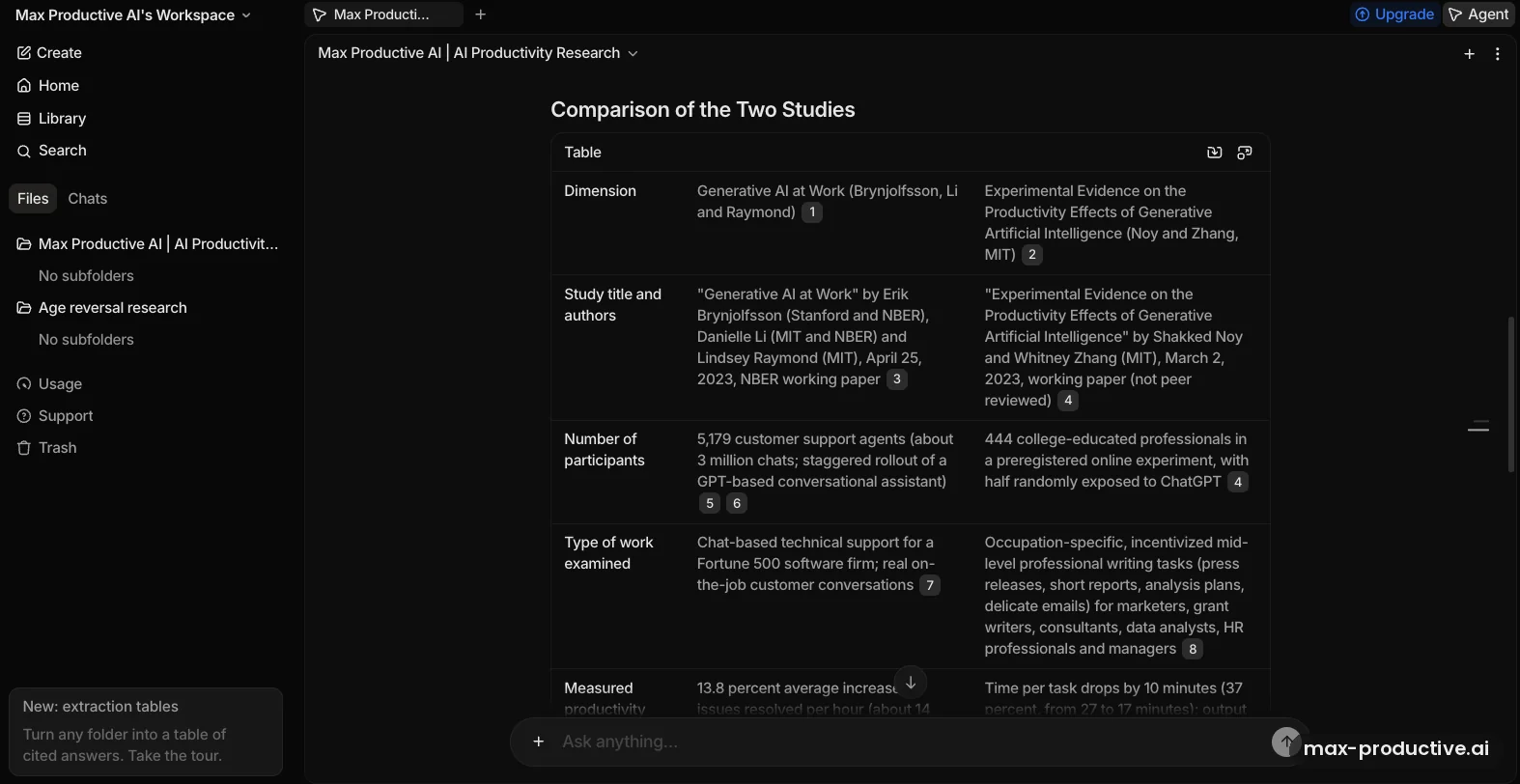
The comparison table
Anara returned a clean table with the two studies side by side and a numbered citation in each cell we could see. The detail is useful. The Brynjolfsson column notes 5,179 support agents, about 3 million chats and a staggered rollout at a Fortune 500 software company. The Noy and Zhang column lists the actual writing tasks, such as press releases, short reports, analysis plans and delicate emails, and the six occupations in the study.
We checked these numbers against the two PDFs, and they match. The papers report 5,179 agents, a 13.8% rise in issues resolved per hour, 444 professionals, and a 10-minute cut in time per task from a 27-minute average.
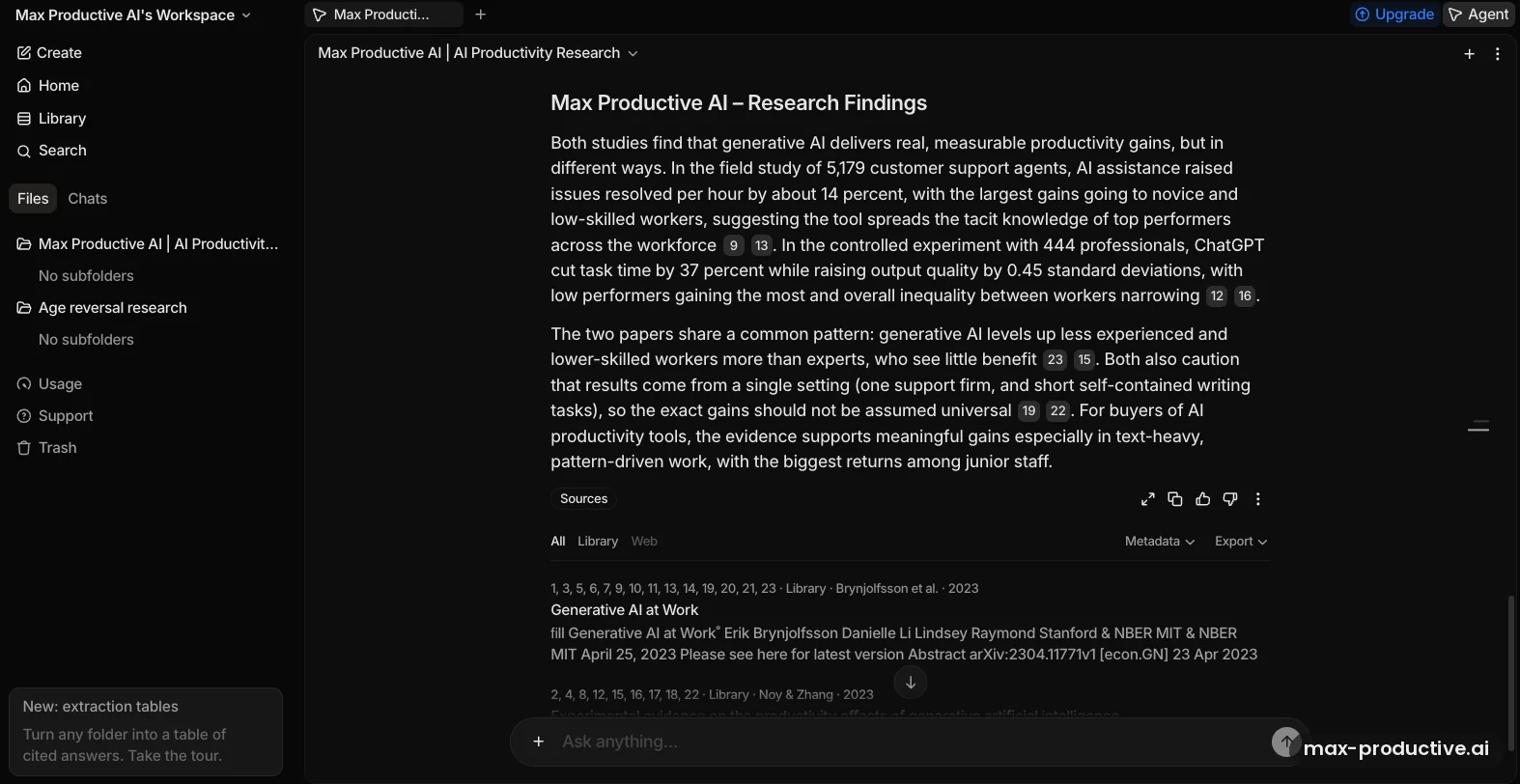
Findings and the source list
The conclusion reads like a careful analyst wrote it. It reports the 14% gain for support agents (the abstract's rounding of the 13.8% in the body) and, for writers, the 37% time saving with 0.45 standard deviations of extra quality. It notes that less experienced and lower-performing workers gained the most, and it repeats the papers' own warning that each study covers one setting. That caution is worth keeping in anything you publish.
Below it, Anara lists 23 citations by source: 14 from the Brynjolfsson paper and 9 from Noy and Zhang, all tagged Library, none from the web. It's a quick way to confirm the answer stayed inside the evidence you set. One fine point: the 0.45 figure comes from the body of the Noy and Zhang paper, while its abstract rounds it to 0.4.
One click back to the source
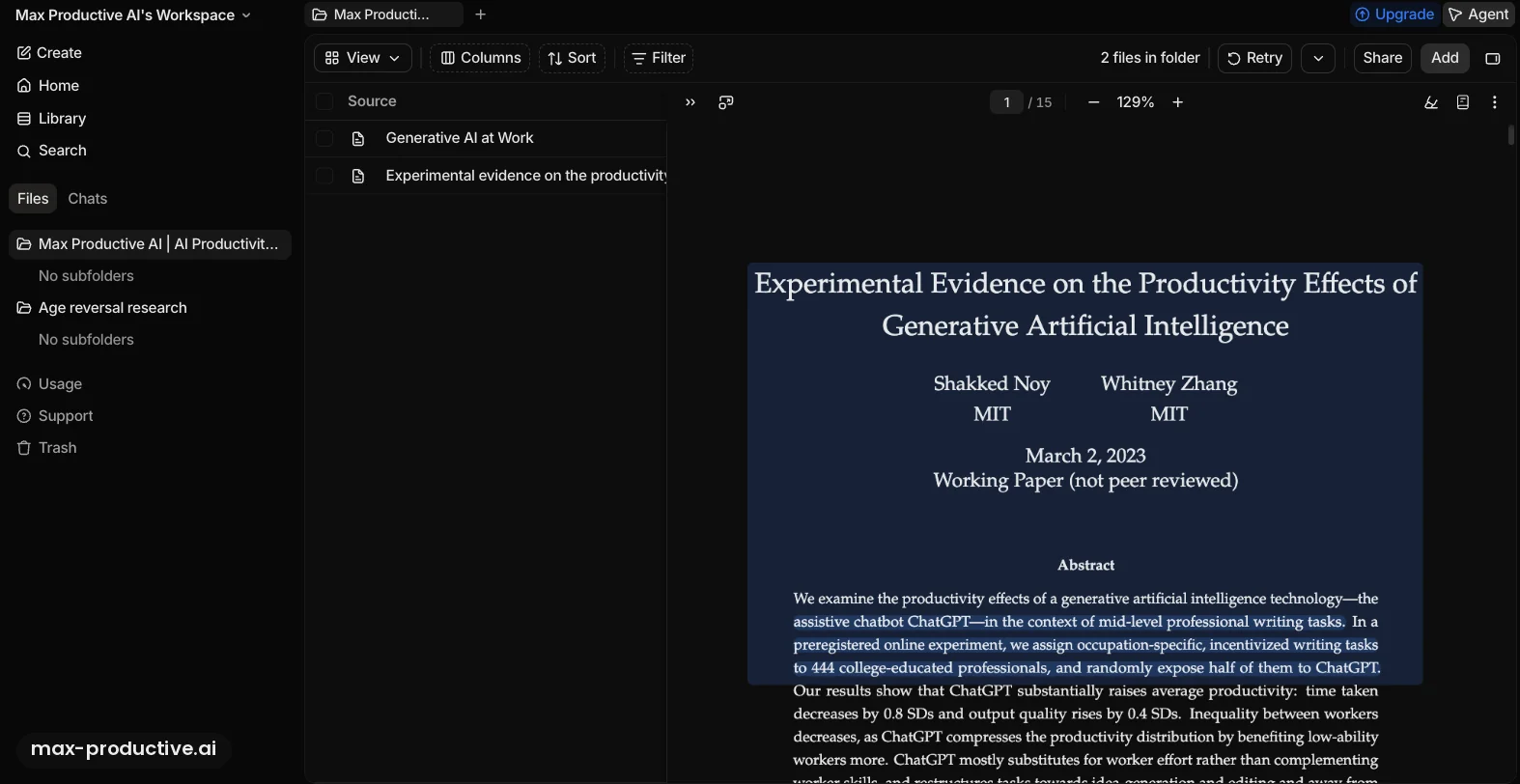
This is the feature that makes Anara worth your time. Clicking a citation opened the Noy and Zhang PDF next to the folder, at the abstract, with the supporting passage highlighted: 444 college-educated professionals, half of them given ChatGPT. You can read the text around it and judge for yourself in seconds.
Anara's help docs are clear that a citation shows where a claim came from, not that the claim is right. Our advice: open the citation behind every number you plan to quote, and check which version of the paper you're citing.
Everything above ran on the Free plan. Two papers and a few prompts is a light load. A literature review with dozens of papers, extraction tables across a folder and long follow-up chats would draw far more from the daily allowance, and Anara doesn't publish its size. For sustained research, plan on Plus or Pro.
Anara key features
Here's what Anara offers and which parts sit on paid plans. Where a feature goes beyond our test, we rely on Anara's help docs and changelog.
-
Passage-level citations
Answers carry numbered citations. A library citation opens the file at the supporting passage, and a web citation links to the page. You can copy or download an answer's source list as TXT, BibTeX, RIS or CSV for your reference manager.
-
Research agent and source controls
Chat with a file, a folder or your whole library. Turn Web and Library on or off, or @-mention a specific file or folder. The agent can also search academic literature, organize your workspace and create notes, spreadsheets or Word files.
-
Views
New in July 2026Turn a folder into a table with one row per file and one column per question, such as sample size, study design or outcome. Every cell links to its source evidence, and one run fills up to 2,000 cells. Our Free workspace showed the View button and a prompt to try Views, but we didn't build one, and Anara doesn't say which plans include them.
-
Literature search and import
Anara says its agent searches over 300 million academic papers as well as the web. Import papers by DOI, PMID, arXiv ID or link. Plus and higher plans add science databases such as PubMed and ClinicalTrials.gov.
-
Notes and citation styles
A notes editor with LaTeX math, Quick Edit, Search citation, version history and co-editing. Pick from more than 10,000 citation styles and export to PDF, Word, Markdown, HTML or LaTeX.
-
Model choice, Deep Search and Model Council
Pro and MaxFree and Plus use Auto, which picks the model for you. Pro opens the full model picker, which Anara's pricing page says includes GPT 6 Sol, Opus 5.5, Gemini 3.1 Pro and Grok 4.7. Max adds Deep Search for multi-step research and Model Council, which asks several models the same question.
-
Connectors
Zotero and Mendeley import is available on every plan, Free included. Plus adds science databases and app integrations, and Pro adds cloud storage such as Google Drive and OneDrive, plus custom MCP servers.
-
Files, audio and video
OCR from ProAnara reads PDF, Word, PowerPoint, Excel and CSV, EPUB, Markdown and text files, as well as images. It also transcribes MP3, M4A, WAV and MP4 audio and video. Searchable OCR for scanned documents starts on Pro.
-
Web, Mac, iPhone, iPad and Word
Use Anara on the web, in the Mac app or on iPhone and iPad (iOS 26 or later). There's also a Word add-in for Windows, Mac and the web, MCP access from AI tools like Claude and ChatGPT, and a Chrome extension that saves pages to your library.
Our read: the citations and folder chat are the mature core, and they worked as promised in our test. Views, the Mac and iOS apps and the Word add-in all arrived between July and September 2026, so we'd try them on a small project before building a big workflow around them.
Anara security and privacy
Anara's security page says the company is SOC 2 Type II and ISO/IEC 27001:2022 certified and GDPR compliant. Data is encrypted with TLS 1.2 or higher in transit and AES-256 at rest. To answer a question, Anara sends only the relevant passages, not your whole library, to model providers such as OpenAI, Anthropic, Google and xAI, under zero data retention terms.
Data is processed in the United States, and EU-only residency isn't offered. A DPA is available to sign, and Enterprise adds SSO, SCIM and a HIPAA business associate agreement on request. Anara's privacy policy, updated September 22, 2026, lists model training among the ways it may use what you provide, including uploaded files. Gmail and Google Drive data is excluded from training general-purpose AI models. If you work with unpublished or confidential material, read the policy and the DPA before you upload, and ask about Enterprise terms if your institution needs them.
Anara pricing
As of October 2026, Anara has a Free plan, four paid plans from $8 to $160 a month per seat on yearly billing, and Enterprise on a custom quote. You're mostly paying for more AI usage, bigger files and model choice.
| Plan detail | Free | Plus | Pro | Max 5x | Max 20x | Enterprise |
|---|---|---|---|---|---|---|
| Billed yearly | $0 | $8/mo | $16/mo | $80/mo | $160/mo | Custom |
| Billed monthly | $0 | $10/mo | $20/mo | $100/mo | $200/mo | Custom |
| AI usage | Limited, resets daily | Extended, resets weekly | 4x Plus | 5x Pro | 20x Pro | Custom |
| File size per upload | 20MB or 120 pages | 100MB or 600 pages | 300MB or 10,000 pages | No limit | No limit | No limit |
| AI models | Auto | Auto | All models | All models | All models | All models |
| Folder collaborators | Not included | 5 per folder | 50 per folder | Unlimited | Unlimited | Unlimited |
| Also worth knowing | Zotero and Mendeley. No credit card. | Buy extra credits. PubMed and ClinicalTrials.gov. | OCR for scans, Google Drive and OneDrive. | Deep Search, Model Council, priority access. | Same features as Max 5x. | SSO, SCIM, HIPAA BAA, live sync. |
Swipe sideways to see every plan.
Prices are per seat in US dollars and come from Anara's pricing page and help docs, last verified on October 14, 2026.
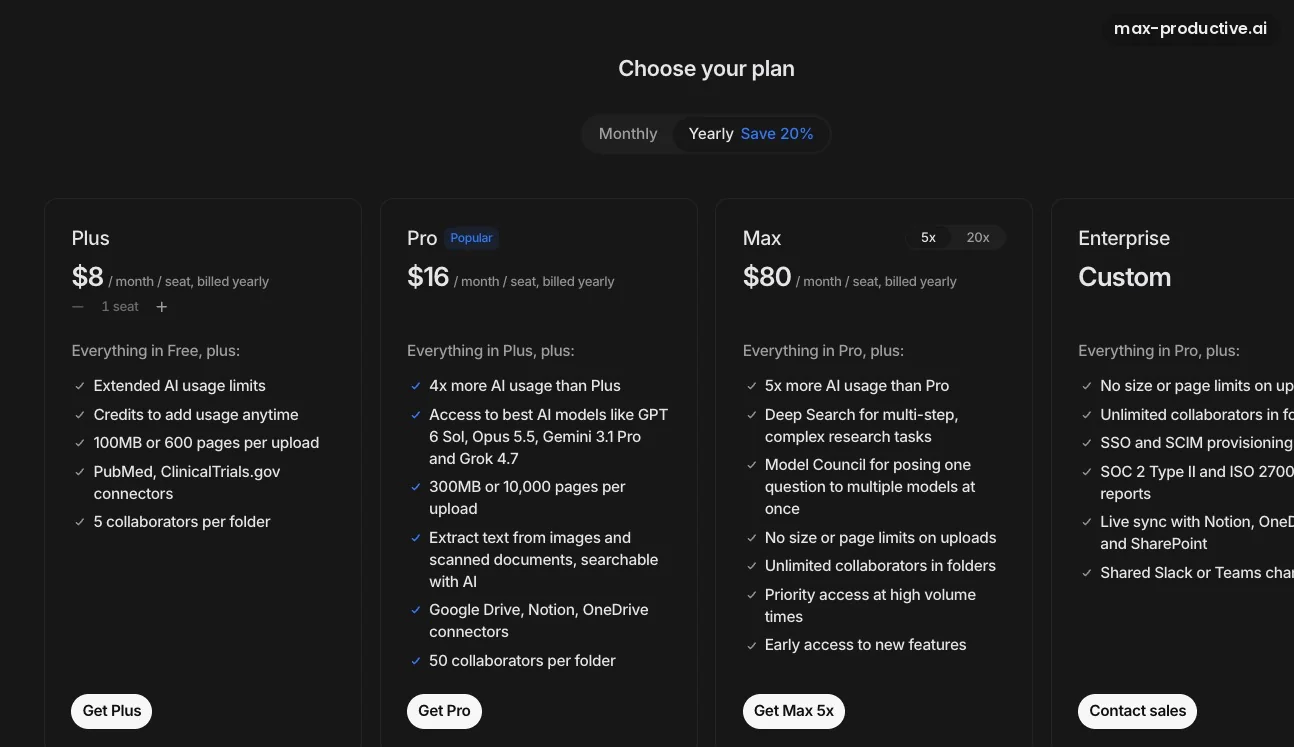
Anara plans on yearly billing
This is Anara's pricing page as we saw it on October 14, 2026, with yearly billing selected. Switch to monthly and the same cards read $10, $20 and $100. The Max card has a 5x and 20x toggle, and the 20x size costs $160 a month billed yearly, or $200 monthly.
Pro carries the Popular tag, and it's where model choice, OCR for scanned files and the Google Drive and OneDrive connectors begin.
Start free and upgrade only if you hit the limits.
Try Anara freeWhich Anara plan should you choose?
Start on Free and run a real project through it, as we did. Move to Plus when the daily allowance gets in your way or your files run past 120 pages. It switches to a larger weekly allowance, lets you buy credits and adds science databases such as PubMed. Pro is the plan for heavy literature work, scanned PDFs that need OCR, much longer files, or a specific model. Max is for teams and power users who need Deep Search, Model Council or many times Pro's usage. Enterprise is where SSO, SCIM and a HIPAA agreement live.
Is Anara worth the money?
For most students and researchers, yes at the Plus or Pro level. Plus at $8 a month, billed yearly, costs less than SciSpace Premium ($12) and Elicit Plus ($11) on the same billing, and PDF.ai Pro is $10. Gemini Notebook is free, so the real question is whether you need what Anara adds on top: academic search, reference exports, citation styles and cited extraction tables. If you write papers, reports or a thesis that others will check, those features earn their keep. If you only read and take notes, the free options will likely do.
Usage, credits and refunds
Anara measures AI work instead of counting messages. Chat, AI editing, View extraction and imports all draw from your allowance, and stronger models use more of it. Free refreshes daily; paid plans reset in full seven days after you first use them. On paid plans you can buy credits from $5 to $1,000 at 100 credits per dollar, and web credits expire 12 months after purchase. There's no student discount, and Anara offers a 7-day refund grace period from your first payment.
What changed in 2026
On August 17, 2026, Anara replaced the old daily word and upload counts with a single usage meter. It also split Max into 5x and 20x sizes and gave Pro access to every model. List prices are also lower than when we reviewed Anara in February 2026, when Plus cost $10 a month and Pro $20 on yearly billing, or $12 and $24 billed monthly.
Anara pros and cons
Pros
Citations open the exact passage
This is Anara's core strength, and it held up in our test. Claims carry numbered citations, and a library citation opens the PDF with the supporting text highlighted. Checking a figure takes seconds instead of a search through 57 pages.
Answers stay inside your evidence
We told Anara to use only our two papers, and all 23 citations in its answer pointed to those files. The figures we checked were right for the versions we uploaded, and the conclusion kept the papers' own caveats instead of overselling the results.
A Free plan you can test properly
Folder chat and cited answers worked on Free in our test, and Zotero and Mendeley import are included, with no credit card. That was enough for our full two-paper comparison, so you can judge the product before paying.
Built for research, not just chat
Anara covers academic search, DOI and arXiv import, a huge catalog of citation styles, BibTeX and RIS export, and cited extraction tables. General chatbots aren't built around these research jobs.
Fast-moving, with lower prices
Between April and September 2026, Anara shipped a new agent, Views, a Mac app, an iPhone and iPad app and a Word add-in. Paid plans also cost less than they did in February.
Security paperwork in place
Anara says it holds SOC 2 Type II and ISO 27001 certification and has zero data retention terms with its model providers. With a ready-to-sign DPA, it's easier to clear with a university or company IT team.
Cons
The Free allowance isn't quantified
Free runs on a daily allowance with no number attached, and long chats, imports and stronger models use more of it. Our two-paper test finished on Free, but a review of 40 papers will likely need Plus or Pro. Keep an eye on the Usage meter in the sidebar.
120 pages per file on Free
Free caps each upload at 20MB or 120 pages. Journal articles fit easily, while a thesis, a book or a long report often won't. Plus raises the cap to 600 pages and Pro to 10,000.
Model choice and OCR start on Pro
Free and Plus use Auto, so you can't pick a model. Scanned PDFs need Pro's OCR to become searchable, which matters for older papers and archive material.
Checking is still your job
Anara's docs say it plainly: a citation shows where a claim came from, not that it's correct. In our test the web answer quoted the journal version of a study and the folder answer the working paper, with different figures. Both were faithful to their sources, so know which edition you're citing. Some independent reviewers also find answers thinner on theoretical or highly specialized material.
Mobile means iPhone and iPad for now
The iPhone and iPad app arrived in September 2026 and needs iOS 26 or later. Anara lists no Android app, so Android users work in the browser. The Mac app and Word add-in are also new, so we'd try them on a small project first.
Read the billing terms before upgrading
A small number of Trustpilot reviews from 2025 and early 2026 describe billing questions after cancelling. Anara offers refunds within 7 days of the first payment. Its docs say to cancel from Settings and check the end date shown, so set a reminder if you're trying a paid plan.
Anara alternatives
Anara sits in our AI search tools directory. The table compares it with four research assistants that do similar jobs.
| Compared on | Anara Reviewed | SciSpace | Gemini Notebook | Elicit | PDF.ai |
|---|---|---|---|---|---|
| Entry paid plan | $8 a month, billed yearly | $12 a month, billed yearly | Free; higher limits with Google AI plans | $11 a month, billed yearly | $10 a month, billed yearly |
| Free plan | Yes, daily allowance | Free sign-up | Yes, 100 notebooks of 50 sources | Yes, with unlimited paper search | Yes, 1 upload a month |
| Works from | Your library, the web and academic papers | A database of 270M+ papers and your PDFs | The sources you add | 138M+ papers and your PDFs | PDFs you upload |
| Standout strength | Passage-level citations across a whole folder | Paper discovery and writing tools | Free, source-grounded notebooks and audio overviews | Screening and data extraction for systematic reviews | Quick answers from a single PDF |
| Best for | Research you'll need to defend | Literature discovery and drafting | Learning a topic on a budget | Evidence synthesis | Occasional PDF questions |
Swipe sideways to see every tool.
Anara vs Gemini Notebook
This is the comparison many readers will weigh. Gemini Notebook, Google's name for NotebookLM since July 2026, answers from the sources you add and is free. The free tier holds 100 notebooks of 50 sources each, and its audio overviews are a pleasant way to absorb a topic. Anara costs money for heavy use and focuses on the research tooling around the answer: academic search, Zotero and Mendeley import, citation styles, reference exports and cited extraction tables. If you're learning a subject, start with Gemini Notebook. If you're writing something others will check, Anara's research tools make it the stronger fit.
Anara vs SciSpace and Elicit
SciSpace and Elicit start mainly from the published literature rather than your own library. SciSpace pairs a large paper database with writing, paraphrasing and citation tools, from $12 a month billed yearly. Elicit pairs search across 138 million papers with workflows for systematic reviews, including screening and data extraction, and its Plus plan is $11 a month billed yearly. Anara overlaps with both. Its strength is working across the papers you already have, with every answer traced to a passage.
Which alternative fits you?
-

SciSpaceOur rating: 4.2 / 5
Best for: Researchers who start from literature discovery and want writing, paraphrasing and citation tools in the same place.
SciSpace Premium costs $12 a month billed yearly, or $20 monthly. It's the better pick when finding new papers matters more than working across a library you've already built.
-

PDF.aiOur rating: 4.0 / 5
Best for: Occasional questions about a single PDF, or developers who want a document API.
The free Hobby plan allows one upload and 100 questions a month, and Pro is $10 a month billed yearly with 100 uploads and 1,000 questions. It's simpler than Anara and lighter on research tools such as citation styles and literature search.
Anara FAQ
Is Anara free?
Yes, Anara has a Free plan that needs no credit card. It includes chat with your files and folders, cited answers, Zotero and Mendeley import, and uploads of up to 20MB or 120 pages per file. AI use runs on a daily allowance whose size Anara doesn't publish. We ran our whole two-paper test on Free. Heavier research usually calls for Plus or Pro.
How much does Anara cost?
As of October 2026, Anara costs $8 (Plus), $16 (Pro), $80 (Max 5x) or $160 (Max 20x) per seat per month on yearly billing, or $10, $20, $100 and $200 billed monthly. Enterprise pricing is custom. Pro is the plan that unlocks model choice, OCR for scanned documents and much larger uploads. Anara doesn't offer a student discount.
Is Anara accurate?
Yes, Anara was accurate in our test. The figures we checked in its folder answer matched the two source papers. The 5,179 support agents, 14% productivity gain, 444 professionals and 37% time saving were each right for the working-paper version we uploaded. Anara's own docs still advise opening citations, because a citation shows where a claim came from, not that it's correct.
What happened to Unriddle?
Unriddle is now Anara. The product took the Anara name in March 2025. Since then it has added a research agent, Views for cited extraction tables, a new notes editor, and apps for Mac, iPhone, iPad and Microsoft Word. If you're searching for Unriddle AI, Anara is the same tool under its current name.
Can Anara search for academic papers?
Yes, Anara's research agent searches the web and, according to Anara, over 300 million academic papers, and you can import what you choose by DOI, PMID, arXiv ID or link. Plus and higher plans add science databases such as PubMed and ClinicalTrials.gov. Anara's docs note that some results include only an abstract, so ask which sources it read in full.
What files can Anara read?
Anara reads PDFs, Word and PowerPoint files, spreadsheets and CSV files, EPUB, Markdown and text files, images, and MP3, M4A, WAV or MP4 audio and video, which it transcribes. It also imports web pages and YouTube links. On the Free plan each file can be up to 20MB or 120 pages, and OCR for scanned documents starts on Pro.
What are Views in Anara?
Views are Anara's extraction tables, launched in July 2026. You turn a folder into a table with one row per file and one column per question, such as sample size or study design, and every cell links to its evidence. One run fills up to 2,000 cells. Our Free workspace showed the View button, but we didn't build a View for this review, and Anara doesn't list which plans include it.
Is Anara safe for confidential research?
Anara says it is SOC 2 Type II and ISO 27001 certified, encrypts data in transit and at rest, and sends only relevant passages to AI providers under zero data retention terms. Data is processed in the US, with no EU-only residency. For unpublished or sensitive work, read the privacy policy and DPA first. Enterprise adds SSO and a HIPAA agreement.
Does Anara have a mobile app?
Yes, Anara has an iPhone and iPad app, launched in September 2026, which needs iOS 26 or later. It's a companion for reading papers, asking questions and following citations, with offline access to saved PDFs and recent chats. Anara also runs on the web, as a Mac app and inside Microsoft Word. It lists no Android app.
Is Anara better than NotebookLM?
Anara is the better fit for cited academic work, while Gemini Notebook, the new name for NotebookLM, is the better free option. Both answer from your sources. Anara focuses on research tools such as academic search, Zotero and Mendeley import, citation styles, reference exports and cited extraction tables. Gemini Notebook is free with generous limits and offers audio overviews.
Should you try Anara?
Anara does the one thing a research assistant has to do: it shows its work. In our test it compared two studies, stayed inside the evidence we set, got the figures right for the versions we uploaded, and opened a cited passage in one click. Its limits are about volume rather than quality. The Free allowance isn't quantified, files stop at 120 pages, and model choice waits for Pro. For anyone who has to defend what they write, Anara earns its 4.2.
What we'd do. Sign up for the Free plan and build one folder for a question you're actually working on, with three to five papers. Ask for a comparison table, tell Anara to use only those files, and open the citation behind every number you plan to keep. Note which version of each paper you uploaded. If you reach the daily limit or need longer files, move to Plus. Pro is the plan for scanned PDFs or a specific model.
Our rating: 4.2 / 5
Very good
About this review
Based on a hands-on research test on Anara's Free plan, our own check of its figures against the two source papers, Anara's pricing page, help docs, security page and changelog, and public user feedback. First published 12 February 2026. Last updated 14 October 2026.
Sources checked
- Pricing and plan limits. Anara pricing page and help docs, checked October 14, 2026.
- Product changes and security. Anara updates (April to September 2026) and the security page, updated September 2026.
- Test papers. Noy and Zhang, working paper of March 2, 2023; Brynjolfsson, Li and Raymond, arXiv version 1 of April 2023.
- User feedback. Public reviews on Trustpilot, the Chrome Web Store and independent academic blogs.
Ratings are our overall editorial judgment on a 5-point scale: 4.5 and up is Excellent, 4.0 to 4.4 Very good, 3.5 to 3.9 Good, 3.0 to 3.4 Fair. We do not use sub-scores.
This review contains affiliate links, so we may earn a commission at no extra cost to you. Our ratings and editorial opinions remain independent.