
GPT-5.1 Released: Everything New in OpenAI's Latest ChatGPT Upgrade
Updated: November 17, 2025

Breaking News: This article was published on November 13, 2025, and updated with GPT-5.1 API details on November 14, 2025. All information is sourced directly from OpenAI's official announcements for both ChatGPT and API releases.
OpenAI just dropped GPT-5.1, marking a significant upgrade to the GPT-5 series with enhanced models for both ChatGPT users and developers. The consumer release introduces GPT-5.1 Instant and GPT-5.1 Thinking with warmer conversational tones and powerful personalization controls. Simultaneously, the GPT-5.1 API release brings adaptive reasoning, extended prompt caching, and innovative developer tools that make building agentic applications faster and more efficient.
This comprehensive update addresses feedback from millions of users and developers, delivering AI that's not only smarter but also more natural to interact with and easier to integrate into production workflows. Whether you're using ChatGPT for everyday tasks or building sophisticated AI applications, GPT-5.1 represents OpenAI's most balanced release yet—combining intelligence, speed, and user experience improvements across the board.
What's New in GPT-5.1?
GPT-5.1 represents OpenAI's response to user feedback requesting AI that's both intelligent and pleasant to converse with, while giving developers the tools they need for reliable agentic workflows. The release spans two major areas:
For ChatGPT Users: Adaptive reasoning, warmer conversational tone, better instruction following, and revolutionary personalization controls that let you shape the AI's personality.
For Developers: API access with "no reasoning" mode for speed, 24-hour prompt caching, new apply_patch and shell tools, and 2-3x faster performance on everyday coding tasks while maintaining frontier intelligence.
GPT-5.1 Instant: Smarter and More Conversational
GPT-5.1 Instant, ChatGPT's most-used model, has received significant upgrades that make it both more capable and more enjoyable to use:
Warmer, More Natural Tone
The model now communicates with a warmer, more conversational tone by default. Early testing shows users are often surprised by its playfulness while maintaining clarity and usefulness. This isn't just superficial—the model has been fundamentally improved to strike a better balance between being helpful and being personable.
Better Instruction Following
One of the most practical improvements is enhanced instruction following. GPT-5.1 Instant more reliably answers the actual question you asked, reducing instances where the AI misinterprets your intent or provides tangential information.
Adaptive Reasoning (New Feature)
For the first time, GPT-5.1 Instant can use adaptive reasoning to determine when deeper thinking is needed. When you ask a challenging question, the model automatically engages more thorough analysis while still responding quickly to simpler queries. This innovation results in:
- More thorough and accurate answers for complex problems
- Faster response times for straightforward questions
- Significant improvements on math evaluations like AIME 2025
- Better performance on coding benchmarks like Codeforces and SWE-bench Verified
GPT-5.1 Thinking: More Efficient, More Understandable
OpenAI's advanced reasoning model has also received substantial upgrades focused on efficiency and clarity. GPT-5.1 Thinking now adapts its thinking time more precisely to match the complexity of your question.
Dynamic Thinking Time
The model now varies its cognitive effort more intelligently than its predecessor. According to OpenAI's testing on representative ChatGPT tasks, GPT-5.1 Thinking is approximately twice as fast on the easiest tasks and twice as deliberate on the most complex ones when both models use Standard thinking time settings.
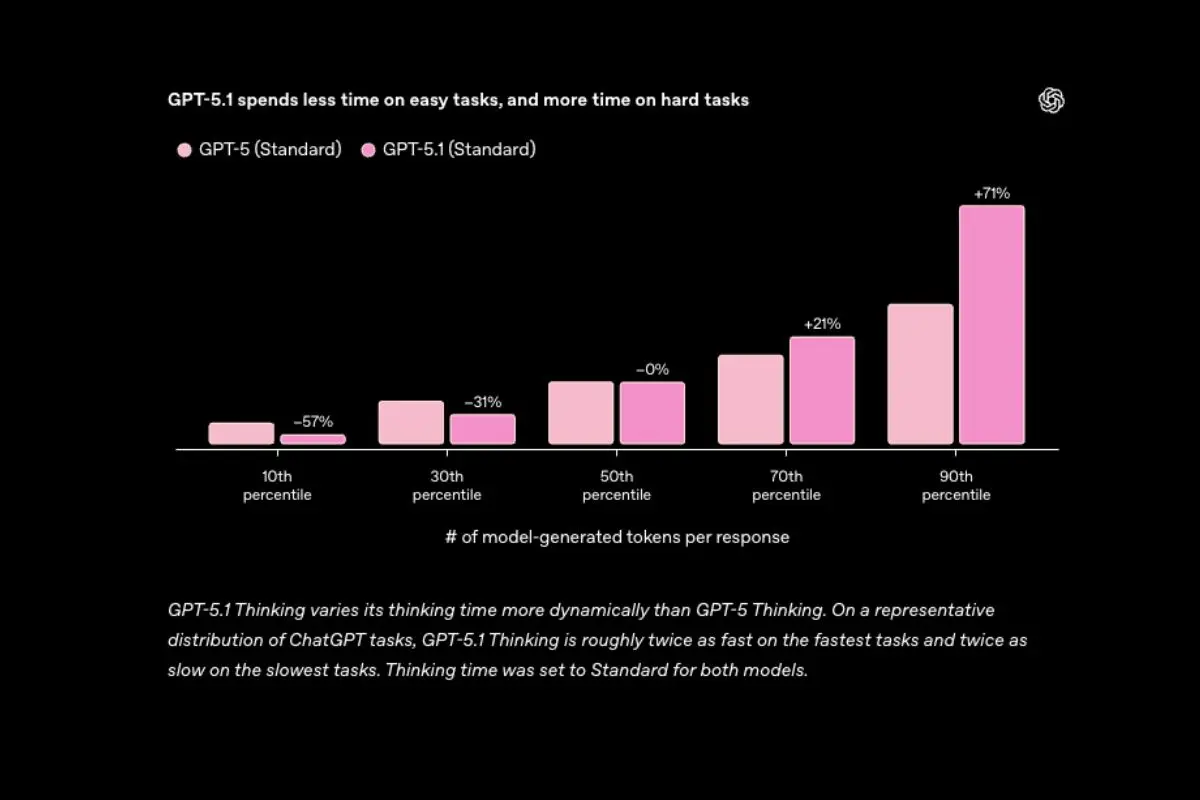
This chart illustrates how GPT-5.1 Thinking allocates computational resources more efficiently across different task complexities. For users, this translates to less waiting on simple questions and more thorough analysis when it truly matters.
Clearer, More Accessible Responses
GPT-5.1 Thinking's responses feature less technical jargon and fewer undefined terms. This makes OpenAI's most capable model more approachable, especially when explaining technical concepts or handling complex workplace tasks. The model maintains its advanced reasoning capabilities while communicating in clearer, more understandable language.
Enhanced Empathy
The default tone of GPT-5.1 Thinking is now warmer and more empathetic, particularly valuable when working through complex problems that may involve stress or uncertainty.
GPT-5.1 API: Built for Developers and Agentic Workflows
The GPT-5.1 API release represents a major leap forward for developers building AI applications. OpenAI worked closely with leading coding companies like Cursor, Cognition, Augment Code, Factory, and Warp to refine the model's coding personality, steerability, and overall developer experience.
Efficient Reasoning Across Tasks
GPT-5.1's adaptive reasoning fundamentally changes how the model allocates computational resources. On straightforward tasks, GPT-5.1 spends fewer tokens thinking, enabling faster responses and lower costs. On difficult tasks requiring extra thinking, the model remains persistent, exploring options and checking its work to maximize reliability.
Real-world results from early adopters demonstrate the impact:
- Companies report GPT-5.1 runs 2-3x faster than GPT-5 on everyday tasks
- Tool-heavy reasoning tasks consistently use about half as many tokens as leading competitors at similar or better quality
- AI insurance BPO agents run 50% faster on GPT-5.1 while exceeding accuracy of GPT-5 and other leading models
- Token usage drops 88% on the easiest 10% of tasks, with the model allocating those savings to complex problems
As a practical example: when asked to show an npm command to list globally installed packages, GPT-5.1 answers in 2 seconds instead of 10 seconds—a 5x speed improvement on this common developer task.
"No Reasoning" Mode for Maximum Speed
Developers can now use GPT-5.1 without reasoning by setting reasoning_effort to 'none'. This makes the model behave like a non-reasoning model for latency-sensitive use cases, while maintaining the high intelligence of GPT-5.1 with the added bonus of performant tool-calling.
Compared to GPT-5 with 'minimal' reasoning, GPT-5.1 with no reasoning excels at:
- Parallel tool calling (which increases end-to-end task completion speed)
- Coding tasks with better code quality and less overthinking
- Following instructions more reliably
- Using search tools and web browsing capabilities
Companies testing this mode report a 20% improvement on low-latency tool calling performance compared to GPT-5 minimal reasoning in real-world evaluations.
Developer Flexibility: GPT-5.1 defaults to 'none' reasoning effort, ideal for latency-sensitive workloads. Developers can choose 'low' or 'medium' for tasks of higher complexity, and 'high' when intelligence and reliability matter more than speed.
Extended Prompt Caching: Up to 24 Hours
Extended caching improves reasoning efficiency by allowing prompts to remain active in the cache for up to 24 hours, rather than the few minutes supported previously. With this longer retention window, more follow-up requests can leverage cached context—resulting in lower latency, reduced cost, and smoother performance for long-running interactions.
Use cases that benefit most:
- Multi-turn chat applications
- Extended coding sessions
- Knowledge retrieval workflows
- Agentic systems with persistent context
Prompt cache pricing remains unchanged, with cached input tokens 90% cheaper than uncached tokens, and no additional charge for cache writes or storage. To use extended caching with GPT-5.1, add the parameter prompt_cache_retention='24h' on the Responses or Chat Completions API.
Coding Improvements and Developer Feedback
GPT-5.1 builds on GPT-5's coding capabilities with a more steerable coding personality, less overthinking, improved code quality, and better user-targeted update messages during sequences of tool calls. The model also generates more functional frontend designs, especially at low reasoning effort.
On simpler coding tasks like quick code edits, GPT-5.1's faster speeds make it easier to iterate. On difficult tasks, performance doesn't degrade—in fact, on SWE-bench Verified, GPT-5.1 works even longer than GPT-5 and reaches 76.3% (up from 72.8%).
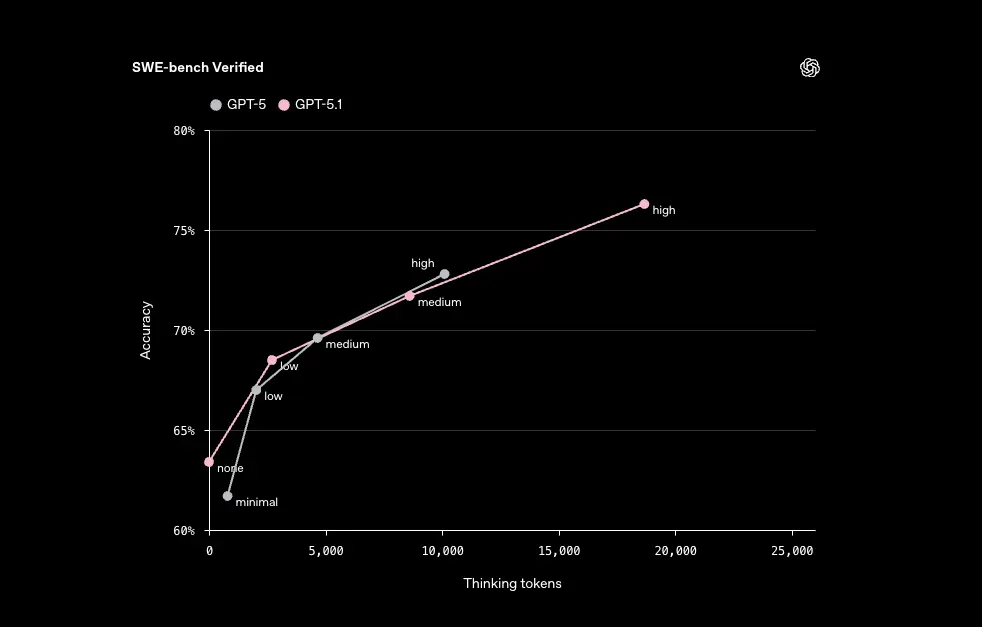
Leading coding companies shared their early impressions of GPT-5.1:
Cursor: "More deliberate with fewer wasted actions, more efficient reasoning, and better task focus. We're seeing more accurate changes, smoother pull requests, and faster iteration across multi-file projects."
Augment Code: "GPT-5.1 achieved SOTA on our diff editing benchmark with a 7% improvement, demonstrating exceptional reliability for complex coding tasks."
CodeRabbit: Called GPT-5.1 their "top model of choice for PR reviews."
Cognition: "Noticeably better at understanding what you're asking for and working with you to get it done."
Factory: "Delivers noticeably snappier responses and adapts its reasoning depth to the task, reducing overthinking and improving the overall developer experience."
Warp: Making GPT-5.1 the default for new users, saying it "builds on the impressive intelligence gains that the GPT-5 series introduced, while being a far more responsive model."
New Developer Tools: apply_patch and shell
OpenAI is introducing two new tools with GPT-5.1 to help developers get the most out of the model in the Responses API:
apply_patch Tool
The freeform apply_patch tool lets GPT-5.1 create, update, and delete files in a codebase using structured diffs. Instead of just suggesting edits, the model emits patch operations that an application applies and reports back on, enabling iterative, multi-step code editing workflows.
To use the apply_patch tool, include it in the tools array with "tools": [{"type": "apply_patch"}] and either include file content in your input or give the model tools for interacting with your file system. The model will generate apply_patch_call items containing diffs that you apply on your file system.
shell Tool
The shell tool allows the model to interact with a local computer through a controlled command-line interface. The model proposes shell commands; a developer's integration executes them and returns the outputs. This creates a simple plan-execute loop that lets models inspect the system, run utilities, and gather data until they can finish the task.
To use the shell tool, developers include it in the tools array with "tools": [{"type": "shell"}]. The API generates "shell_call" items that include shell commands to execute. Developers execute the commands locally and pass back execution results in the "shell_call_output" item in the next API request.
API Model Variants and Pricing
OpenAI is releasing multiple GPT-5.1 variants to serve different use cases:
- gpt-5.1 and gpt-5.1-chat-latest: Available to all paid API tiers
- gpt-5.1-codex and gpt-5.1-codex-mini: Optimized specifically for long-running, agentic coding tasks in Codex or Codex-like harnesses
Pricing remains the same as GPT-5, and OpenAI doesn't currently plan to deprecate GPT-5 in the API. Developers will receive advanced notice if and when any deprecation is decided.
Revolutionary Personalization Controls (ChatGPT)
Alongside the model improvements, OpenAI is introducing more sophisticated tools for customizing ChatGPT's communication style. These changes acknowledge that preferences vary significantly—not just between people, but even within the same person across different conversations.
New Personality Presets
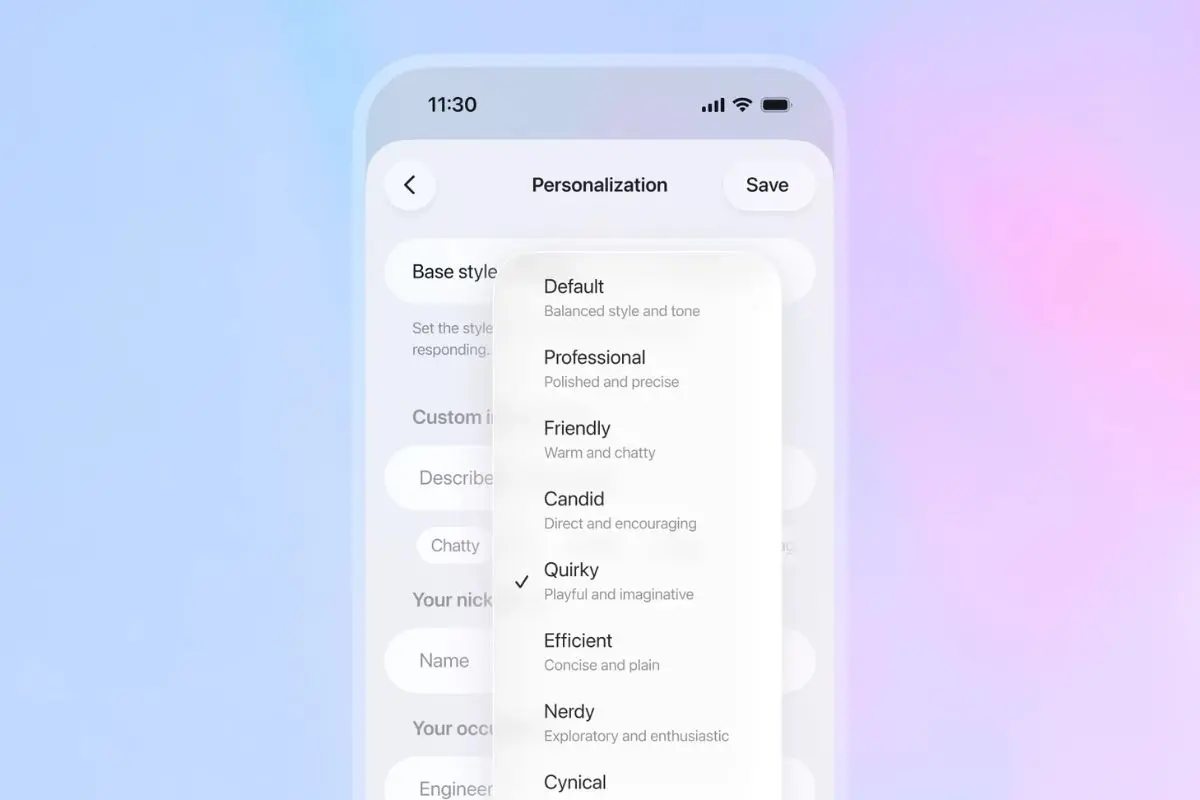
OpenAI has refined its preset options based on how people actually use ChatGPT. The updated lineup includes:
- Default: Balanced style and tone for general use
- Professional: Polished and precise for workplace communication
- Friendly: Warm and chatty for casual conversations (formerly Listener)
- Candid: Direct and encouraging without unnecessary politeness
- Quirky: Playful and imaginative for creative interactions
- Efficient: Concise and plain language (formerly Robot)
The original Cynical and Nerdy options from earlier this year remain available under the same dropdown in personalization settings.
Granular Characteristic Control
For users wanting more precise control, OpenAI is experimenting with the ability to fine-tune specific characteristics directly from personalization settings. This includes adjusting:
- Response conciseness (how brief or detailed)
- Warmth level (how friendly or formal)
- Scannability (how easy to skim)
- Emoji frequency (how often emojis appear)
Smart Feature: ChatGPT can now proactively offer to update these preferences during conversations when it notices you requesting a certain tone or style, eliminating the need to navigate into settings manually.
Immediate Application
Settings changes now take effect across all chats immediately, including ongoing conversations. Previously, modifications to base style and custom instructions only applied to new conversations started afterward. This improvement ensures a consistent experience across your entire ChatGPT usage.
Rollout Schedule and Availability
OpenAI is taking a measured approach to the GPT-5.1 rollout to maintain performance stability as millions of users transition to the new models.
ChatGPT Phased Deployment
The consumer rollout follows this schedule:
- November 13, 2025: GPT-5.1 Instant and Thinking begin rolling out to paid users (Pro, Plus, Go, Business)
- Soon after: Free and logged-out users gain access
- Enterprise & Edu: Seven-day early-access toggle available (off by default)
- After seven days: GPT-5.1 becomes the sole default model across all tiers
- GPT-5 Pro update: Coming soon with GPT-5.1 Pro
Gradual Rollout Notice
Even if you check ChatGPT today, you may not see GPT-5.1 available immediately. OpenAI plans to roll it out gradually over the next few days to ensure stable performance for everyone. This staged approach helps prevent server overload and ensures a smooth experience.
API Availability
The GPT-5.1 API is now available to developers on all paid tiers:
- Available now:
gpt-5.1,gpt-5.1-chat-latest,gpt-5.1-codex, andgpt-5.1-codex-mini - All models include: Adaptive reasoning capabilities with configurable effort levels
- New tools:
apply_patchandshellavailable in the Responses API - Extended caching: 24-hour prompt retention available immediately
Legacy Model Transition
OpenAI is providing a generous transition period for users who want to compare models or adapt at their own pace. GPT-5 (both Instant and Thinking) will remain available in ChatGPT under the legacy models dropdown for paid subscribers for three months.
This sunset period applies only to GPT-5 models and does not affect the availability of other legacy models. OpenAI states that future model introductions will follow this same pattern, providing ample evaluation time with clear advance notice before any deprecation.
Technical Performance Improvements
OpenAI has released comprehensive benchmarks demonstrating GPT-5.1's improvements across multiple domains:
Mathematics and Reasoning
GPT-5.1 demonstrates significant improvements on challenging mathematical benchmarks:
- AIME 2025: 94.0% (virtually unchanged from GPT-5's 94.6%)
- GPQA Diamond: 88.1% (up from 85.7%)
- FrontierMath: 26.7% (up from 26.3%)
- MMMU: 85.4% (up from 84.2%)
Coding Capabilities
Performance on coding benchmarks shows notable gains:
- SWE-bench Verified: 76.3% (up from 72.8%) across all 500 problems
- Codeforces: Significant improvements in competitive programming tasks
- Diff editing: 7% improvement reported by Augment Code
Agent Performance
Real-world agent benchmarks show substantial improvements:
- Tau-bench Airline: 67.0% (up from 62.6%)
- Tau-bench Telecom: 95.6% (down slightly from 96.7%)
- Tau-bench Retail: 77.9% (down from 81.1%)
- BrowseComp Long Context (128k): 90.0% (unchanged)
Adaptive Resource Allocation
The most innovative aspect of GPT-5.1's performance is its dynamic resource allocation. By analyzing task complexity in real-time, the model achieves:
- 88% reduction in tokens generated for the simplest 10% of tasks
- 79% reduction for tasks at the 30th percentile
- 70% reduction for median-difficulty tasks
- Roughly equal or slightly fewer tokens for the 70th percentile
- 36% increase in tokens for the most challenging 10% of tasks
This intelligent scaling ensures computational power goes exactly where it's needed, improving both efficiency and effectiveness while reducing costs for simpler queries.
Understanding the GPT-5.1 Naming Convention
You might wonder why OpenAI chose "5.1" rather than "GPT-6" or another designation. According to the company, this naming reflects meaningful improvements while remaining within the GPT-5 generation. The ".1" increment indicates substantial enhancements to core capabilities without representing a complete architectural overhaul.
OpenAI states that future iterative upgrades to GPT-5 will follow the same pattern. This approach provides clear versioning that helps users and developers understand the scope of changes while maintaining consistency across the model family.
Safety Considerations
OpenAI has published a system card addendum detailing their safety approach for GPT-5.1. While maintaining the core safety frameworks from GPT-5, the new models underwent additional evaluation specifically focused on:
- Ensuring the warmer, more conversational tone doesn't compromise appropriate boundaries
- Validating that adaptive reasoning doesn't introduce new safety risks
- Testing personalization features to prevent misuse or harmful outputs
- Confirming instruction-following improvements don't increase susceptibility to jailbreaking attempts
- Evaluating new developer tools (apply_patch and shell) for security implications
The company emphasizes that making AI more personable, flexible, and capable requires additional vigilance to ensure these improvements don't inadvertently create new safety challenges.
What GPT-5.1 Means for Different User Types
For Casual Users
If you use ChatGPT for everyday questions, creative projects, or learning, GPT-5.1 will feel noticeably more natural and responsive. The warmer tone makes interactions more enjoyable, while improved instruction following reduces frustration when the AI misunderstands your intent.
For Professional Users
Business users benefit from both enhanced capabilities and professional personalization options. The ability to set a "Professional" tone ensures workplace-appropriate responses, while adaptive reasoning helps with complex analytical tasks like financial modeling, strategic planning, or technical documentation.
For Developers
The GPT-5.1 API opens new possibilities for building production-grade AI applications. Key benefits include:
- 50% token reduction on tool-heavy reasoning tasks
- 2-3x faster responses on everyday coding operations
- 24-hour prompt caching for persistent context at 90% cost savings
- New apply_patch and shell tools for reliable code editing and system interaction
- Flexible reasoning effort controls for balancing speed and intelligence
For Researchers and Academics
Improved mathematical reasoning and clearer explanations from GPT-5.1 Thinking make it more valuable for research assistance. The model's ability to explain complex concepts with less jargon could prove particularly useful for interdisciplinary work or teaching applications.
GPT-5.1 Auto: Seamless Model Selection
Most users won't need to manually choose between GPT-5.1 Instant and GPT-5.1 Thinking. GPT-5.1 Auto continues to intelligently route each query to the model best suited for it, ensuring optimal results without requiring model selection expertise.
With Auto mode, you'll simply notice that answers across GPT-5.1 feel both smarter and more natural in tone, regardless of which specific model handled your query.
Frequently Asked Questions About GPT-5.1
GPT-5.1 is rolling out starting November 13, 2025, beginning with paid users (Pro, Plus, Go, Business), followed by free and logged-out users. The rollout is gradual over several days to maintain performance stability. The API is available now to all paid API tiers.
No. GPT-5.1 is included in existing ChatGPT plans at no additional cost. API pricing remains the same as GPT-5. Paid subscribers get priority access to ChatGPT features, but free users will also receive access to GPT-5.1 shortly after the initial rollout.
Yes. GPT-5 (both Instant and Thinking) will remain available in the legacy models dropdown for paid subscribers for three months after GPT-5.1's release. In the API, GPT-5 remains available with no current deprecation plans.
GPT-5.1 Instant is optimized for everyday tasks with a balance of speed and intelligence, now including adaptive reasoning. GPT-5.1 Thinking is the advanced reasoning model for complex problems requiring deep analysis. It spends more time "thinking" before responding and is better suited for challenging technical, mathematical, or strategic questions.
You can set ChatGPT's tone using preset styles (Default, Professional, Friendly, Candid, Quirky, Efficient) or fine-tune specific characteristics like conciseness and warmth. Changes apply immediately to all conversations, including ongoing ones. ChatGPT can also proactively suggest updating preferences when it notices you requesting a particular style.
GPT-5.1 is available now to all paid API tiers. Use model names gpt-5.1 or gpt-5.1-chat-latest for general use, or gpt-5.1-codex and gpt-5.1-codex-mini for specialized coding tasks. All models support adaptive reasoning with configurable effort levels.
Setting reasoning_effort: 'none' makes GPT-5.1 behave like a non-reasoning model for maximum speed. This mode is ideal for latency-sensitive applications while maintaining GPT-5.1's high intelligence and improved tool-calling capabilities. It shows 20% improvement on low-latency tool calling compared to GPT-5 minimal reasoning.
Extended caching allows prompts to remain active for up to 24 hours (versus minutes previously). Cached input tokens are 90% cheaper than uncached tokens with no additional charges for cache writes or storage. Enable it by adding prompt_cache_retention='24h' to your API calls.
Yes, significantly. GPT-5.1 achieves 76.3% on SWE-bench Verified (up from 72.8%), runs 2-3x faster on everyday coding tasks, and shows 7% improvement on diff editing benchmarks. Developers report more accurate changes, smoother pull requests, and better understanding of intent.
The apply_patch tool enables reliable code editing through structured diffs, allowing GPT-5.1 to create, update, and delete files iteratively. The shell tool allows the model to propose shell commands that your integration executes, enabling system inspection and data gathering workflows.
OpenAI's announcement doesn't specify changes to the context window. The focus of GPT-5.1 is on improved reasoning, better instruction following, warmer tone, enhanced personalization, and developer tools rather than architectural changes like context length.
The Future of Conversational AI and Agentic Development
GPT-5.1 represents OpenAI's vision for AI that's both highly capable and genuinely practical to use—whether you're having casual conversations or building production applications. By combining enhanced intelligence with warmer communication, sophisticated personalization, and powerful developer tools, the update addresses the most consistent feedback from both users and developers.
The introduction of adaptive reasoning across both consumer and API models demonstrates technical innovation that improves efficiency and effectiveness simultaneously. Rather than applying uniform computational resources to every query, GPT-5.1 intelligently scales its effort to match task complexity—fast when speed matters, thorough when accuracy is critical.
For developers, the API release is particularly significant. The combination of "no reasoning" mode, extended prompt caching, new developer tools, and dramatic speed improvements on everyday tasks makes GPT-5.1 the most practical model yet for building reliable agentic applications. Companies like Cursor, Warp, and JetBrains are already making it their default choice.
OpenAI emphasizes that today's release is just one step in an ongoing evolution. The company plans continued improvements along these dimensions, promising much more to come in making ChatGPT an AI assistant that truly fits how you work and communicate, and building API models that developers can reliably deploy at scale.
Try GPT-5.1 Today
The best way to understand GPT-5.1's improvements is to experience them yourself. If you have access, start a conversation and notice the difference in tone, responsiveness, and intelligence. Experiment with the personalization settings to find a style that feels uniquely right for you. Developers can start building with the API immediately using the documentation and code examples provided by OpenAI.