OpenAI DevDay 2025: AgentKit Launch, ChatGPT Apps SDK & Major Updates
Updated: October 6, 2025

OpenAI DevDay 2025 has just concluded with game-changing announcements that reshape the AI development landscape.
OpenAI DevDay 2025 has delivered the most significant developer announcements in the company's history. CEO Sam Altman revealed that ChatGPT now serves 800 million weekly active users—doubling from 400 million just eight months ago—while processing over 6 billion tokens per minute through the API. The event introduced AgentKit, a complete platform for agent development, and the ChatGPT Apps SDK, enabling developers to build interactive applications directly within ChatGPT conversations.
These announcements mark a fundamental shift from AI-as-a-service to AI-as-a-platform, positioning OpenAI to directly compete with established workflow automation platforms. With AgentKit's visual builder and ChatGPT's new app ecosystem, OpenAI is creating an integrated development environment that could disrupt the $6.65 billion marketing automation market currently dominated by platforms like Zapier, Make, and n8n.
⚡ Why This Matters Now: The automation and agent-building landscape is shifting dramatically. If you're currently paying for multiple automation tools, AgentKit could consolidate your workflow into a single, more powerful platform with built-in AI intelligence.
ChatGPT Apps SDK: A New Developer Ecosystem
OpenAI unveiled the ChatGPT Apps SDK in preview, enabling developers to build interactive applications directly within ChatGPT conversations. The SDK provides full-stack capabilities including data connections, action triggers, and interactive UI rendering, all built on the Model Context Protocol (MCP) standard.
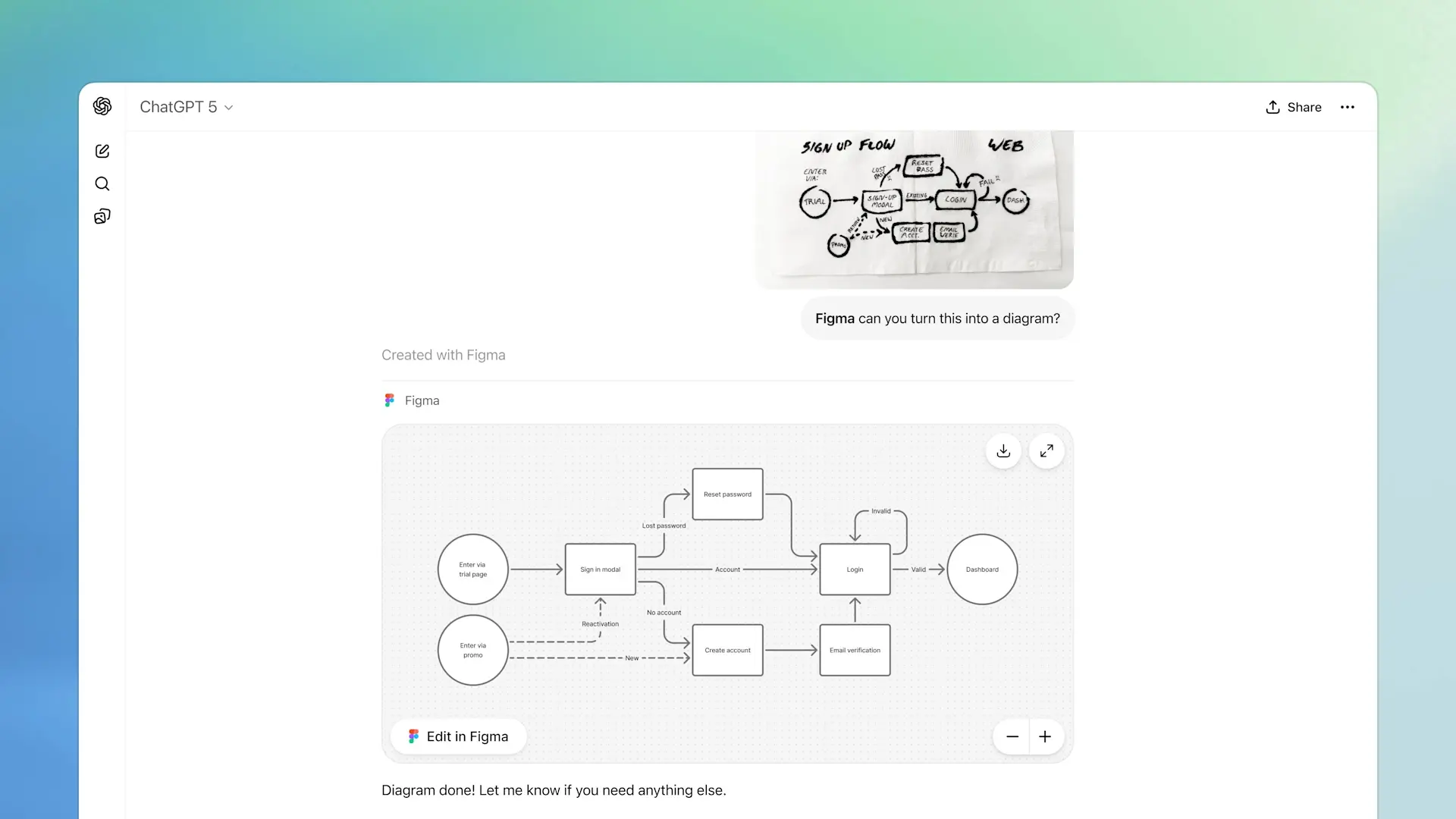
Launch partners include major platforms like Canva, Figma, Spotify, Zillow, Booking.com, Coursera, and Expedia. These apps integrate seamlessly into conversations, allowing users to invoke functionality by name or through AI-suggested recommendations. For example, users can ask "Figma, turn this sketch into a workable diagram" and the Figma app will respond inline with editable results.
App Discovery and Monetization
The Apps SDK supports multiple discovery methods including direct name invocation, contextual suggestions during conversations, and a forthcoming directory where developers can publish apps for review. Apps that meet higher design and functionality standards will receive prominent featuring and suggestion placements across ChatGPT's 800 million weekly users.
OpenAI announced future support for multiple monetization methods, including the Agentic Commerce Protocol enabling instant checkout directly within ChatGPT. Users with existing subscriptions to third-party services can log in directly from conversations, while new users will soon be able to purchase access without leaving ChatGPT.
Developer Opportunity: This distribution model gives developers immediate access to hundreds of millions of potential users without traditional app store friction. The approach mirrors mobile app ecosystems but with AI-powered contextual discovery, where apps surface precisely when users need them.
AgentKit: Complete Platform for Agent Development
AgentKit represents OpenAI's most comprehensive developer toolkit, designed to take agents from prototype to production with significantly less friction. The platform addresses one of the biggest challenges in AI development: the complexity of orchestration, evaluation loops, tool connections, and UI building that typically prevents agents from reaching production.
For developers currently using workflow automation platforms like Zapier, Make, Lindy, or MindStudio, AgentKit offers a compelling alternative that combines visual workflow building with GPT-5-class reasoning capabilities.

Three Core Components
- Agent Builder: A visual drag-and-drop interface for designing agent workflows without starting with code. Built on the Responses API already used by hundreds of thousands of developers, it allows teams to model complex workflows using common patterns extracted from production agent deployments. Developers can wire up specialized agents, add if/else logic nodes, integrate tools, and customize outputs with visual widgets.
- ChatKit: Embeddable chat interfaces that developers can brand and customize for their own applications. The component handles the complete chat experience including conversation history, tool invocation display, and custom widget rendering. This eliminates months of frontend development typically required for conversational AI interfaces.
- Enhanced Evaluations: Includes trace grading to understand agent decisions step-by-step, datasets for assessing individual agent nodes, and automated prompt optimization. The platform even supports running evaluations on external models directly within the OpenAI Evals platform, enabling comprehensive performance testing across different AI systems.

Real-World Enterprise Implementations
Real-world deployments demonstrate AgentKit's production readiness. Albertsons, operating over 2,000 grocery stores with 37 million weekly shoppers, built an agent using AgentKit that analyzes sales patterns and recommends promotional adjustments. When ice cream sales dropped 32%, the agent automatically analyzed seasonality, historical trends, and external factors to suggest display changes or local advertising.
HubSpot used AgentKit to enhance Breeze, their AI tool serving hundreds of thousands of organizations worldwide. The custom response widget enables Breeze to search knowledge bases, look up location-specific information, and pull policy details to deliver comprehensive answers across multiple data sources.
Ready to Build AI Agents?
Explore the complete landscape of agent-building and automation platforms
Compare Top Automation ToolsSee side-by-side comparisons of AgentKit, Zapier, Make, n8n, Lindy, and more
The Automation Platform Disruption
AgentKit's visual builder and integrated tooling position OpenAI as a direct competitor to established automation platforms. The competitive landscape is shifting dramatically:
| Platform | Starting Price | AI Agents | Visual Builder | User Base |
|---|---|---|---|---|
| AgentKit | OpenAI API Pricing | ✅ GPT-5 Native | ✅ Built-in | 800M ChatGPT users |
| Zapier | $19.99/month | ⚠️ Limited AI | ✅ 8,000+ integrations | Millions of users |
| Make | $9/month | ⚠️ Basic automation | ✅ Visual workflows | Large user base |
| n8n | Self-hosted/Free | ❌ Manual setup | ✅ Open source | Developer-focused |
| Lindy | $49-299/month | ✅ Agent building | ✅ No-code builder | Growing user base |
The automation market, valued at $6.65 billion in 2024 and projected to reach $15.58 billion by 2030, faces disruption from OpenAI's integrated approach. While platforms like Zapier dominate with 8,000+ integrations and n8n offers self-hosted control, AgentKit combines the ease-of-use of no-code builders with the power of GPT-5-class reasoning models and native access to ChatGPT's massive user base.
Platforms like Lindy ($49-299/month for agent building) and Make (focused on visual workflow automation) now compete with a solution that offers agent intelligence, conversational interfaces, and API access through a single vendor. AgentKit's connector registry and admin control panel match enterprise requirements while maintaining the simplicity that made Zapier successful.
Codex Reaches General Availability
OpenAI announced that Codex, its software engineering agent, has moved from research preview to general availability. Powered by the new GPT-5-Codex model specifically trained for agentic coding, Codex now works across IDE, terminal, GitHub, and cloud environments with unified access through ChatGPT accounts.
Since launching GPT-5-Codex in early August 2025, daily messages across Codex have increased 10x. The model has served over 40 trillion tokens, making it one of OpenAI's fastest-growing models. Internally at OpenAI, almost all new code is written by Codex users, with engineers completing 70% more pull requests per week.

Enterprise Features for Development Teams
- Slack Integration: Developers can delegate coding tasks or ask questions directly from team channels or threads, bringing Codex into existing collaboration patterns. This addresses feedback from thousands of development teams who wanted Codex accessible within their communication flows.
- Codex SDK: Teams can extend and automate Codex within custom workflows, including the ability to programmatically trigger code reviews, refactoring tasks, or automated testing. The SDK was demonstrated live at DevDay, where voice commands integrated with Codex to modify running applications in real-time.
- Admin Tools and Reporting: Environment controls, monitoring dashboards, and analytics for enterprise governance. Organizations like Cisco rolled out Codex across entire engineering organizations, achieving 50% faster code reviews and reducing average project timelines from weeks to days.
GPT-5 Pro API Now Available
OpenAI launched GPT-5 Pro in the API, making their most intelligent model available to all developers. Originally released in August 2025, GPT-5 was trained specifically for steering agents and end-to-end coding. The Pro version delivers PhD-level reasoning capabilities across scientific domains with enhanced accuracy for complex tasks.
Leading coding startups including Cursor, Windsurf, and Vercel have adopted GPT-5 to transform how software gets written and shipped in their applications. The model excels at assisting developers with difficult tasks in domains like finance, legal, and healthcare where high accuracy and reasoning depth are critical.
GPT-5 Pro's API availability removes the barrier that kept advanced reasoning capabilities limited to ChatGPT Plus subscribers, enabling developers to integrate the most capable OpenAI model into production applications.
Voice and Video Model Updates
GPT-Realtime-Mini
OpenAI launched GPT-Realtime-Mini as a smaller, cheaper version of the advanced voice model shipped two months ago. Offering the same voice quality and expressiveness as the full model but at 70% lower cost, it makes conversational AI accessible for budget-conscious applications. The model supports MCP server integration, image inputs, and SIP phone calling.
Sora 2 API Preview
The Sora 2 API Preview gives developers access to the model powering stunning video outputs in their own applications. The most significant improvement is controllability—developers can provide detailed instructions while Sora maintains state and delivers stylized, accurate, composed results. The model can expand iPhone footage into cinematic wide shots and generates rich soundscapes with ambient audio and synchronized effects.
Sora 2 API Pricing Structure
OpenAI introduced transparent per-second pricing for video generation, making it accessible for developers at different scales:
| Model | Resolution Options | Price per Second |
|---|---|---|
| sora-2 | Portrait: 720 × 1280 Landscape: 1280 × 720 |
$0.10 |
| sora-2-pro | Portrait: 720 × 1280 Landscape: 1280 × 720 |
$0.30 |
| sora-2-pro | Portrait: 1024 × 1792 Landscape: 1792 × 1024 |
$0.50 |
Cost Example: Generating a 10-second video in standard resolution with sora-2 costs $1.00, while the same duration in high resolution with sora-2-pro costs $5.00. This pricing model makes video generation accessible for everything from quick prototypes to production-ready content.
Learn More About Sora 2
Discover everything announced about OpenAI's revolutionary video AI model
Read Full Sora 2 CoverageDeveloper Platform Growth Statistics
OpenAI's platform growth metrics underscore the developer momentum behind these announcements:
- 4 million developers now build with OpenAI, up from 2 million in 2023
- 800 million weekly ChatGPT users, doubling from 400 million in February 2025
- 6 billion tokens per minute processed through the API, up from 300 million in 2023
- Multiple developers processing over 1 trillion tokens on the platform
Network Effect: The platform's scale creates a powerful network effect where new capabilities like AgentKit and the Apps SDK immediately reach millions of potential users and thousands of active developers.
Impact on the AI Development Ecosystem
OpenAI DevDay 2025 consolidates multiple fragmented tools into a unified platform that challenges the existing automation and agent-building landscape. The combination of AgentKit's visual builder, ChatGPT's app ecosystem, Codex's engineering capabilities, and cutting-edge models creates an integrated development environment that competitors will struggle to match.
For automation platforms like Zapier (valued in the billions with 8,000+ integrations), Make (known for visual workflow building), and n8n (popular for self-hosted control), OpenAI's entry represents existential competition. AgentKit offers comparable visual workflow building with superior AI capabilities and direct access to 800 million users.
Agent-building platforms including Lindy AI ($49-299/month) and Relevance AI ($199-599/month) face a competitor offering more powerful models, better infrastructure, and wider distribution at potentially lower total cost of ownership. The marketing automation market, projected to reach $15.58 billion by 2030, now includes a dominant AI platform with unmatched model capabilities and user reach.
What This Means for Developers and Businesses
OpenAI's announcements signal the platform's evolution from AI model provider to comprehensive development ecosystem, fundamentally reshaping how developers build, deploy, and monetize AI-powered applications and agents. Organizations currently investing in multiple automation tools should evaluate whether AgentKit can consolidate their workflows, while developers have unprecedented access to advanced AI capabilities and a massive built-in user base.
Compare features, pricing, and use cases across the leading platforms
Frequently Asked Questions: OpenAI DevDay 2025
OpenAI DevDay 2025 on October 6, 2025, featured five major announcements: AgentKit platform launch, ChatGPT Apps SDK in preview, GPT-5 Pro API availability, Codex general availability, and Sora 2 API preview. OpenAI also revealed ChatGPT reached 800 million weekly active users, doubling from 400 million in February 2025.
AgentKit is OpenAI's complete platform for building, deploying, and optimizing AI agents. It includes three core components: Agent Builder (visual drag-and-drop workflow designer), ChatKit (embeddable chat interfaces), and Enhanced Evaluations (trace grading, datasets, and automated prompt optimization). AgentKit is built on the Responses API and enables developers to create production-ready agents without complex coding.
The ChatGPT Apps SDK enables full interactive applications within ChatGPT conversations, not just simple integrations. Built on the Model Context Protocol (MCP), it provides full-stack capabilities including data connections, action triggers, and custom UI rendering. Apps can maintain context across conversations and offer features like picture-in-picture video, full-screen modes, and instant checkout.
Launch partners for ChatGPT Apps SDK include Canva, Figma, Spotify, Zillow, Booking.com, Coursera, and Expedia. AgentKit is being used by Albertsons (grocery store management across 2,000+ stores) and HubSpot (enhancing Breeze AI assistant). Cisco deployed Codex across their entire engineering organization, achieving 50% faster code reviews.
Yes, GPT-5 Pro API launched for all developers on October 6, 2025. This marks the first time OpenAI's most intelligent model is accessible via API, offering PhD-level reasoning capabilities for complex tasks in finance, legal, and healthcare domains. Leading startups like Cursor, Windsurf, and Vercel are already using GPT-5 in their applications.
GPT-5-Codex is a specialized version of GPT-5 specifically trained for agentic coding and software engineering tasks. It powers Codex and offers better performance at code refactoring, code review, and can dynamically adjust thinking time based on task complexity. Since launching in August 2025, it has served over 40 trillion tokens and increased daily Codex usage by 10x.
AgentKit offers visual workflow building like Zapier and Make, but adds AI agent capabilities, integrated evaluation tools, and direct access to 800 million ChatGPT users. While Zapier charges $19.99/month for 750 tasks and Make starts at $9/month, AgentKit provides agent intelligence, conversational interfaces, and deployment infrastructure through existing OpenAI pricing.
Sora 2 API preview gives developers access to OpenAI's video generation model for their own applications. Key improvements include enhanced controllability with detailed instructions, synchronized audio-visual generation, and the ability to expand iPhone footage into cinematic wide shots. The model generates rich soundscapes with ambient audio and synchronized effects. Pricing ranges from $0.10 to $0.50 per second depending on resolution.
GPT-Realtime-Mini offers 70% cost reduction compared to the advanced voice model while maintaining the same voice quality and expressiveness. It supports MCP server integration, image inputs, and SIP phone calling, making conversational AI more accessible for budget-conscious applications.
Yes, OpenAI announced future support for multiple monetization methods including the Agentic Commerce Protocol for instant checkout within ChatGPT. Users with existing subscriptions can log in directly from conversations, and new monetization options will be available when the full SDK launches.
Codex general availability includes three enterprise features: Slack integration for team collaboration, Codex SDK for workflow automation, and admin tools with environment controls, monitoring, and analytics dashboards. These features address enterprise governance and team-based development workflows.
AgentKit is available starting October 6, 2025, through the OpenAI platform. Developers can access the visual Agent Builder, create workflows with pre-built components like tools and guardrails, test with preview mode, and deploy with workflow IDs or embedded ChatKit components. No coding experience is required to start building agents.
MCP is the open standard underlying both ChatGPT Apps SDK and AgentKit. It enables apps to work everywhere ChatGPT is distributed (web, mobile) and allows developers to enhance existing MCP integrations by simply adding HTML templates. This standardization ensures compatibility across OpenAI's ecosystem.
ChatGPT now serves 800 million weekly active users, up from 400 million in February 2025. The platform also supports 4 million developers and processes over 6 billion tokens per minute through the API. This scale provides immediate distribution for apps and agents built with the new tools.
OpenAI announced that developers will be able to submit apps for review and publication later in 2025. A directory for users to browse apps will also launch, with apps meeting higher design and functionality standards receiving prominent featuring. The preview SDK is available immediately for development.