

Anara AI
AI-powered research workspace for scientists, students, and research teams. Formerly Unriddle AI—analyze documents with passage-level citations, cross-reference your entire library, and write faster with verified sources.
Try Anara Free →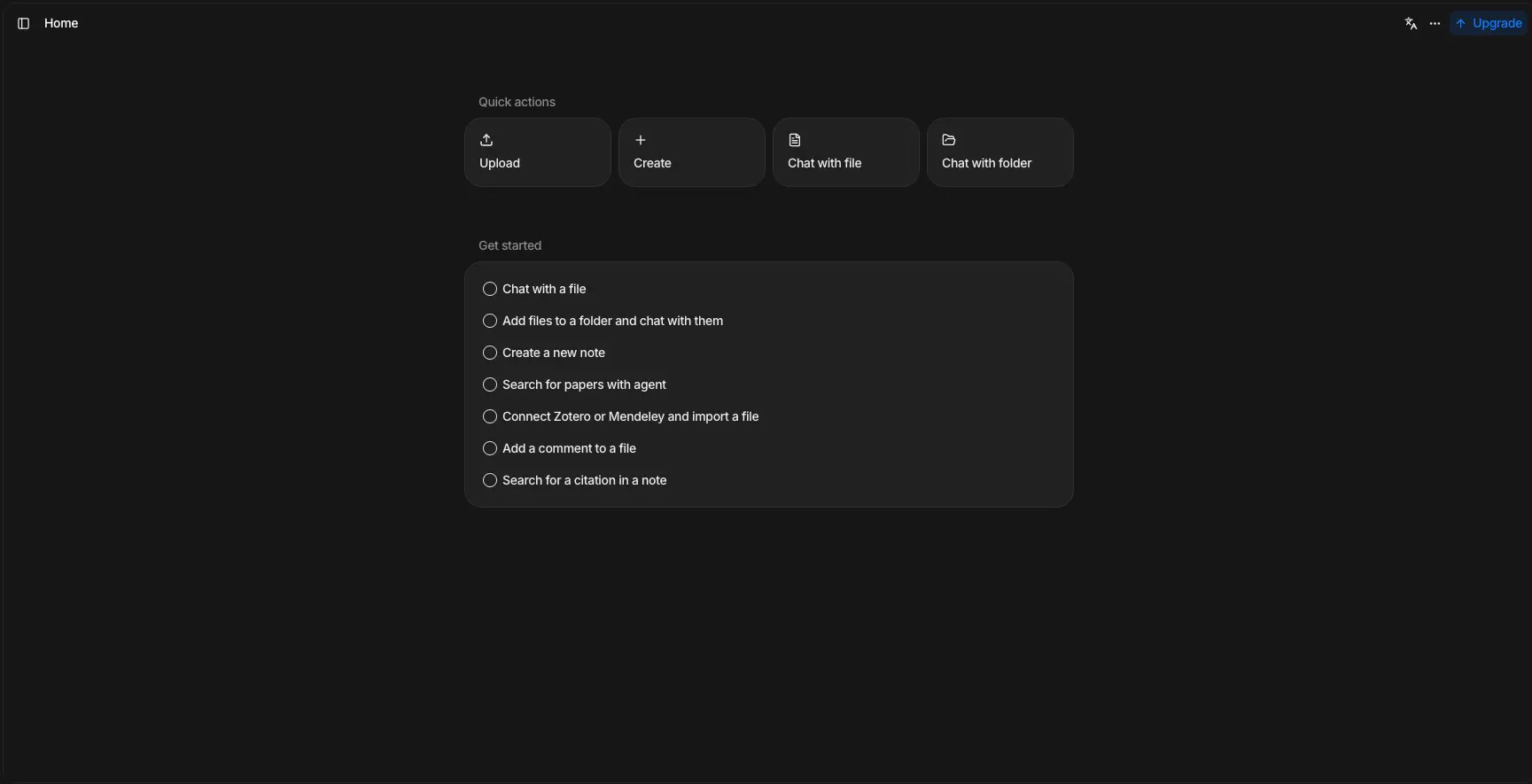
Citation-Verified AI Research
for Students & Scientists
Anara (formerly Unriddle) delivers on its core promise: citation-verified document analysis with passage-level source linking. Its ability to handle PDFs, video, audio, and images in a single workspace—combined with multiple AI model options (GPT, Claude, Gemini)—makes it one of the most versatile AI research tools available in 2026. Backed by Y Combinator and trusted by 3M+ users at institutions like Stanford and MIT, it offers genuine value for researchers who need verifiable AI-assisted analysis.
✓ What We Love
- Passage-level citations—verify every claim
- Multimodal: PDFs, video, audio, images
- Multiple AI models in one platform
- Free tier with no credit card required
! Could Be Better
- Free plan has daily usage limits
- Better with empirical than theoretical texts
- Desktop-optimized, no native mobile app
What Is Anara AI?
A comprehensive overview of the platform, its origins, and who it's built for.
Anara is an AI-powered research workspace designed to help scientists, students, and professional research teams understand, organize, and write about complex documents faster. If the name sounds unfamiliar but "Unriddle" rings a bell—they're the same product. Originally launched as Unriddle AI in 2023 by founder Naveed Janmohamed (MSc in Human-Computer Interaction, UCL), the platform rebranded to Anara in March 2025 to signal a deeper commitment to serving academic and scientific researchers specifically.
The platform is backed by Y Combinator (S24 batch) and investors including the founders of GitHub and Reddit. As of February 2026, Anara has grown to over 3 million registered users and is trusted by researchers at institutions including Stanford University, MIT, Johns Hopkins, Yale, UC Berkeley, as well as companies like GSK, Roche, Biogen, Intel, Goldman Sachs, and PwC.
What sets Anara apart from general-purpose AI tools like ChatGPT is its specialized focus on verified, citation-backed research. While ChatGPT can hallucinate paper titles, fabricate authors, and provide unsourced claims, Anara uses a Retrieval-Augmented Generation (RAG) approach—meaning when you ask questions about your documents, every AI response includes clickable inline citations linking directly to the exact sentence or paragraph in the source material. This audit trail is designed to satisfy academic integrity requirements and makes the tool significantly more trustworthy for research work.
Beyond citation verification, Anara stands out with true multimodal input support. While most competing research tools only process PDFs, Anara handles PDFs, Word documents, PowerPoint slides, EPUB files, images (with OCR), audio files (with transcription), video files, YouTube URLs, and web pages. This makes it a genuinely versatile workspace for researchers who work with diverse source materials.
Who Is Anara Best For?
Anara delivers the most value for graduate students and PhD researchers conducting literature reviews, research scientists in pharmaceutical and biotech settings analyzing large volumes of studies, academic writing teams collaborating on shared research libraries, and students preparing for exams who want to convert lectures and textbooks into flashcards and practice quizzes. If you regularly work with multiple research documents and need AI assistance you can actually verify and cite, Anara is built for you.
Another significant differentiator is Anara's AI model flexibility. Unlike competitors locked into a single AI provider, Anara lets you choose between models from OpenAI (GPT 5.1, o3), Anthropic (Claude 4 Sonnet, Claude Opus 4.5), and Google (Gemini 2.5 Pro, Gemini 3 Pro)—depending on your subscription tier. An "Auto" mode intelligently selects the optimal model for each task, balancing speed and reasoning depth. This flexibility is rare in the research tool space and gives users control over their AI experience.
See Anara AI in Action
Real screenshots from the platform showing key features and the research workflow.
Home Dashboard
Your central hub for managing research files and starting new workflows
The Anara home dashboard provides a clean, focused interface with quick actions for uploading files, creating new notes, and chatting with individual files or entire folders. The "Get Started" checklist guides new users through key features including importing files, connecting reference managers like Zotero and Mendeley, creating notes, and searching for papers. The dark-themed UI is easy on the eyes during long research sessions.
AI Chat Interface (Agent Mode)
Ask questions, search papers, and generate citations with specialized AI agents
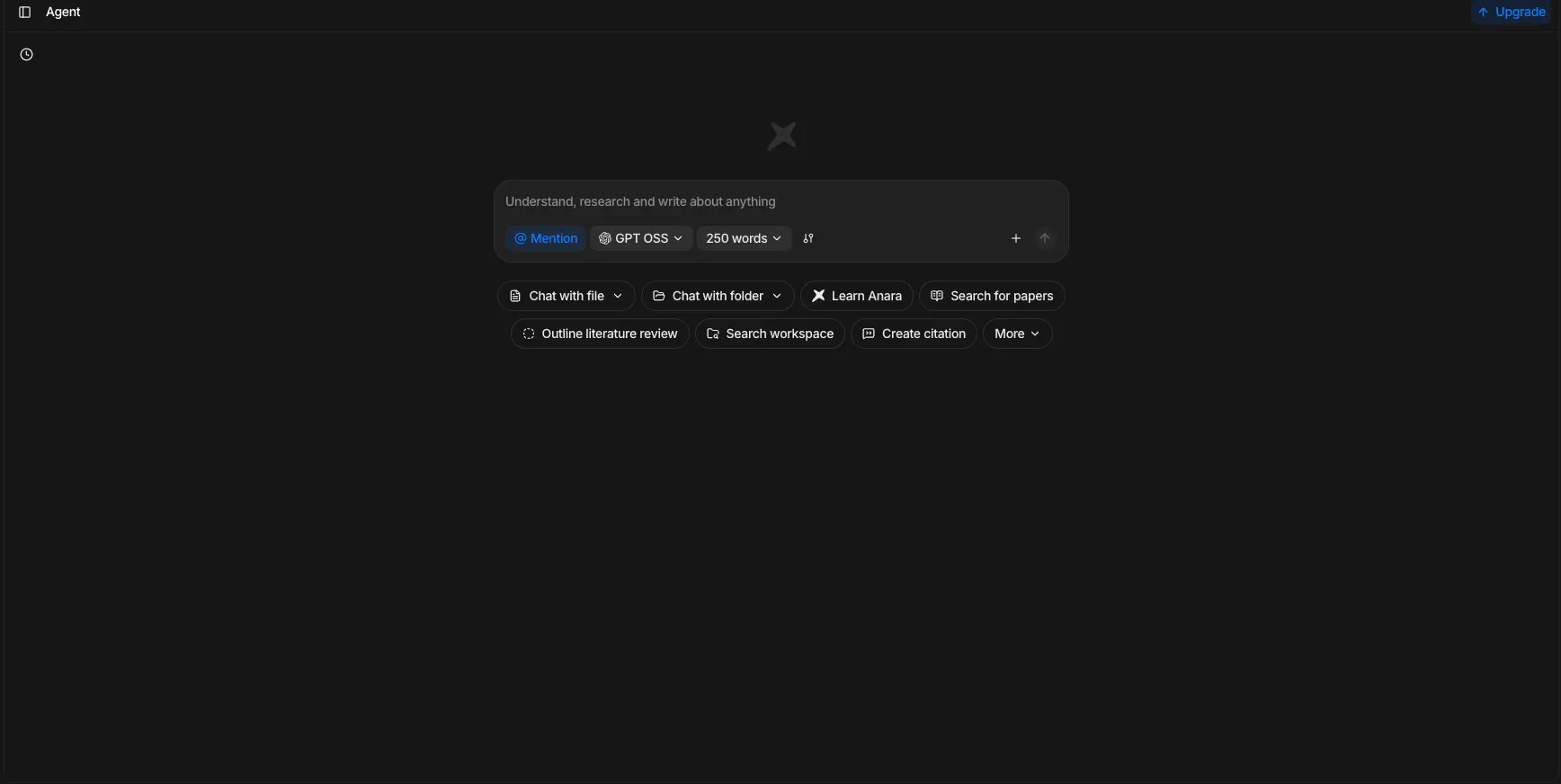
The Agent mode chat interface showcases Anara's specialized research capabilities. The @Mention system lets you invoke specific agents—"Search for papers" queries academic databases like PubMed and arXiv, "Outline literature review" generates structured review frameworks, and "Create citation" formats references in your preferred style. Quick-action buttons for "Chat with file," "Chat with folder," "Learn Anara," and "Search workspace" make common tasks instantly accessible.
Document Analysis View
Read papers side-by-side with AI summaries, suggested questions, and study tools
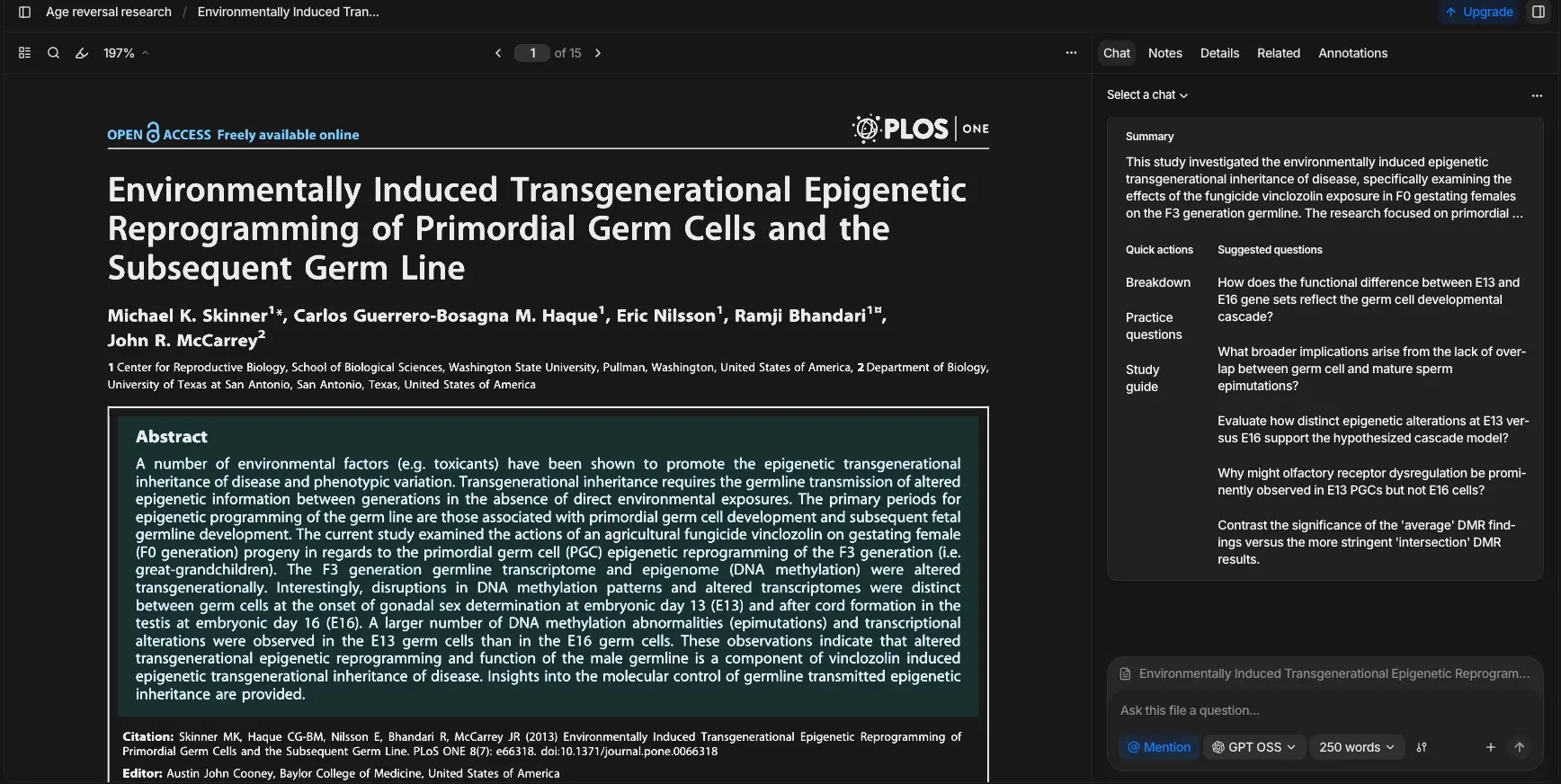
The document analysis view is where Anara truly shines. The left panel displays the full paper with navigation controls, while the right panel provides an AI-generated summary, quick actions (Breakdown, Practice Questions, Study Guide), and suggested research questions tailored to the paper's content. You can also open a per-document chat to ask specific questions—every answer comes with clickable citations linking back to the exact passage in the paper.
AI Model Selector
Choose between multiple AI models based on your task requirements
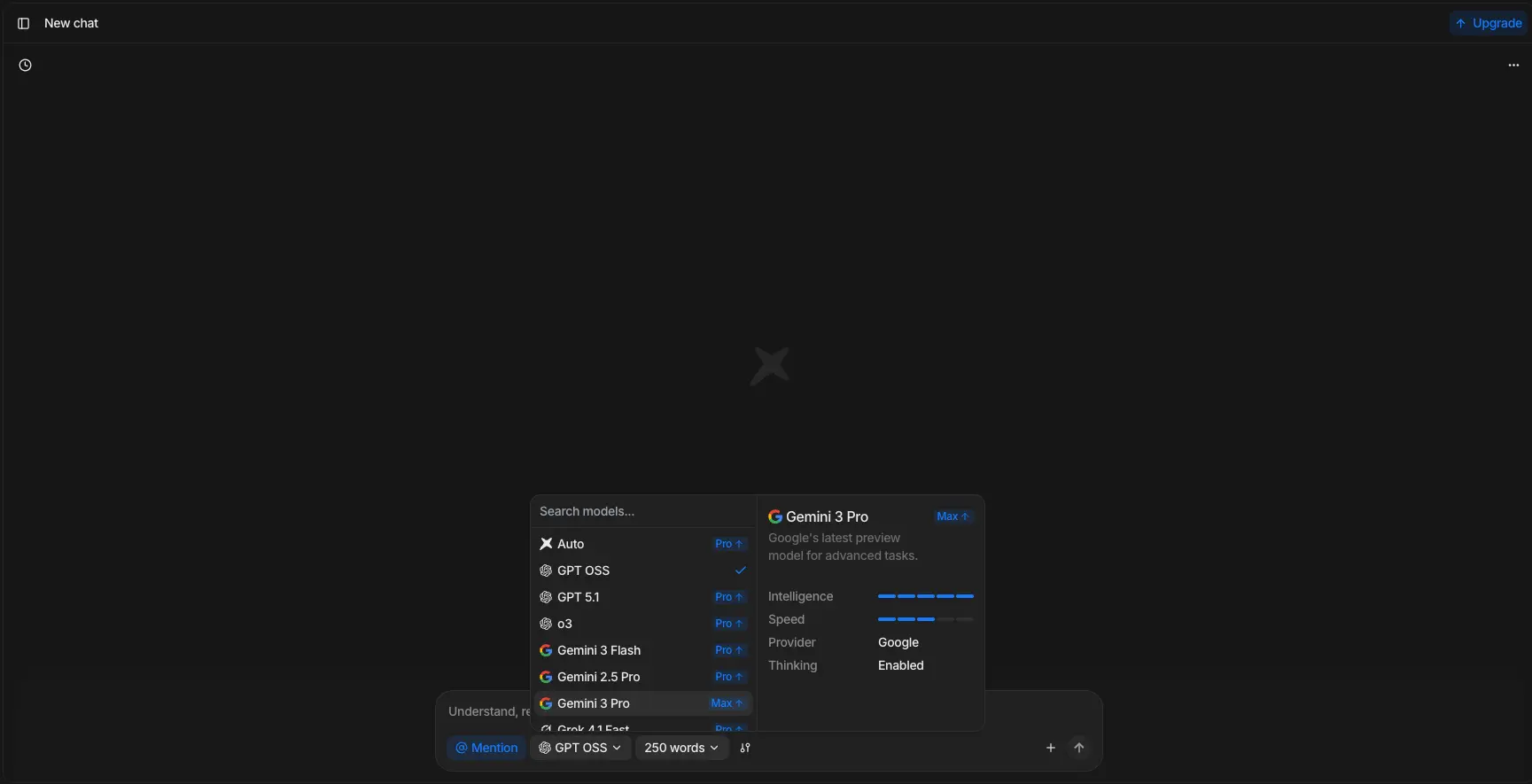
Anara's model selector is a standout feature in the research tool space. You can search and switch between models including GPT OSS (free), GPT 5.1, o3, Gemini 3 Flash, Gemini 2.5 Pro, Gemini 3 Pro, and more—each with visual intelligence and speed indicators. Some models are available on the free plan, while others require Pro or Max subscriptions. This flexibility lets you choose faster models for quick queries and more powerful models for complex analysis tasks.
Ready to try AI-powered research with verified citations?
Try Anara Free →Free plan available • No credit card requiredHow Anara AI Works
From uploading your first document to generating citation-verified insights in minutes.
Upload Your Research Materials
Start by uploading documents to your Anara library. You can import PDFs, Word documents, PowerPoint slides, EPUB files, images, audio, video, YouTube URLs, and web pages. For researchers with existing libraries, Anara connects to Zotero and Mendeley for bulk importing. You can also paste a DOI, PMID, or arXiv ID to import papers directly. The Chrome Web Clipper extension lets you save any webpage or PDF to your library while browsing.
Organize into Folders & Collections
Group related documents into folders to create focused research collections. This is essential for cross-document analysis—when you chat with a folder, Anara queries all documents inside it simultaneously. Common approaches include organizing by research topic, literature review section, or project. The Graph View provides a visual network map showing AI-detected relationships between your documents, helping you spot gaps and unexpected connections in your research.
Ask Questions with Verified Citations
Chat with individual files or entire folders using natural language. Every AI response includes clickable inline citations linking to the exact sentence or paragraph in your source material. You can hover over citations to see a preview and an AI explanation of relevance. Source Settings let you control whether the AI draws from your files only, the internet, or its general knowledge—giving you full control over answer provenance. Use specialized agents like @SearchPapers to discover new papers from PubMed, arXiv, and JSTOR without leaving the workspace.
Write, Cite, and Collaborate
Use Anara's built-in editor to draft sections with AI-assisted autocomplete that predicts your next sentence. The editor suggests relevant citations from your library as you write, supports 10+ citation styles (APA, MLA, Chicago, and more), and offers paraphrase and tone-shift tools. For team projects, share folders with collaborators for real-time co-editing, comments, and version history. When finished, export your work in your preferred format.
Data Security & Privacy
Anara uses AES-256 encryption at rest and TLS 1.2+ in transit. Your data is never used to train Anara's AI models or shared with third-party AI providers for training. All AI model providers operate under zero data retention agreements—your documents are processed and immediately deleted from their servers. You can delete your data at any time with full purging within 30 days. Anara is GDPR compliant with data portability and right-to-be-forgotten support.
AI Agents for Specialized Tasks
Anara includes purpose-built AI agents accessible via @mentions in chat: @Research synthesizes insights across your library and academic databases, @SearchPapers queries PubMed, arXiv, and JSTOR, @CreateCitation generates formatted references, @CreateFlashcards converts materials into study cards, and @DeepSearch (Max plan) performs comprehensive analysis across all your files. These agents extend Anara beyond simple document chat into a complete research workflow.
Key Features
Everything Anara offers for accelerating your research workflow.
Passage-Level Citations
Every AI response includes clickable inline citations linking to the exact sentence or paragraph in your source documents. Hover for previews and relevance explanations. The most granular source verification among research AI tools.
Multimodal Document Support
Upload PDFs, DOCX, PPTX, EPUB, images (with OCR), audio (MP3/WAV with transcription), video (MP4/YouTube), Excel, CSV, and web URLs. Far broader format support than most research tools that only handle PDFs.
Cross-Document Analysis
Group documents into folders and query across your entire collection simultaneously. Anara detects contradictions, extracts common themes, and identifies research gaps across multiple papers—essential for literature reviews.
Multiple AI Models
Switch between GPT 5.1, Claude 4 Sonnet, Claude Opus 4.5, Gemini 2.5 Pro, Gemini 3 Pro, and more. Auto mode intelligently selects the best model per task. A rare differentiator—most competitors lock you into one AI provider.
AI Agents System
Specialized agents via @mentions: @SearchPapers (PubMed, arXiv, JSTOR), @Research (multi-source synthesis), @CreateCitation (formatted references), @CreateFlashcards (study materials), @DeepSearch and @CompleteForm (Max plan).
AI Writing Assistant
Built-in editor with autocomplete (press Tab for AI predictions), paraphrase, tone-shift, and citation-suggest tools. Supports APA, MLA, Chicago, and 7+ other citation styles. Helpful for structuring drafts with proper source attribution.
Real-Time Collaboration
Share folders with collaborators for co-editing, comments, and version history. Plus supports 5 users per folder, Pro supports 50, and Max offers unlimited collaborators. Essential for research teams and academic writing groups.
Graph View & Literature Mapping
Visual network map turning your library into an interactive graph where nodes are files and edges represent AI-detected conceptual relationships. Useful for spotting gaps in your literature review and discovering connections between papers.
Beyond these core features, Anara integrates with Zotero and Mendeley for reference management, Google Drive, Notion, and OneDrive for file syncing (Pro+), and offers a Chrome Web Clipper extension for saving PDFs, webpages, and YouTube videos directly to your library. The AI understands and responds in 90+ languages, and all content is processed with zero data retention agreements with AI providers.
Experience all features with a free plan—no credit card required:
Try Anara Free →Free tier available • Upgrade anytimePricing Plans
From a generous free tier to unlimited Pro—Anara AI pricing for every research budget.
Free
Plus
Pro
Max
Enterprise: Custom pricing with SSO (SAML 2.0/OAuth2), SOC 2, ISO 27001, SharePoint live sync, and dedicated account manager
Tip: Student discount codes (e.g., "ANDY20", "ILYA20") are frequently available for 20-75% off annual plans
Is Anara Worth the Investment?
Researchers report saving 40-60% of time on literature reviews with Anara. At Pro pricing ($20/month), the tool pays for itself if it saves just 1-2 hours of research time monthly. For graduate students and professionals regularly conducting reviews, the time savings compound significantly over a semester or project lifecycle.
Compared to alternatives: Elicit Pro costs $42/month for systematic reviews, SciSpace Premium is $20/month with credit-based limits, Scite Personal is $12/month (annual) for citation analysis only, and NotebookLM Plus requires Google One AI Premium at $19.99/month. Anara Pro at $20/month offers the broadest feature set per dollar for general research workflows with unlimited usage.
Detailed Pros & Cons
An honest, balanced assessment based on real user feedback and independent analysis.
✓ Pros
Every AI claim links to the exact source passage with clickable inline citations. You can hover for previews and relevance explanations. This is the most granular source verification available among AI research tools—essential for maintaining academic integrity and eliminating hallucination concerns.
Handles PDFs, Word, PowerPoint, EPUB, images (with OCR for handwritten notes), audio (MP3/WAV with transcription), video (MP4/YouTube), Excel, CSV, and web URLs. Most competing tools are limited to PDFs only, making Anara significantly more versatile for researchers working with diverse source materials.
Choose between GPT 5.1, Claude 4 Sonnet, Claude Opus 4.5, Gemini 2.5 Pro, Gemini 3 Pro, and more depending on your plan. The Auto mode intelligently selects the optimal model per task. This flexibility is unique in the research tool space—competitors lock you into a single AI provider.
Group files into folders and ask questions spanning your entire collection. The AI detects contradictions, extracts themes, and identifies research gaps across dozens of papers simultaneously. This capability is a genuine time-saver for literature reviews and systematic analysis work.
Y Combinator-backed (S24) with 3M+ users. Trusted by researchers at Stanford, MIT, Johns Hopkins, Yale, GSK, Roche, Biogen, and Intel. The platform has raised funding from notable investors including the founders of GitHub and Reddit, signaling strong long-term viability.
The changelog shows frequent updates—new models, tables, tags, deep search, and UI improvements added regularly throughout 2025-2026. The free plan (1,000 AI words/day, 5 uploads) requires no credit card and is sufficient for casual exploration or testing before committing to a paid plan.
✗ Cons
The free tier provides 1,000 AI words/day and 5 uploads—enough for casual use but quickly exhausted during intensive research sessions. Most serious researchers will need to upgrade to Pro ($20/month) for unlimited usage. That said, the free plan is still useful for evaluating the tool before committing.
Anara excels at analyzing data-driven and empirical research but can be less precise with highly theoretical, philosophical, or deeply interpretive arguments. For nuanced conceptual work, you may find the AI summaries somewhat simplified. This is a limitation shared by most AI research tools.
Full functionality requires a desktop or laptop browser. There's no dedicated native mobile app as of February 2026. Features like Graph View and side-by-side PDF comparison work best on larger screens. The Chrome Web Clipper extension partially bridges this gap for mobile browsing.
The Zotero connector is functional but still considered in beta. Some users with large reference libraries report occasional sync issues. For researchers who rely heavily on Zotero, it's worth testing the integration with your specific library before committing to a paid plan.
The AI writing assistant is helpful for structuring drafts, suggesting citations, and paraphrasing—but it doesn't produce publication-ready prose. Plan on editing and refining the output yourself, especially for academic submissions. Think of it as a capable first-draft helper rather than a ghostwriter.
While Anara uses strong encryption and zero data retention agreements, SOC 2 and ISO 27001 certifications are still being finalized (available on Enterprise roadmap). Organizations with strict compliance requirements should verify current certification status before adopting at scale.
Anara AI vs Alternatives
How Anara compares to the top AI research tools in 2026.
| Feature | Anara AI | SciSpace | Elicit | NotebookLM |
|---|---|---|---|---|
| Starting Price | Free ($0) | Free (limited) | Free (limited) | Free (generous) |
| Pro Price | $20/mo | $20/mo | $42/mo | $19.99/mo* |
| Paper Database | PubMed, arXiv, JSTOR | 200M+ papers | 138M+ papers | None |
| Document Upload | ✓ PDF, audio, video, images, DOCX | PDF only | PDF only | PDF, audio, video, images |
| Citation Verification | ✓ Passage-level linking | Page-level | Basic | Source links |
| AI Model Choice | ✓ GPT, Claude, Gemini | Single model | Single model | Gemini only |
| Writing Assistant | ✓ Autocomplete + editor | ✓ Full AI writer | No | No |
| Best For | Deep analysis + cross-referencing | Paper discovery + writing | Systematic reviews | Free AI notes + audio |
*NotebookLM Plus requires Google One AI Premium ($19.99/mo) which bundles other Google AI features.
Which Tool Is Right For You?
Anara AI
Most VersatileBest for: Graduate students, PhD researchers, and research scientists who need deep document analysis with verified citations across multiple file types. Ideal if you value passage-level source verification, AI model flexibility, and cross-document synthesis. The all-in-one workspace approach means fewer tools to juggle during complex research projects. Previously known as Unriddle AI.

SciSpace
Paper DiscoveryBest for: Researchers who need a large paper discovery database (200M+ papers) combined with AI writing tools. SciSpace offers a built-in AI Writer, Deep Review for multi-paper synthesis, and podcast-style summaries. Choose SciSpace if paper discovery and AI-assisted writing are your primary needs. Note that the credit-based system can lead to unpredictable costs for heavy users.

Elicit
Systematic ReviewsBest for: Researchers conducting structured systematic reviews and meta-analyses. Elicit's automated data extraction tables, Evidence Matrix, and PRISMA-compliant workflows are purpose-built for evidence synthesis. With 138M+ papers and up to 30 custom extraction columns, it excels at the most tedious parts of evidence-based research. Choose Elicit if systematic reviews are your primary workflow.

Scite
Citation IntelligenceBest for: Understanding how papers are cited—whether supporting, contrasting, or merely mentioning another work. With 281M articles and 1.9B citation statements, Scite is the only tool that classifies citation intent. Use Scite alongside Anara: Scite to assess citation landscape and credibility, Anara for deep content analysis and synthesis. They complement each other well.

NotebookLM
Best Free OptionBest for: Anyone wanting a powerful free AI research assistant with no strings attached. NotebookLM offers 100 notebooks, 50 sources each, audio and video overviews (podcast-style summaries), mind maps, flashcards, and more—all for free. Choose NotebookLM if budget is your primary constraint. It pairs well with Anara: use NotebookLM for initial understanding and Anara for rigorous citation-verified academic work.
Frequently Asked Questions
Should You Try Anara AI?
After thorough evaluation, Anara delivers a genuinely compelling research workspace. Its passage-level citation verification is the most granular among AI research tools—every claim links to the exact source sentence, making hallucinations immediately visible. The multimodal support (PDFs, video, audio, images, handwritten notes) and multiple AI model options (GPT, Claude, Gemini) give it the broadest capability set in the category. For researchers who regularly work with diverse source materials and need verifiable AI assistance, Anara represents strong value in 2026.
The limitations are worth acknowledging: the free plan's daily limits mean serious users will need Pro at $20/month, the writing assistant helps with structure but won't produce publication-ready prose, and the Zotero integration is still maturing. But for the target audience of graduate students, PhD researchers, and research teams, the time saved on literature reviews alone justifies the investment. With 3M+ users and Y Combinator backing, the platform's trajectory is promising.
Our Recommendation
Start with the free plan (no credit card required) and test with a few real documents from your current research. Focus on the citation verification and cross-document analysis—these are Anara's strongest features. If the passage-level citations and document chat prove useful within your first week, consider upgrading to Pro ($20/month) for unlimited usage. Look for student discount codes that can reduce annual pricing by 20-75%. Low risk entry with genuine upside for research productivity.
Ready to Accelerate Your Research?
Join 3M+ researchers using Anara AI for citation-verified document analysis, cross-referencing, and faster writing