
Lindy AI
Lindy AI combines natural language agent creation, autonomous app building through Lindy Build, computer use capabilities, and AI phone agents (Gaia) into a single platform. With recent Claude Sonnet 4.5 integration and 5,000+ business integrations, it offers a practical approach to AI automation across text, web, and voice channels for businesses without extensive technical resources.
What is Lindy AI?
Lindy AI is a no-code platform for creating AI agents and applications without programming knowledge. Rather than connecting apps with simple if-then rules like Zapier, Lindy uses large language models to create agents that can understand context, make decisions, and adapt to changing situations.
The platform targets businesses that need intelligent automation but lack dedicated technical teams. With recent updates including Claude Sonnet 4.5 integration and expanded computer use capabilities, Lindy positions itself as a bridge between simple automation tools and complex developer frameworks.
Three core capabilities define Lindy's offering: Agent Builder for creating AI workers through natural language, Lindy Build for developing applications with automated testing, and Computer Use for web automation beyond traditional API limitations. These combine with 5,000+ integrations and enterprise security features including SOC 2, HIPAA, and GDPR compliance.
See How Lindy AI Works
This demonstration shows the process of building an email management agent using natural language. The video covers setup, testing, and deployment in a real-world scenario.
At a Glance
Best For
- Growing businesses (10-500 employees)
- Teams needing contextual automation
- Organizations without AI specialists
- Companies frustrated by API limits
Not Ideal For
- Enterprises needing maximum control
- Startups with tight budgets
- Simple automation needs
- Teams requiring deterministic workflows
Key Differentiators
- Natural language agent creation
- Computer use beyond APIs
- Autonomous testing (Lindy Build)
- Claude Sonnet 4.5 integration
Price Consideration
- Premium: $49.99/mo starting
- Credit-based system
- Free: 400 credits to test
- No hidden execution fees
AI Agent Platform for Business Automation
Our Rating
Tool Information
- Category: AI Agent Builder
- Starting Price: $49.99/month
- Free Plan: 400 Credits
- Platform: Web-based
- Target Users: Business Teams
Bottom Line
Lindy AI delivers solid value for businesses needing intelligent automation without technical complexity. Computer use and autonomous testing differentiate it from traditional tools, though premium pricing requires careful evaluation.
Core Features and Capabilities
Agent Builder: Natural Language Automation
Core FeatureAgent Builder enables creating AI agents through conversational descriptions rather than complex workflow diagrams. Describe what you need in plain English, and Lindy generates an agent that understands context, makes decisions, and adapts to variations in input data.
Unlike traditional automation requiring "if condition A, then action B" logic, Agent Builder interprets intent and handles edge cases through AI reasoning. This reduces setup time significantly but introduces some unpredictability in how agents handle unusual situations.
Example Use Case: A customer support agent that reads incoming tickets, researches solutions across documentation, drafts contextually appropriate responses, and escalates complex issues—all without predefined rules for every scenario.
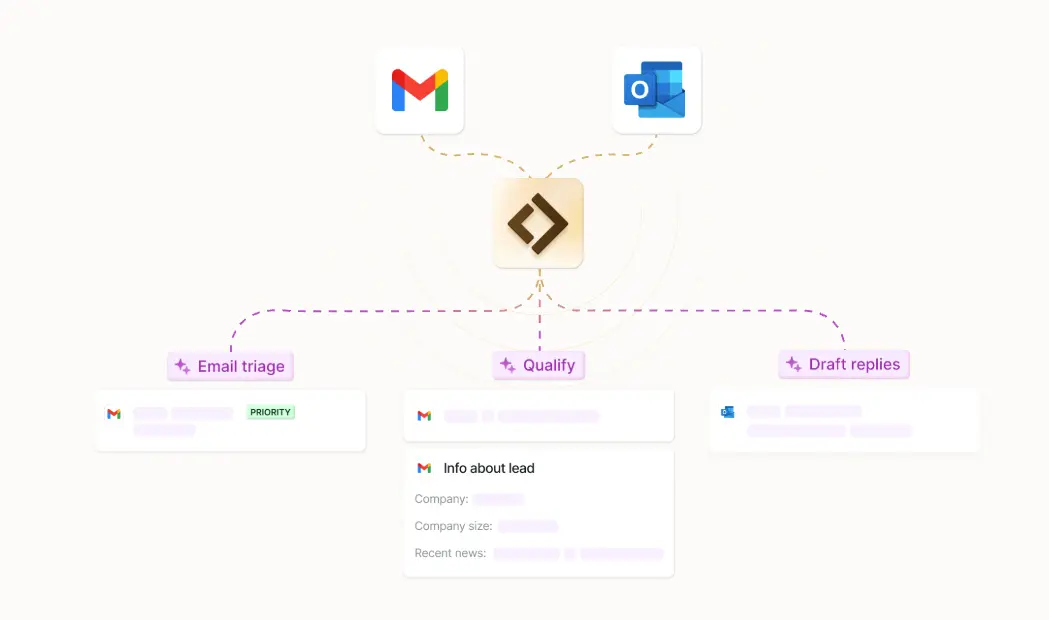
Best for: Teams automating knowledge work requiring judgment, such as email triage, lead qualification, content moderation, or research tasks.
Less suitable for: Workflows requiring absolute consistency or audit trails showing exact decision logic for compliance purposes.
Claude Sonnet 4.5 Integration
September 2025In September 2025, Lindy integrated Claude Sonnet 4.5, which brings measurable improvements in coding performance (77.2% on SWE-bench Verified) and extended autonomous operation capacity (over 30 hours on complex tasks). This represents a significant upgrade from previous models, particularly for coding-heavy workflows and long-running processes.
The practical impact: agents can now handle more complex decision trees without human intervention, and coding tasks show fewer errors requiring manual correction. For businesses automating technical processes, this translates to reduced oversight requirements.
Performance Gains: 300% improvement in autonomous operation time enables overnight processing of complex multi-step workflows that previously required checkpoints.
Lindy Build: Application Development with Testing
August 2025Lindy Build creates applications from text descriptions and then tests them automatically using AI agents that interact with the interface. This addresses a common pain point in no-code development: manual testing and debugging cycles.
The system works by generating QA agents that click through interfaces, fill forms, and verify functionality. When issues are detected, the platform attempts automatic fixes and retests. While this reduces development time significantly, complex applications may still require manual refinement for edge cases.
Real Example: A team built a customer portal with order tracking and support ticketing in approximately 4 hours, compared to 2-3 weeks with traditional no-code platforms. The autonomous testing caught 12 issues before deployment.
Best suited for: Internal tools, customer portals, simple SaaS applications, and business process applications where speed matters more than highly customized user experiences.
Less ideal for: Complex enterprise software requiring extensive customization, applications needing pixel-perfect design, or products where automated testing cannot cover all user scenarios.
Computer Use (Autopilot)
EnhancedComputer Use provides agents with browser automation capabilities, enabling interaction with web applications that lack APIs. This extends automation possibilities to platforms like LinkedIn, social media networks, and legacy business tools.
Agents can navigate websites, fill forms, extract data, and perform sequences of actions across multiple platforms. Persistent sessions maintain login credentials and preferences, reducing authentication friction.
Practical Application: A sales team automates LinkedIn prospecting by having agents research profiles, extract relevant information, and add qualified leads to their CRM—working around LinkedIn's API rate limits.
Practical limitations: Website redesigns can break automation sequences, complex CAPTCHA systems may require workarounds, and some platforms explicitly prohibit automated access in their terms of service.
Gaia: AI Phone Agent Capability
October 2025Gaia extends Lindy agents beyond text and web automation into voice interactions. AI agents can handle inbound customer calls, conduct outbound sales campaigns, schedule appointments, and qualify leads through natural phone conversations. The system handles multi-turn dialogues, understands context, and can transfer to humans when needed.
Voice agents use the same knowledge base and integrations as your text-based agents, providing consistent responses across channels. Calls are billed separately at $0.19/minute using GPT-4o, with other model options available.
Example Use Case: A real estate company deploys phone agents to handle property inquiry calls, answer questions about listings, schedule showings, and capture lead information—operating 24/7 without human staff.
Best for: Customer support overflow handling, lead qualification calls, appointment scheduling, simple sales conversations, and after-hours coverage.
Less suitable for: Complex negotiations requiring nuanced human judgment, highly regulated call center environments with strict scripting requirements, or conversations requiring deep emotional intelligence.
Multi-Model AI Support
UpdatedLindy supports multiple AI models: Claude Sonnet 4.5 and 3.7, GPT-5 and GPT-5 Codex, Gemini Flash 2.0, and Claude Haiku 3.5. This multi-model approach allows task-specific optimization, though the credit system means costs vary based on model selection.
Model selection affects both performance and cost. Claude Sonnet 4.5 provides best coding performance but consumes more credits. Claude Haiku 3.5 offers faster responses at lower credit cost for simple tasks.
Enterprise Security & Compliance
CertifiedEnterprise security features include SOC 2 Type II and HIPAA compliance, making Lindy suitable for regulated industries. AES-256 encryption, Business Associate Agreements, and role-based access controls address common enterprise requirements. Audit logs provide activity tracking for compliance documentation.
How Lindy AI Works: Step-by-Step
Describe Your Need
Start by describing what you want to automate in natural language. For example: "Create an agent that monitors customer support emails, categorizes them by urgency, drafts initial responses for common questions, and escalates complex issues to the team."
Connect Your Tools
Link Lindy to your existing business applications. With 5,000+ integrations, you can connect email, CRM, project management, communication tools, and databases. For applications without APIs, Computer Use provides browser automation capabilities.
Test and Refine
Lindy generates your agent and provides testing tools. Run sample scenarios to verify behavior, adjust parameters, and refine responses. The AI learns from corrections, improving accuracy over time.
Deploy and Monitor
Activate your agent to handle tasks autonomously. Monitor performance through Lindy's dashboard, which tracks actions taken, decisions made, and when human escalation occurred. Adjust rules and refine behavior based on real-world performance.
Latest Updates (August-October 2025)
Gaia: AI Phone Agent Platform
October 2025Lindy launched Gaia, enabling AI agents to make and receive phone calls autonomously. Agents can conduct customer support calls, sales outreach, appointment scheduling, and lead qualification through natural voice conversations. Pricing starts at $0.19/minute with GPT-4o.
Claude Sonnet 4.5 Integration
September 2025Integration of Anthropic's latest model brings 77.2% performance on SWE-bench Verified and 30+ hour autonomous operation capabilities. Significant improvements in coding accuracy and extended task execution without human oversight.
Lindy Build Launch
August 2025Autonomous application builder with built-in QA testing. Creates full-stack applications and tests them automatically using AI agents that interact with interfaces like human testers.
Enhanced Computer Use
September 2025Expanded browser automation capabilities with persistent sessions and parallel processing. Agents can now manage multiple computer instances simultaneously for complex workflows.
Additional AI Models
October 2025Added support for GPT-5, Gemini Flash 2.0, and Claude Haiku 3.5. Multi-model support enables task-specific optimization for cost and performance.
Pricing Structure and Cost Analysis
Free Plan
- 400 credits monthly
- Agent Builder access
- Lindy Build access
- 1M character knowledge base
- Basic integrations
Pro Plan
- 5,000+ credits monthly
- Claude Sonnet 4.5 access
- Computer Use capabilities
- Autonomous testing
- All integrations
- Priority support
Business Plan
- 30,000+ credits monthly
- Team collaboration
- Permission management
- Audit logs
- SOC 2, HIPAA compliance
Understanding the Credit System
Lindy uses a credit-based pricing model where simple tasks consume 1 credit and complex operations require more. Additional credits cost $10 per 1,000. Phone capabilities start at $0.19 per minute with GPT-4o.
This model provides transparency but requires monitoring usage patterns. Teams with unpredictable workloads may find monthly costs variable. The Pro plan's 5,000 credits typically support moderate automation needs for small teams, while the Business plan targets larger organizations with extensive agent deployments.
Cost consideration: Calculate expected usage based on pilot testing before committing to annual plans. The credit consumption rate varies significantly based on model selection and task complexity.
Competitive Analysis: When to Choose Lindy vs. Alternatives
The AI automation landscape includes traditional workflow tools, developer frameworks, and AI-native platforms. Understanding where Lindy fits helps determine if it matches your specific requirements.
| Capability | Lindy AI | Zapier | Make.com | n8n |
|---|---|---|---|---|
| AI Decision Making | Claude Sonnet 4.5 | No AI reasoning | No AI reasoning | Optional integration |
| Setup Complexity | Natural language | Visual, simple | Visual, complex | Visual, technical |
| Browser Automation | Built-in | Not available | Not available | Requires setup |
| App Development | Lindy Build | Not available | Not available | Not available |
| Starting Price | $49.99/mo | $19.99/mo | $9/mo | Free (self-hosted) |
| Integration Count | 5,000+ | 7,000+ | 1,500+ | 400+ |
Detailed Comparison: Use Case Guidance
Lindy AI vs. Zapier
Choose Zapier when:
- You need the largest integration library (7,000+ apps)
- Your workflows follow predictable, linear paths
- Budget constraints favor lower entry cost ($19.99/mo)
- Your team prefers established, widely-adopted platforms
- You don't need AI-powered decision making
Choose Lindy AI when:
- Your workflows require contextual decision-making
- You need to automate web applications without APIs
- Building simple applications is part of your automation needs
- Natural language setup appeals to non-technical teams
- Extended autonomous operation reduces manual oversight
Real-world scenario: A customer support team using Zapier can route tickets based on keywords. With Lindy, agents can read ticket context, research solutions across documentation, draft contextually appropriate responses, and escalate only when necessary. This requires higher investment but reduces manual intervention.
Lindy AI vs. Make.com
Choose Make when:
- You need granular control over data transformation
- Your team has technical expertise for complex logic
- Visual workflow debugging is essential
- Budget is limited ($9/mo starting point)
- You prefer deterministic, fully controllable workflows
Choose Lindy AI when:
- You want faster setup without technical configuration
- AI can handle workflow complexity better than manual rules
- You need agents to adapt to changing inputs
- Browser automation is required frequently
- Development speed matters more than perfect control
Real-world scenario: Make excels when processing invoices with consistent formatting—you define exactly how to extract each field. Lindy handles invoices with variable formats better, using AI to understand context and extract relevant information regardless of structure.
Lindy AI vs. n8n
Choose n8n when:
- You require self-hosted deployment for data control
- Open-source flexibility is important
- Your team can manage infrastructure and updates
- Budget requires free or low-cost solutions
- Custom node development fits your workflow
Choose Lindy AI when:
- You prefer managed cloud services
- AI capabilities are central to your automation needs
- Your team lacks technical operations resources
- Enterprise compliance (HIPAA, SOC 2) is required
- You value faster time-to-value over customization
Real-world scenario: n8n suits development teams building custom internal tools who need complete control and can manage hosting. Lindy fits business teams who need AI automation deployed quickly without infrastructure concerns.
Lindy AI vs. MindStudio
Choose MindStudio when:
- You're building customer-facing AI applications
- Custom UI design is critical
- You need extensive AI model customization
- Public deployment and sharing is primary focus
Choose Lindy AI when:
- Internal business automation is the priority
- You need workflow automation beyond app building
- Business integrations are essential
- Computer use capabilities provide value
Strengths and Limitations
Strengths
- Natural language agent creation Reduces technical barriers for business users building automation workflows
- Computer Use capabilities Extends automation beyond API-dependent workflows to any web application
- Autonomous testing in Lindy Build Addresses major pain point in no-code development with automatic QA
- Claude Sonnet 4.5 integration Provides measurable performance improvements for coding and complex tasks
- Enterprise compliance SOC 2, HIPAA, GDPR certifications make it viable for regulated industries
- 5,000+ integrations Cover most common business tools through Pipedream Connect partnership
- Transparent pricing Clear credit system with no hidden execution fees
Limitations
- Premium pricing $49.99/mo starting cost is significantly higher than Zapier ($19.99) or Make ($9)
- Credit-based variability Usage monitoring required; complex operations consume credits quickly
- AI unpredictability Agents may handle edge cases differently than expected
- Learning curve exists Despite natural language interface, understanding agent behavior takes time
- Less granular control Compared to Make for deterministic workflows requiring exact logic
- Computer use limitations Website redesigns break automations; CAPTCHA challenges; TOS restrictions
- Not open source Unlike n8n, limiting customization for technical teams
Frequently Asked Questions
What is Lindy AI and how does it differ from traditional automation tools?
Lindy AI is a no-code platform for creating AI agents that automate business workflows and build applications. Unlike traditional tools like Zapier that connect apps with if-then rules, Lindy uses large language models (including Claude Sonnet 4.5) to create agents that understand context and make decisions. The platform combines three core capabilities: Agent Builder for workflow automation through natural language, Lindy Build for application development with automated testing, and Computer Use for browser automation beyond API limitations.
How much does Lindy AI cost and is the pricing transparent?
Lindy uses a credit-based system with three paid tiers: Free Plan ($0, 400 credits), Pro Plan ($49.99/month, 5,000+ credits), and Business Plan ($299.99/month, 30,000+ credits). Simple tasks consume 1 credit while complex operations use more. Additional credits cost $10 per 1,000. Phone capabilities start at $0.19/minute. The pricing is transparent with no hidden execution fees, though you'll need to monitor usage as credit consumption varies with task complexity and AI model selection.
When should I choose Lindy AI over Zapier or Make.com?
Choose Lindy when your workflows require contextual decision-making, you need to automate web applications without APIs, or you're building simple applications alongside automation. Choose Zapier if you need the largest integration library and simple, predictable workflows at a lower price point ($19.99/mo). Choose Make if your team has technical expertise and needs granular control over data transformation with visual debugging. Lindy's premium pricing ($49.99/mo) makes sense when AI capabilities justify the investment.
What AI models does Lindy support and why does it matter?
Lindy supports multiple AI models as of October 2025: Claude Sonnet 4.5 (default, best for coding with 77.2% SWE-bench score), Claude Sonnet 3.7, GPT-5 and GPT-5 Codex, Gemini Flash 2.0, and Claude Haiku 3.5. Model selection affects both performance and credit consumption. Claude Sonnet 4.5's recent integration enables agents to operate autonomously for 30+ hours on complex tasks and provides better coding accuracy. This matters because choosing the right model balances cost with capability for your specific use cases.
Can I try Lindy AI before committing to a paid plan?
Yes, Lindy offers a free plan with 400 credits monthly and access to core features including Agent Builder, Lindy Build, and a 1M character knowledge base. This allows testing basic automation workflows and simple applications. No credit card is required for the free tier. For production use with advanced features like Claude Sonnet 4.5, Computer Use, and higher credit limits, you'll need to upgrade to the Pro plan ($49.99/month). Consider running pilot projects on the free plan to estimate credit consumption before committing.
What is Lindy Build and how does automated testing work?
Lindy Build creates full-stack applications from text descriptions and then automatically tests them using AI agents that interact with the interface like human QA testers. The system generates agents that click buttons, fill forms, and verify functionality. When bugs are detected, Lindy Build attempts automatic fixes and retests. This reduces development time significantly, though complex applications may still require manual refinement for edge cases. It's best suited for internal tools, customer portals, and simple SaaS applications where speed matters more than pixel-perfect customization.
How many integrations does Lindy offer and what about platforms without APIs?
Lindy offers 5,000+ integrations through partnership with Pipedream Connect, covering major categories including CRM (Salesforce, HubSpot), communication (Slack, Teams), productivity (Google Workspace, Notion), and e-commerce (Shopify, Stripe). For platforms without APIs, Lindy's Computer Use feature provides browser automation capabilities. Agents can navigate websites, fill forms, and extract data from any web application. However, this approach has limitations: website redesigns can break automations, CAPTCHA systems may require workarounds, and some platforms prohibit automated access in their terms of service.
Is Lindy AI secure enough for enterprise use and regulated industries?
Lindy maintains SOC 2 Type II, HIPAA, and GDPR compliance certifications, making it suitable for regulated industries including healthcare and finance. Security features include AES-256 encryption for data in transit and at rest, Business Associate Agreements for healthcare organizations, enterprise SSO, role-based access controls, and comprehensive audit logs. The Business Plan ($299.99/month) and Enterprise tiers include these compliance features. Teams should still conduct their own security assessments based on specific regulatory requirements and risk tolerance.
What tasks can Lindy AI agents handle and what are the limitations?
Lindy agents can handle email management, calendar scheduling, customer support, sales lead qualification, meeting transcription, CRM updates, social media management, document processing, web scraping, and phone calls. With Computer Use, they can navigate websites and interact with applications lacking APIs. However, limitations exist: agents may handle edge cases unpredictably, complex decision trees require careful setup, AI responses can vary, and some tasks requiring human judgment should include escalation workflows. The platform works best for knowledge work requiring contextual understanding rather than purely mechanical tasks.
How does Lindy AI compare to developer frameworks like CrewAI or AutoGen?
Lindy targets business users with no-code simplicity, while frameworks like CrewAI and AutoGen serve developers building custom systems. CrewAI requires Python expertise and costs $99-$120,000 annually but offers maximum customization. AutoGen is free and open-source but requires technical infrastructure management. Choose Lindy when you need fast deployment without technical resources, built-in compliance, and managed cloud services. Choose developer frameworks when you have dedicated AI teams, need complete control over implementation, or are building highly specialized systems requiring custom behavior.
What is Gaia and how do AI phone agents work?
Gaia is Lindy's AI phone agent platform that enables agents to make and receive phone calls autonomously. Phone agents can conduct natural voice conversations for customer support, sales outreach, appointment scheduling, and lead qualification. They use the same knowledge bases and integrations as text-based agents, providing consistent responses across channels. Calls are billed at $0.19 per minute with GPT-4o, separate from standard credit consumption. The system handles multi-turn dialogues and can transfer to humans when conversations exceed the agent's capabilities.
Try Lindy AI Free
- ✓ 400 free credits monthly
- ✓ No credit card required
- ✓ Test all core features
- ✓ Build agents and apps
- ✓ Upgrade when ready
Tool Specifications
- Category
- AI Agent Builder
- AI Model
- Claude Sonnet 4.5
- Latest Update
- October 2025
- Free Plan
- 400 credits/month
- Starting Price
- $49.99/month
- Website
- lindy.ai
Why Trust This Review
- 🔍 Independent analysis
- 📊 Hands-on testing
- 🔄 Updated October 2025
- ⚖️ Balanced assessment
Final Assessment
Lindy AI delivers on its promise of making AI automation accessible to business users. The combination of natural language agent creation through Agent Builder, computer use capabilities, and autonomous testing in Lindy Build addresses real pain points in workflow automation and application development. Claude Sonnet 4.5 integration brings measurable improvements in coding accuracy and autonomous operation time. The platform works best for growing businesses that need intelligent automation without building dedicated AI teams, are willing to invest premium pricing for reduced technical overhead, and can benefit from browser automation beyond traditional API limitations. However, the $49.99/month starting price requires careful evaluation against alternatives like Zapier ($19.99) or open-source n8n (free). Teams with simple automation needs may find traditional tools sufficient, while enterprises requiring maximum control might prefer developer frameworks. For its target market of mid-sized businesses seeking practical AI automation, Lindy represents solid value despite premium pricing.
Ready to Test Lindy AI?
Start with 400 free credits and explore AI automation without commitment.
No credit card required • 400 credits included • Full feature access