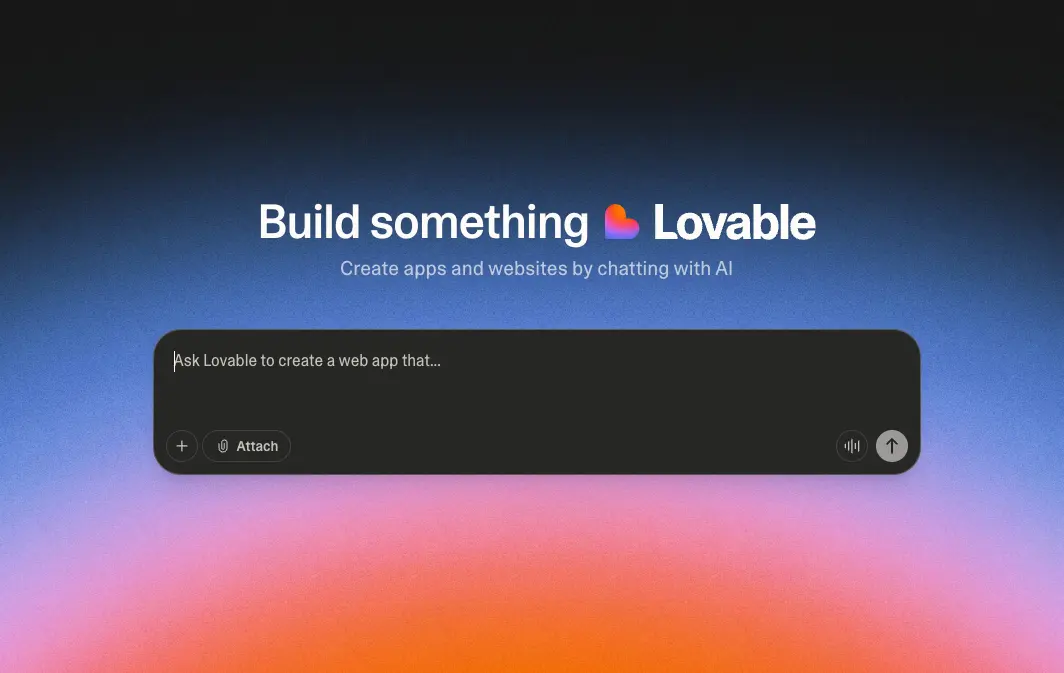
Lovable
AI-powered full-stack development platform enabling anyone to build production-ready web applications through natural language conversations. With nearly 8 million users, Lovable (formerly GPT Engineer) transforms ideas into functional React/TypeScript applications in hours using Claude Sonnet 4.5 and GPT-4. Generate complete frontend, backend, database, and authentication through conversational prompting—no coding knowledge required. Build MVPs 20x faster than traditional coding with full GitHub export, one-click deployment, and SOC 2 Type 2 compliance.
30-Second Summary
Bottom Line: Lovable stands as the fastest AI-powered full-stack development platform for building web applications through natural language, with nearly 8 million users validating its approach. Simply describe what you want in plain English, and Lovable generates production-ready React/TypeScript applications with backend, database, and authentication—all deployable in one click. Recent Claude Sonnet 4.5 integration delivers 25% fewer errors while Agent Mode provides autonomous development assistance. However, the platform reaches approximately 60-70% production readiness automatically, with debugging loops consuming 80% of credits and costs potentially reaching $200-500 monthly for active projects beyond the $25 base tier.
Best For
- Non-technical founders building startup MVPs in hours instead of months
- Designers creating functional prototypes for client presentations
- Product managers validating ideas before committing development resources
- Small teams building internal tools, dashboards, and CRMs
Skip If
- You need production-grade enterprise applications with complex business logic
- Budget constraints require predictable monthly costs without credit exhaustion
- Your project involves mission-critical systems requiring 99.9% reliability
- Native mobile apps are priority—Lovable focuses exclusively on web
No credit card required • 5 daily credits • Full GitHub export
Lovable at a Glance
What Exactly is Lovable?
Lovable is an AI-powered full-stack development platform launched in 2024 (formerly GPT Engineer) that enables users to build complete web applications through natural language conversations, eliminating the need for traditional coding while generating production-ready React, TypeScript, and Tailwind CSS applications with integrated backend infrastructure, database management, and deployment automation.
The platform has achieved remarkable market validation, growing from zero to nearly 8 million users by November 2025 while generating $17 million in annual recurring revenue. Unlike traditional no-code platforms that limit customization, Lovable generates real, exportable code that you own completely—enabling full GitHub integration and continued development outside the platform. This positions Lovable as both a no-code tool for non-technical users and a powerful scaffolding system for experienced developers seeking rapid prototyping.
Traditional Development vs Lovable AI
Traditional Coding
- Requires 3-6 months for MVP development with skilled engineering teams
- Hire developers at $80K-$150K annually or pay agencies $50K-$200K per project
- Manually configure frontend frameworks, backend APIs, databases, authentication, deployment
- Deep technical knowledge required for React, TypeScript, database design, DevOps
- Full code ownership with unlimited customization and complete architectural control
With Lovable
- Build functional MVPs in 1-4 hours through conversational AI interface
- Start at $0 free tier or $25/month Pro; founders save months of development time
- AI automatically generates frontend, backend, database schema, authentication, deployment config
- Zero coding knowledge required—describe features in plain English
- Full code export to GitHub for continued development and complete ownership
The Evolution of Lovable's Platform
Originally launched as GPT Engineer in 2024, the platform rebranded to Lovable and rapidly evolved into a comprehensive full-stack solution. Key milestones include the October 2025 introduction of Agent Mode providing autonomous AI assistance, November 2025 integration of Claude Sonnet 4.5 bringing 25% fewer errors and 40% faster performance, and continuous improvements to visual editing capabilities. The platform now offers three distinct development modes—Agent Mode for autonomous development, Edit Mode for targeted modifications, and Chat Mode for planning and debugging without code changes.
Lovable operates entirely cloud-based, accessible through web browsers without local installation requirements. The platform achieved SOC 2 Type 2 compliance, ISO 27001:2022 certification, and GDPR compliance, providing enterprise-grade security for production applications. Infrastructure runs on modern cloud hosting with automatic SSL certificates, AES-256 encryption, and comprehensive security scanning detecting potential vulnerabilities before deployment.
How Lovable's AI Technology Works
Lovable leverages multiple frontier AI models including Claude Sonnet 4.5 (the default as of November 2025), OpenAI GPT-4, Deepseek, Groq, and Mistral—allowing users to select models based on specific needs. The platform translates natural language descriptions into executable code using sophisticated prompt engineering and contextual understanding of application architecture. Behind the scenes, Lovable generates clean, production-ready React components with TypeScript for type safety and Tailwind CSS for styling.
- Agent Mode: Autonomous AI development assistant that independently handles complex tasks, searches codebases, inspects logs, browses web resources, and makes architectural decisions
- Edit Mode: Targeted code generation for specific modifications using visual element selection and natural language instructions
- Chat Mode: Planning and debugging conversations without making code changes, enabling strategic discussions and troubleshooting
- Backend Integration: Automatic Supabase connection or Lovable Cloud backend providing PostgreSQL database, authentication, and API infrastructure
Development happens through conversational prompts—users describe desired features, UI elements, business logic, and data structures, with Lovable generating complete implementations instantly visible in real-time preview. When ready to deploy, one-click publishing pushes applications to Lovable hosting, Netlify, or Vercel with automatic configuration and custom domain support.
How Does Lovable's AI Development Actually Work?
Lovable's conversational development system operates through sophisticated AI models that understand application architecture, generate production-ready code, and handle full-stack infrastructure—all accessible through an intuitive chat interface requiring zero coding knowledge while providing complete code ownership through GitHub export.
Lovable's Development Capabilities
✅ Where Lovable Excels
- Unprecedented development speed: Build functional MVPs in 1-4 hours instead of 3-6 months; users report 20x faster development than traditional coding methods
- Zero coding requirement: Entirely conversational interface where non-technical founders, designers, and product managers describe features in plain English
- Full-stack automation: AI generates React/TypeScript frontend, PostgreSQL database schema, authentication flows, API endpoints, and deployment configurations automatically
- Beautiful UI generation: Consistently produces polished, professional interfaces with Tailwind CSS styling from minimal prompting—superior design quality compared to competitors
- Complete code ownership: Export all generated code to GitHub with full ownership—continue development in any IDE like Cursor or VS Code
- Enterprise-grade security: SOC 2 Type 2 compliant, ISO 27001 certified, GDPR compliant with automatic security scanning detecting vulnerabilities before deployment
- Real-time collaboration: Multiplayer mode enabling teams to build together with shared workspaces, centralized billing, and role-based permissions
⚠️ Current Limitations
- Reaches 60-70% production readiness: Most applications require 30-40% manual refinement by developers for production deployment—complex business logic remains challenging
- Frustrating debugging loops: AI can get stuck repeatedly attempting same fixes without progress, consuming 80% of credits on debugging rather than feature development
- Credit costs can escalate quickly: Base $25/month often insufficient for active projects; real-world costs frequently reach $200-500 monthly with intensive use
- Performance degrades with complexity: Platform works best for projects under 300 lines per component; larger applications show declining AI effectiveness requiring more manual intervention
- Web applications only: No native mobile app support—builds responsive web apps using React but cannot generate native iOS or Android applications
- Prompt engineering required for best results: Despite being no-code, optimal outcomes require understanding how to structure clear, specific instructions and strategic development sequencing
Step-by-Step: Getting Started with Lovable
Starting with Lovable takes approximately 15-30 minutes to create your first simple application, with functional MVPs achievable in 1-4 hours for most use cases:
- Create your free account: Sign up at lovable.dev using email or Google authentication—no credit card required for free tier with 5 daily credits
- Describe your application: In the chat interface, explain what you want to build in plain English—"Create a booking system for photography clients with calendar scheduling and payment integration"
- Choose development mode: Agent Mode for autonomous development, Edit Mode for targeted changes, or Chat Mode for planning and discussion without code changes
- Connect your backend: Select Lovable Cloud for instant managed backend or connect your own Supabase project for greater control and direct database access
- Iterate through conversation: Refine features, adjust UI elements, and add functionality through natural language follow-up prompts
- Test in real-time preview: See changes instantly in live preview, test workflows, and verify functionality before deployment
- Deploy with one click: Publish to Lovable hosting, Netlify, or Vercel with automatic configuration, or export to GitHub for custom deployment
For optimal results, successful Lovable users follow strategic workflows: plan features before prompting, use Chat Mode for planning to conserve credits, break complex requests into logical phases, provide specific detailed descriptions rather than vague instructions, upload project knowledge files for consistent context, and leverage visual editing for precise UI adjustments without consuming credits unnecessarily.
Core Features That Define Lovable
🤖 Multi-Model AI Generation
Claude Sonnet 4.5Lovable provides access to multiple frontier AI models selectable within the chat interface, with Claude Sonnet 4.5 as the default delivering 25% fewer errors and 40% faster performance compared to previous versions. The platform also supports OpenAI GPT-4, Deepseek, Groq, and Mistral, allowing users to choose optimal models for specific tasks. Agent Mode introduced in October 2025 provides autonomous AI development assistance that independently searches codebases, inspects logs, browses web resources, and makes architectural decisions without constant prompting.
⚡ Three Development Modes
Flexible WorkflowsAgent Mode serves as the default autonomous development assistant handling complex tasks independently, making architectural decisions, implementing complete features, and managing project structure without constant guidance. Edit Mode enables targeted code generation and modifications using visual element selection—click specific UI components and describe desired changes through natural language instructions. Chat Mode provides planning and debugging conversations without code modifications, perfect for discussing implementation strategies, understanding codebase structure, and troubleshooting issues before committing credits to actual changes.
🎨 Visual Editing System
No-Code InterfaceSelect & Edit feature allows clicking specific UI elements in preview mode to target modifications through conversational instructions—adjust button colors, spacing, typography, and layout without writing Tailwind CSS classes manually. Visual Edits provides comprehensive Tailwind-based controls for modifying spacing, colors, typography, shadows, borders, and responsive breakpoints through intuitive interfaces. Image upload and swap functionality enables replacing placeholder images with brand assets directly through drag-and-drop interactions. Real-time preview shows all changes instantly, enabling rapid iteration and experimentation without deployment delays.
🗄️ Automatic Backend Integration
Full-StackLovable Cloud provides managed backend infrastructure powered by Supabase, automatically provisioned for every new project with zero configuration required. The AI generates PostgreSQL database schemas defining tables, relationships, field types, and constraints based on application requirements. Alternatively, connect your own Supabase project for direct database access, custom configurations, and integration with existing infrastructure. Automatic API endpoint generation creates REST APIs for database operations without manual API development. Row Level Security policies implement database-level access controls ensuring users only access their authorized data.
🔐 Built-In Authentication & Security
Enterprise-GradeAutomatic user authentication generation creates complete signup, login, password reset, and email verification flows without manual implementation. Support for multiple authentication providers including Google, Facebook, LinkedIn, GitHub through OAuth integration. Role-based access controls enable different permission levels for admins, managers, and standard users. Security Checker 2.0 automatically scans applications for potential vulnerabilities, exposed API keys, security misconfigurations, and common pitfalls before deployment. On-demand security reviews available at any time provide comprehensive vulnerability assessments. SOC 2 Type 2 compliance, ISO 27001:2022 certification, and GDPR compliance meet enterprise security requirements.
💻 Complete Code Ownership
GitHub ExportSeamless two-way GitHub synchronization automatically commits every code change to connected repositories, maintaining complete version history and enabling professional version control. Export includes full React/TypeScript codebase with all components, styles, logic, database schemas, authentication configurations, and deployment settings. Continue development in any IDE including Cursor, VS Code, or WebStorm while maintaining synchronization with Lovable platform. Generated code uses standard technologies—React 18, TypeScript, Tailwind CSS, Vite, Node.js, Supabase—ensuring portability and developer familiarity. Deploy exported code to any hosting platform including Netlify, Vercel, AWS, Azure, Google Cloud, or self-hosted infrastructure without platform restrictions.
🚀 One-Click Deployment
Instant PublishingDeploy applications instantly to Lovable's built-in hosting, Netlify, or Vercel with automatic configuration of build settings, environment variables, and deployment pipelines. Custom domain support enables professional branding with automatic SSL certificate provisioning and DNS configuration guidance. Security scanning runs automatically before every deployment, detecting potential vulnerabilities and blocking publication until issues are resolved. Continuous deployment from GitHub enables automatic updates whenever code changes are pushed to repository. Preview deployments for development branches allow testing changes before merging to production without affecting live applications.
👥 Real-Time Collaboration
Multiplayer ModeMultiple team members work simultaneously in shared workspace with real-time updates showing all changes instantly across all participants. Role-based permissions control who can view, edit, or administer projects with granular access management. Centralized billing for Pro and Business plans covers unlimited collaborators under single subscription, simplifying team payment management. Comment system enables feedback and discussion directly on specific UI elements and features. Version history tracks all changes with author attribution and timestamps, enabling rollback to previous states when needed. Up to 20 collaborators on free plan enable large teams to explore platform before upgrading.
📊 Version Control & History
Git IntegrationComplete version history tracking every code change with timestamps, author attribution, and description of modifications. GitHub integration maintains professional version control with commit messages, branch management, and pull request workflows. Restore previous versions instantly when experimental changes don't work out or new features introduce regressions. Compare versions side-by-side to understand differences between iterations and identify when specific issues were introduced. Export at any point preserves complete state enabling migration to external development while maintaining all historical context.
🔧 Modern Tech Stack
React & TypeScriptReact 18 for modern component-based frontend architecture with hooks, context, and state management following current best practices. TypeScript for type safety reducing bugs through compile-time error detection and improved developer experience. Tailwind CSS for utility-first styling enabling rapid UI development and consistent design systems. Vite for fast development server, hot module replacement, and optimized production builds. Node.js backend runtime supporting full JavaScript ecosystem and npm packages. Supabase integration providing PostgreSQL database, authentication, real-time subscriptions, and file storage. Standard technology choices ensure developer familiarity, extensive documentation, large community support, and easy hiring when transitioning to traditional development.
Lovable Pricing: What You Actually Pay
| Plan | Monthly Price | Credits | Key Features | Best For |
|---|---|---|---|---|
| Free | $0 | 5 daily (30/month) | Public projects, unlimited collaborators | Learning & experimentation |
| Pro | $25/month | 100 monthly + 5 daily (150 total) | Private projects, custom domains, no badge | Solo founders & small teams |
| Business | $50/month | 200 monthly + 5 daily (250 total) | SSO, internal publishing, opt-out training | Growing companies |
| Enterprise | Custom | Custom allocation | Dedicated support, custom integrations | Large organizations |
Understanding Lovable's Credit System
How Credits Work
Credits measure AI interactions, with consumption varying by task complexity:
- Simple changes: 0.50 credits ("Make button gray")
- Medium changes: 0.90 credits ("Remove footer from all pages")
- Complex features: 1.20 credits ("Add user authentication with email verification")
- Full builds: 2.00 credits ("Build complete landing page with hero, features, pricing, contact form")
Credit System Benefits & Challenges
Unique characteristics of Lovable's pricing:
- Message-based not token-based: Pay per prompt regardless of length, unlike Bolt's token counting
- Daily credits stack: 5 daily credits add to monthly allocation, maximizing available credits
- Credit rollovers: Unused credits carry forward to next month on Pro and Business plans
- Reality check: 80% of credits often consumed by debugging loops and repeated fixes rather than feature development
- Actual costs: Active projects frequently require $200-500 monthly despite $25 base pricing
Free Plan: Unlimited Learning
The permanently free plan provides unlimited time to explore Lovable with meaningful limitations:
- 5 daily credits: Approximately 30 credits per month for experimentation and learning (less than paid tier rollover potential)
- Unlimited public projects: Build as many applications as needed with visible source code and Lovable branding
- Unlimited collaborators: Up to 20 team members can work together, unique among freemium platforms
- GitHub synchronization: Full two-way sync maintaining version control and enabling external development
- One-click deployment: Publish applications to Lovable hosting with automatic configuration
- Lovable badge required: Applications display "Built with Lovable" branding on published sites
Best use: Thoroughly evaluate platform capabilities, learn conversational development workflows, build complete prototypes, and validate fit before financial commitment. Many successful applications start on free tier and upgrade only when ready to remove branding or need additional credits.
Pro Plan: Full Production Capabilities
At $25/month, Pro plan removes free tier limitations enabling professional applications:
- 150 total monthly credits: 100 base allocation plus 5 daily credits (150 maximum) supporting serious development activity
- Credit rollovers: Unused credits carry forward to subsequent months, preventing waste from inconsistent usage patterns
- Unlimited private projects: Develop applications with confidential source code not visible publicly
- Custom domains: Connect professional domains (yourcompany.com) with automatic SSL configuration
- Remove Lovable badge: White-label applications without platform attribution for professional branding
- User roles & permissions: Control team member access levels and project permissions
- Shared across unlimited users: Unlike per-seat pricing, single Pro subscription covers entire team
Pro plan suits solo founders, small teams, freelance developers, and agencies serving clients requiring professional deployments. The unlimited user sharing makes Pro extremely cost-effective for teams compared to traditional per-developer licensing.
Business Plan: Advanced Team Features
Business Plan ($50/month) adds enterprise readiness and enhanced credits:
- 250 total monthly credits: Additional 100 credits (200 base plus 50 daily maximum) for heavier development workloads
- SSO (Single Sign-On): SAML integration for enterprise identity management and centralized authentication
- Internal publishing: Deploy applications within organizational networks without public exposure
- Personal projects: Separate personal development from organizational work
- Opt out of data training: Ensure proprietary code and prompts aren't used for AI model training
- Design templates: Pre-built UI patterns and component libraries accelerating development
Enterprise Plan: Custom Solutions
Custom pricing for organizations requiring specialized capabilities:
- Custom credit limits: Allocations tailored to organizational development volume and team size
- Dedicated support: Priority assistance, account management, and direct engineering access
- Custom integrations: Specialized connections to internal systems, legacy infrastructure, and proprietary services
- Expert architecture support: Consultation on application design, scalability planning, and best practices
- Group access controls: Advanced permission management for complex organizational hierarchies
- Dedicated onboarding: Hands-on training and implementation assistance for team adoption
Enterprise plans typically suit organizations with 50+ developers, mission-critical applications requiring high availability, or specialized compliance and security requirements beyond standard certifications.
Cost Reality: Hidden Expenses
Understanding actual costs requires acknowledging common challenges:
- Debugging consumes 80% of credits: Users consistently report majority of credits spent on repeated fix attempts and AI looping rather than new feature development
- Real monthly costs reach $200-500: Active projects frequently exhaust base tier credits, with serious development requiring Business plan or multiple Pro subscriptions
- No à la carte credit purchases: Cannot buy additional credits without upgrading entire plan, forcing tier jumps for temporary increases
- Credit exhaustion mid-project: Projects reaching critical milestones may hit credit limits requiring immediate upgrades or development pauses
- Learning curve credit waste: New users burn credits on vague prompts producing poor results, with costs decreasing as prompting skills improve
Honest Assessment: Pros and Cons
What Works Exceptionally Well
- Unprecedented development speed transforming idea validation Build functional MVPs in 1-4 hours instead of 3-6 months—20x faster than traditional coding enabling rapid testing of multiple concepts before committing significant resources
- Zero coding requirement democratizing application development Entirely conversational interface accessible to non-technical founders, designers, product managers, and entrepreneurs—describe features in plain English without understanding React, TypeScript, or database design
- Beautiful UI generation superior to competitors Consistently produces polished, professional interfaces with excellent design aesthetics from minimal prompting—Tailwind CSS styling and component structure rival designs from experienced frontend developers
- Complete code ownership eliminating vendor lock-in Full GitHub export with real React/TypeScript source code you own completely—continue development in any IDE, deploy anywhere, and maintain all rights regardless of subscription status
- Comprehensive full-stack automation removing infrastructure complexity AI generates frontend UI, backend APIs, PostgreSQL database schemas, authentication flows, and deployment configurations automatically—eliminating months of infrastructure development and DevOps complexity
- Enterprise-grade security meeting compliance requirements SOC 2 Type 2 compliant, ISO 27001:2022 certified, GDPR compliant with automatic security scanning detecting vulnerabilities before deployment—enables B2B sales to regulated industries and enterprise customers
- Massive market validation with 8 million users Nearly 8 million users and $17M ARR demonstrate market validation and platform stability—large community provides tutorials, templates, troubleshooting assistance, and proven use cases
- Continuous AI improvements with Claude Sonnet 4.5 November 2025 Claude Sonnet 4.5 integration delivers 25% fewer errors and 40% faster generation—Agent Mode introduced October 2025 provides autonomous development assistance improving with each update
- Real-time collaboration enabling team development Multiplayer mode with unlimited users on single Pro subscription—cross-functional teams work simultaneously with designers refining UI while developers implement logic and product managers plan features
Significant Limitations
- Reaches only 60-70% production readiness automatically Multiple independent reviews confirm most applications require 30-40% manual developer refinement for production deployment—complex business logic, edge cases, performance optimization, and specialized workflows remain challenging for AI generation
- Frustrating debugging loops consuming majority of credits Users consistently report AI getting stuck repeatedly attempting same fixes without progress, with 80% of credits burned on debugging and repeated attempts rather than new feature development—inconsistency causes significant frustration and credit waste
- Credit costs can escalate dramatically beyond base pricing Base $25/month often insufficient for active projects with real-world usage frequently requiring $200-500 monthly—debugging loops, iterative refinements, and learning curve waste drain credits faster than anticipated
- Performance degrades significantly with project complexity Platform works best for projects under 300 lines per component—larger applications show declining AI effectiveness, increased errors, and diminishing returns requiring more manual intervention as complexity increases
- Web applications only without native mobile support Lovable focuses exclusively on React web applications—cannot generate native iOS or Android apps, limiting use cases to responsive web apps accessed through mobile browsers rather than app store distributions
- Prompt engineering required despite being no-code Optimal results require understanding how to structure clear, specific instructions and strategic development workflows—vague prompts produce buggy results consuming credits without progress, creating learning curve steeper than expected for non-technical users
Who Should (and Shouldn't) Use Lovable
✅ Ideal Users
Non-Technical Startup Founders
Entrepreneurs without coding backgrounds building MVPs to validate product-market fit benefit enormously from Lovable's conversational development. The platform enables founders to transform ideas into functional applications demonstrable to investors and early customers within hours, accelerating fundraising timelines and customer acquisition without hiring expensive engineering teams. Lovable's 20x development speed advantage lets founders test multiple concepts rapidly, pivoting based on real user feedback rather than committing months to single directions.
Perfect if: You're bootstrapping your startup with limited capital, need to launch quickly to secure funding or early customers, want complete control over product direction without developer bottlenecks, require sophisticated backend logic that simpler no-code tools cannot provide, or need to demonstrate working prototypes during investor pitches and customer discovery calls.
Product Designers Creating Functional Prototypes
Design professionals leverage Lovable to create interactive prototypes with real functionality beyond static mockups. Unlike Figma prototypes demonstrating only UI flows, Lovable generates functional applications with working databases, authentication, and business logic—enabling user testing of actual features rather than simulated interactions. The platform's superior UI generation quality matches design aesthetics expected by clients and stakeholders, while conversational editing matches Figma-like workflows familiar to designers.
Perfect if: You create client presentations requiring functional demonstrations, need to validate UX decisions with real interactions rather than clickable mockups, want to show stakeholders working features during design reviews, require rapid iteration based on user testing feedback, or bridge the gap between design handoff and developer implementation with working prototypes.
Product Managers Validating Requirements
Technical product managers use Lovable to prototype features before committing engineering resources, validating requirements with stakeholders through functional demonstrations rather than written specifications. The platform enables testing multiple approaches to solving user problems, gathering quantitative data on feature effectiveness, and communicating requirements to engineering teams through working examples rather than abstract descriptions. Product managers without coding backgrounds can still create sophisticated prototypes demonstrating complex workflows and business logic.
Perfect if: You need to validate product concepts before sprint planning and resource allocation, want to demonstrate features to executives and stakeholders for buy-in, bridge communication gaps between business requirements and technical implementation, rapidly test multiple solutions to user problems before committing development time, or create high-fidelity prototypes replacing lengthy PRD documentation.
Development Teams Seeking Rapid Scaffolding
Experienced developers leverage Lovable for initial application scaffolding and boilerplate elimination, using Agent Mode to generate project foundations in hours instead of days. Teams export to GitHub and continue development in preferred IDEs like Cursor or VS Code, combining Lovable's rapid generation with precise manual control. The modern tech stack (React, TypeScript, Tailwind) generated by Lovable matches professional development practices, requiring no refactoring to align with team standards.
Perfect if: Your team wants to eliminate repetitive boilerplate setup focusing developer time on complex custom logic, you follow agile methodologies requiring rapid prototyping for stakeholder validation, experienced developers comfortable debugging AI-generated code want to accelerate initial phases, hybrid approach combining AI generation with manual refinement fits team workflow, or prototyping multiple technical approaches before committing architecture decisions.
Small Businesses Building Internal Tools
Operations teams create custom CRMs, dashboards, inventory management systems, and workflow automation tools tailored to specific business processes without IT department involvement. Internal tools don't require polished consumer-grade design—they need functionality, integration with existing systems, and ability to evolve quickly as business needs change. Lovable excels at these requirements, enabling non-technical staff to build operational improvements directly addressing pain points.
Perfect if: Your business has unique workflows that off-the-shelf software doesn't address adequately, you need to integrate multiple data sources into unified dashboards, employees require mobile-responsive access to company databases and operational processes, custom tools provide competitive advantages worth development investment, or rapid iteration on internal processes requires frequent application updates without developer bottlenecks.
Freelancers and Agencies Serving Clients
Development agencies and freelancers use Lovable to deliver client projects faster, enabling higher profit margins through reduced development time or competitive pricing through cost savings. The platform's visual nature allows clients to see progress in real-time during meetings, provide feedback during development, and request changes without massive technical debt accumulation. Lovable projects demonstrate concepts to clients before committing to full development, reducing scope creep and misaligned expectations.
Perfect if: You run development agency serving SMBs and startups needing rapid MVP delivery, freelance building prototypes and custom applications for diverse clients, want to expand service offerings without hiring additional developers, maintain ongoing client relationships through Lovable subscription requirements creating recurring revenue, or demonstrate working concepts securing larger development contracts for full implementation.
❌ Better Alternatives Exist For
Production-Grade Enterprise Applications
Lovable's 60-70% production readiness limitation makes it unsuitable for mission-critical enterprise systems requiring extensive customization, complex business logic, specialized compliance requirements, or 99.9% uptime guarantees. Applications expecting millions of users, handling sensitive regulated data (healthcare, finance), or requiring unusual architectural patterns exceed Lovable's capabilities without significant developer refinement.
Try instead: Traditional development with React, TypeScript, and professional engineering teams provides unlimited customization, optimal performance tuning, and complete architectural control. For enterprise low-code platforms with extensive customization, consider OutSystems or Mendix providing deeper enterprise integration and specialized workflow capabilities. Use Lovable for prototyping and validation, then transition to traditional development for production hardening.
Native Mobile Applications (iOS/Android)
Lovable focuses exclusively on web applications using React—it cannot generate native iOS or Android apps requiring app store distribution, native device APIs (camera, GPS, push notifications), offline functionality, or platform-specific UI patterns. While Lovable creates mobile-responsive web apps accessible through browsers, these lack native mobile app experiences users expect from app store downloads.
Try instead: FlutterFlow provides native iOS and Android development with smooth animations, device integration, offline capabilities, and full Flutter code export enabling unlimited customization. For React Native development with AI assistance, consider Cursor IDE with specialized React Native plugins. Bubble recently launched native mobile capabilities (August 2025) for no-code mobile app development. If mobile-first experiences are priority, specialized mobile development tools deliver better results than Lovable's web-focused generation.
Projects Requiring Predictable Costs
Lovable's credit-based system with debugging loops consuming 80% of usage creates unpredictable monthly expenses. Organizations requiring fixed budgets, financial predictability, or cost certainty struggle with usage-based pricing where actual costs frequently reach $200-500 monthly despite $25 base tier. The inability to purchase additional credits à la carte forces expensive tier upgrades for temporary increases.
Try instead: Cursor provides AI-assisted development at fixed $20/month with predictable API credit pools and transparent usage tracking. Bubble offers workload-based pricing with clearer cost predictability for production applications. Traditional development with upfront project pricing eliminates ongoing subscription variability. For budget-conscious teams, evaluate cost predictability carefully before committing to Lovable for long-term projects.
Marketing Websites and Content-Focused Sites
Lovable's strengths lie in application functionality with databases, authentication, and complex logic—not content presentation or SEO optimization. Marketing websites, portfolios, blogs, and content-heavy sites benefit from platforms purpose-built for design aesthetics, search engine visibility, and content management rather than application logic.
Try instead: Wix provides beautiful templates and extremely simple editing for small business websites with excellent SEO tools. Webflow delivers superior design control with pixel-perfect layouts, automatic SEO optimization, clean code export, and fast static page loads—ideal for marketing sites, landing pages, and content platforms where design and organic traffic matter most. WordPress or Ghost provide better content management systems for blogs and editorial sites.
Developers Wanting Direct Code Control
While Lovable exports code to GitHub, the primary development experience emphasizes conversational prompting over direct code editing. Developers comfortable writing code directly often find the conversational layer frustrating when they know exactly what code changes are needed but must describe them to AI for generation.
Try instead: Cursor provides AI assistance directly within VS Code-style IDE with inline suggestions, code completion, and chat-based help while maintaining complete manual control. Bolt.new offers direct code editing even on free plan with comprehensive IDE experience. GitHub Copilot provides inline AI suggestions during traditional coding without conversational overhead. Choose Lovable for initial rapid scaffolding, then transition to Cursor for detailed refinements requiring precise control.
Complex Multi-Language Projects
Lovable focuses exclusively on React, TypeScript, and Tailwind CSS stack—it cannot generate Python backends, Java enterprise applications, Go microservices, or non-JavaScript technology stacks. Projects requiring specific programming languages or frameworks for technical requirements, team expertise, or existing infrastructure compatibility need different solutions.
Try instead: Replit supports 50+ programming languages with AI-powered Replit Agent for multi-language projects, educational environments, and diverse technical stacks. Cursor works with any programming language and framework, providing AI assistance for Python, Java, Go, Rust, and specialized stacks. Traditional development with specialized frameworks remains necessary when specific technology requirements cannot be met by Lovable's React-focused generation.
How Lovable Compares to Alternatives
| Feature | Lovable | Bolt.new | Cursor | Bubble |
|---|---|---|---|---|
| Primary Use Case | ★★★★★ AI app generation |
★★★★★ Browser IDE |
★★★★★ Code assistance |
★★★★★ No-code platform |
| Development Speed | ★★★★★ 1-4 hours |
★★★★ Similar speed |
★★★ Depends on dev |
★★★★ Days to weeks |
| Code Ownership | ★★★★★ Full export |
★★★★★ Full export |
★★★★★ Complete |
❌ No export |
| Technical Knowledge | ★★★★★ None required |
★★★ Some helpful |
★★ Developer tool |
★★★★ Minimal |
| UI Quality | ★★★★★ Excellent |
★★★★ Very good |
★★★ Developer-grade |
★★★★ Good |
| Starting Price | $25/mo | $20/mo | $20/mo | $29/mo |
| Best For | Non-tech founders | Tech-savvy builders | Professional devs | Complex no-code |
Quick Comparison Insights
vs Bolt.new: Bolt.new provides direct code editing even on free plan with comprehensive IDE experience, making it better for developers wanting immediate code access. Lovable emphasizes structured workflows with superior GitHub integration and backend automation, making it better for non-technical users and teams prioritizing collaboration. Bolt uses transparent token-based pricing while Lovable uses message-based credits. Both reach similar development speeds, but Lovable produces more polished UI consistently. Choose Bolt for developer control; choose Lovable for team collaboration and design quality.
vs Cursor: Cursor is an AI-powered code editor for experienced developers who want AI assistance within existing workflows—it requires coding knowledge and provides deep codebase understanding for professional development. Lovable is a complete platform for building applications from scratch through conversation—accessible to non-developers without any coding knowledge. Cursor produces 90%+ production-ready code with developer oversight; Lovable reaches 60-70% requiring refinement. Choose Cursor when you're an experienced developer working on active codebases; choose Lovable when you're a non-technical founder building MVPs from scratch.
vs Replit: Replit supports 50+ programming languages with full cloud IDE providing language flexibility beyond web apps—excellent for education, multi-language projects, and diverse technical stacks. Lovable focuses exclusively on React/TypeScript web applications with AI-driven generation optimized for rapid prototyping. Replit requires coding knowledge; Lovable operates entirely through conversation. Choose Replit for language flexibility and educational environments; choose Lovable for fastest web app prototyping without coding.
vs v0.dev (Vercel): v0.dev specializes in prompt-to-UI generation creating frontend components for integration into existing projects—excellent component-level work within Vercel ecosystem. Lovable handles full-stack applications including backend, database, and deployment—complete applications ready to ship. v0 requires separate backend setup; Lovable provides integrated infrastructure. Choose v0 for high-quality React components integrating into existing Next.js projects; choose Lovable for standalone applications with full backend functionality.
vs Bubble: Bubble provides mature no-code platform with visual drag-and-drop development, extensive plugin ecosystem (1,000+ plugins), and proven scalability serving apps with 100,000+ daily users. Lovable uses AI-powered conversational development generating real exportable code with full GitHub integration. Bubble offers no code export creating complete vendor lock-in; Lovable exports full React/TypeScript source code. Choose Bubble for mature no-code platform with proven scalability and extensive integrations; choose Lovable for AI-powered rapid prototyping with code ownership and modern tech stack.
What's New in November 2025
Claude Sonnet 4.5 Integration
November 2025 rollout of Claude Sonnet 4.5 as default AI model delivers transformative quality improvements with 25% fewer errors compared to previous versions and 40% faster generation speeds. The upgraded model demonstrates deeper understanding of application context, produces cleaner code structure, handles complex architectural requirements more effectively, and reduces debugging loops through more accurate initial implementations. Long-context capabilities enable understanding entire application architecture rather than isolated components, resulting in more coherent cross-file implementations and better maintenance of design systems throughout applications.
Agent Mode Launch
October 2025 introduction of Agent Mode fundamentally changed development experience by providing autonomous AI development assistant handling complex tasks independently. Agent Mode searches codebases intelligently, inspects application logs for debugging, browses web resources for implementation patterns, makes architectural decisions aligned with project goals, and implements complete features with minimal prompting. The agentic approach reduced error rates by 91% compared to previous implementations by understanding entire application context and making holistic decisions rather than isolated code generation. Agent Mode became default development experience, with teams reporting significant productivity increases through reduced back-and-forth iterations.
Improved Chat Mode
Significant Chat Mode enhancements enable smarter conversational debugging, strategic planning discussions, and implementation guidance without consuming credits on code modifications. The improved mode provides detailed explanations of codebase structure, suggests optimal implementation approaches, helps troubleshoot issues through analytical conversations, and enables architectural planning before committing to specific implementations. Users leverage Chat Mode extensively for cost-effective planning and problem-solving, only switching to Agent Mode or Edit Mode when ready to generate actual code changes.
Enhanced Visual Editor
Visual editing experience received comprehensive improvements including faster access to element selection controls, enhanced Tailwind-based modification interfaces, improved image handling with drag-and-drop replacement, and better responsive design preview across device sizes. The visual editor now supports more granular control over component styling, spacing, and layout without requiring Tailwind CSS knowledge. Long-run user experience improvements based on community feedback make visual editing more intuitive for designers and non-technical users while maintaining power and flexibility for advanced customization.
API Key Detection & Security Scanning
Automatic API key detection warns developers before accidentally exposing sensitive credentials in code or deployment configurations, preventing security vulnerabilities that affected 170+ Lovable apps in September 2025. Enhanced Security Checker 2.0 scans for common security pitfalls including exposed secrets, insecure authentication patterns, SQL injection vulnerabilities, and misconfigured Row Level Security policies. On-demand security reviews provide comprehensive vulnerability assessments at any development stage, with detailed remediation guidance. The security improvements respond to September 2025 vulnerability disclosure, demonstrating platform commitment to security through proactive scanning and developer education.
Code Editor Image Support
New image support in code editor context enables uploading design references, mockups, and visual examples directly into development conversations. The AI analyzes provided images to understand intended designs, replicate visual aesthetics, implement matching color schemes, and maintain design consistency throughout applications. This visual reference capability bridges gap between design tools like Figma and Lovable implementation, enabling designers to provide visual guidance without translating designs into text descriptions. Teams report improved design accuracy and reduced iteration cycles when providing visual references alongside textual requirements.
Common Questions Answered
What is Lovable and how does it work?
Lovable is an AI-powered full-stack development platform that enables users to build complete web applications through natural language conversations without coding knowledge. Simply describe what you want to create in plain English, and Lovable's AI generates the entire application including frontend UI built with React and Tailwind CSS, backend logic and API endpoints, PostgreSQL database structure with proper relationships, authentication systems with multiple providers, and deployment configurations for instant publishing. The platform works through a chat-based interface where you interact with AI agents—Agent Mode for autonomous development, Edit Mode for targeted modifications, and Chat Mode for planning without code changes. Unlike traditional no-code platforms, Lovable generates real exportable code using React, TypeScript, and Tailwind CSS that you own completely, allowing full GitHub export and continued development outside the platform.
Do I need coding knowledge to use Lovable?
No, you do not need any coding experience to use Lovable successfully. The platform is specifically designed for non-technical users including founders, designers, product managers, and entrepreneurs who want to build functional applications without writing code. Lovable operates entirely through natural language conversations where you describe features and the AI handles all technical implementation automatically. According to Lovable's data, a significant portion of their nearly 8 million users have little to no coding experience. However, there's an important caveat: while you can absolutely start with zero coding knowledge, having basic understanding of web development concepts, application logic, and problem-solving significantly improves your results. Users report that understanding how to structure prompts effectively, think logically about application architecture, and troubleshoot issues leads to better outcomes and more efficient credit usage. Many successful non-technical users pair Lovable with ChatGPT or Claude to help refine prompts and debug issues. Bottom line: you can start with zero coding knowledge and be successful, but you'll become more effective as you learn basic development concepts through using the platform.
How fast can I build an app with Lovable?
Development speed with Lovable varies significantly by project complexity and user experience. Simple applications take 1-4 hours, with users consistently reporting functional prototypes and MVPs completed within a single afternoon session. Landing pages and basic websites can be generated in minutes to hours, with some users creating working demos in as little as 10 minutes. Moderate complexity apps with authentication, databases, and multiple features typically require several hours to a few days depending on requirements and iteration needs. Complex applications with custom business logic, multiple integrations, and advanced features may require weeks of development, especially for users learning the platform. Lovable claims to be 20 times faster than traditional coding methods, and this appears validated by user experiences—tasks traditionally requiring months can often be completed in days or weeks. One notable example involved a developer building 30 different applications in 30 days using Lovable, a feat impossible with traditional development. However, 80% of development time can be consumed by debugging, iterations, and refinements rather than initial generation, so actual timelines depend heavily on project complexity, your prompting skills, and how effectively you structure development workflows. The speed advantage is most dramatic for initial prototyping and MVP development before production hardening requirements emerge.
Is Lovable worth the cost in 2025?
Yes, Lovable is worth it if you need rapid prototyping and MVP validation, but value depends heavily on your specific use case and understanding of limitations. At $25/month for the Pro plan, Lovable offers exceptional value for founders, designers, and small teams who need to test ideas quickly without hiring developers. The platform is particularly worth it for startup founders validating MVPs before investing in full development, saving months of time and enabling faster customer discovery; designers creating functional prototypes for client presentations rather than static mockups; product managers building proof-of-concepts to secure stakeholder buy-in; and small teams developing internal tools and operational improvements. However, Lovable is not worth it for production-grade enterprise applications requiring extensive customization beyond 60-70% automatic completion; projects with complex business logic beyond standard CRUD operations; applications requiring detailed code-level control and optimization; or teams with strict budget constraints where real costs often reach $200-500/month with active use rather than $25 base price. The critical reality is that while base pricing seems affordable, 80% of credits are often consumed by debugging and repeated fixes rather than feature development, and active projects frequently exhaust base tiers. Lovable is worth it if speed and time-to-market matter more than cost savings, and if you understand it's primarily a prototyping tool delivering 60-70% production readiness automatically. For serious development beyond MVPs, budget for either upgrading tiers or transitioning to traditional development after validation.
Can Lovable build production-ready applications?
Yes, but with important caveats—Lovable can absolutely build production-ready applications, but most projects reach approximately 60-70% production readiness automatically, with the remaining 30-40% requiring manual developer intervention. What "production-ready" means for Lovable: the platform handles well standard CRUD applications with create, read, update, delete operations; user authentication and role-based access controls; database integration with Supabase or Lovable Cloud providing PostgreSQL storage; payment integration with Stripe for transaction processing; responsive professional UI/UX using modern design patterns; and deployment and hosting infrastructure with automatic SSL and security. However, Lovable struggles with highly specialized or complex business logic beyond standard patterns; enterprise-grade compliance requirements for fintech or healthcare applications; advanced custom workflows requiring unusual architectural approaches; applications expecting millions of users without migration and optimization plans; and complex integrations with legacy systems requiring specialized protocols. Real user experiences validate both capabilities and limitations: one user reported "I've built fully-fledged apps on Lovable and continue to host them there," demonstrating production viability, while another noted "AI-generated apps are more of a 60-70% solution rather than production-ready code," highlighting finishing work typically required. Professional development services exist specifically to turn Lovable prototypes into enterprise-grade applications, which validates both Lovable's capabilities for initial development and its limitations for complex production scenarios. Best practice: use Lovable for rapid MVP development and initial prototyping, then engage developers for production hardening, security audits, performance optimization, and scaling preparation if needed for serious production deployments.
What are the main limitations of Lovable?
Lovable has several significant limitations you should understand before committing to the platform. Credit system and costs: the credit-based pricing can become expensive quickly, with 80% of credits often spent on debugging loops and repeated fixes rather than actual feature development, with real-world costs frequently reaching $200-500/month for active projects far exceeding the $25 base tier. AI looping problems: users frequently report frustrating issues where the AI gets stuck trying to fix bugs, often reintroducing old errors while consuming paid credits without making progress—this inconsistency wastes both time and money. Complexity ceiling: Lovable reaches approximately 60-70% completion for production applications automatically with the remaining 30-40% requiring manual refinement; complex business logic, specialized workflows, and unusual requirements remain challenging. Performance degrades with larger projects, particularly those exceeding 300 lines per component. Limited code editing access: direct code editing requires paid plans, with free tier users needing GitHub export for any manual modifications creating friction in development workflow. Web applications only: Lovable focuses exclusively on web applications using React, TypeScript, and Tailwind CSS—it does not support native mobile app development for iOS/Android or desktop applications; you can create mobile-responsive web apps but not native mobile apps. Backend vendor dependencies: projects using Lovable Cloud are tightly coupled to the platform making migration challenging, while Supabase integration provides more flexibility but requires additional technical setup. Scalability concerns: while Lovable apps can scale with proper infrastructure, the platform itself works best for smaller projects; as applications grow in complexity and size, the AI's effectiveness diminishes requiring more manual intervention. Learning curve for best results: despite being no-code, achieving optimal results requires understanding prompt engineering, project structure, and strategic development workflows—vague instructions produce buggy results consuming credits without progress.
What types of applications can I build with Lovable?
Lovable excels at building a wide variety of web applications, particularly those involving structured data, user workflows, and standard business logic. Business and productivity tools: CRM systems with contact management and lead tracking, project management dashboards, inventory management systems, internal business tools and admin panels, task tracking and workflow management. E-commerce and marketplace apps: product databases with order forms, booking and reservation systems, marketplace platforms with buyer/seller interactions, payment-enabled applications via Stripe integration. Content and social applications: landing pages and marketing websites, portfolios and personal websites, social media applications with posts, likes, and comments, blog platforms and content management systems. Data and analytics: dashboards displaying real-time data, reporting tools with data visualization, analytics platforms tracking metrics. SaaS products: subscription-based web applications, user authentication and profile management, multi-tenant applications with role-based access. Educational and learning: e-learning platforms with course management, quiz and assessment applications, progress tracking systems. What Lovable CANNOT build: native mobile apps for iOS/Android (only responsive web apps), desktop applications, real-time multiplayer games, GPU-intensive processing applications, applications requiring specialized low-level system access, or highly complex enterprise systems with unusual architectural requirements. Lovable is specifically optimized for functional web applications with databases, authentication, and standard business logic, making it ideal for most startup MVPs, internal business tools, and SaaS platforms that don't require specialized technical architectures or native mobile distribution.
How does Lovable's pricing work and what do credits mean?
Lovable uses a credit-based (message-based) pricing model where each AI interaction consumes credits regardless of complexity. The pricing tiers as of November 2025 include: Free Plan at $0/month with 5 daily credits (maximum 30-50 per month depending on rollover), unlimited public projects, unlimited collaborators, one-click deployment, GitHub sync, and Lovable badge required. Pro Plan starting at $25/month with 100 monthly credits plus 5 daily credits (up to 150 total per month), credit rollovers where unused credits carry forward, unlimited private projects, custom domains, removed Lovable badge, and user roles and permissions. Business Plan at $50/month with all Pro features plus additional 100 credits (200 total), internal publishing capabilities, SSO (Single Sign-On), opt out of data training, and design templates. Enterprise Plan with custom pricing offering custom credit limits, dedicated support and onboarding, custom integrations, and expert architecture support. How credits are consumed varies by task complexity: simple changes like "Make button gray" consume approximately 0.50 credits; medium changes like "Remove footer" consume approximately 0.90 credits; complex features like "Add authentication" consume approximately 1.20 credits; and full builds like "Build landing page" consume approximately 2.00 credits. Important credit system details: no token counting unlike competitors—Lovable charges per message/prompt not by token length; daily limits stack with your 5 daily credits on top of monthly allocations; no month-to-month carryover as unused messages/credits reset at billing cycle; and error fixes using "Try to Fix" button don't count against limits but manual fix requests do. Real-world cost reality: while $25/month seems affordable, actual costs often reach $200-500/month for active development because 80% of credits can be consumed by debugging and repeated attempts rather than actual feature development, making cost prediction difficult and budgeting challenging for serious projects.
Can I export my code from Lovable and continue development elsewhere?
Yes, absolutely—Lovable provides full code ownership with comprehensive export capabilities, ensuring you're never locked into the platform. GitHub integration serves as the primary export method offering seamless two-way synchronization: automatically commits changes to your connected GitHub repository, maintains full version control history, enables working in external IDEs like Cursor or VS Code while syncing back to Lovable, and allows team collaboration through standard Git workflows. The exported code structure uses production-ready standard technologies including React 18 for frontend, TypeScript for type safety, Tailwind CSS for styling, Vite for build tooling, Node.js for backend runtime, and Supabase integration for database and authentication—all fully portable and modifiable using standard npm packages. What you get includes complete codebase with all components and logic, database schemas and migration files, authentication configurations, API endpoints and integrations, and deployment configurations ready for any hosting platform. Post-export development options include continuing in professional IDEs where many users follow the workflow of using Lovable for initial scaffolding and major features, then exporting to Cursor or VS Code for detailed refinements combining Lovable's speed with precise manual control. Deploy anywhere once exported: Netlify, Vercel, AWS, Azure, Google Cloud, your own servers or infrastructure, or containerized environments using Docker. You can modify and scale the code by refactoring structure as needed, optimizing performance for production, adding custom features beyond Lovable's capabilities, and integrating with legacy systems. Important consideration: while code export is fully supported, AI-generated code can be hard to understand or manage especially for developers who weren't involved in its creation—the exported code is functional but may require refactoring for long-term maintainability. Professional services like Sourcetoad specifically offer services to take Lovable-exported code and transform it into secure, scalable, production-ready enterprise applications, demonstrating both the export capability and typical refinement needs. Bottom line: you have complete freedom to export and continue development elsewhere with genuine code ownership, not a proprietary locked ecosystem.
How does Lovable compare to traditional coding?
Lovable is demonstrably significantly faster than traditional coding for initial development and prototyping, claiming to be 20 times faster than traditional coding methods with this speed advantage validated by user experiences. Tasks requiring months traditionally can be completed in days or weeks with Lovable, with simple MVPs built in 1-4 hours instead of weeks or months, and functional prototypes ready in hours versus weeks of traditional development. One developer notably built 30 applications in 30 days using Lovable—impossible with traditional methods. However, the quality equation is more nuanced: Lovable advantages include producing clean modern React/TypeScript code following current best practices, generating production-quality UI consistently, handling standard patterns and common use cases excellently, and automatically implementing best practices for common features like auth, database, and APIs. Lovable disadvantages include reaching only 60-70% production readiness automatically with remaining 30-40% requiring manual developer refinement, AI-generated code can be bloated or too generic requiring cleanup, may create more complex than needed code, and quality degrades with increasing project complexity. When Lovable wins on speed: prototyping and MVP validation, standard web applications including CRUD, dashboards, and forms, initial scaffolding and boilerplate generation, and getting stakeholder buy-in quickly. When traditional coding wins on quality: complex custom business logic, enterprise-grade applications requiring specific architecture, applications needing precise performance optimization, and systems requiring deep security compliance. Hybrid approach as best practice: many successful teams use Lovable for rapid initial development achieving 70% completion, then transition to traditional coding tools like Cursor for the final 30% of production polish—this combines Lovable's speed with traditional coding's precision and control. Real user verdict: "Lovable is not about replacing developers. It's about amplifying their capabilities." The tool excels at eliminating boring setup work so developers can focus on complex, interesting challenges rather than repetitive infrastructure configuration.
What security features does Lovable provide?
Lovable takes security seriously with comprehensive enterprise-grade certifications and built-in security features. Security certifications include SOC 2 Type 2 compliance demonstrating audited operational security controls, ISO 27001:2022 certification showing information security management systems, and GDPR compliance meeting EU and UK data privacy requirements. Built-in security features include AI-powered Security Checker 2.0 that automatically detects potential vulnerabilities before deployment, identifies exposed API keys and sensitive credentials, scans for common security pitfalls and weaknesses, and provides on-demand security reviews available at any time. Authentication and access control features include built-in user authentication with multiple providers like Google, Facebook, LinkedIn through OAuth, role-based access controls (RBAC) for different permission levels, Row Level Security (RLS) policies for database protection ensuring users only access authorized data, and support for SSO (Single Sign-On) on Business+ plans. Infrastructure security includes secure hosting infrastructure with automatic SSL certificates, encrypted data transmission and storage using industry-standard protocols, regular security updates and patches applied automatically, and DDoS protection. Best practices documentation provides comprehensive guides on avoiding security pitfalls including proper API key management, secure authentication implementation, database security configurations, and input validation and sanitization. Data privacy features include optional zero data retention on Enterprise plans, opt out of AI training on Business+ plans ensuring proprietary code isn't used for model training, and GDPR-compliant data handling. Security audit capabilities enable requesting comprehensive security reviews, exporting code to GitHub for external security audits, and hiring third-party security experts to review exported code. Known security concerns: in September 2025, a security researcher identified vulnerabilities in 170+ Lovable apps due to misconfigured Row Level Security policies, to which Lovable responded by implementing enhanced security scanning, improving default security configurations, and providing better documentation on security best practices—this incident led to improved security features demonstrating responsive security management. Bottom line: Lovable provides enterprise-grade security certifications and proactive security scanning, but proper security implementation still requires user attention to best practices, especially for production applications handling sensitive data.
Final Verdict: Should You Choose Lovable?
The Bottom Line
Lovable earns our exceptional 4.7/5 rating as the fastest AI-powered full-stack development platform for transforming ideas into functional web applications through natural language conversations. The platform's remarkable growth from zero to nearly 8 million users and $17 million ARR in just over one year validates its revolutionary approach to application development, making sophisticated web creation accessible to anyone regardless of technical expertise.
With recent Claude Sonnet 4.5 integration delivering 25% fewer errors and 40% faster generation, Agent Mode providing autonomous development assistance, and comprehensive full-stack automation handling frontend, backend, database, and deployment automatically, Lovable demonstrates both market leadership and continued innovation. The platform's complete code ownership through GitHub export eliminates vendor lock-in concerns plaguing traditional no-code platforms, enabling seamless transitions to manual development when needed.
Where Lovable Dominates
Lovable excels decisively for rapid MVP development where time-to-market determines success—build functional prototypes in 1-4 hours instead of 3-6 months, enabling founders to validate product-market fit before investing significant capital. The conversational interface genuinely democratizes application development, with non-technical founders, designers, and product managers creating sophisticated applications previously requiring professional engineering teams. Superior UI generation quality consistently produces polished professional interfaces rivaling designs from experienced frontend developers, making Lovable particularly valuable for client presentations and stakeholder demonstrations.
The comprehensive backend automation distinguishes Lovable from simpler no-code tools—automatic PostgreSQL database schema generation, authentication flows with multiple providers, API endpoint creation, and deployment configurations eliminate months of infrastructure development typically requiring DevOps expertise. Integration with Supabase or Lovable Cloud provides production-ready database and authentication without manual configuration, while SOC 2 Type 2, ISO 27001, and GDPR compliance meet enterprise security requirements enabling B2B sales to regulated industries.
Real-time collaboration with unlimited users on Pro plan creates exceptional team value—cross-functional teams work simultaneously with designers refining UI, developers implementing logic, and product managers planning features, all for $25/month versus typical per-seat pricing models costing hundreds monthly for teams. The modern React/TypeScript/Tailwind tech stack ensures generated code follows current best practices, maintaining long-term maintainability and enabling easy hiring when transitioning to traditional development.
The Critical Trade-Offs
Lovable's most significant limitation—reaching only 60-70% production readiness automatically—demands realistic expectations. The remaining 30-40% requiring manual developer refinement means Lovable functions best as a powerful prototyping and initial development tool rather than complete replacement for traditional development workflows. Complex business logic beyond standard CRUD operations, specialized workflows requiring unusual architectural patterns, and performance optimization for high-scale applications remain challenging for AI generation alone.
Frustrating debugging loops where AI gets stuck repeatedly attempting same fixes without progress waste substantial credits and time. Multiple independent users report 80% of credits consumed by debugging and repeated attempts rather than new feature development, creating credit exhaustion far exceeding expectations. This inconsistency, combined with usage-based pricing where real-world costs frequently reach $200-500 monthly despite $25 base tier, demands careful budget planning and credit optimization strategies.
The web-only focus limits use cases—Lovable cannot generate native iOS or Android applications requiring app store distribution, native device APIs, or platform-specific UI patterns. While creating excellent responsive web apps accessible through mobile browsers, teams needing true native mobile experiences must look elsewhere. Performance degradation with project complexity means the platform works best for applications under 300 lines per component, with diminishing AI effectiveness as complexity increases requiring more manual intervention.
Despite being no-code, optimal results require understanding prompt engineering, strategic development sequencing, and project management for AI workflows. Vague instructions produce buggy results consuming credits without progress, creating a learning curve steeper than purely conversational marketing suggests. Success requires investing time in learning effective prompting patterns, understanding when to use different development modes, and developing strategies for credit optimization through careful planning.
November 2025 Market Position
Lovable maintains technological leadership through continuous innovation validated by massive user adoption. The November 2025 Claude Sonnet 4.5 integration addresses historical error rate concerns while Agent Mode launched October 2025 provides genuinely autonomous development assistance competitors lack. The platform's focus on beautiful UI generation, comprehensive backend automation, and complete code ownership through GitHub export creates a unique combination unmatched by alternatives.
Security and compliance meet enterprise standards with SOC 2 Type 2, ISO 27001, and GDPR certifications enabling B2B sales, while automatic security scanning detecting vulnerabilities before deployment prevents common pitfalls. The responsive handling of September 2025 security vulnerabilities demonstrates platform commitment to security through enhanced scanning and developer education rather than defensive dismissal.
Competitive positioning remains strong despite crowded AI development tools market. Lovable costs less than enterprise platforms while providing similar capabilities for small-to-mid-market use cases, offers superior UI generation quality compared to code-focused tools like Cursor or Bolt, and provides complete code ownership unlike vendor lock-in plaguing Bubble. The $25 Pro plan covering unlimited users creates exceptional team value versus per-seat pricing models costing $100-200+ monthly for small teams.
Our Recommendation
Start with Lovable's free plan providing 5 daily credits (30 per month) with unlimited time to experiment and validate platform fit. The permanent free tier enables thorough capability evaluation before financial commitment, perfect for building complete prototypes and testing workflows.
- You're building startup MVPs, SaaS platforms, marketplaces, or internal tools requiring rapid validation before major investment
- Development velocity matters—you need functional applications in hours or days to demonstrate to investors, customers, or stakeholders
- Budget constraints demand alternatives to $80K-$150K developer salaries or $50K-$200K agency contracts during validation phase
- Non-technical founder or team needs sophisticated applications without learning to code or hiring engineering talent
- Beautiful UI quality matters for client presentations, stakeholder demonstrations, or early customer acquisition
- Complete code ownership important for future flexibility—Lovable's GitHub export enables seamless transitions to traditional development
- Applications serve moderate user volumes with optimization—platform handles production apps serving thousands of users effectively
Consider alternatives if:
- Production-grade enterprise applications with complex business logic beyond 60-70% AI completion are primary need
- Native mobile apps for iOS/Android app stores are priority → Consider FlutterFlow for mobile-native development
- Marketing websites or content-focused sites are goal → Wix or Webflow provide better SEO and design control
- Predictable monthly costs required → Credit-based pricing reaching $200-500/month with active use creates budget uncertainty
- Experienced developers wanting direct code control → Cursor provides AI assistance within traditional IDE workflows
- Complex business logic or specialized technical requirements → Traditional coding maintains necessary flexibility and control
- Mission-critical systems requiring 99.9% reliability → Enterprise platforms or traditional development ensure necessary robustness
No credit card required • 5 daily credits • Full code ownership
Ready to Start?
- Free forever plan
- AI-powered generation
- Full code ownership
Quick Specifications
- Users
- 8 Million
- Annual Revenue
- $17M ARR
- Tech Stack
- React/TypeScript
- Starting Price
- $25/month
- Free Plan
- Yes (5 daily credits)
- Development Time
- 1-4 hours MVP
- Code Export
- Yes (GitHub)
- AI Models
- Claude 4.5, GPT-4
Why Trust This Review?
- Independent research & analysis
- Compared with 6+ alternatives
- Verified pricing November 2025
- Research-based content only
- Balanced pros & cons assessment
Updated November 14, 2025
Ready to Build Your Web Application with AI?
Join nearly 8 million users building production-ready applications 20x faster than traditional coding
No credit card required • 5 daily credits • Full code ownership via GitHub

Softr
No-code platform transforming Airtable and Google Sheets into functional web apps using pre-built blocks. Perfect for client portals, directories, and membership sites requiring fast deployment without complex database modeling or AI prompting.
Bubble
Comprehensive no-code full-stack platform with visual drag-and-drop development, PostgreSQL database, workflow automation, and 1,000+ plugins. Proven scalability serving apps transacting $1B+ annually, though no code export creates vendor lock-in.

BLACKBOX AI
AI coding assistant providing real-time code completion, generation, and optimization across multiple programming languages. Enhances developer productivity with intelligent suggestions and automated code improvements for professional development.

Wix
User-friendly website builder for creating marketing sites, portfolios, blogs, and e-commerce stores with beautiful templates and simple editing. Focus on design aesthetics and fast deployment for small business online presence.

Cursor
AI-powered code editor built on VS Code providing intelligent code suggestions, refactoring, and natural language code generation. Perfect for developers seeking AI assistance while maintaining full control over traditional development workflows.
Shipixen
Next.js boilerplate generator creating production-ready codebases with pre-configured authentication, payments, database, and deployment. Accelerates development for developers wanting code ownership with rapid professional setup.