Pangram
AI writing detection tool from Pangram Labs that flags AI-generated text and images, highlights exactly which segments look synthetic, and names the model that likely wrote them. Built for people who need answers they can defend.
Try Pangram →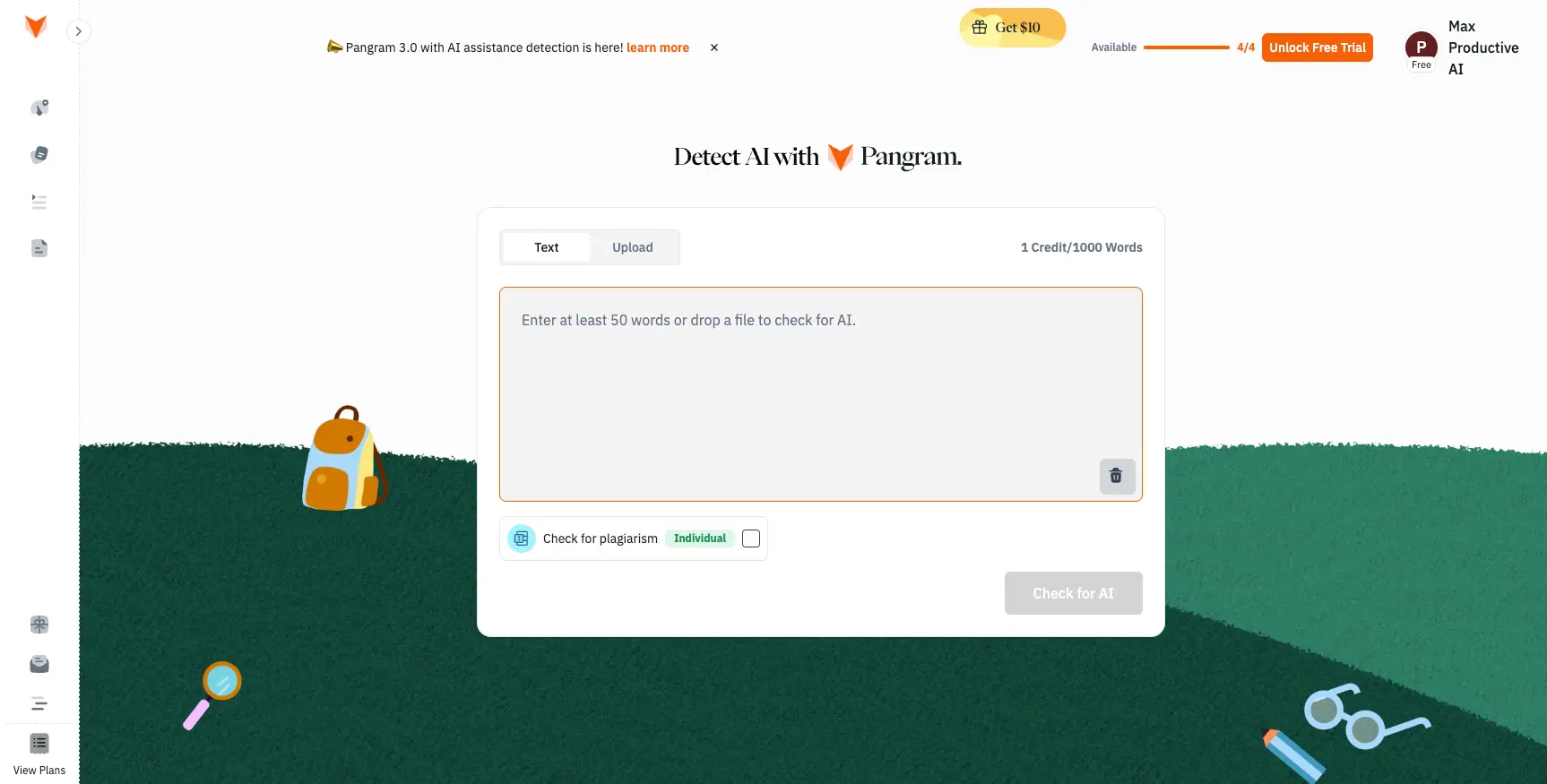
Best-in-Class Detection Accuracy,
Best Used as a Signal — Not a Verdict
Pangram is the most technically serious AI detector we've tested. The new Pangram 4 model doesn't just score a document — it highlights which segments look AI-written, sorts them into four tiers, and names the model that probably produced them. Independent benchmarks consistently place it at or near the top of the category. The catch: no detector can prove authorship, and Pangram's own high-profile false-positive disputes are the clearest proof of that. Used as a screening layer rather than a final judge, it's the strongest accurate AI checker you can start using today for free.
✓ What We Love
- Lowest published false-positive rate in the category
- Tells you which AI model likely wrote the text
- Catches "humanized" AI text most rivals miss
- Free tier with daily text and image scans
! Could Be Better
- Real-world false-positive disputes have made headlines
- New per-100-word billing raised effective API costs
- Image detection is still a research preview
What Is Pangram?
Who built it, what makes it different from every other AI checker, and where its limits genuinely are.
Pangram is an AI detection platform from Pangram Labs, a New York startup founded by Stanford-trained machine learning engineers Max Spero (CEO) and Bradley Emi (CTO), whose résumés run through Google, Tesla Autopilot, and Two Sigma. The company markets itself as "an AI detector that actually works" — a pointed jab at a category with a credibility problem — and its customer list backs up the ambition: Substack, Quora, schools, publishers, law firms, and recruiting teams all use it to verify that content was written by the humans who claim to have written it.
The accuracy claims are aggressive but unusually well-documented for this space. Pangram advertises over 99.98% accuracy with a false-positive rate around 1 in 10,000, and — unlike most vendors — points to outside validation: researchers at the University of Chicago Booth School of Business and the University of Maryland have verified its low false-positive performance under controlled conditions, and it tied for first place on the COLING 2025 academic benchmark. Whether that makes it the best AI detector in 2026 outright is debatable (more on GPTZero's counter-claim later), but it's firmly in the top tier.
What actually separates Pangram from a typical AI checker is the shape of its output. Instead of one binary score, it classifies each segment of a document into four tiers — fully human, lightly AI-assisted, moderately AI-assisted, and fully AI-generated — and then does something almost no competitor offers: it names the model that likely wrote the flagged text, whether that's ChatGPT, Claude, Gemini, Grok, Llama, DeepSeek, or Mistral. Compare that to the coarser pass/fail checker bundled into QuillBot, and the difference in forensic depth is obvious.
Here's the thing, though — accuracy on a benchmark and reliability in the wild are not the same claim. Pangram has been at the center of several publicized false-positive disputes in 2026, including a canceled book contract the author fought back against. We cover this honestly in the cons section, because it's the single most important context for using any detector responsibly. The technology is excellent; the way people use its output is where things go wrong.
The company itself is moving fast. In late July 2026, Pangram Labs closed a $9 million round led by Menlo Ventures (through its Anthology Fund), bringing total funding to roughly $13 million, and within a week it had shipped two major releases: the Pangram 4 text model and a brand-new image detector. It also holds SOC 2 Type II certification, which matters if you're evaluating it for legal, enterprise, or institutional use.
Who Is Pangram Best For?
Editors and publishers screening submissions, teachers checking student work (with due process), hiring managers reviewing writing samples, agencies verifying freelance deliverables, and platform trust-and-safety teams. Basically: anyone whose job now includes the question "did a human write this?" — and who needs a defensible, segment-level answer rather than a vague percentage.
Our Testing
We tested Pangram on the free tier with our own material: a short AI-drafted paragraph and an AI-generated image. The text came back flagged as entirely AI by Pangram 4.0 — correctly — with an upfront caveat that confidence is limited on short samples. The image was identified as AI before Pangram's model even ran, because the tool read the C2PA content credentials embedded by the generator. Both results, including that honest short-text disclaimer, are shown in the screenshots below.
Pangram in Action: Real Screenshots
Screenshots from our own free Pangram account — the text detector, the image detector, and the results they returned.
Text Detector Interface
The main scan screen: paste text or drop a file, and optionally add a plagiarism check
No onboarding maze, no forced tutorial — you land on a text box and a Check for AI button. The interface asks for at least 50 words (fair, since ultra-short samples aren't reliably classifiable), accepts file uploads for PDF, DOCX, and RTF, and shows your remaining daily credits in the header so there's never billing ambiguity. It's one of the least cluttered dashboards we've seen in this category.
Text Detection Result
Our AI-drafted test paragraph, flagged with segment highlighting and an honest confidence caveat
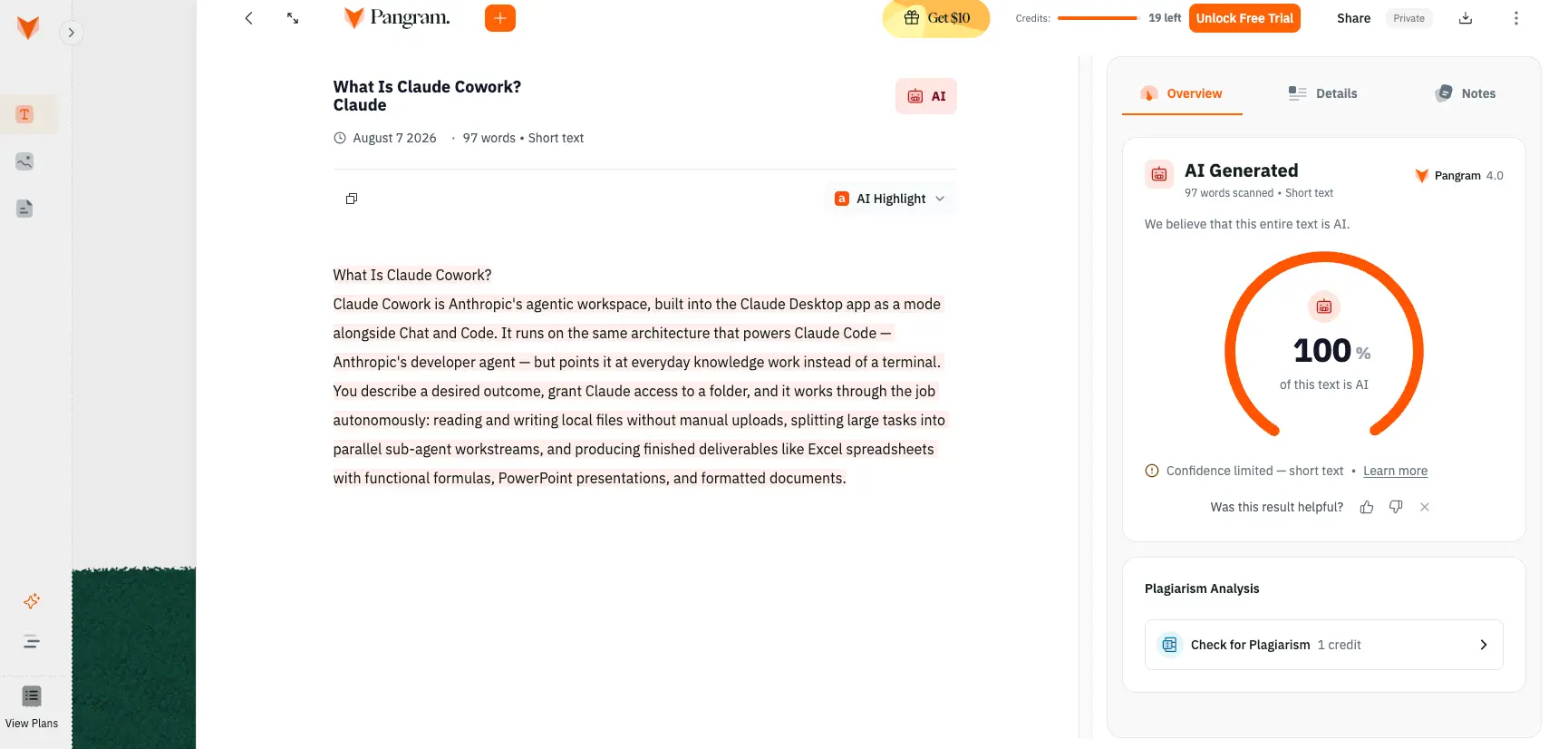
This is our actual test: a 97-word paragraph we drafted with AI, scanned on the free tier. Pangram called it fully AI-generated — correct — and highlighted the flagged text inline via the AI Highlight view. The detail we appreciated most is the small warning underneath the score: "Confidence limited — short text." A detector that volunteers its own uncertainty is a detector taking the false-positive problem seriously, and it's exactly what you want to see before anyone acts on a score.
Curious what Pangram says about your own writing?
Try Pangram →Free daily allowance • Results in secondsImage Detector Upload Tool
The newer half of the platform: drop images or paste a URL to check for AI generation
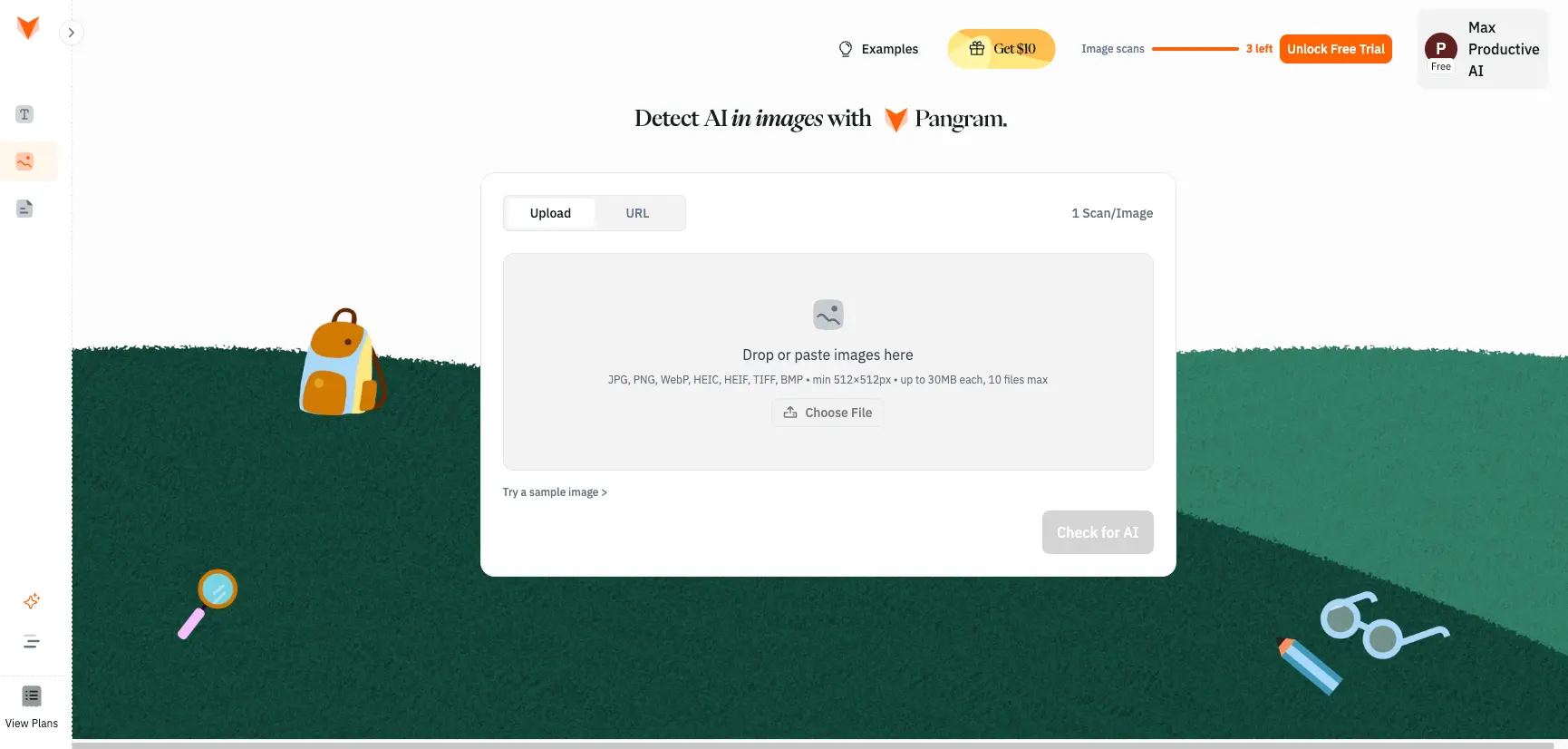
The image tool mirrors the text workflow: drag, drop, done. It takes up to 10 files at once at 30MB each, and the URL tab is quietly useful for checking suspicious images found online without saving them first. Worth noting the minimum resolution requirement — thumbnails and small social avatars are below the floor, which rules out some of the exact use cases (profile photo verification) people will instinctively reach for.
Image Result with C2PA Provenance
Our AI-generated test image, identified via its cryptographic content credentials
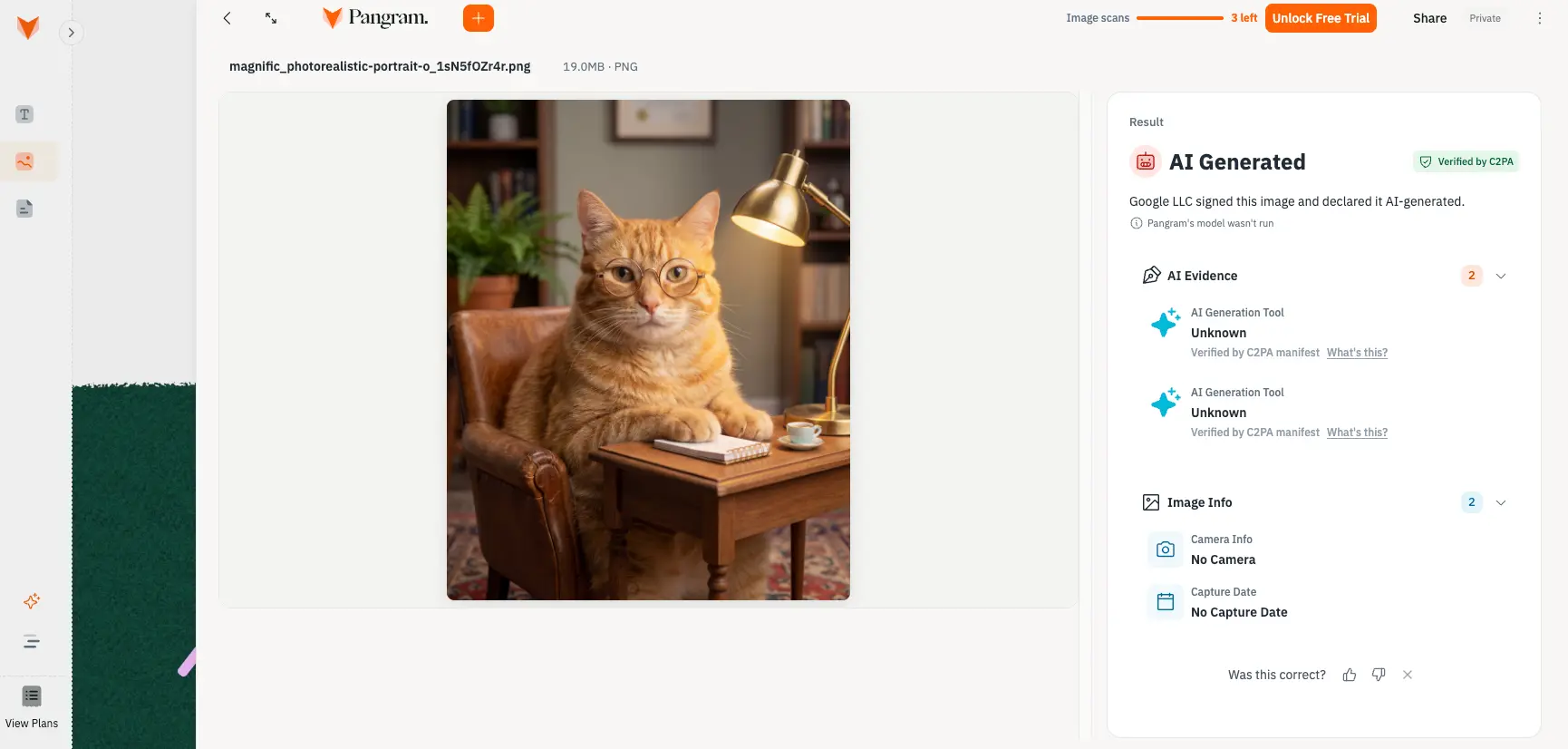
This result surprised us in a good way. Before spending its own model on our test image, Pangram checked the file's C2PA content credentials and found a manifest signed by Google LLC declaring it AI-generated — case closed, verdict delivered, with a note that Pangram's model wasn't even run. The evidence panel also confirms the absence of camera info and a capture date. Layering cryptographic provenance under machine-learning detection is exactly the right architecture, because a signed manifest is proof in a way a probability score never can be.
How Pangram Works
From paste to verdict in under a minute — here's the actual workflow, step by step.
Paste Text or Upload Files
Drop in anything from a 50-word paragraph to a full manuscript. Pangram accepts PDF, DOCX, and RTF uploads, and educators can batch up to 100 files in one go — a whole class set of essays in a single pass. Detection works across more than 20 languages, so a Spanish essay or French article doesn't need a separate tool.
Get a Four-Tier Analysis
Rather than a single number, Pangram returns a document-level score plus segment-by-segment classification: fully human, lightly AI-assisted, moderately AI-assisted, or fully AI-generated. The AI Highlight view marks flagged passages inline, so you can see exactly where the suspicious writing starts and stops. That distinction between "used AI to polish" and "generated wholesale" is the difference between a conversation and an accusation.
Dig Into the Evidence
On flagged content, Pangram can attribute the text to a likely source model — ChatGPT, Claude, Gemini, and the rest of the frontier lineup. Paid plans bundle a plagiarism check into the same scan, producing one combined authenticity report instead of two separate tool runs. Results can be shared, which matters when a score needs to travel to a department head or an editor.
Extend Beyond the Web App
The Chrome extension lets you right-click any text on X, LinkedIn, Substack, Reddit, or Medium for an instant label, and can even scan an entire social feed to estimate its human-vs-AI ratio. The image detector handles visual content, LMS integrations (Canvas, Brightspace, Moodle, Google Classroom) bring detection into grading workflows, and the API puts the same engine inside your own product.
A Signal, Not a Verdict
This applies to every detector, and Pangram is no exception: detection is probabilistic pattern-matching, not a database match. A high score means "this writing strongly resembles AI output" — it does not prove a specific person used AI. Before any consequential decision (a grade, a contract, a hire), pair the score with drafts, edit history, and a conversation with the writer. Pangram's segment-level output makes that follow-up conversation easier, which is precisely why we prefer it to binary-score tools.
It Flags Its Own Uncertainty
Scan a short sample and Pangram tells you, right under the score, that confidence is limited. It's a small design choice with big implications: the tool actively discourages over-reading its own results on thin evidence. Most competitors happily print a confident-looking percentage on a 60-word snippet.
Key Features
What you get with Pangram 4.0 and the toolkit built around it.
Pangram 4 Detection Engine
The August 2026 flagship model — over six times larger than Pangram 3 — is the first that can separate AI-edited writing from interleaved human-AI content in one pass. Internally reported false-positive rate: 0.0041%, roughly 1 in 24,000 documents. The older model retires on September 30, 2026.
Model Attribution
Pangram's signature trick: it names the LLM that likely wrote a flagged passage — ChatGPT, Claude, Gemini, Grok, Llama, DeepSeek, Mistral. No other mainstream detector offers this, and for editorial or legal contexts it turns a vague suspicion into a specific, checkable claim.
Four-Tier Segment Highlighting
Every segment gets classified along a spectrum from fully human to fully AI-generated, with two AI-assisted tiers in between. In a world where most people write with AI rather than by AI, that nuance is the feature — a binary score can't tell a polished paragraph from a fabricated one.
Humanizer Resistance
Paraphrasing tools that "humanize" AI text are the standard evasion play, and they defeat a lot of detectors. Pangram 4 catches AI involvement in humanizer-processed text 98.83% of the time across 13 commercial humanizing tools — an area the new model was explicitly built for.
Pangram Image Detection
A research-preview model on the DINOv3 vision architecture covering GPT Image, Gemini, Midjourney, FLUX, and video frames from Kling, Seedance, Veo, and Wan — with a 0.16% false-positive rate on a pre-2022 human-photo dataset. It also reads C2PA content credentials before running detection. Honest take: promising, but treat it as a preview, not a production tool.
Browser Extension
Right-click any text on X, LinkedIn, Substack, Reddit, or Medium and get an instant AI label — or scan a whole feed for its human-vs-AI breakdown. Slightly depressing as a pastime, genuinely useful as a reflex for anyone vetting sources or freelancers.
LMS & Classroom Integrations
Native connections for Canvas, Brightspace, Moodle, Google Classroom, and Google Docs, plus batch scanning of up to 100 files at once. For teachers, the combination of segment highlighting and assisted-vs-generated tiers supports a conversation with the student rather than a bare accusation.
Plagiarism + Multilingual Detection
Paid scans bundle a plagiarism check into the same report, so authenticity and originality get answered together. Detection quality holds across Spanish, French, Arabic, and dozens more languages — a real gap in this category, where several big names are English-first or English-only.
There's also a REST API with a Python SDK for teams building detection into their own products — the same engine Substack and Quora rely on at platform scale. Between the web app, extension, LMS hooks, and API, Pangram covers more surfaces than any other detector we've looked at; the closest rival ecosystems each miss at least one of those four.
Every feature above can be tested on the free tier before you pay anything:
Try Pangram →Upgrade only if you need volumePangram Labs Pricing
A real free tier, two flat individual plans, and an API priced per word. Here's how it breaks down.
Free
- ✓ 2,000 words of text scans per day
- ✓ 3 image scans per day
- ✓ AI-assistance detection tiers
- ✓ Chrome extension
- ✓ File upload with OCR
- ✓ No credit card required
Individual
- ✓ 300,000 words per month
- ✓ 100 image scans per month
- ✓ Bundled plagiarism reports
- ✓ Model attribution
- ✓ Batch uploads (up to 100 files)
- ✓ Multilingual detection included
Professional
- ✓ 1,500,000 words per month
- ✓ 500 image scans per month
- ✓ $200 of included API credit
- ✓ Everything in Individual
- ✓ Built for heavy editorial volume
Worth knowing: billing moved from per-1,000-word to per-100-word increments with the Pangram 4 rollout — a real cost increase for long documents on the API, partly offset by image scans now being included on every plan
Pricing last verified August 2026. Visit Pangram for current rates.
Is It Worth the Money?
The $20 Individual plan works out to about 6.7 cents per 1,000 words — a fraction of what the same volume costs through the API. For casual spot-checking, the free daily allowance is honestly all most people need. The math only argues for paying once you're screening submissions, essays, or freelance work regularly.
For context against the competition: GPTZero's Essential plan runs $14.99/month ($8.33 on annual billing) for 150,000 words — cheaper, but half the volume and no image scans. Originality.ai starts around $14.95/month with no free detector tier at all. Turnitin doesn't sell to individuals, period. And QuillBot Premium is the budget option at roughly $8.33/month annually, but its detector is a bundled extra rather than the main event. Pangram costs a few dollars more than the pure-text rivals and justifies it with accuracy headroom, image detection, and that free tier for trying before buying.
Detailed Pros & Cons
The honest breakdown — including the controversies most Pangram reviews skip past.
✓ Pros
University of Chicago Booth researchers found Pangram to be the only detector meeting a strict sub-0.5% false-positive policy cap without giving up detection power. In blind, crowdsourced pairwise testing on DetectArena, it won 45 of 62 head-to-head matchups against Originality.ai. If your priority is not wrongly accusing a human, this is the strongest starting position available.
Model attribution changes what a detection result is worth. "This looks like AI" invites an argument; "this matches Gemini's output patterns" invites a specific question. For editors, integrity officers, and legal teams, that specificity is the difference between a hunch and evidence worth acting on.
Most people in 2026 write with AI somewhere in the loop. Pangram's lightly-assisted and moderately-assisted tiers acknowledge that reality instead of collapsing everything into guilty-or-innocent. A student who used AI to fix grammar and a student who generated the essay wholesale get visibly different results — as they should.
The company tested 13 commercial humanizer tools against Pangram 4 and caught AI involvement in the high nineties, percentage-wise. Several rivals drop below 70% on the same category of adversarial text. Since paraphrase-to-evade is the single most common bypass tactic, this is arguably the most practically important benchmark of all.
Daily text and image allowances, sentence-level highlighting, the browser extension — all without entering a card. That's enough to run real spot-checks indefinitely, and more importantly, enough to calibrate the tool against your own known-human writing before you trust it with anyone else's.
Pangram 4 and the image detector shipped in the same week, right after a $9 million round led by Menlo Ventures. Detection is an arms race against ever-improving generators; a detector that isn't iterating quickly is a detector that's quietly going stale. Pangram is visibly not that.
✗ Cons
In 2026, publisher Hachette canceled a novel after Pangram flagged most of the manuscript as AI-generated — a decision the author disputed and a Wall Street Journal opinion piece sharply criticized, arguing the evidence didn't support the claim. Separately, a 2025 University of Maryland/Microsoft study measured a roughly 2% false-positive rate under certain conditions, well above the marketed figure. The tech is strong; the marketing sets expectations the real world doesn't always meet.
Academic benchmarks love Pangram; a small pool of Trustpilot reviewers does not (averaging 2.4/5 across just 13 reviews at the time of writing). The complaints follow a pattern — personal essays and dissertations flagged as fully AI, plus reports of identical text scoring differently on reruns. Small sample, but a consistent theme worth knowing before you rely on a single scan.
GPTZero's Writing Replay reconstructs how a document was actually typed from Google Docs and Word edit history — a paper trail that can exonerate an accused student in a way no probability score can. Pangram offers nothing comparable. For classroom disputes specifically, that's a meaningful gap.
Switching from per-1,000-word to per-100-word billing sounds like an accounting detail, but it raised effective API costs 1-2x on short documents and up to 10x on long ones. Image scans being added to every plan softens the blow for subscribers; high-volume API customers got a genuine price hike.
The benchmarks are impressive, but the limitations list is long: a minimum resolution floor that excludes small images, no reliable deepfake or face-swap detection, and NSFW content blocked outright. It's a compelling glimpse of where the platform is going — just don't build a moderation workflow on it yet.
This is a category-wide truth, but Pangram's own public use of its results — including research that implicated named journalists — has drawn due-process criticism from the very outlets it flagged. When the vendor itself blurs the line between signal and verdict, users need to be the adults in the room. Screen with it, investigate with it, but don't convict with it.
Pangram Alternatives
How Pangram stacks up against the other detectors — and the adjacent writing tools people weigh alongside it.
| Feature | Reviewed Pangram | GPTZero | Turnitin | QuillBot |
|---|---|---|---|---|
| Starting Price | Free / $20/mo | Free / $14.99/mo | Institutional only | Free / $8.33/mo annual |
| Free Tier | Daily words + image scans | 10,000 words/mo | None | Basic detector included |
| Model Attribution | ✓ Unique feature | — | — | — |
| Segment Highlighting | ✓ Four-tier | ✓ | ✓ | Coarser |
| Image Detection | ✓ (research preview) | Document/OCR uploads only | — | — |
| Humanizer Resistance | Strongest tested | Good | Conservative but reliable | N/A — sells a humanizer |
| Edit-History Evidence | — | ✓ Writing Replay | — | — |
| LMS Integration | Canvas, Moodle, Classroom+ | Canvas, Classroom, Moodle | Deepest (native) | None |
| Best For | Forensic accuracy, publishers | Classrooms, evidence trails | Licensed institutions | Writing suite + sanity checks |
Which Tool Is Right For You?
The first three below are direct detection alternatives. The last three — Grammarly, Sudowrite, and MagicPost — sit on the other side of the same workflow: tools for producing writing that people then run detectors against. Knowing both sides is useful whichever one you're on.
Pangram
ReviewedBest for: Anyone who needs the most defensible answer available to "did AI write this?" — publishers screening submissions, editors vetting freelancers, integrity officers who understand a score is a starting point. The combination of top-tier benchmark accuracy, model attribution, and tiered highlighting is unmatched in the category, and the free tier means testing it costs nothing but time.

GPTZero
Education FocusBest for: Teachers who want evidence beyond a probability score. GPTZero's Writing Replay reads Google Docs and Word edit history to show how a document was actually typed over time — the single best due-process feature in this market. On the February 2026 Chicago Booth benchmark it even edged Pangram (99.5% vs 99.1%), though independent real-world tests have measured much rougher accuracy on mixed and humanized samples. The free tier covers 10,000 words a month.

Turnitin
InstitutionalBest for: Universities already paying for it. Turnitin's LMS integration is the deepest in education, but it's deliberately conservative — its own Chief Product Officer has said real-world detection sits closer to 85%, a trade-off made to keep false positives low — and it supports only three languages. There's no individual access at all, and several universities have disabled its AI feature over reliability concerns. If you have it, use it as a first pass and cross-check flags with Pangram or GPTZero.
QuillBot
Writing SuiteBest for: Writers who mainly want paraphrasing, grammar correction, and summarizing, with an occasional AI sanity-check on the side. QuillBot's detector runs around 78% accuracy on standard AI text and closer to 60% on hybrid content — fine for a quick gut check, nowhere near forensic grade. And if you're eyeing its Humanizer to slip past detectors: don't bother, the bypass rates are poor and Pangram 4 was built specifically to catch it.
Grammarly
Grammar + AuthorshipBest for: Everyday grammar, clarity, and tone work — the classic grammar checker role that detection tools don't fill. Notably, Grammarly's Authorship feature tracks how a document comes together as you write it, giving students and professionals a proactive way to demonstrate their work is their own before anyone runs a detector on it. Prevention beats dispute.

Sudowrite
Fiction WritingBest for: Novelists and fiction writers using AI as a creative collaborator. It's the mirror image of this review's subject — and given how detection disputes have hit the publishing world, fiction writers working with AI assistance should keep drafts, notes, and version history as a matter of routine. If your manuscript ever gets scanned, process evidence is your best defense.
MagicPost
LinkedIn ContentBest for: Creators producing LinkedIn content at volume. Worth mentioning here because Pangram's browser extension can scan social feeds for AI content — LinkedIn very much included — so anyone publishing AI-assisted posts should assume readers can check. The bar for AI-assisted content that still sounds like you keeps rising, and that's ultimately a good thing.
Frequently Asked Questions
Should You Try Pangram?
If AI detection matters to your work, Pangram is the tool to start with. The underlying technology is the strongest in the category by most independent measures, and the output — tiered segments, inline highlighting, model attribution — is built for people who need to explain a result, not just wave a percentage around. Add a working free tier and an image detector no direct rival matches, and the 4.5 rating writes itself on technical merit.
The half star we held back is about the gap between lab and life. Documented false-positive disputes, polarized user reviews, and the company's own occasionally aggressive use of its results are all reminders that this is a probabilistic instrument in a world that wants certainties. That's not a reason to skip Pangram — it's a reason to use it the way its best customers do: as the first step in a review process, never the last word.
Our Recommendation
Start on the free tier and calibrate before you trust: run several pieces of your own past writing — work you know is fully human — through it first. If your genuine writing comes back clean, you've established a baseline and can use Pangram confidently as a screening layer. Upgrade to the $20 Individual plan only when your volume demands it, and pair any consequential flag with drafts, edit history, and an actual conversation.