
Lovable vs Bubble: Which AI App Builder Should You Use in 2026?
One generates real React code you own forever. The other lets you build visually without writing a single line. Here's how to choose the right AI app builder for your project.
Choose Lovable
If you're a technical founder or startup that needs a working prototype fast, wants full code ownership on GitHub, and plans to eventually hand the codebase to a development team.
Choose Bubble
If you're a non-technical founder building for the long term, need complex workflows and role-based logic, want native mobile apps, and prefer a fully managed environment with zero DevOps.
| Feature | Lovable | Bubble |
|---|---|---|
| Best For | Technical founders, rapid MVPs, startups | Non-technical founders, complex SaaS, marketplaces |
| Starting Price | $25/mo (Pro) | $69/mo (Starter) |
| Key Strength | Real React code + full GitHub ownership | Visual everything + native mobile (beta) |
| Code Export | Full React/TypeScript codebase | None — platform-locked |
Building a web application used to take months and a team of developers. In 2026, AI app builders have compressed that timeline to hours — but the two leading platforms take fundamentally different approaches to getting you there.
In this in-depth Lovable vs Bubble comparison, we break down architecture, pricing, features, scalability, and real-world use cases to help you choose the best AI app builder for your project. These tools solve the same problem — turning your idea into a working application — but from opposite directions: Lovable generates real, exportable code through AI conversation, while Bubble lets you build visually with drag-and-drop, never producing a single line of code.
After hands-on testing of both platforms, the verdict is clear: neither is universally better. The right choice depends on whether you value code ownership and speed, or visual control and long-term self-sufficiency.
What Is Lovable?
Lovable is an AI-powered app builder founded in 2023 that generates complete full-stack web applications from natural language prompts. You describe what you want in plain English, and the AI produces a real React/TypeScript/Tailwind CSS application backed by Supabase for the database and authentication layer — complete with a codebase you can sync bidirectionally to GitHub and hand off to any developer.
The growth numbers speak for themselves: Lovable reached $20M ARR in its first two months — the fastest growth in European startup history. By Q4 2025, the platform had scaled to $200M ARR, surpassed 8 million global users, and was valued at approximately $6.6 billion. In February 2026, Lovable 2.0 launched with real-time multi-user collaboration, a visual editing layer, and direct code editing inside the platform.
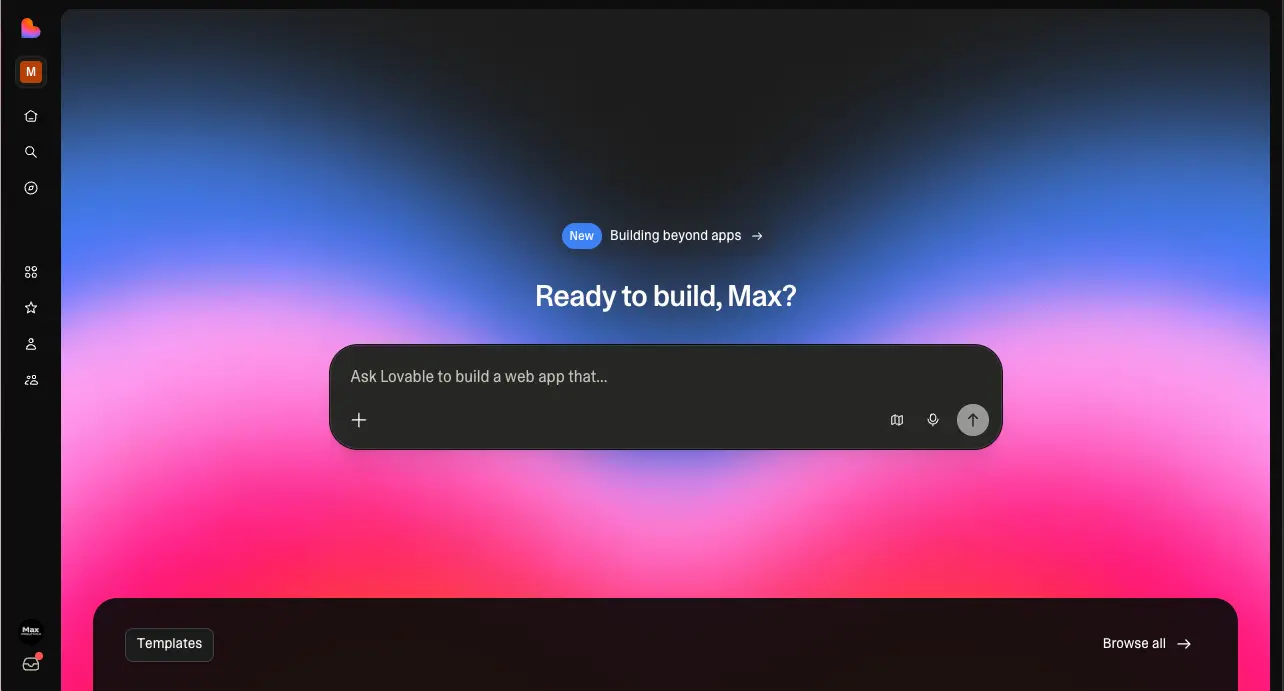
How Lovable Works: Three Operating Modes
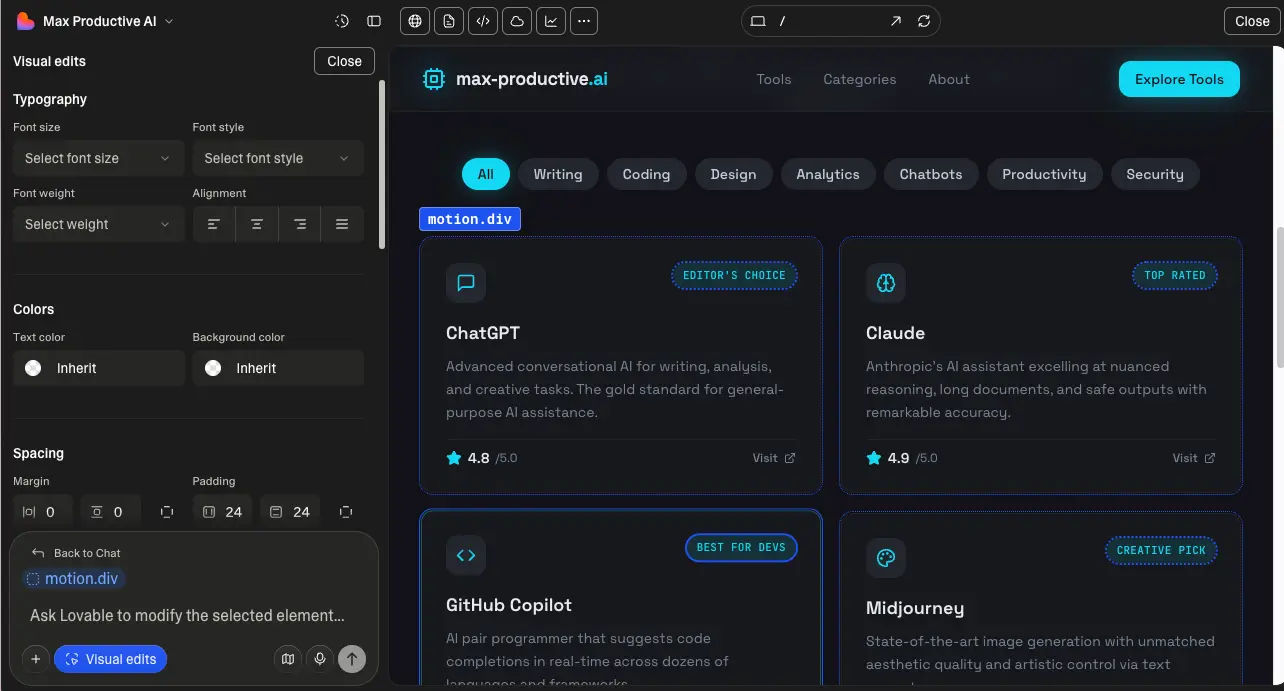
Lovable offers three distinct ways to build, each suited to different stages of your project. Agent Mode is the autonomous powerhouse — it explores your codebase independently, proactively debugs issues, uses real-time web search, and makes multi-file edits without you steering every step. Chat Mode takes a more collaborative approach, planning features and reasoning through problems in multiple steps before writing code — reducing wasted credits on wrong approaches. And Visual Edits lets you click directly on elements to change text, colors, fonts, margins, and padding without writing prompts or touching code.
Code Ownership: Lovable's Key Differentiator
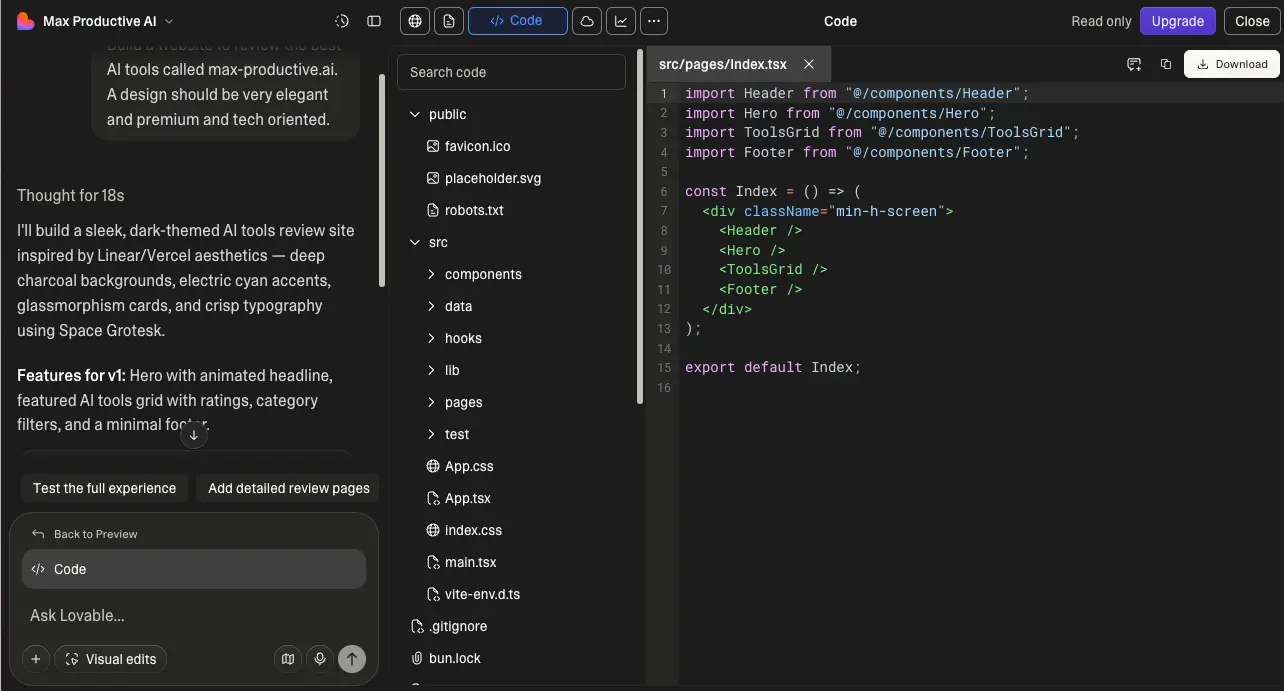
The single biggest advantage Lovable holds over every no-code platform is this: you own the code. Every Lovable app is a real React/TypeScript project synced to GitHub with bidirectional real-time sync. Changes made locally in tools like Cursor or VS Code are automatically pulled back into Lovable. This means you can start with AI-generated code, then bring in a developer to extend it — or take the entire codebase and move to any hosting environment. Zero vendor lock-in.
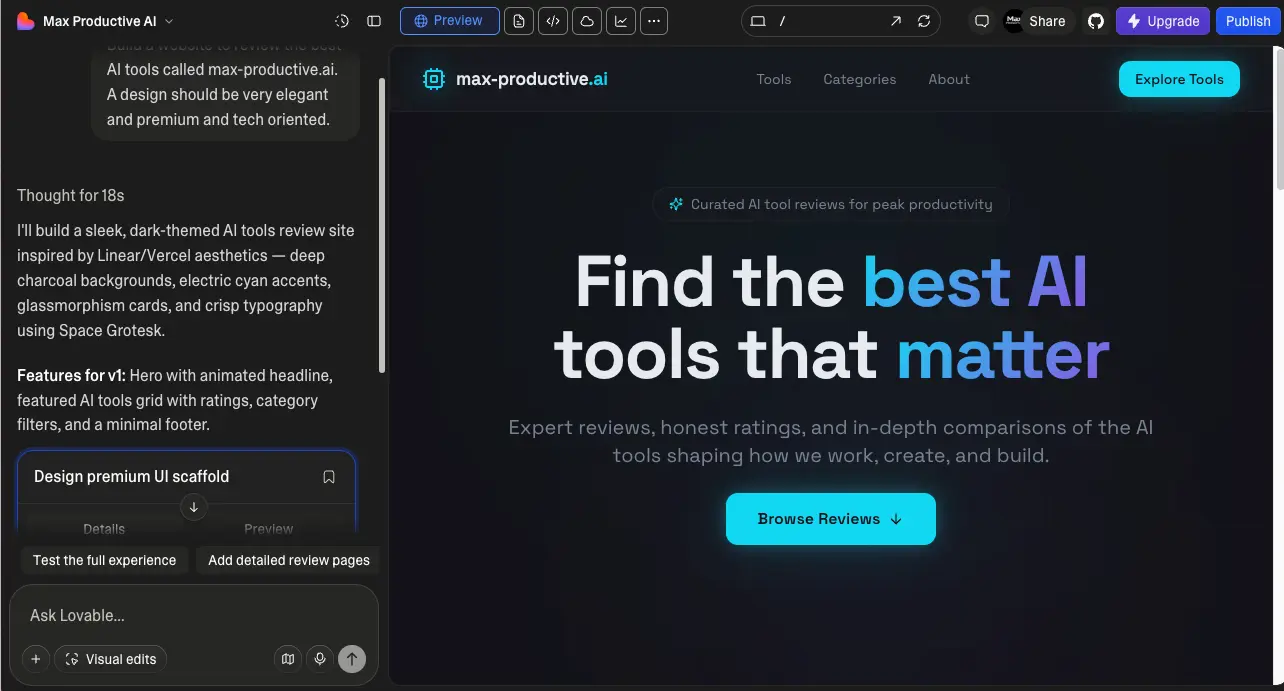
The platform also includes a growing ecosystem of shared connectors (Stripe, Shopify, Slack, Twilio, Linear, Telegram, and more) and personal connectors via MCP servers (Notion, Linear, Miro) that give Lovable context while building. Since the generated code is standard React, you also get full access to the entire npm package ecosystem — install any library your project needs.
What Is Bubble?
Bubble is a visual no-code development platform founded in 2012, making it one of the most mature and proven tools in the entire no-code space. It uses a drag-and-drop visual editor paired with a graphical workflow builder, a built-in database, and fully managed hosting infrastructure — all without generating or requiring any code. Every piece of application logic lives inside Bubble's visual environment.
The scale is substantial: over 3 million registered users have launched 7.2 million applications, with Bubble apps collectively transacting more than $1 billion per year. The platform is SOC 2 Type II and GDPR compliant, and in October 2025, Bubble launched its AI Agent — a conversational AI that can build and edit your app alongside the visual editor, marking a major step in combining no-code with AI assistance.
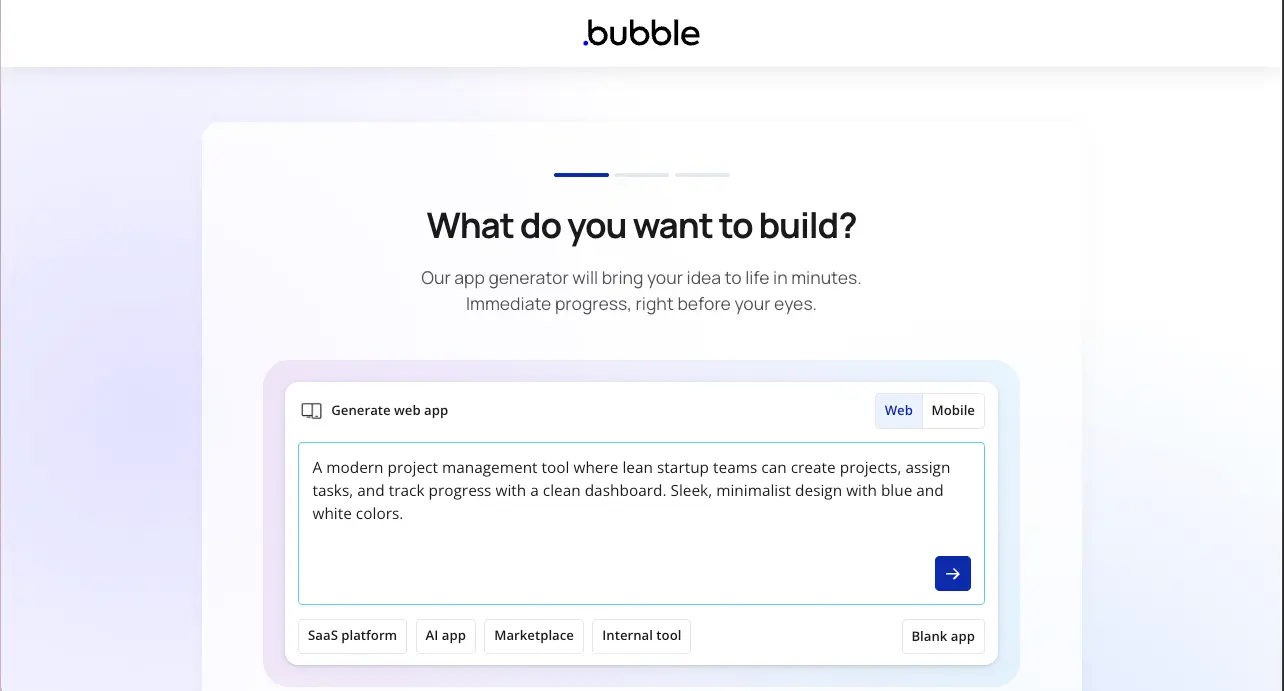
Bubble's AI Tools: The Visual Approach to AI Building
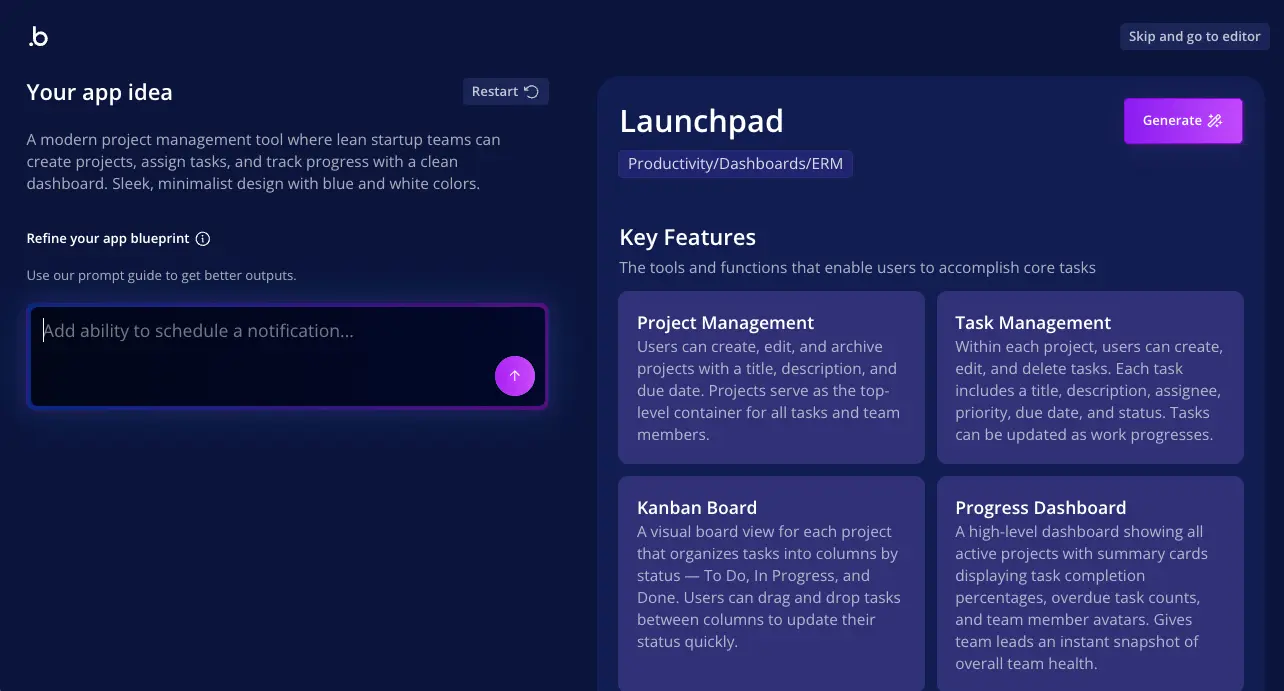
Bubble now offers three AI-powered features that work within its visual paradigm. The AI App Generator lets you enter a prompt and generates an "app blueprint" — a preview of features, data types, and workflows — for your review before building anything. Once you approve, it generates a complete application (frontend UI, backend database, and all workflow logic) in approximately 5–7 minutes.
The AI Agent (launched October 2025, expanding to all existing apps by end of March / early April 2026) is a conversational assistant that generates and edits UI, dynamic expressions, data types, and workflows through chat — while everything it creates remains fully editable in the visual editor. Unlike Lovable, where the AI produces code, Bubble's AI produces visual, inspectable elements that any non-technical team member can understand and modify.
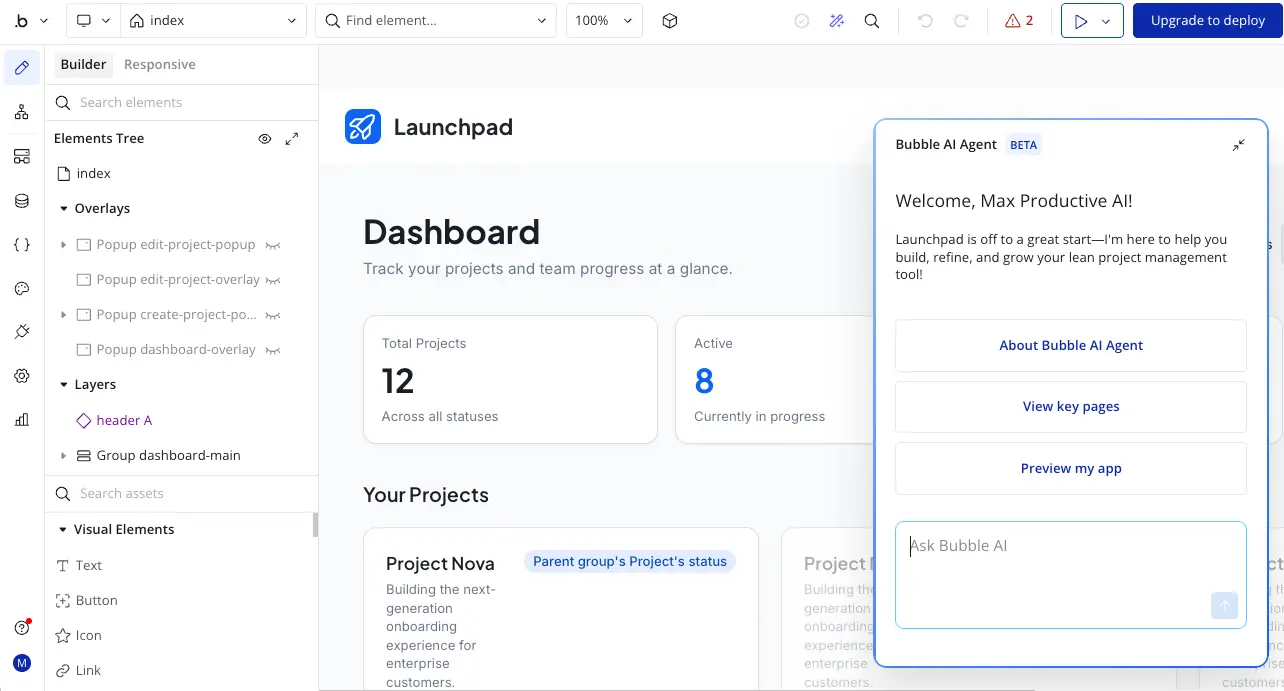
Visual Everything: Bubble's Key Differentiator
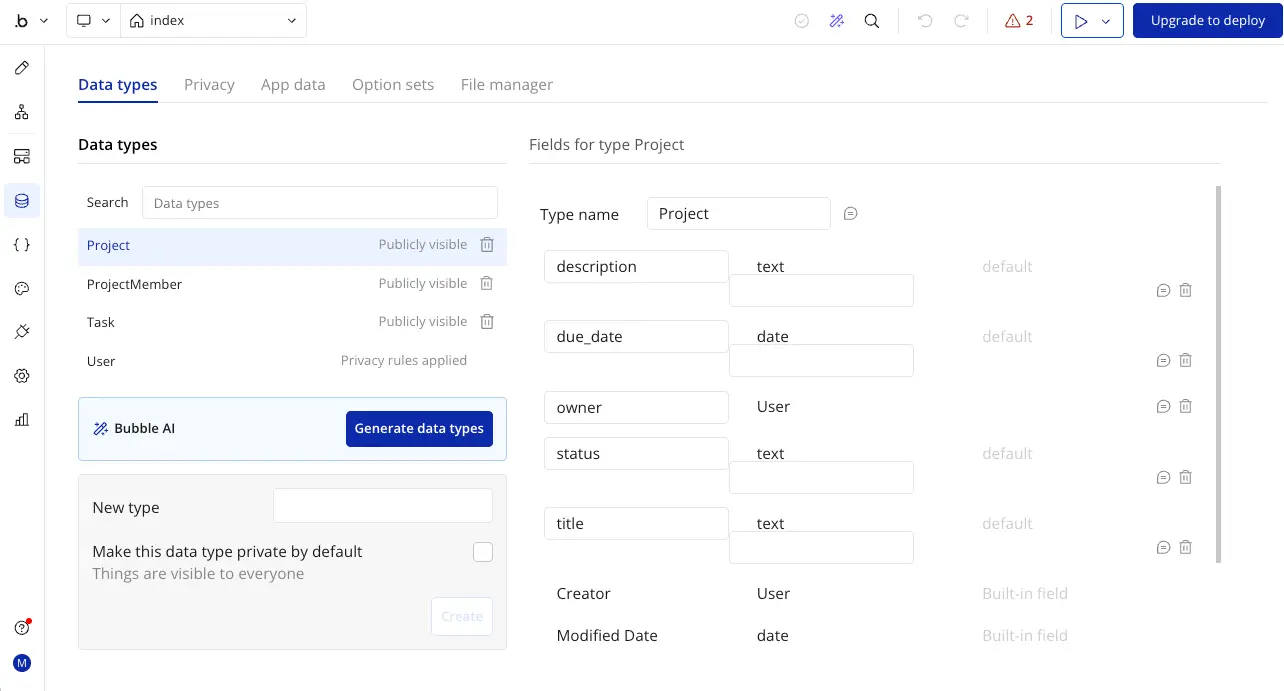
Where Lovable's power is code ownership, Bubble's power is visual transparency. Every workflow, every database relationship, every conditional rule is visible and editable through a graphical interface. A non-technical founder can read, understand, and modify their entire app's logic — from simple form submissions to complex multi-step approval chains — without ever reading a line of code.
The ecosystem around Bubble is also significantly more mature: over 1,000 plugins (Stripe, OpenAI, Twilio, Google Maps, and thousands more), native Figma import, a built-in API connector for any REST API, and 14 years of community resources including Bubble Academy, an extensive manual, an active forum, coaching programs, and bootcamps.
Technology & Architecture
Understanding what's under the hood matters — it determines what you can build, how you scale, and what happens if you ever need to move off the platform.
| Layer | Lovable | Bubble |
|---|---|---|
| Frontend | React + Tailwind CSS + Vite | Proprietary visual engine |
| Backend logic | Generated TypeScript code | Visual workflow system |
| Database | Supabase (PostgreSQL) | Built-in relational database |
| Authentication | Supabase Auth | Built-in (2FA, SSO, social login) |
| Hosting | Lovable Cloud / Vercel / Netlify | Fully managed AWS infrastructure |
| Code sync | GitHub (bidirectional, real-time) | Built-in visual version control |
| Mobile apps | Web only (responsive) | Native iOS/Android (React Native, beta) |
| Code export | Full React/TypeScript codebase | None — no source code exists |
Feature-by-Feature Comparison
Build Experience & Design
| Feature | Lovable | Bubble | Winner |
|---|---|---|---|
| Time to first prototype | ~90 minutes | 1–3 months to proficiency | Lovable |
| AI-generated UI quality | Best in class (Tailwind + shadcn/ui) | Functional, requires styling effort | Lovable |
| Design customization depth | Limited visual edits; most via AI chat | Full drag-and-drop, pixel-level control | Bubble |
| Figma import | Via third-party plugin | Native direct import | Bubble |
| Responsive design | Auto-generated, mobile-responsive | Manual responsive engine per breakpoint | Tie |
| Learning curve | Minutes (describe in plain English) | 1–3 months of consistent effort | Lovable |
Backend, Logic & Data
| Feature | Lovable | Bubble | Winner |
|---|---|---|---|
| Workflow / logic builder | Logic lives in code (AI or Dev Mode) | Visual graphical workflow builder | Bubble |
| Database management | Supabase (external, user-managed) | Built-in, fully managed | Bubble |
| Authentication | Supabase Auth (standard flows) | Built-in (2FA, SSO, social login) | Bubble |
| Security rules setup | Via Supabase dashboard (technical) | Visual privacy rules (no code) | Bubble |
| Code ownership | Full — React/TypeScript on GitHub | None — proprietary format, no export | Lovable |
| API integration | REST API via code or prompts + npm | Native API Connector (no code) + 1,000+ plugins | Bubble |
| Complex conditional logic | Difficult via AI chat for non-technical users | Visual workflows handle complex logic natively | Bubble |
Platform & Infrastructure
| Feature | Lovable | Bubble | Winner |
|---|---|---|---|
| Native mobile apps | Not available (web only) | iOS + Android (React Native, beta) | Bubble |
| Hosting management | User manages (or Lovable Cloud) | Fully managed AWS infrastructure | Bubble |
| Plugin / integration ecosystem | Growing connectors + full npm access | 1,000+ expert-maintained plugins | Bubble |
| Collaboration | Up to 20 users, unlimited seats (paid) | Real-time editing, seat caps by plan | Tie |
| Version control | GitHub (bidirectional sync) | Built-in visual versioning + rollback | Tie |
| Security certifications | SOC 2 Type II + ISO 27001:2022 | SOC 2 Type II + GDPR/DPA | Tie |
| Community & education | Growing docs, YouTube | 14-year ecosystem: Academy, forum, coaching | Bubble |
Pricing Comparison (March 2026)
Lovable Pricing
| Plan | Monthly | Annual | Credits/Mo | Key Features |
|---|---|---|---|---|
| Free | $0 | $0 | 30 (5 daily) | Public projects only, Lovable badge |
| Pro | $25/mo | ~$21/mo | Up to 150 | Custom domains, private projects, rollover |
| Business | $50/mo | ~$42/mo | Up to 150 | SSO, team workspace, design templates |
| Enterprise | Custom | Custom | Custom | Dedicated support, compliance add-ons |
How credits work: Each AI interaction consumes credits. Routine prompts typically cost less than 1 credit, while complex generation or debugging may consume 1–2+ credits per interaction. Credits roll over on paid plans. Additional credit top-ups are available — for example, scaling from 100 to 400 monthly credits on the Pro plan costs $100/month total.
Unlimited team members on all paid plans with no per-seat pricing — a notable advantage for growing teams.
Bubble Pricing
| Plan | Monthly | Annual | Workload Units | Editors |
|---|---|---|---|---|
| Free | $0 | $0 | 50,000 | 1 |
| Starter | $69/mo | $59/mo | ~175,000 | 1 |
| Growth | $249/mo | $209/mo | ~250,000 | 2 |
| Team | $649/mo | $549/mo | ~500,000 | 5 |
| Enterprise | Custom | Custom | Custom | Unlimited |
How Workload Units work: WU represents the server computing resources consumed by your app. Every database query, workflow execution, API call, file upload, and page load consumes WU. Overage rates are $0.30 per 1,000 WU without a pre-purchased add-on. Bubble includes hosting, database, authentication, and security management in the plan price — no separate infrastructure costs.
Mobile included: The native mobile builder (iOS + Android) is available at the same pricing on all paid plans.
Pricing Reality Check: Side-by-Side
| Scenario | Lovable | Bubble |
|---|---|---|
| Testing / learning | $0 (deploys live) | $0 (no live deployment) |
| Solo founder, live MVP | ~$50/mo ($25 + $25 Supabase) | $69/mo all-in |
| Small team (2–3 people) | $25–50/mo + infrastructure | $249/mo (Growth) |
| Production app scaling | Variable (credits + hosting) | $249–649/mo + WU add-ons |
Pros and Cons
Lovable
Pros
- Fastest time to working prototype — functional app in ~90 minutes
- Full code ownership: real React/TypeScript exported to GitHub
- Best AI-generated UI aesthetics via Tailwind CSS + shadcn/ui
- Bidirectional GitHub sync for hybrid AI + developer workflow
- Unlimited team members at no per-seat cost
- SOC 2 Type II + ISO 27001:2022 certified
- Lovable 2.0: real-time collaboration, Visual Edits, Dev Mode
- Growing connector ecosystem (Stripe, Twilio, Notion, Linear, etc.)
- Full npm ecosystem access — install any React library
- Zero vendor lock-in — take your code anywhere
Cons
- Credit consumption can be unpredictable during debugging cycles
- Free tier limited to 5 credits/day (non-rolling) for evaluation
- No native mobile app output (web/responsive only in 2026)
- Visual editor covers only a subset of UI properties
- Complex backend logic can challenge non-technical users
- Infrastructure management (Supabase, hosting) is the user's responsibility
- Community resources still maturing compared to Bubble's 14-year ecosystem
- Data training opt-out requires Business or Enterprise plan
- Realistic annual TCO ($1,800–$5,000) often higher than plan price suggests
Bubble
Pros
- Fully visual — no code required for design, logic, database, or auth
- Visual workflow builder handles complex conditional logic transparently
- All-in-one: hosting, DB, auth, security — fully managed, zero DevOps
- Scales to approximately 100,000 daily active users
- Native mobile builder (iOS + Android, public beta) from the same editor
- 1,000+ plugins for instant integrations
- SOC 2 Type II + GDPR compliant with enterprise AWS infrastructure
- Mature 14-year ecosystem: Academy, forum, coaching, bootcamps
- AI Agent for conversational building within the visual editor
- Any team member can read and edit workflows — no developer needed
Cons
- No code export — vendor lock-in; migration requires full rebuild
- Steeper learning curve: 1–3 months to build confidently
- WU pricing can be difficult to predict; costs may rise with traffic
- Complex apps can become fragile as small logic changes ripple across workflows
- 50,000 item hard limit for sorted database searches
- Proprietary visual format limits standard developer handoff
- Mobile builder still in beta with some feature limitations
- Higher entry price floor ($69/mo vs. $25/mo for production)
- Editor seat caps on lower plans (Growth = 2, Team = 5)
Real-World Use Cases & Success Stories
When Lovable Wins
Lovable shines when speed to market and code ownership are the priorities. The Brazilian EdTech platform Qconcursos built a premium version in just two weeks using Lovable — and generated $3M in revenue within 48 hours of launch. Plinq, a women's safety app, was built by a non-engineer and reached $456K ARR in months. The One Love Foundation used Lovable to build a donation platform that raised $150,000 (50% above target) with over 200 monthly recurring donors.
The pattern is consistent: founders who need to validate an idea quickly, show investors a working product, or build an MVP that can later be handed to a development team find Lovable's approach compelling. The React codebase on GitHub is already a standard project that any developer can take over.
When Bubble Wins
Bubble excels where complex business logic, multi-user workflows, and long-term non-technical independence matter most. My AskAI — an AI-powered SaaS serving 40,000+ businesses — is built entirely on Bubble. Flexiple, a freelance marketplace, has processed over $6M in talent payments through its Bubble-built platform. The conference app Create With was built in just 3 days and achieved 95% attendee adoption.
Bubble's sweet spot is two-sided marketplaces, role-based SaaS applications, multi-tenant platforms, and any project where a non-technical founder wants to maintain full control over their application's logic and evolution without ever needing a developer.
Who Should Choose Each Tool?
Choose Lovable If You Are:
- A technical founder or have developers on your team (or plan to hire them)
- Building an MVP for investor demos and want to ship in days, not months
- Focused on code ownership and IP protection for fundraising
- Building a SaaS with straightforward CRUD functionality and clean data models
- Comfortable managing Supabase and hosting infrastructure (or willing to learn)
- Planning to eventually transition to a dedicated engineering team
- A designer or developer who wants AI acceleration on a standard React stack
- On a tight initial budget and want the lowest entry price for a live app
Choose Bubble If You Are:
- A non-technical founder who wants long-term self-sufficiency without ever coding
- Building a two-sided marketplace, role-based SaaS, or multi-tenant application
- Need native mobile apps alongside your web app
- Prefer a fully managed environment with zero DevOps responsibility
- Building complex conditional workflows (approval chains, dynamic pricing, role logic)
- Want your entire team — designers, operations, product managers — to understand and edit app logic
- Need a mature plugin ecosystem for integrating with dozens of third-party services
- Comfortable with a steeper learning curve in exchange for deeper long-term control
Quick Decision Guide: Which Tool Wins Per Scenario
| Scenario | Better Choice |
|---|---|
| Need a working prototype this week | Lovable |
| Non-technical founder, long-term independence | Bubble |
| Raising seed funding — code ownership matters | Lovable |
| Two-sided marketplace with role-based logic | Bubble |
| Need native iOS + Android apps | Bubble |
| Solo developer wanting AI + GitHub workflow | Lovable |
| Complex approval chains and conditional workflows | Bubble |
| Beautiful UI as quickly as possible | Lovable |
| Want zero infrastructure management | Bubble |
| Future developer handoff planned | Lovable |
| Need 1,000+ plugin integrations | Bubble |
| Prototyping on a $25/mo budget | Lovable |
| Building an AI-powered SaaS with complex API logic | Bubble |
Exploring Other Options?
If neither Lovable nor Bubble is the perfect fit, the AI app building space has several strong alternatives worth exploring. Softr offers a gentler learning curve for building apps on top of existing databases like Airtable and Google Sheets — see our Softr Ask AI review for how its built-in AI is changing no-code apps. Base44 provides rapid AI app generation with a focus on simplicity. Hostinger Horizons combines AI building with integrated hosting. Cursor is the go-to choice for developers who want AI-assisted coding in a full IDE. And Blackbox AI offers AI code generation aimed at developers. Browse our complete AI app building tools directory to find the right fit.
Can You Use Both Together?
Lovable and Bubble solve different problems — and for some teams, using both makes strategic sense. The typical combined workflow looks like this:
- Lovable for the frontend: Build polished, design-forward landing pages, marketing sites, or customer-facing interfaces using Lovable's superior AI-generated aesthetics, then export the React code for production hosting
- Bubble for the backend application: Build the core business logic — user management, workflows, database operations, API integrations, and admin dashboards — in Bubble's visual environment, where non-technical team members can maintain and iterate independently
This approach combines Lovable's design speed and code portability with Bubble's workflow depth and managed infrastructure. The two platforms communicate via APIs — Bubble can expose custom API endpoints for your Lovable-built frontend to consume.
Final Verdict: Lovable vs Bubble
| Speed to first prototype | Lovable |
| AI-generated UI quality | Lovable |
| Design customization control | Bubble |
| Workflow / logic building | Bubble |
| Code ownership & portability | Lovable |
| Backend complexity handling | Bubble |
| Native mobile apps | Bubble |
| Integration ecosystem | Bubble |
| Lowest entry price | Lovable ($25/mo) |
| Vendor lock-in risk | Lovable (zero lock-in) |
| Non-technical founder independence | Bubble |
| Technical founder / dev teams | Lovable |
| Learning curve | Lovable |
| Community & education | Bubble |
| Debugging ease | Bubble |
| Scalability ceiling | Tie |
| Security certifications | Tie |
| Best for fundraising | Lovable |
Bottom line: The fundamental difference is code ownership vs. visual independence:
- Lovable = Speed + Code Ownership: Get to a working prototype in 90 minutes, own the full React codebase on GitHub, hire any developer to extend it, deploy anywhere. Best for technical founders, startup MVPs, and teams planning a future engineering handoff.
- Bubble = Visual Depth + Self-Sufficiency: Build complex applications with visual workflows, manage everything from one platform (hosting, DB, auth, security), publish native mobile apps, and never need a developer for maintenance. Best for non-technical founders, complex SaaS, and long-term independent operation.
Neither platform is perfect. Both will save you months compared to traditional development. If you need to ship fast and own your code, start with Lovable. If you need visual control, complex logic, and long-term independence without code, invest in learning Bubble.
Frequently Asked Questions
Learn more about other AI app building tools in our comprehensive directory. For deeper analysis, read our full Lovable review, Bubble review, or explore how Softr's built-in AI compares in our Softr Ask AI review.