
MuleRun
A self-evolving AI agent platform with a dedicated 24/7 cloud VM, a marketplace of 1,000+ specialized agents, and a Creator Studio for developers. Delegate a task — it keeps working even after you close the tab.
Try MuleRun →
A Genuinely Novel AI Agent Platform —
With Early-Stage Rough Edges
MuleRun is one of the few AI platforms launching in 2026 that feels architecturally ahead of the market. The combination of a dedicated 24/7 cloud VM per user, a three-tier self-evolving memory system, and a marketplace of 1,000+ specialized agents at a sub-$20/month entry price has no direct equivalent. It's not polished yet — the billing flow has well-documented issues on annual trials, and agent quality varies across the marketplace — but for solopreneurs, creators, and e-commerce operators who want an always-on digital worker, it's the strongest option available right now.
✓ What We Love
- Dedicated 24/7 VM — genuinely always-on, not ephemeral
- Self-evolving memory compounds over time
- 1,000+ agents covering ecommerce, content, finance, media
- Model-agnostic (GPT-5, Claude, Gemini) with unified billing
! Could Be Better
- Annual trial billing has documented "immediate charge" issues
- Marketplace agent quality is uneven
- No published uptime SLA or SOC2/HIPAA certifications
What Is MuleRun?
A new kind of AI product — not a chatbot, not a workflow tool, but a digital worker with its own computer.
MuleRun is a self-evolving AI agent platform built by Intelligent Cloud Computing (Singapore). It officially launched at its "Agentic Computer" event in San Francisco on March 18, 2026, though the public marketplace had been live since 2025. What separates it from the hundreds of other AI tools released in the past year is a simple architectural choice: every user gets their own dedicated cloud virtual machine that stays on 24/7, not an ephemeral chat session that resets when you close the tab.
That single decision cascades into a product that behaves less like ChatGPT and more like a junior employee. You describe a task in plain language — research a market, build a Shopify store, produce a batch of YouTube videos, monitor competitor prices overnight — and MuleRun's agents execute it on your private VM, opening browsers, calling APIs, writing files, and delivering finished results. The work doesn't pause when you log off.
The platform has three tightly integrated layers. First, the personal AI computer — your dedicated VM with a browser, persistent file system, and native application support. Second, an agent marketplace with over 1,000 pre-built specialized agents covering everything from Etsy store operations to institutional-grade stock analysis. Third, a Creator Studio where developers can build, publish, and monetize their own agents while keeping approximately 100% of revenue.
Is any of this polished yet? Honestly, no — and I'll be direct about that throughout this review. MuleRun is early-stage. Creator Studio is still in beta. There's a documented billing issue where annual trial buttons can charge immediately. But architecturally, it's ahead of almost every agent platform we've reviewed, and the trajectory is clearly upward.
Who Is MuleRun Best For?
Solopreneurs and small teams who want an autonomous 24/7 digital worker rather than another chatbot. Particularly strong for e-commerce operators (the verified Etsy $10M GMV case study is genuine), content creators running multi-step production pipelines, retail investors needing research automation, and AI developers who want to monetize agents without building billing infrastructure. If you're looking for a non-technical entry point to agentic AI, the free tier is the easiest way in.
The "self-evolving" label is load-bearing and worth unpacking. MuleRun's memory system works in three layers: a Task Layer that remembers your specific workflows and preferences, a Domain Layer that acquires deeper skills in your professional area, and a Community Layer where anonymized, opt-in solutions from other users feed back into everyone's agents. The practical result is that the platform gets progressively more useful the longer you use it — unlike ChatGPT, which starts every conversation with the same generic baseline.
Model-wise, MuleRun is agnostic by design: GPT-5, Claude Sonnet 4, and Gemini are all available through a unified billing system with automatic failover if a provider goes down. That matters more than it sounds — it means you're not locked into OpenAI's pricing roadmap or Anthropic's availability. Worth noting: this also applies to creators building agents, who don't pay separately for underlying LLM costs.
See MuleRun in Action
Real screenshots showing the main interfaces and what actually happens when an agent runs a task.
The Main Chat Interface
Your starting point — describe what you need in plain language
The entry experience is deliberately minimal. One text box, a few starter suggestions, and a credit balance in the top right. This is MuleRun Chat — launched April 12, 2026 — which acts as a general-purpose executor. You don't need to pick an agent from the marketplace; describe the task, and the system decides which skills (browser, code, media generation, APIs) to activate. For first-time users, this is the least-friction way to understand what the platform does.
MuleRun Computer: Your 24/7 Cloud VM
The dedicated virtual machine that runs your agents continuously
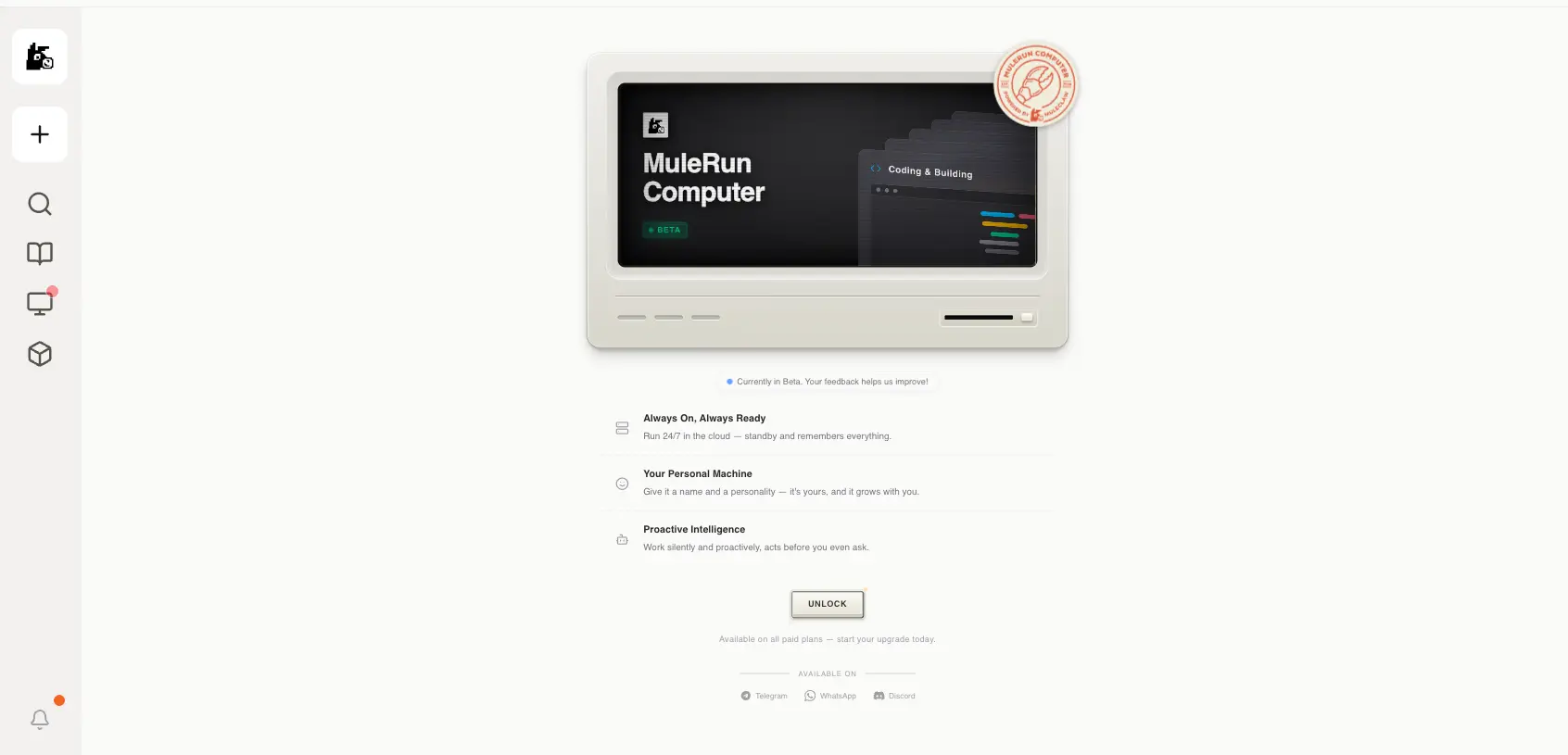
This is the feature that justifies the whole product architecture. Every paid plan includes a dedicated cloud VM that stays on around the clock — not a shared pool, not an ephemeral session. Files, context, knowledge bases persist between sessions. You can assign a task before bed and find the delivered result in the morning. It's currently in beta, which shows up mostly as occasional latency spikes, but the core concept works. This is fundamentally different from how Manus AI or ChatGPT's agent features behave.
An Agent Actually Running a Task
Multi-step autonomous research execution with live action tracking
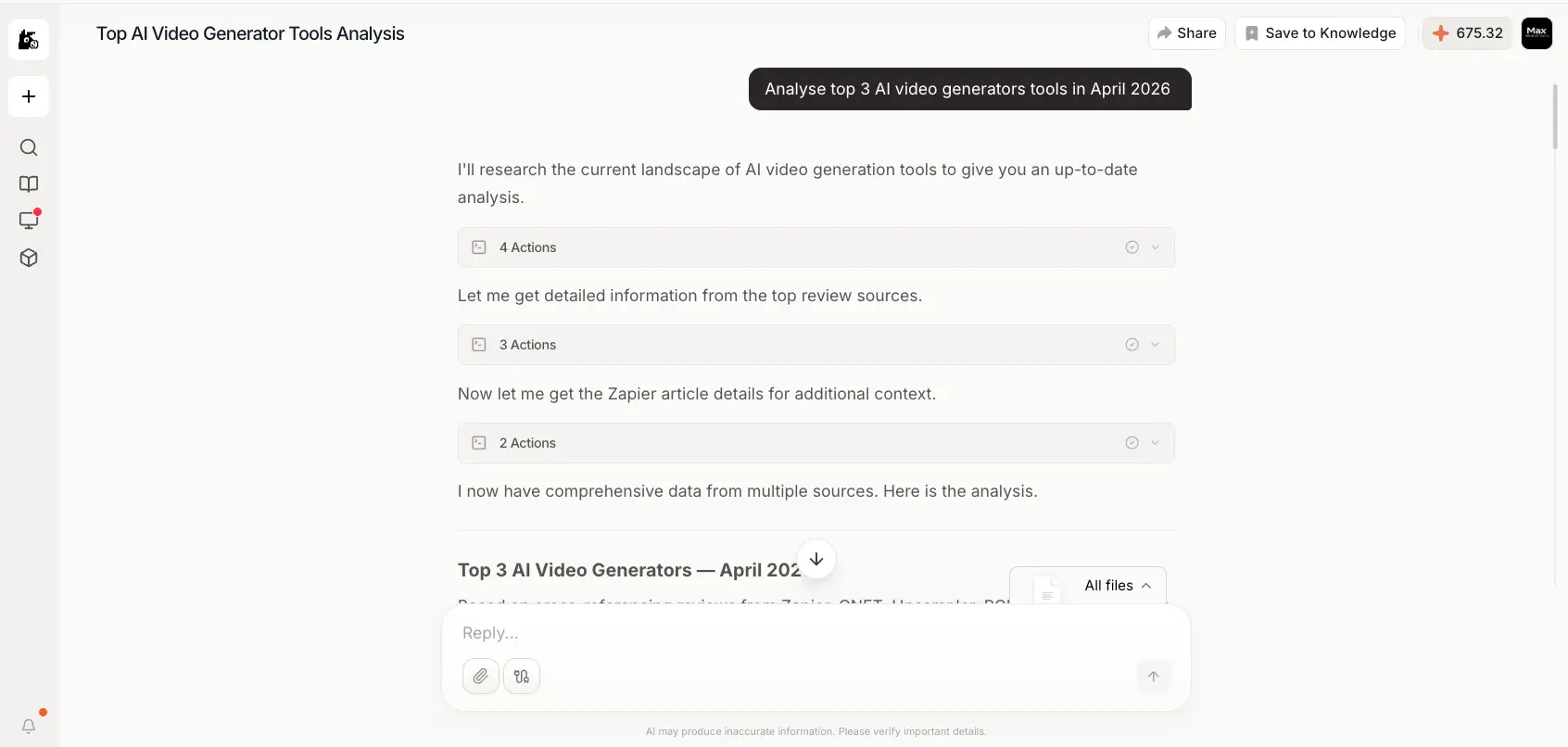
Here's what "agent execution" actually looks like. A prompt — "Analyse top 3 AI video generators tools in April 2026" — triggers the agent to research across multiple sources, cross-reference reviews, and compile findings. The collapsible action blocks show exactly what the agent is doing at each step (which is useful for debugging and builds trust). The full report generates inline. Worth noting: tasks like this burn more credits than a simple question — the research document alone likely consumed 100+ credits based on the scope.
Curious how your own workflow would run on MuleRun?
Try MuleRun →Free plan includes 200 credits refreshed daily • No card requiredThe Knowledge Network & Agent Marketplace
Community-built agents discoverable by category — the Community Layer in action

The marketplace is where MuleRun's network effect lives. Each card is an agent built and published by a real creator — WeChat article scrapers, HTML5 game generators, academic research pipelines, and hundreds more niche tools. This is the Community Layer of the self-evolving architecture: one user's solution becomes available to everyone else (opt-in). It's also where the Creator Studio economics come alive — builders earn revenue whenever their agents run. Quality varies, which is fair criticism, but the breadth is genuinely impressive for a platform barely a year into its public life.
How MuleRun Works
From sign-up to an autonomous agent completing real work — it's a shorter path than you'd expect.
Sign Up and Claim Your VM
Free accounts get immediate access without a credit card, plus a 500-credit welcome bonus and 200 daily refresh credits. Paid plans provision a dedicated cloud VM (2–8 cores, 4–16 GB RAM depending on tier) that stays on 24/7. The VM isn't shared with other users — it's yours, with its own file system, browser profile, and install permissions. This is the piece competitors don't offer at this price point.
Describe a Task in Natural Language
There's no workflow canvas to learn, no API configuration, no integration setup required to start. You either use MuleRun Chat (a general executor where you just describe what you want) or browse the marketplace for a specialized agent. The system breaks your request into steps, identifies which skills to activate — browser automation, code execution, image generation, video creation, API calls — and starts running. Startup time is typically under three seconds.
Watch (or Don't) As the Agent Executes
You can monitor progress via the VNC desktop view if you want to see exactly what's happening, or close the tab entirely — the agent keeps running on your VM. Simple tasks complete in minutes; complex ones (bulk research, full e-commerce product uploads, multi-day monitoring) run overnight. The collapsible action blocks in the chat interface show each step the agent took, which is useful when you need to debug or understand why a specific decision was made.
Results Compound Over Time
This is where the self-evolving part kicks in. After a few weeks of regular use, the platform starts anticipating your needs — drafting briefings before meetings, preparing weekly reports, monitoring the things you've asked it to monitor before. Files and context accumulate on your persistent VM storage. The anecdotal pattern from power users is consistent: the first week feels like standard AI, week three starts feeling like working with a junior employee who's learning your preferences.
Isolated Execution Environments
Each agent runs in its own isolated sandbox on your VM. Agents cannot access each other's data, and all access is controlled by keys and permissions. Data is transmitted via TLS encryption and stored on Singapore servers under the PDPA framework. Worth flagging: MuleRun's own privacy policy recommends not inputting highly sensitive data such as government IDs, financial account numbers, or health records. There are no SOC2 or HIPAA certifications as of April 2026.
Model-Agnostic by Design
GPT-5, Claude Sonnet 4, Gemini — all accessible through MuleRun's unified billing system, with automatic failover if one provider goes down. You're not locked into a single vendor's pricing or outages. This also matters for Creator Studio builders, who don't pay LLM costs separately; MuleRun absorbs the model billing and passes it through as credits.
Key Features
The capabilities that matter — and honest notes on which are mature, which are still in beta.
Dedicated 24/7 Cloud VM
The headline feature. A private virtual machine per user with a full web browser, persistent file system, native app execution, and API access. Unlike Manus AI's ephemeral sessions or Zapier's trigger-based runs, your VM is continuously available — files, context, and active tasks survive closures. VNC desktop view lets you watch automation in real time.
MuleRun Chat (General Executor)
Launched April 12, 2026 — just over a week before this review. Type any task in plain language and the system breaks it into steps, selects skills (browser, code, media, APIs), and runs the whole pipeline on your VM. This is the no-setup entry point that makes the platform accessible to non-technical users.
1,000+ Agent Marketplace
Specialized agents for e-commerce (Etsy, Amazon, Shopify), YouTube pipelines, financial research, business intelligence, game development, 3D design, crypto analysis, and more. Quality varies — this is honest, not a dig — but the breadth is something no other platform at this price matches. Lindy has deeper polish in its narrow niche; MuleRun trades polish for scope.
Self-Evolving Memory (Three Layers)
Task Layer remembers your individual workflows and preferences. Domain Layer acquires deeper skills in your professional area. Community Layer surfaces anonymized solutions from other users facing similar tasks. The compounding effect is genuine — power users consistently report the agent becoming anticipatory after a few weeks.
Full Media Generation Pipeline
Callable from a single MuleRun Chat prompt: Midjourney for images, Sora/Kling/Wan/Veo for video, TTS, music generation, and Hyper3D Rodin for 3D models. Content creators can run complete production pipelines overnight — script to thumbnail to published video — which no workflow-automation tool currently offers.
Model-Agnostic with Unified Billing
GPT-5, Claude Sonnet 4, Gemini — all available under one credit system, with automatic failover if a provider has an outage. No separate accounts, no managing multiple API keys, no vendor lock-in. For creators building agents in the marketplace, underlying LLM costs are absorbed by the platform.
Creator Studio & Agent Builder
Still in beta as of April 2026. Lets anyone — coder or not — build, publish, and monetize agents. Creators keep ~100% of revenue; platform handles billing, hosting, LLM costs, and distribution. Launch bonuses from $100 to $10,000 based on agent adoption. Supports LangChain, LangGraph, n8n, Flowise, ComfyUI, ADK, and Docker.
Financial Research Suite
Built in partnership with FundaAI (equities) and Bitget (crypto and macro). Institutional-grade stock analysis via plain-language queries — "analyze NVIDIA's earnings outlook" — returns in under ten seconds. 19 data tools covering equities, gold, forex, CPI, GDP, and FOMC. Genuinely useful if you're a retail investor who doesn't want to pay Bloomberg Terminal prices.
Worth being direct about what's not in MuleRun: native voice agents (Lindy and Relevance AI do this better with phone call handling), deep SaaS integration breadth (Zapier's 8,000+ apps and Make's 3,000+ are in a different league), and enterprise compliance certifications. MuleRun's approach is API-based integration — strong for custom work, weaker for one-click SaaS connectivity.
Free plan includes access to every feature above:
Try MuleRun →200 credits refreshed daily • 500 welcome bonus • No card requiredPricing Plans
Credit-based system where 100 credits = $1. Free tier is genuinely usable; paid plans unlock the dedicated VM.
Free
- ✓ 200 credits refreshed daily
- ✓ 500 welcome bonus credits
- ✓ Full marketplace access
- ✓ MuleRun Chat included
- ✓ 10 GB storage
- ! Shared VM resources
Plus
- ✓ 2,000 monthly credits
- ✓ +200 daily bonus credits
- ✓ Dedicated VM (2 cores, 4 GB RAM)
- ✓ 100 GB storage
- ✓ Priority support
- ✓ All premium models
Pro
- ✓ 23,000 monthly credits
- ✓ +200 daily bonus credits
- ✓ Dedicated VM (8 cores, 16 GB RAM)
- ✓ 1 TB storage
- ✓ Priority execution queue
- ✓ Best for heavy automation
Important billing note: There's a documented issue where clicking "7-day free trial" on annual plans has charged users the full annual amount immediately. Use a virtual or prepaid card for any trial, start with monthly billing before committing to annual, and screenshot the pricing flow before you click.
Pricing last verified April 2026. Visit MuleRun for current rates.
Is It Worth the Money?
The real value calculation isn't time saved against a human wage — it's whether you're willing to pay ~$16/month to have tasks you'd otherwise drop on the floor completed overnight. For solopreneurs and creators running multiple parallel workflows, one or two recovered hours a week covers the Plus plan. The Pro tier is only justified if you're running heavy automation pipelines — content factories, e-commerce operations, bulk research.
Pricing in context: Make starts at $12/month but AI agent tokens are billed on top. Lindy's Pro plan is $49.99/month — three times MuleRun's entry — though it's deeper in email and CRM automation. n8n's cloud starts at $24/month and is more flexible for developers. Zapier Agents at $33.33/month offer 1,500 activities vs MuleRun Plus's 2,000 credits. Manus AI's Standard is $20/month. At sub-$20, MuleRun is the only option combining a dedicated VM with a full agent marketplace — the value proposition holds up.
Detailed Pros & Cons
What actually holds up in daily use, and what doesn't — based on research, the platform's documentation, and user-reported experiences.
✓ Pros
This is the single feature that justifies MuleRun over almost any competitor. Your agents don't pause when you close the tab, and they don't restart from scratch each session. For recurring workflows, overnight research, or continuous monitoring, no other platform in this price class offers a dedicated persistent VM. Manus AI runs ephemeral sessions; Zapier is trigger-based; Lindy executes when called. MuleRun runs whether you're there or not.
The three-layer architecture — Task, Domain, Community — produces a compounding effect that's genuinely felt after a few weeks of use. Multiple Reddit users describe the agent becoming anticipatory: drafting briefings before meetings, preparing weekly reports, surfacing relevant context without being asked. This is categorically different from ChatGPT's per-conversation memory model.
The marketplace breadth is one of the strongest in the category. E-commerce operations, content production pipelines, financial research, game development, 3D asset creation, crypto and macro analysis, competitive intelligence — most niches have at least one working agent, and the best ones are actively maintained by creators earning revenue from them. The verified Etsy team doing $10M GMV on MuleRun agents is a genuine proof point.
GPT-5, Claude Sonnet 4, Gemini — all callable from a single unified billing system with automatic failover. That matters more than it sounds: you're not betting on one vendor's roadmap, and you're not paying three separate subscriptions to access different models. For Creator Studio builders, MuleRun absorbs the LLM costs entirely, which is an unusually generous economic model.
200 daily credits plus a 500-credit welcome bonus is enough to genuinely test the platform — not the kind of "free tier" that requires upgrading after three queries. You get full marketplace access and MuleRun Chat. The only real limitations are shared VM resources (slower during peak hours) and higher latency on premium models. For non-critical exploration, the free plan holds up.
Approximately 100% revenue share to agent builders, platform-managed billing and hosting, absorbed LLM costs, and cash launch bonuses from $100 to $10,000 based on adoption. For developers building in this space, it's one of the most commercially accessible monetization paths available. Compare to App Store or Play Store economics and the gap is substantial.
MuleRun Chat, launched in April 2026, is the easiest entry point into agentic AI currently available. No workflow canvas to configure, no APIs to wire up, no prompts to engineer — describe what you want in plain language and the system figures out the rest. For founders and operators who don't want to learn another tool, this lowers the barrier meaningfully.
✗ Cons
This has to be the first con because it's the most important. Multiple Reddit users and at least one independent review site have documented the same pattern: clicking "7-day free trial" on the annual Super plan triggers an immediate $384 charge with no pre-payment confirmation, and refund requests have been denied. If you're going to subscribe, use a virtual or prepaid card, start with monthly billing, and screenshot the flow before you click. The platform needs to fix this — it's a trust-breaking UX bug at scale.
With 1,000+ agents built by a wide range of creators, quality varies significantly. Some are production-ready and brilliant; others are clearly weekend experiments. Independent industry analysts have called automated agent evaluation "an unsolved problem" — a fair assessment. Plan on trying a few agents in any given workflow before settling on one that fits your use case.
Despite the "24/7" promise being central to the pitch, MuleRun publishes no formal Service Level Agreement or uptime commitment. For business-critical workflows, that's a real concern. If your operations depend on MuleRun running reliably overnight, you're trusting a platform that hasn't committed to a specific reliability number. This will matter less as the platform matures, but it matters today.
Simple tasks cost a few credits; a single multi-step research pipeline with premium models can burn 500+. There's no pre-task cost estimator, so you're often flying blind on consumption until after the fact. The Plus plan's 2,000 monthly credits feels generous until you run two or three heavy workflows and realize you need to top up. Daily bonus credits help, but plan on experimenting with usage for the first month before committing to annual billing.
Creator Studio is still in beta. Agent Builder launched in January 2026. MuleRun Chat dropped April 12, 2026 — just over a week before this review. The platform is moving fast, which is good, but it also means features ship before they're fully polished. Expect bugs, occasional regressions, and documentation gaps. If you want stability over innovation, wait six to twelve months.
No SOC2, no HIPAA, no ISO 27001 as of April 2026. For regulated industries — healthcare, finance, legal — this rules out production deployment regardless of how good the product is. Lindy's Business plan (SOC2, HIPAA) is the cleaner option in those environments. MuleRun's privacy policy also explicitly recommends against inputting sensitive personal data.
MuleRun takes an API-first approach to integration rather than offering 8,000+ pre-built connectors. For most modern SaaS tools that expose APIs, this works fine. For legacy systems, industry-specific software, or platforms without public APIs, you'll need Zapier or Make in the mix. MuleRun and traditional workflow automation tools often end up complementary rather than competitive.
MuleRun vs Alternatives
How MuleRun compares to the main task automation and AI agent platforms in its competitive set.
| Feature | Reviewed MuleRun | Lindy | Make | Zapier |
|---|---|---|---|---|
| Starting Price | Free / ~$16 | Free / $49.99 | Free / $12 | Free / $19.99 |
| Dedicated 24/7 VM | ✓ Per user | ✗ | ✗ | ✗ |
| Agent Marketplace | ✓ 1,000+ | ✗ | ✗ | ✗ |
| Self-Evolving Memory | ✓ 3-tier | ⚠️ Session-based | ✗ | ✗ |
| SaaS Integrations | API-based | 3,000+ | 3,000+ | 8,000+ |
| Media Generation | ✓ Full pipeline | ✗ | ⚠️ Via integrations | ⚠️ Via integrations |
| Creator Monetization | ✓ ~100% rev share | ✗ | ✗ | ✗ |
| Enterprise Compliance | None published | SOC2 / HIPAA | SOC2 | SOC2 / SSO |
| Best For | Solopreneurs, creators, ecomm | Email, CRM, calendar | Visual workflows | SaaS integration |
Which Tool Is Right For You?
MuleRun
ReviewedBest for: Solopreneurs, creators, and e-commerce operators who want an autonomous 24/7 digital worker rather than another chat assistant. The dedicated persistent VM, self-evolving memory, and 1,000+ marketplace agents make it the strongest option at a sub-$20/month entry price. Particularly compelling if you need overnight execution of recurring workflows or a full media production pipeline in one place. Skip it if you need enterprise compliance certifications or deep SaaS integration breadth.

Lindy
Personal AI WorkerBest for: Individuals and small teams whose primary automation need is email, calendar, CRM sync, and phone call handling. Lindy's 3,000+ integrations, iMessage support, and SOC2/HIPAA compliance on the Business plan outperform MuleRun in communications-heavy workflows. The entry price is higher ($49.99/month vs MuleRun's ~$16), but if your day revolves around inbox and meetings, Lindy is deeper in that lane.

Flowith
AI Agent PeerBest for: Users who want a similar AI agent platform experience with a canvas-based multi-agent orchestration approach. Flowith is the closest direct peer to MuleRun in our directory, sharing the same 4.1 rating. Choose Flowith if you prefer visual multi-agent flows and a more exploratory, creative interface. Choose MuleRun if you want the dedicated 24/7 VM and marketplace scale.

n8n
Open SourceBest for: Developers and technical teams who want open-source, self-hostable workflow automation with deep customization. n8n rates 4.9 in our directory for a reason — it's the most flexible workflow tool if you can write a bit of JavaScript. Choose n8n if you need full control, on-premise deployment, or heavy data pipeline work. Choose MuleRun if you want autonomous agents that execute without you designing the workflow first.

Make
Visual WorkflowsBest for: Teams building complex, multi-branch workflows who benefit from visual mapping. Make's canvas builder is the most intuitive in the category, with 3,000+ integrations and AI Agents now in beta. Entry price of $12/month is the lowest in this comparison. Choose Make if you're engineering precise, multi-branch automations; choose MuleRun if you want to delegate work rather than design it.

Zapier
Market IncumbentBest for: Anyone needing reliable integration between SaaS tools — triggers, webhooks, data passing, notifications across 8,000+ apps. Zapier excels at deterministic, high-volume simple automations where predictability and debuggability matter more than intelligence. The 2025–2026 AI Agents product layers reasoning onto this foundation. Choose Zapier when the problem is connecting apps; choose MuleRun when the problem is executing complex multi-step work.
Frequently Asked Questions
Should You Try MuleRun?
MuleRun is the rare launch where the architecture is genuinely ahead of the market. A dedicated 24/7 cloud VM per user, a three-tier self-evolving memory system, a marketplace of 1,000+ specialized agents, and creator monetization that actually works — all at a sub-$20/month entry point. For solopreneurs, content creators, and e-commerce operators who want an autonomous digital worker rather than another chatbot, nothing else in its price class comes close.
The downsides are real, and worth being direct about. The annual trial billing issue is documented and needs fixing. Marketplace quality varies. There's no published uptime SLA or enterprise compliance certifications. Creator Studio is in beta. Credit burn on heavy tasks is hard to predict. If any of those matter to your use case, slow down and evaluate carefully before committing to an annual plan.
Our Recommendation
Start with the free tier — 200 daily credits plus the 500-credit welcome bonus are enough to genuinely test whether MuleRun fits your workflow. Spend a week on actual tasks you'd delegate to a junior employee: research, content production, monitoring, ecommerce ops. If the output holds up, move to the Plus plan on monthly billing (not annual — given the documented trial billing issues). If after another month it's still delivering, then consider annual. Treat this as a year-one platform you grow with, not a finished product you buy.