10 Best Facebook Ad Spy Tools in 2026: What Media Buyers Actually Use (Free & Paid)
Meta's Ad Library shows you what's running, not what's working — and the paid tools built to fix that just lived through a year of shutdowns, acquisitions, and quiet price rewrites. We checked every price below on the live pricing pages in August 2026, sorted the market by the job you're actually hiring a tool for, and tell you plainly which of these ten pay us a commission and which pay us nothing.
The short answer, as of August 2026: start with Meta's free Ad Library — it's the baseline every paid tool improves on, and it costs nothing to learn its limits. When you outgrow it, the market splits by job: Atria is the strongest pick for creative teams who want a big searchable library plus AI analysis wired into their Meta ad accounts, Foreplay is the best pure swipe-file and briefing workflow, and Minea or Brandsearch lead for ecommerce and dropshipping research. Nobody needs all ten tools below. Most stores and teams need exactly one, and the sections that follow exist to tell you which.
Best overall for creative teams: Atria
Atria pairs a large ad library with AI creative analysis and a performance view that connects to your own Meta accounts, so research and results live in one place. At $129/month billed annually it's the priciest pick on this list that isn't an archive tool, and the one that replaces the most tabs.
Best free starting point: Meta Ad Library
Meta's Ad Library is awkward to search, forgets inactive ads, and shows no performance data for ordinary commercial ads. And it's still where every media buyer should start, because it's free, official, and teaches you exactly which gaps are worth paying to close.
| Tool | Best For | Entry Price | Free Way In |
|---|---|---|---|
| Atria | Creative teams & agencies | $129/mo (annual) | Free start, 1,000 credits |
| Foreplay | Swipe files & briefs | $49/mo (annual) | Trial, no card required |
| Minea | Ecommerce & dropshipping | $34/mo (annual) | Free trial |
| Meta Ad Library | Everyone's baseline | Free | Entirely free |
Prices verified August 11, 2026 on each tool's live pricing page
One thing worth knowing upfront: four of the ten tools in this guide pay this site a commission (Atria, Foreplay, Gethookd, and Brandsearch). The other six — including the free tool we rank first and Minea, our ecommerce pick — pay us nothing. We'd rather tell you that in the second paragraph than have you wonder about it for the next fourteen minutes.
First, the thirty-second definition for anyone new here: a Facebook ad spy tool is software that archives and organizes competitors' Meta ads — including the inactive ones Meta's free Ad Library forgets — so you can search them, track brands over time, and study what keeps running long enough to be working. That last clause is the entire value proposition, and the reason this category survives a free official alternative.
Search for the best Facebook ad spy tools and page one is a strange place: vendor homepages ranking for a comparison query, a Reddit thread doing the real work at position two, and an AI Overview citing a six-month-old Medium post written for dropshippers. Almost nothing there is an independent comparison, and almost everything was written before the market's 2026 upheaval. We don't sell a spy tool. We reviewed Atria (4.6/5) on this site, we run our own accounts on Brandsearch and BigSpy, and where an interface image below comes from a vendor's demo rather than our login, we say so.
Why This List Looks Different From Every Older One
Four things happened to this market recently, and most existing roundups of the best ad spy tools predate all of them. First, MagicBrief, one of the category's best-known names, was acquired by Canva in June 2025 and shut down entirely on July 31, 2026, sending its customers hunting for replacements (there's a full section on that below). Second, Meta rewrote its automated data collection terms effective January 1, 2025 to prohibit scraping whether or not you're logged in, which changed the legal ground every one of these tools stands on. Third, Meta stopped running political and social-issue ads in the EU in late 2025, quietly retiring the richest tier of free transparency data there. And fourth, several vendors restructured pricing outright: BigSpy's current plans, for example, look nothing like the tiers most reviews still describe. A list written in 2024 isn't just stale; it's describing a different market.
The First Thing to Know: Nobody Can Show You Real Ad Spend
Before comparing tools, one piece of calibration that vendor marketing tends to blur. Meta does not publish spend data for ordinary commercial ads. Spend and impression ranges exist only for political and social-issue ads, and ads delivered in the EU show reach and demographic breakdowns under the Digital Services Act — reach, not spend. For a standard US ecommerce ad, Meta discloses nothing about money or performance. Which means any spy tool showing you a spend figure for such an ad is either modeling it from reach estimates and benchmark CPMs, or quoting EU-disclosed data and presenting it more broadly than it is. TrendTrack, a newer entrant we looked at, advertises spend sourced straight from Meta's own data, which is accurate only in the EU/UK sense of that sentence. This isn't a reason to dismiss these tools. It's a reason to judge them on what's real: library depth, freshness, filters, and workflow, not on precise-looking dollar columns.
The 10 Best Facebook Ad Spy Tools at a Glance
| Tool | Best For | Platforms | From (Aug 2026) | Free Option |
|---|---|---|---|---|
| Meta Ad Library | The official baseline | FB, IG, Messenger | Free | Entirely free |
| Vaizle | Quick free lookups | Meta, Google, LinkedIn | Free | Free spy tool |
| Atria | Creative teams | Meta + ad accounts | $129/mo annual | Free start (credits) |
| Foreplay | Swipe files & briefs | Meta-centric | $49/mo annual | No-card trial |
| Gethookd | Budget research-to-creative | Meta & Google | $19/mo annual | 7-day trial |
| Minea | Ecom & dropshipping | Meta, TikTok | $34/mo annual | Free trial |
| Brandsearch | Store + ad intelligence | Meta, TikTok, IG, email | $47/mo annual | Free Chrome extension |
| BigSpy | Multi-platform breadth | FB + multi-network | $49/mo annual | Limited free account |
| AdSpy | Deep FB/IG archive | FB, IG only | $149/mo flat | None (24h refund) |
| PowerAdSpy | Multi-network tiers | Up to 10 networks | $29/mo annual | $1 three-day trial |
Start Free: The Facebook Ad Spy Tools That Cost Nothing
If you've never paid for a free Facebook ad spy tool alternative before, don't. Learn the free layer first: it's better than its reputation, and its genuine gaps are the only honest justification for a subscription.
1. Meta Ad Library — The Official Baseline
Meta's own Ad Library lets anyone search every active ad running across Facebook, Instagram, and Messenger — creative, copy, start date, and placements — with no account required for basic lookups. In April 2026 Meta even added sorting by impression volume, though that only works for ads with enough EU-reported delivery to show a range. What it won't do is the entire reason the rest of this list exists: ordinary commercial ads vanish from it the moment they're switched off, there's no historical archive for them, no spend or engagement data, and the search itself is the thing Reddit threads keep calling clunky. You can't tag, organize, or track anything over time.
Pricing: free, forever, at facebook.com/ads/library. Use it for: checking any specific brand right now. Its limits are the shopping list for everything below.
2. Vaizle — The Free Tool Worth Bookmarking
Vaizle's free ad spy tool is the rare lead magnet that's actually useful: enter a keyword or brand and it pulls competitor creatives across Meta, Google, and LinkedIn into one view, good for category sweeps the Ad Library makes tedious. It's a doorway into Vaizle's paid marketing-analytics suite, and it shows: there's no swipe file, no tracking, no workflow. Treat it as a faster window, not a library.
Pricing: the spy tool itself is free at vaizle.com; paid plans cover its separate analytics products. Use it for: quick multi-platform checks before you've committed to any paid tool.
Best Facebook Ad Spy Tools for Creative Teams & Agencies
This is the segment built around creative strategy: saving and organizing competitor ads, briefing editors, and increasingly, AI analysis of what's working. It's also where we should repeat the disclosure: all three tools here pay us a commission, which is why each entry leads with the thing you'd want to know before paying.
3. Atria — The Creative Intelligence Platform
Atria combines a large multi-brand ad library with AI-assisted creative analysis (hooks, angles, transcripts) and a performance layer that connects to your own Meta ad accounts. Its Radar view grades your live ads and flags iteration candidates, built on what Atria says is over $1 billion in analyzed ad spend (a vendor claim; the homepage cites $9B+ tracked). The interface below is Atria's own demo of Radar:
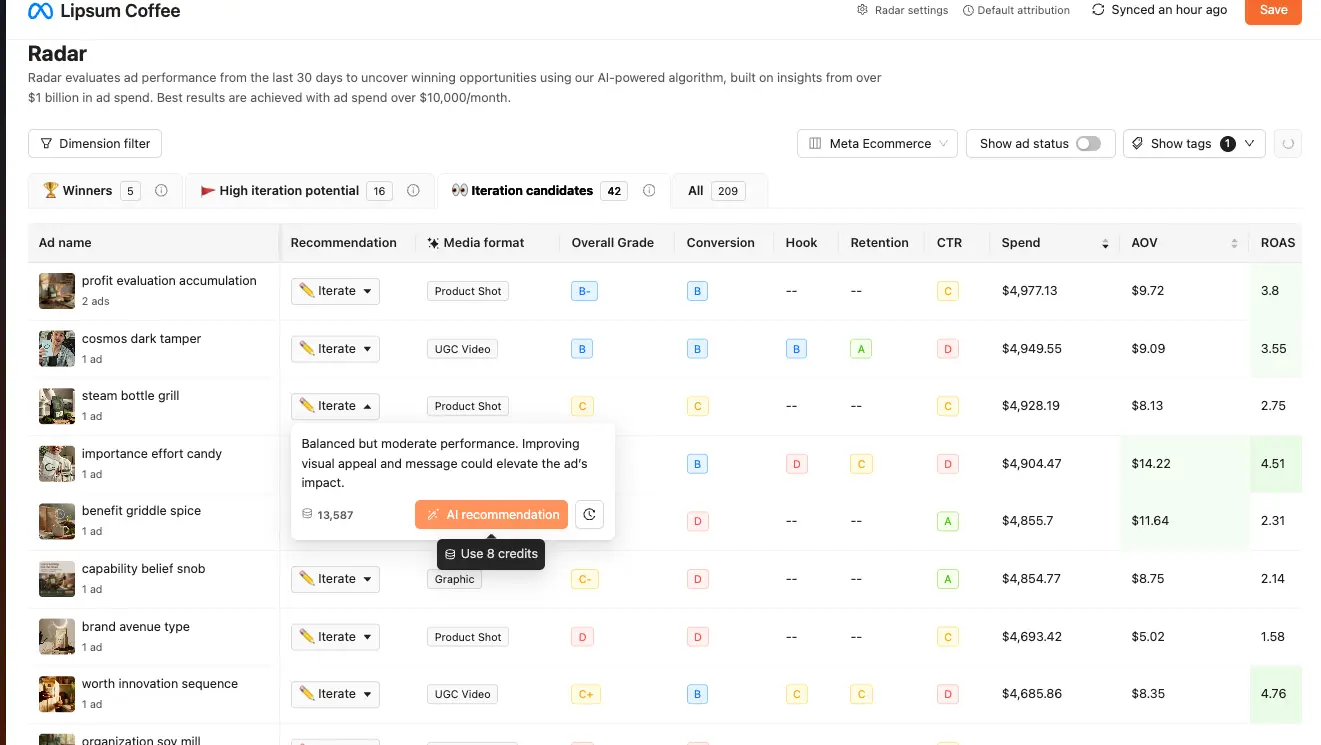
Community sentiment on Atria splits, which we cover in the Reddit section — some buyers call it the tool that replaced two subscriptions, others find its library curation less refined than Foreplay's. What's not in dispute: it's the most ambitious product in this segment, and the one that bundles research, analysis, and performance into one login. We rated it 4.6/5 in our full Atria review.
Pricing (verified Aug 2026): Core $129/mo billed annually ($159 monthly) with $500K tracked ad spend and 5 seats; Plus $479/mo annual ($599 monthly); Business $959/mo annual ($1,199 monthly); extra seats $20/mo. There's a free way in with 1,000 credits and no card, per Atria's site. Skip it if you just want a swipe file — you'd be paying for analytics you won't open.
4. Foreplay — The Swipe File Standard
Foreplay is the tool most creative teams mean when they say swipe file: save any ad from the Ad Library or TikTok via its extension, tag and organize it into boards, turn winners into briefs for your editors, and let Spyder track chosen brands automatically. Its Lens analytics product — notable for not billing you by ad spend, unlike most creative analytics — rounds out the workflow on higher tiers. Here's Spyder's competitor view, from Foreplay's demo:
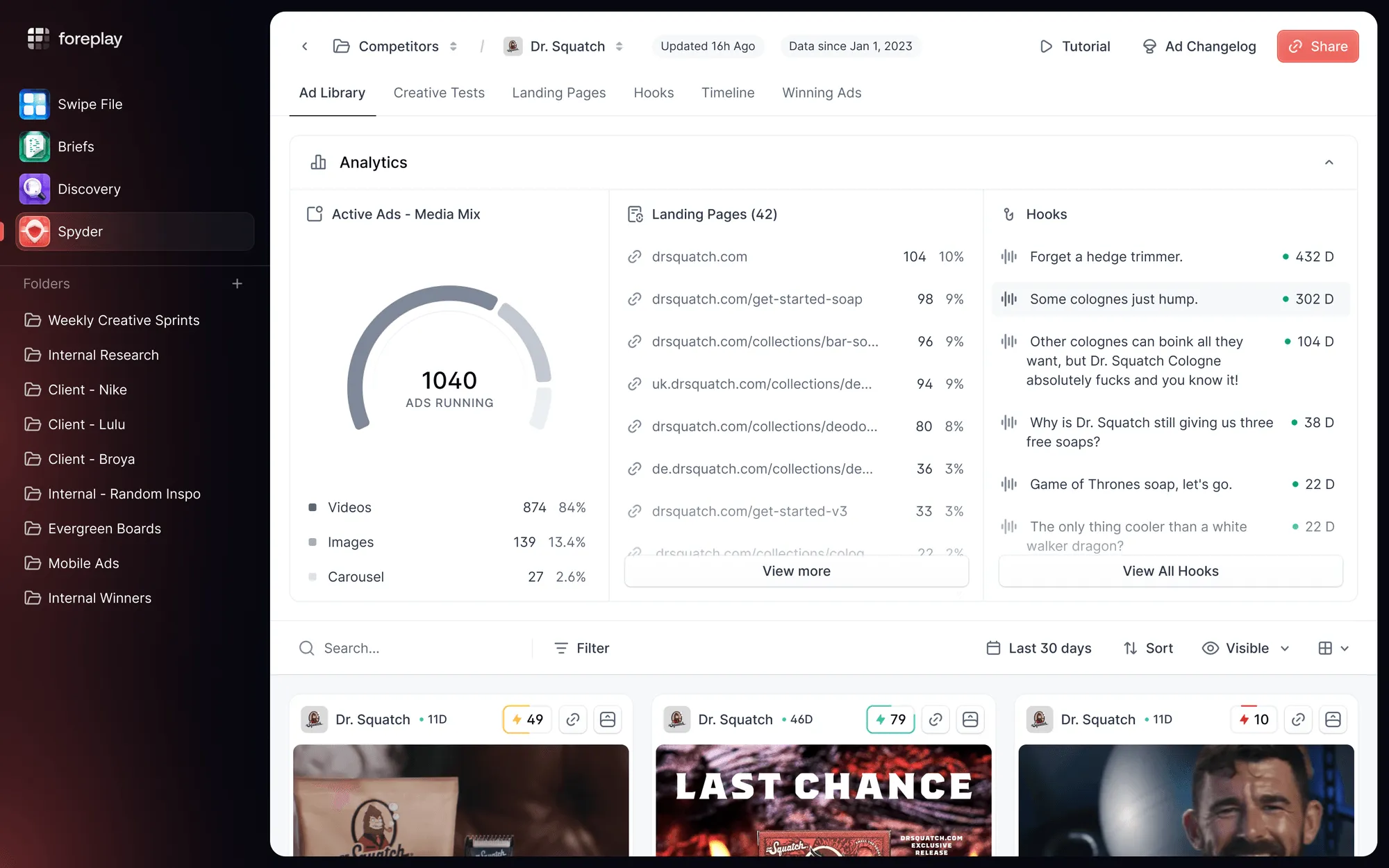
Foreplay overhauled its pricing in May 2025 (Spyder became unlimited on annual plans), so ignore any review quoting older tiers. It publishes no database-size number at all, which we'd rather see than an inflated one; the product's value is the workflow, not a counter.
Pricing (verified Aug 2026): Basic $49 a month billed annually ($59 month-to-month, 1 user, $20 per extra); Workflow $149/mo annual ($175 monthly, up to 5 users); Agency $389/mo annual ($459 monthly, up to 10). No permanent free tier; trials require no card. Skip it if you need performance analytics on a Basic budget — that lives in higher tiers.
5. Gethookd — The Budget Option, With Caveats You Should Read
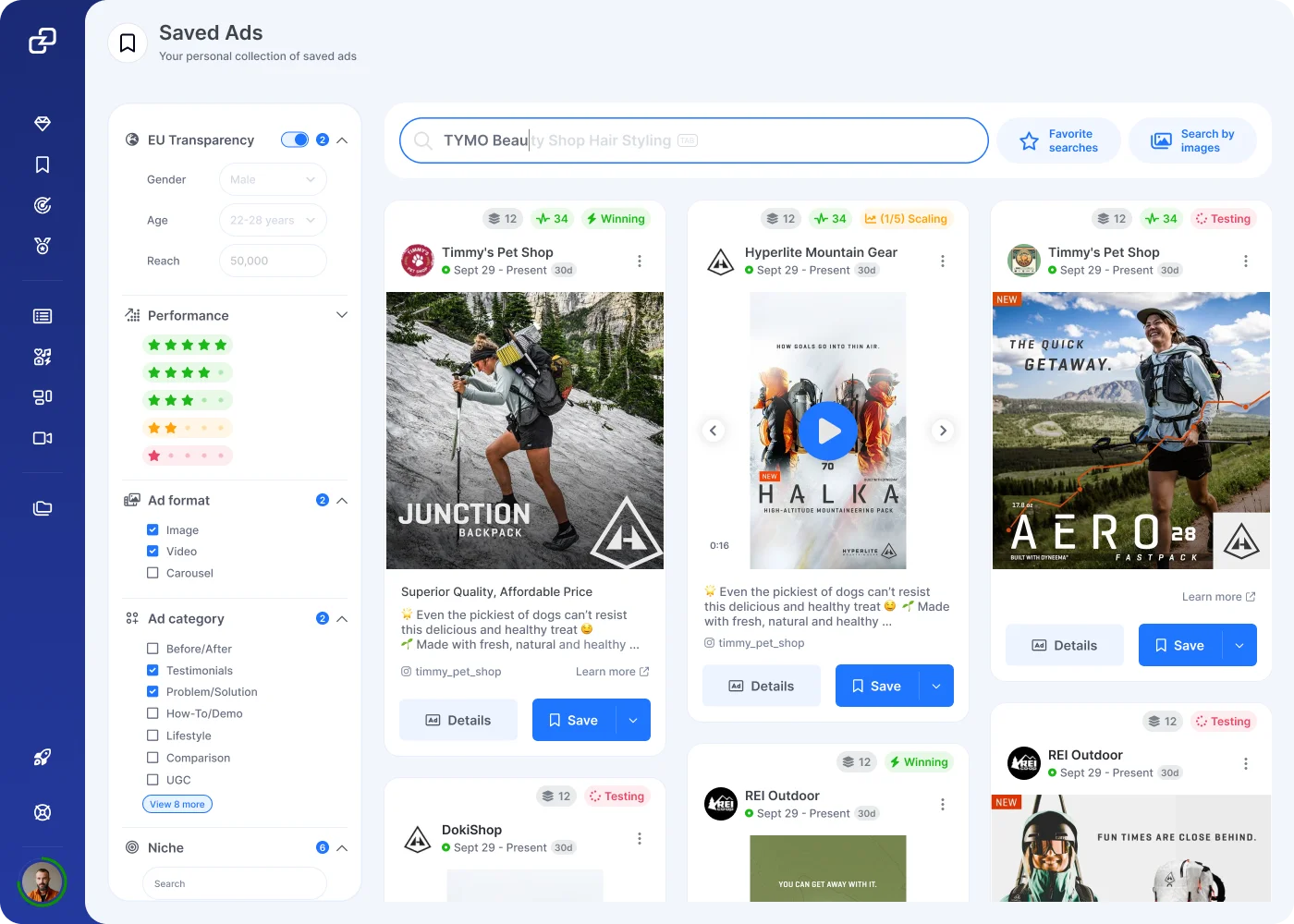
Gethookd is an AI-assisted ad research and creative tool that markets itself as the Facebook Ads Library on steroids: a searchable ad and brand database across Meta and Google (65M+ ads, per the vendor's own figures), plus AI scripts, static templates, and a saved-ads swipe file with EU transparency filters — the view below is from its demo:
Now the caveats, because you should have them before paying. A critical December 2025 video review argued Gethookd mostly repackages free Ad Library data behind a restrictive credit system, and reported billing complaints around trial conversion. A more balanced July 2026 review scored it 8.7 and called it the best value research-to-creative loop under $50/mo, while confirming credit burn is real (competitor deep-dives cost 8 credits each, so entry tiers run out fast). And its current refund policy, updated March 2026, is unusually strict: refunds apply only to your first charge, in full within 24 hours or half within 48, one refund per account, ever; annual plans are non-refundable. None of that makes it a bad product at $19/mo. It makes it a product you should trial with a calendar reminder set for day six.
Pricing (verified Aug 2026): Starter $19/mo billed annually ($29 monthly); Pro $32/$49; Team $52/$79; Agency $83/$129. 7-day free trial on most plans. Skip it if you research many competitors per month — the credit math favors Atria or Foreplay surprisingly quickly.
Best Facebook Ad Spy Tools for Ecommerce & Dropshipping
Different job, different tools: here the point isn't briefing a creative team, it's finding winning products and the ads scaling them. Only one of these three pays us a commission — Brandsearch — and our category pick is one that doesn't.
6. Minea — The Ecommerce Standard
Minea is the established name in dropshipping ad research: Meta and TikTok ad discovery paired with product listings, shop tracking, daily niche lists, and metered AI ad analysis. It calls itself the leading adspy for ecommerce, and for once the self-description matches how often it appears in seller stacks. The main structural note: features are heavily tier-gated (shop listings and the brand tracker start at Premium), and its terms include a no-refund policy, so pick your tier deliberately.
Pricing (verified Aug 2026): Starter $49 monthly, $39 quarterly, $34 annually; Premium $99/$79/$69; Business $199/$158/$139. A free trial is offered on-site. Third-party pages still quoting a $279–$399 Business tier are describing pricing that's no longer live. Skip it if your work is creative strategy for established brands — that's the previous segment.
Visit Minea → (not an affiliate link — we earn nothing from Minea)
7. Brandsearch — Store Intelligence Plus Ad Spy in One
Brandsearch is the newer entrant Reddit's ecommerce threads keep bringing up, and after opening our own account we see why. It fuses a Shopify store database (7.5M+ stores, per the vendor; its own pages quote counts between 6M and 7.5M depending where you look) with ad discovery across Meta, TikTok, Instagram, and email, ongoing competitor tracking via Spectre, a searchable database of transcribed ad hooks, and, the clever part, EU/UK ad-spend data surfaced under the Digital Services Act, the one context where spend figures are real disclosures rather than estimates. Its Discovery view, from our account:
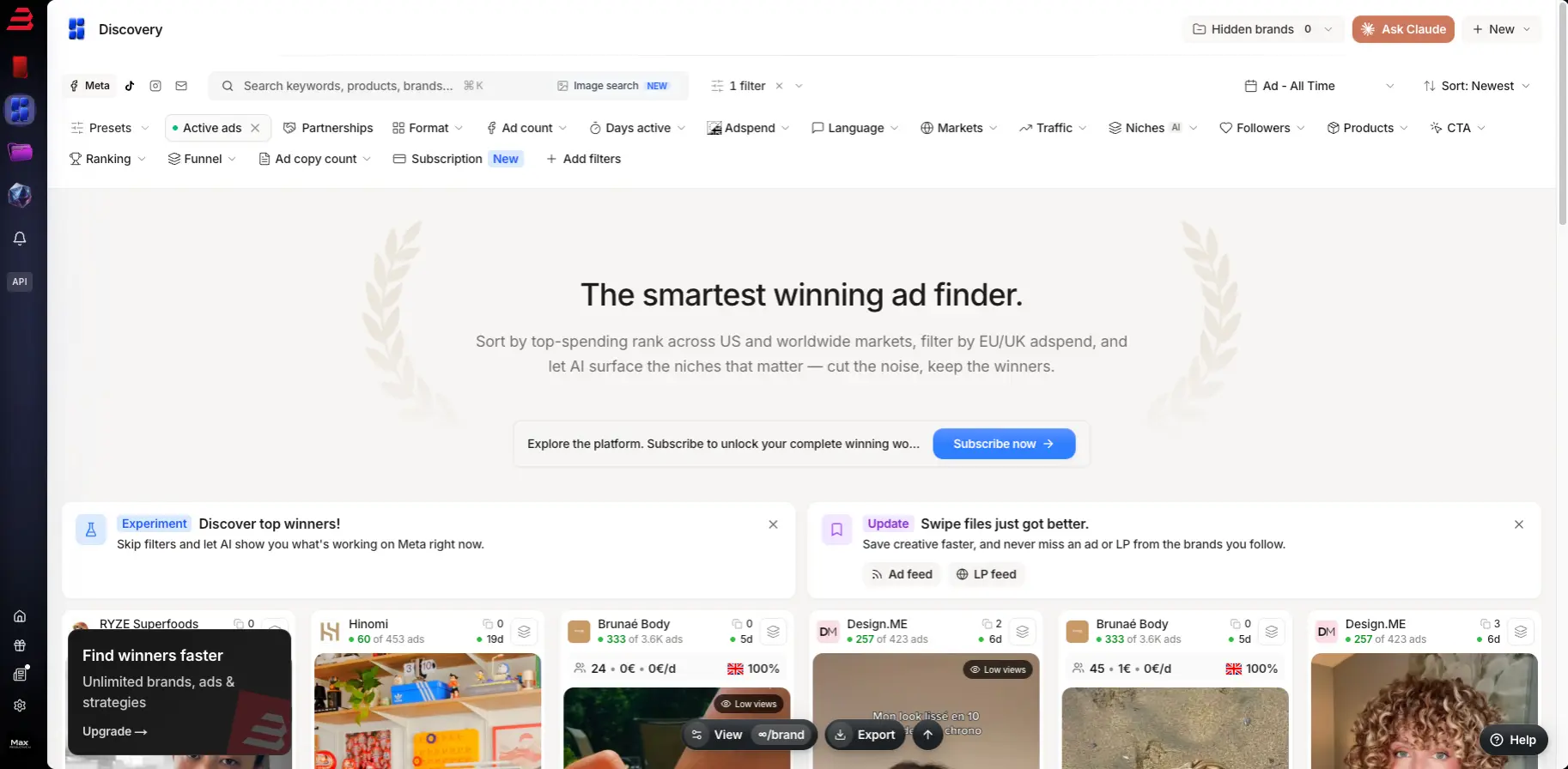
The free Chrome extension alone earns the install: it overlays EU ad-spend data directly inside Meta's Ad Library, upgrading the free baseline at zero cost.
Pricing (verified Aug 2026): Starter $47/mo billed annually ($63 monthly, 15K-store brand library, 5 tracked brands); Outscaler $59/mo annual ($79 monthly, unlimited brands, 50 tracked); Agency $119/mo annual ($149 monthly, 100 tracked). Chrome extension free. Skip it if you don't sell physical products — its store-intelligence half would sit unused.
8. BigSpy — Breadth Over Depth
BigSpy is a multi-network ad database: Facebook on every tier, with Instagram, TikTok, YouTube, AdMob and more unlocking on paid plans, plus recently added semantic and visual search. About that scale: its marketing has variously claimed figures from 100 million to a billion ads. In our own account, the search interface reports 376M ads found, dropping to 179M after default deduplication and 56M after strict deduplication, which is the right way to read every database counter in this category: the usable number is always smaller than the marketed one. Our account view:
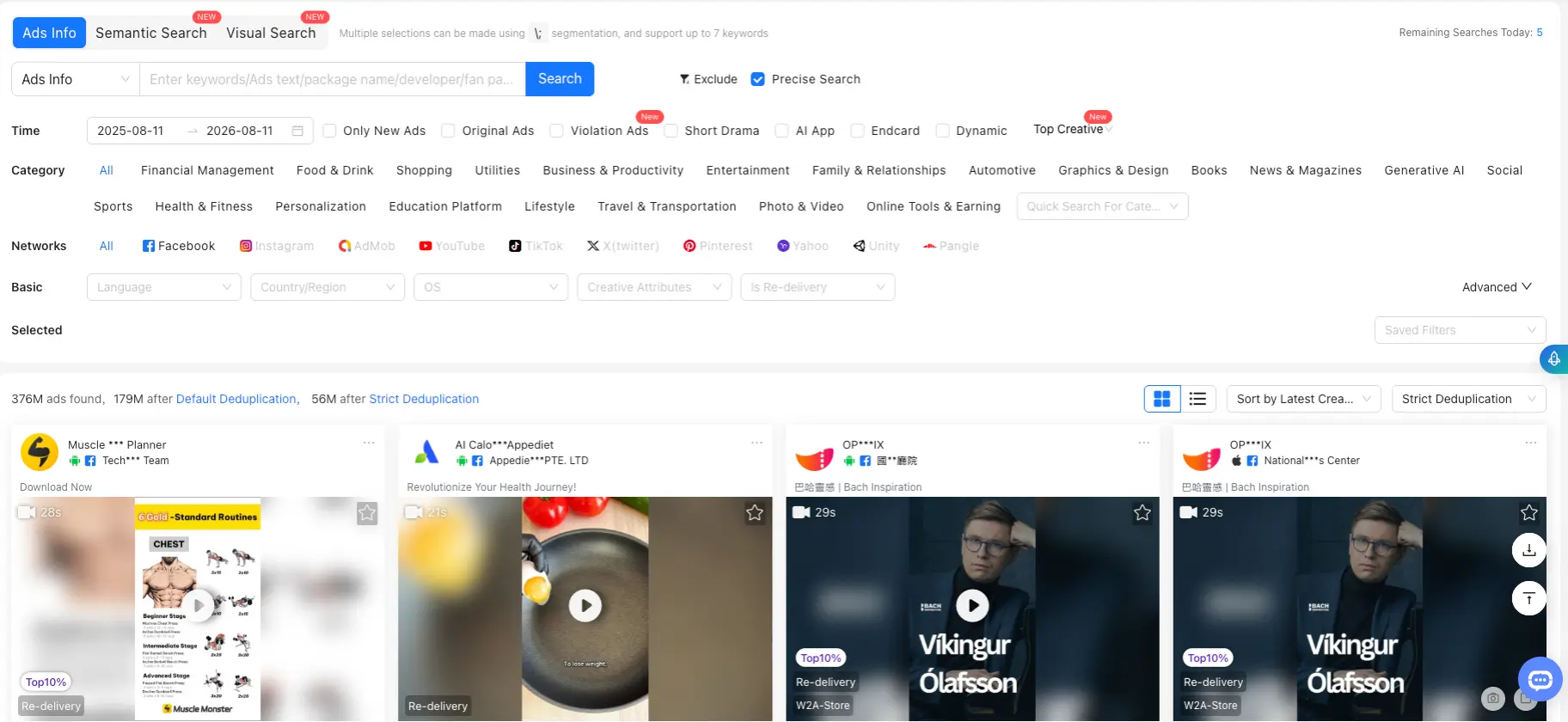
BigSpy restructured its pricing this year: the widely-quoted $149 Pro tier and $19 Basic are gone. And while the pricing page no longer advertises a free plan, our free account still works, capped at a handful of daily searches: enough to evaluate the interface, not enough to work from.
Pricing (verified Aug 2026): Starter $69 month-to-month or $49 on annual billing; Growth $119/$159; Scale $299/$399 with 5 seats; Ultimate $399/$499. Skip it if you need workflow — there's no briefing or swipe-file layer here to speak of.
Visit BigSpy → (not an affiliate link)
Best for Raw Archives & Multi-Network Research
The old guard: fewer AI features, deeper databases. Lists of the best ad spy tools have carried these two names for a decade, and neither pays us anything.
9. AdSpy — The Deep Archive
AdSpy is the category's original heavyweight: a Facebook and Instagram archive its own counter puts past 200 million ads from nearly 30 million advertisers, with one feature nobody else on this list matches: searchable ad comments, which is often where a product's real customer objections live. It's deliberately old-school: one flat price, no tiers, no AI layer, no creative workflow, and a refund window of exactly 24 hours after purchase.
Pricing (verified Aug 2026): $149/mo, single tier, still labeled an introductory offer years on. No trial. Skip it if $149 is your whole tool budget; for most readers a segment-specific tool above does more per dollar.
Visit AdSpy → (not an affiliate link)
10. PowerAdSpy — Ten Networks, Priced by Tier
PowerAdSpy sells breadth by subscription rung: Facebook only on Basic, then Instagram, YouTube, Google, native networks, Reddit, Quora, and LinkedIn unlocking as you climb toward Palladium. Its search covers keywords, advertisers, and domains, with competitor-tracking quotas per tier and an estimated ad budget feature (an estimate; see the spend section above). The annual pricing is the story: Basic drops to $29/mo billed yearly, the cheapest paid Facebook coverage on this list after Gethookd.
Pricing (verified Aug 2026): Basic $69/mo monthly or $29/mo annual; tiers step up through Standard $129/$42, Premium $179/$67, Platinum $279/$83, Titanium $349/$92, Palladium $399/$125. Trials: $1 for 3 days on Basic, $7 on higher tiers. Skip it if you only need Meta; the multi-network unlocks are the entire reason to pay more here.
Visit PowerAdSpy → (not an affiliate link)
What Reddit Says About the Best Facebook Ad Spy Tools
Search for best Facebook ad spy tools Reddit and you'll find the same question, usually phrased the way the top-ranking thread puts it (what Facebook ads spy tool do people actually use), asked in r/FacebookAds, r/AskMarketing, and r/Affiliatemarketing steadily from 2023 through 2026. That recurrence tells you the existing articles haven't settled it. The threads are more useful than most of those articles, and the consensus is messier than any vendor would like.
On the creative-team side, sentiment genuinely splits. The top answer in the most-upvoted recent thread calls Foreplay "really solid for D2C brands" while finding Atria less refined; an earlier, equally emphatic thread argued the exact opposite, praising Atria as cheaper with the bigger library and built-in analytics. Both camps are describing real trade-offs (workflow polish versus platform ambition), and that unresolved split is why those two get our next head-to-head. On the ecommerce side, the newer threads increasingly name Brandsearch, with one commenter saying it goes much deeper than a standard adspy. And the loyalists are still out there: users defending Afterlib after years of use, and others recommending Adplexity's social product. We looked hard at both for this list — Afterlib's current pricing and even its product identity couldn't be verified across sources, and Adplexity's own main pricing page no longer shows a social/Meta product at all, so neither cleared the verification bar we apply before recommending anything. If that changes, this list will too.
The recurring complaints are as telling as the recommendations: how fresh is the database, is the tool reliable, and, in the thread title that keeps repeating, the free Ad Library is clunky and limited. Weigh all of it as what it is: individual experiences, not data. But the pattern maps cleanly onto the segments above.
How Do These Tools Get Their Data — and Is It Even Legal?
The sharpest question in those Reddit threads is technical: Meta's API doesn't hand out ad images and videos for ordinary commercial ads, so how do spy tools have them? The honest answer: no major vendor publicly documents its method. Meta's official Ad Library API covers only political and social-issue ads plus EU-targeted ads, is rate-limited, and returns no engagement data; it cannot be the source of these libraries. What remains is some combination of large-scale collection from the public Ad Library, browser extensions, and user-contributed saves, and every vendor stays quiet about its mix.
The legal ground is unsettled; here is its actual state. In January 2024, a federal court in Meta v. Bright Data found that logged-off scraping of public Meta data did not breach Meta's then-current terms: a visitor who never logs in never accepts them. Meta didn't appeal; instead, effective January 1, 2025, it rewrote its automated data collection terms to prohibit scraping regardless of login status. That new language hasn't been tested in court. The broader US precedent, from the hiQ v. LinkedIn saga, cuts both ways: scraping public data is generally not a criminal offense, but platforms can and do win on breach-of-contract theories. For you as a subscriber, the practical exposure is close to nil (the legal risk sits with the vendors), but it's context worth having when a tool's data suddenly thins out or a vendor disappears. None of this is legal advice; it's the state of play as of August 2026.
What Happened to MagicBrief — and Where Its Users Went
If you're here because your team's tool vanished: MagicBrief shut down on July 31, 2026, a year after Canva announced its acquisition in June 2025. The team now builds Canva Grow, an AI ad-creation and publishing product inside Canva that generates campaigns and pushes them to Meta and TikTok with performance feedback. Canva itself describes Grow as a new product built on MagicBrief's thinking rather than the same software relaunched. Notably, the ad-library and competitor-research layer many teams used daily is not part of Grow's published description. Former customers were offered six months of Canva Business free, with codes redeemable until September 30, 2026; if you qualify, claim that before it lapses regardless of what you do next.
For the research side of what MagicBrief did, the practical replacements are the creative-team segment above: Foreplay if your center of gravity is the swipe file and briefs, Atria if it's analytics plus library, Gethookd if the budget is the constraint. Several vendors published aggressive migration guides ranking themselves first — read those with the skepticism their incentives deserve.
How to Choose Your Facebook Ad Spy Tool
Match the tool to the job, not the feature list. Creative team or agency briefing editors weekly: Foreplay for the workflow, Atria if you also want the analytics layer — and if you're torn between exactly those two, that's the most common dilemma in this market and the subject of our upcoming head-to-head. Solo media buyer or lean DTC brand under $50/mo: Gethookd, trialed carefully with its refund clock in mind, or PowerAdSpy annual. Dropshipping and product research: Minea as the default, Brandsearch if you want store intelligence and real EU spend data in the same tool. Deep historical digging on a specific advertiser: AdSpy, if the flat $149 pencils out. Not ready to pay at all: Meta's Ad Library plus Vaizle's free tool plus Brandsearch's free extension is a workable zero-dollar stack, and it will teach you which paid gap actually hurts.
Final Verdict — Best Facebook Ad Spy Tools in 2026
| Best for creative teams | Atria (library + AI analysis + ad-account performance) |
| Best swipe file & briefing workflow | Foreplay (Spyder tracking, briefs, Lens analytics) |
| Best under $20/mo | Gethookd (mind the credits and refund clock) |
| Best for ecommerce & dropshipping | Minea (non-affiliate pick) |
| Best store + ad intelligence combo | Brandsearch (plus a free Chrome extension) |
| Best free option | Meta Ad Library + Vaizle's free tool |
| Deepest FB/IG archive | AdSpy (searchable comments, flat $149) |
Bottom line, as of August 2026: the best Facebook ad spy tools aren't interchangeable: they're built for three different jobs, and buying across jobs is how people end up disappointed. Start free with Meta's Ad Library until its gaps annoy you, then pay for the segment that matches your work: Atria or Foreplay for creative strategy, Minea or Brandsearch for ecommerce research, AdSpy or PowerAdSpy for raw archive depth. Every tool here offers a free start, a cheap trial, or a refund window, so the cheapest way to settle it is the same advice we always give: run your shortlist for a week on your own competitors and keep the one whose tab stays open.
Found Winning Ads? The Generation Side of the Stack
Spy tools answer what's working; a second family of tools turns that research into your own creatives. On that side we've reviewed AdCreative.ai (4.3/5), Predis AI (4.7/5), Holo (4.1/5), and Oz (4.0/5), and compared the leaders head-to-head in AdCreative.ai vs Predis AI and Holo vs AdCreative.ai. The full ad creation directory covers both sides of the stack.