
10Web vs Shopify: Which AI Website Builder Is Right for Your Business in 2026?
Two fundamentally different platforms with AI at their core. One builds your entire WordPress site from a text prompt; the other runs your ecommerce empire with proactive AI intelligence. The right choice depends on whether your business is content-first or commerce-first.

Choose 10Web
If you need a content-driven website, full WordPress flexibility, superior SEO control, agency white-labeling, or a budget-friendly ecommerce store with no platform transaction fees via WooCommerce.
Choose Shopify
If ecommerce is your primary business, you want the fastest path to selling with built-in payments, POS, dropshipping, marketing automation, and AI-powered store management via Sidekick.
| Feature | 10Web | Shopify |
|---|---|---|
| Best For | Content sites, SEO, blogs, agencies | Ecommerce, dropshipping, retail POS |
| Starting Price | $10/mo (AI Starter, annual) | $5/mo (Starter) / ~$29/mo (Basic) |
| Key Strength | AI site generation + WordPress ecosystem | All-in-one ecommerce + Sidekick AI |
| Trustpilot Rating | 4.7/5 (2,100+ reviews) | 4.5/5 on Capterra (6,500+ reviews) |
Choosing between 10Web and Shopify in 2026 is not about which platform is "better" — it's about which one aligns with how your business actually works. These two platforms take fundamentally different approaches to building an online presence, and understanding that difference is the key to making the right decision.
In this hands-on comparison, we break down pricing, AI features, ecommerce capabilities, SEO, design experience, and real-world use cases to help you pick the right AI website builder for your specific needs. We tested both platforms directly — every screenshot in this article comes from our own accounts — so you're getting a practical, real-world perspective rather than a spec-sheet comparison.
The core difference comes down to philosophy: 10Web treats the website as the foundation, with ecommerce as an extension you add when needed. Shopify treats ecommerce as the product, with everything else supporting the act of selling. Let's dig into the details.
What Is 10Web?
10Web is an AI-powered WordPress website builder and managed hosting platform, founded in 2017 and now serving over 60,000 users. It sits on top of WordPress — meaning you get full access to the WordPress ecosystem (61,000+ free plugins, 30,000+ themes) while AI handles the heavy lifting of site generation, content creation, and performance optimization.
10Web's standout capability is its AI website generation: describe your business in a few sentences, and the platform generates a fully functional WordPress site in 2–3 minutes — complete with pages, sections, layouts, content, and images. It also offers a unique AI cloning feature where you can paste any website URL and the AI will replicate that site's design as your editable starting point.
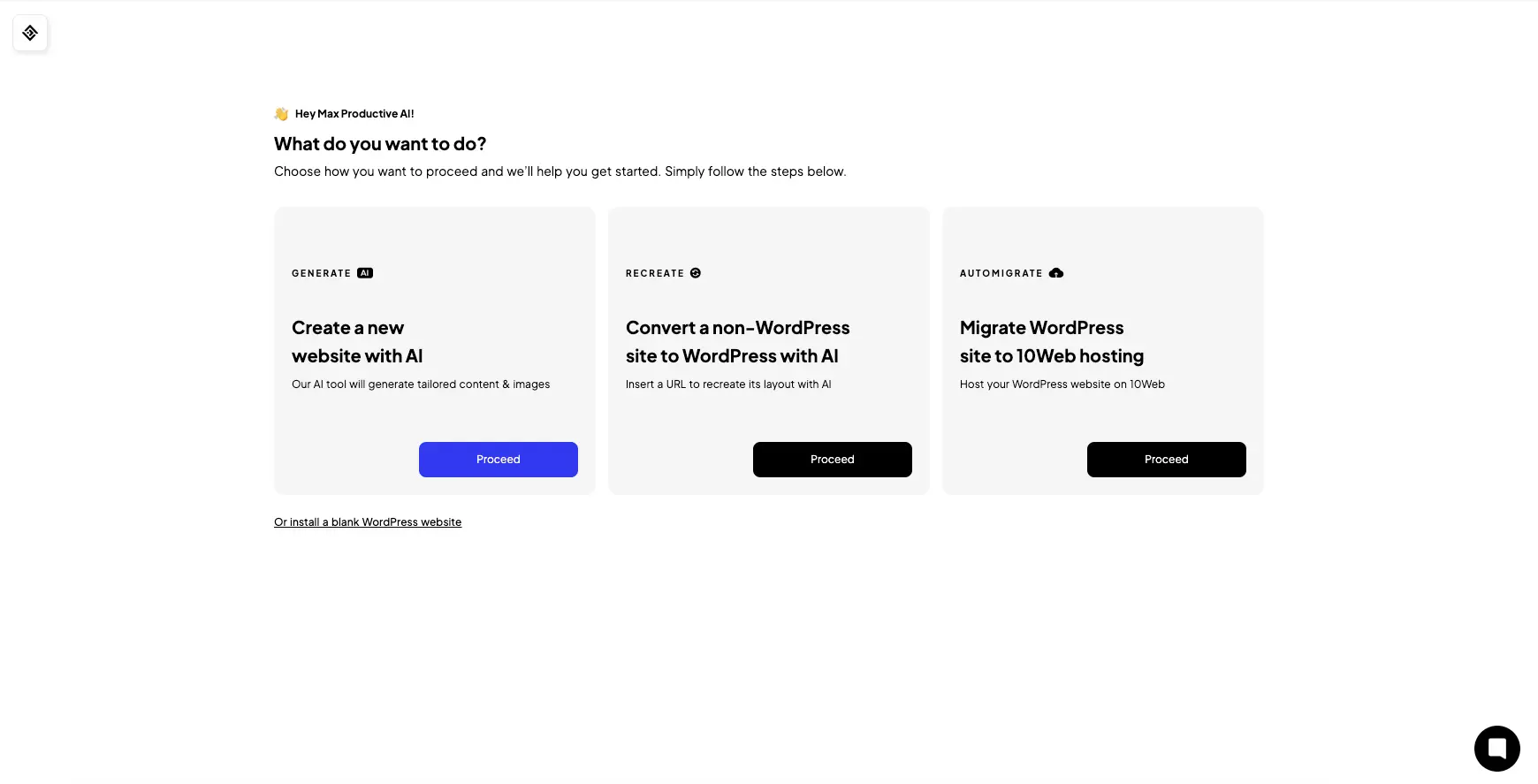
The 10Web dashboard greets you with three clear paths: Generate a new website with AI, Recreate a non-WordPress site by pasting its URL, or Automigrate an existing WordPress site to 10Web's hosting. This AI-first onboarding sets the tone for the entire platform — you're not starting from a blank canvas.
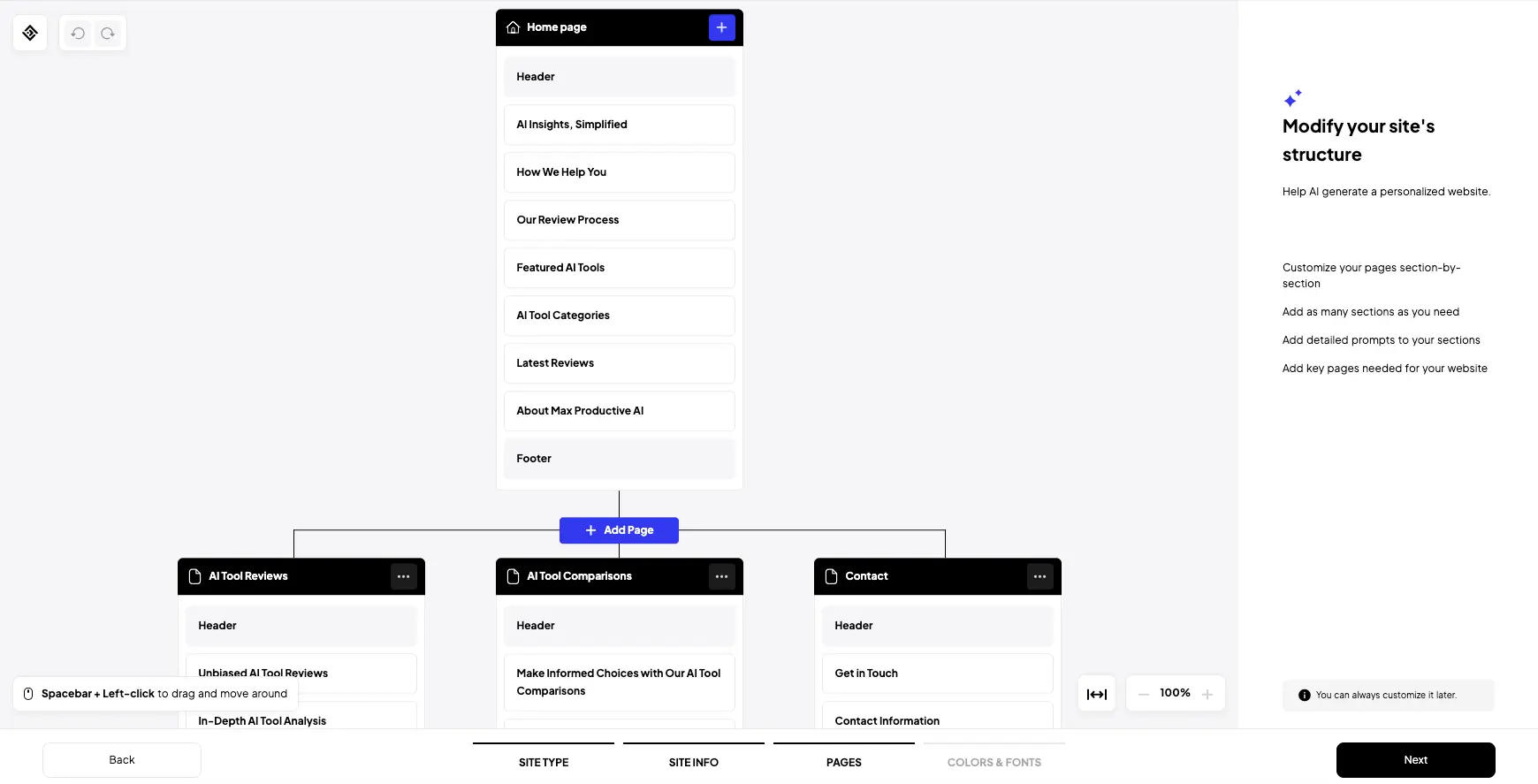
Once you describe your site, 10Web's AI generates a full site structure you can customize before the build begins. As shown above, you can modify your homepage sections, add or remove subpages, and write detailed prompts for each section. This level of structural control during the AI generation phase is something most competitors skip entirely.
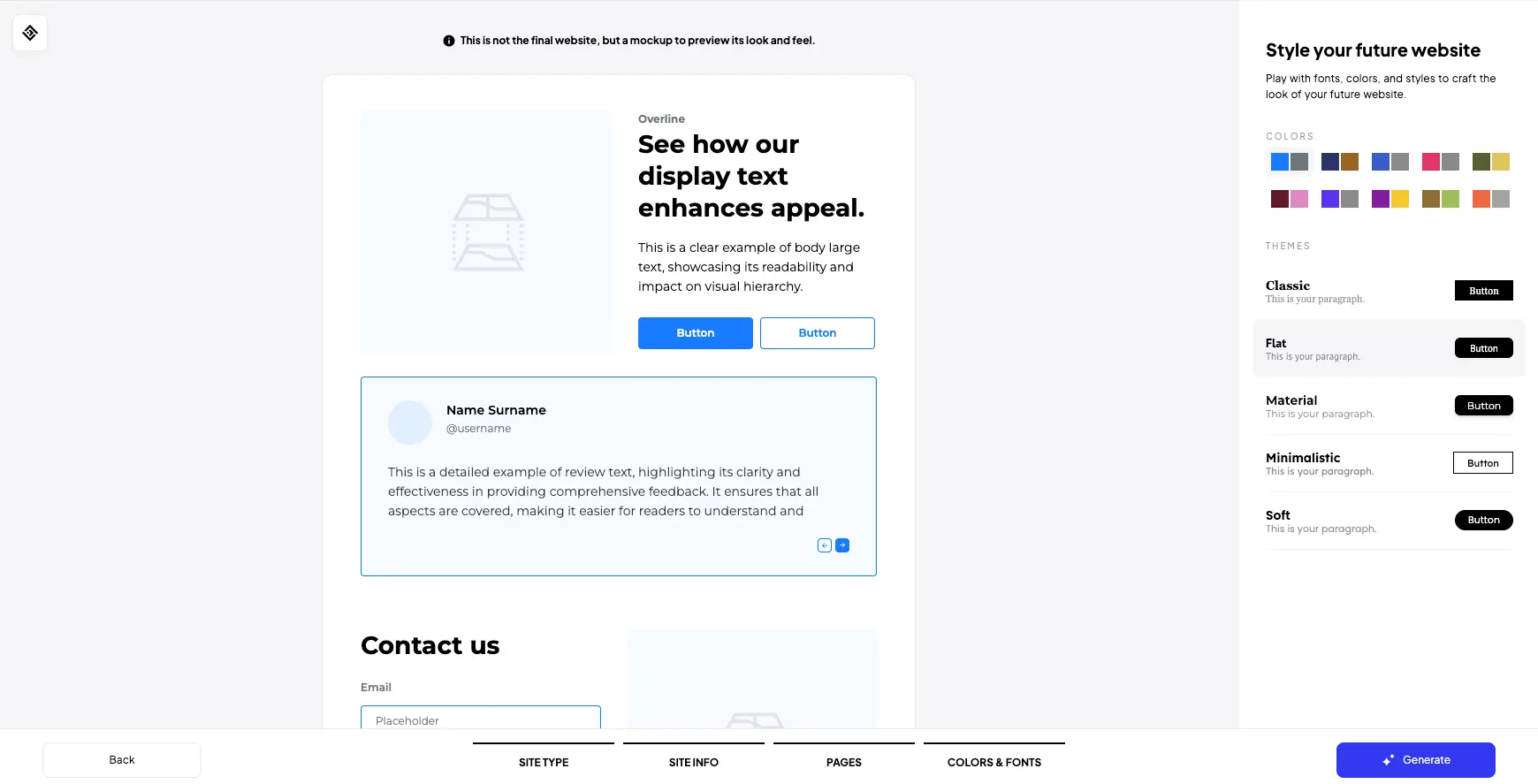
Before generating, you can also choose your visual identity: color palettes and theme styles (Classic, Flat, Material, Minimalistic, Soft). This mockup preview helps you visualize your site's look and feel before the AI builds it. All hosting runs on Google Cloud with 12 data center locations and a claimed 99.9% uptime guarantee.
What Is Shopify?
Shopify is the world's leading dedicated ecommerce platform, founded in 2006 and now powering approximately 4.8–6.5 million live stores worldwide. It holds roughly 26% of global ecommerce platform market share and processed $292 billion in gross merchandise volume (GMV) in 2024 — effectively making it the second-largest US retail ecommerce entity by volume.
Shopify's approach is fundamentally different from 10Web: everything is built around selling. Payments, shipping, inventory, checkout, abandoned cart recovery, POS for physical retail, marketing automation, and even AI-powered business management are all integrated natively — no plugins or third-party assembly required.

Shopify's dashboard guides you through store setup with a structured checklist — add products, customize your theme, set up payments, review shipping rates, and customize your domain. On the right, Shopify's Sidekick AI assistant proactively offers guidance at each step, making the platform remarkably approachable for beginners. The entire onboarding is designed so you can go from zero to a live store within hours.

Shopify's AI theme generator lets you describe your business and instantly generates custom theme options with personalized content. In our test, we typed a business description and received three unique free themes — Clarity, Flora, and Radiant — each pre-populated with relevant imagery and copy. Below the AI-generated options, Shopify also surfaces popular free themes for manual selection.

Shopify Magic extends AI into your daily operations. The product description generator (shown above) lets you enter features and keywords, select a tone (Expert, Supportive, Persuasive, etc.), and generate optimized descriptions instantly. This same AI engine powers blog content generation, email subject lines, and a "Brand Voice Cloning" feature that learns your writing style from past content.
Feature-by-Feature Comparison
AI Capabilities
Both platforms use AI extensively, but their AI serves fundamentally different purposes — and understanding this distinction is critical for choosing the right tool.
| AI Feature | 10Web | Shopify | Winner |
|---|---|---|---|
| AI site generation | Full site from text prompt in 2–3 min | AI theme generation with content | 10Web |
| AI website cloning | Paste any URL, replicate design | Not available | 10Web |
| AI product descriptions | Via AI content generator | Native with tone/keyword controls | Shopify |
| AI business assistant | AI Co-Pilot for editing | Sidekick (proactive, data-driven) | Shopify |
| AI content generation | 5K–unlimited words/mo by plan | Blog posts, emails, subject lines | Tie |
| AI image generation | Unlimited on all plans | Background removal, limited generation | 10Web |
| Brand voice cloning | Not available | Learns tone from past content | Shopify |
| AI product syndication | Not available | ChatGPT, Perplexity, Apple Intelligence | Shopify |
10Web's AI excels at getting your site built from scratch — full site generation, website cloning, structural customization, and unlimited image creation. Shopify's AI excels at running your business day-to-day — product descriptions, sales analytics, workflow automation, and proactive business recommendations through Sidekick Pulse.
Ecommerce Capabilities
This is where the platforms diverge most dramatically. Shopify was built from the ground up for selling; 10Web adds ecommerce through WooCommerce.
| Ecommerce Feature | 10Web (WooCommerce) | Shopify | Winner |
|---|---|---|---|
| Built-in checkout | Via WooCommerce plugin | Native, conversion-optimized | Shopify |
| Payment processing | WooCommerce gateways (Stripe, PayPal, etc.) | Shopify Payments + 100+ gateways | Shopify |
| Platform transaction fee | None (processor fee only) | 0–2% on third-party gateways | 10Web |
| Abandoned cart recovery | Via plugins (requires setup) | Built-in on all plans | Shopify |
| POS (physical retail) | Via plugins (limited) | Native POS system ($89/mo Pro) | Shopify |
| Dropshipping/POD | Printful, AliDropship plugins | Native one-click integrations | Shopify |
| Multi-currency | Via WPML or plugins (setup required) | Built-in Shopify Markets (130+ currencies) | Shopify |
| Shipping discounts | Not included | Up to 88% via approved carriers | Shopify |
| Product limits | Unlimited | Unlimited on all plans | Tie |
| B2B wholesale | Via plugins | Native on Shopify Plus | Shopify |

Shopify's built-in marketing automation library is a good example of its all-in-one approach. As shown above, pre-built templates cover abandoned checkout recovery, cart abandonment, welcome series with discounts, post-purchase thank-yous, birthday campaigns, win-back emails, and upsell workflows — all available without installing a single third-party app.
SEO & Content Marketing
This is one of the most important differences between the two platforms, especially for businesses that rely on organic search traffic as a growth strategy. WordPress (and by extension, 10Web) was built for content. Shopify was built for selling.
| SEO Feature | 10Web (WordPress) | Shopify | Winner |
|---|---|---|---|
| URL structure | Full control, custom hierarchies | Forced paths (/products/, /collections/) | 10Web |
| Schema markup | Any type (FAQ, HowTo, Product, Article) | Limited — requires apps or Liquid code | 10Web |
| SEO plugins | Rank Math, Yoast SEO, AIOSEO | Plug In SEO, ConvertMate (paid) | 10Web |
| Blog capabilities | Full CMS: categories, tags, custom post types, revision history | Basic: tags only, no categories, no revisions | 10Web |
| robots.txt access | Full access | Locked (meta robots only) | 10Web |
| Category hierarchy | Parent-child hierarchies supported | Flat structure only | 10Web |
| Sitemap generation | Via plugins (highly configurable) | Automatic (less configurable) | Tie |
| Mobile optimization | Theme-dependent | All themes mobile-optimized by default | Shopify |

Shopify does include an AI blog content generator (shown above) with topic prompts, special instructions, and tone controls. For simple product-adjacent content — how-to guides, product announcements, brand stories — it's adequate. However, the underlying blogging infrastructure lacks categories, revision history, editorial workflows, and advanced formatting that content-driven businesses need.
For businesses that rely on content marketing, topical authority, and organic search visibility, WordPress/10Web provides a significantly deeper toolkit. Multiple independent analyses consistently reach this conclusion: WordPress wins for SEO-heavy strategies, while Shopify is sufficient for product-page SEO but limited for technical SEO control and content marketing.
App Ecosystem & Integrations

| Ecosystem | 10Web (WordPress) | Shopify |
|---|---|---|
| Total apps/plugins | 61,000+ free WordPress plugins | 16,800+ Shopify apps |
| Cost of extensions | Many free; premium $0–100/year | Average merchant runs 6.5 apps; $0–300+/mo for scaling stores |
| Ecommerce extensions | WooCommerce extensions (modular, interchangeable) | Curated, Shopify-optimized apps |
| Portability | Plugins are standard WordPress — portable across hosts | Apps are Shopify-specific — don't transfer |
Shopify's app store, shown in the screenshot above, proactively recommends apps based on your store type — from product sourcing (Syncee, DSers) to email marketing (Klaviyo, Mailchimp) and Google & YouTube integrations. This curated approach reduces decision fatigue, but app costs can add up quickly for scaling stores. WordPress/10Web's plugin ecosystem is larger but requires more self-directed discovery.
Pricing Comparison (February 2026)
10Web Pricing
| Plan | $/month (Annual) | Storage | Key Features |
|---|---|---|---|
| AI Starter | $10 | 10GB | 1 site, hosting, builder, SSL, 5K AI words |
| AI Premium | $15 | 15GB | All Starter + 50K visitors, 50K AI words |
| AI Ultimate | $23 | 20GB | VIP support, multisite, unlimited AI words |
| AI Ecommerce Starter | $11 | 10GB | WooCommerce, 30K visitors, 10K AI words |
| AI Ecommerce Premium | $23 | 25GB | Advanced ecommerce, 210K visitors, 50K AI words |
| Agency (3–100 sites) | $24–$250 | 15GB–Custom | White-label dashboard, bulk pricing |
All 10Web plans include Google Cloud hosting, automated daily backups, free SSL, a staging environment, and SSH/SFTP access. Overage charges apply at $2/month per extra 10K visitors and $2/month per extra 5GB storage. The 7-day free trial requires no credit card on signup.
Shopify Pricing
| Plan | $/month (Annual) | Staff Seats | Key Features |
|---|---|---|---|
| Starter | $5 | 1 | Social/link selling, no full online store |
| Basic | ~$29 | 1 | Full online store, 2.9% + 30¢ CC rate |
| Grow | ~$79 | 5 | Professional reports, 2.7% + 30¢ CC rate |
| Advanced | ~$299 | 15 | Custom reports, 2.5% + 30¢, carrier shipping |
| Plus | $2,300+ | Unlimited | B2B, headless commerce, custom checkout |
Shopify offers a 3-day free trial followed by $1/month for 3 months — effectively 93 days of access for just $3 total. Using Shopify Payments eliminates the third-party gateway fee, but Shopify Payments is not available in every country (notably absent in the UAE and GCC countries). Merchants using third-party gateways pay an additional 0.6–2% per transaction depending on plan tier.
Hosting & Performance
| Feature | 10Web | Shopify |
|---|---|---|
| Infrastructure | Google Cloud (12 locations) | Shopify's proprietary global cloud |
| Uptime | 99.9% guarantee | Excellent (no stated SLA for standard plans) |
| CDN | Cloudflare Enterprise (add-on $4–6/mo) | Built-in global CDN |
| PageSpeed | 90+ score (PageSpeed Booster included) | Fast out-of-the-box |
| SSL | Free (Let's Encrypt) | Free on all plans |
| Backups | Daily automated | Automatic (no user-facing restore) |
| Staging environment | Included on all plans | Not available on standard plans |
| SSH/SFTP access | Full access | Not available (closed platform) |
10Web provides more technical control — staging environments, SSH/SFTP access, and server-level configuration that developers and agencies need. Shopify provides a more hands-off experience where performance is handled for you with zero server management. For non-technical users, Shopify's approach is a clear advantage. For developers and power users, 10Web's Google Cloud infrastructure and granular controls are preferable.
Pros and Cons
10Web
Pros
- AI generates a full WordPress site from text description in 2–3 minutes
- Unique AI website cloning — replicate any site's design from a URL
- Full WordPress ecosystem: 61,000+ plugins, 30,000+ themes
- Superior SEO: full URL control, schema markup, Rank Math/Yoast support
- No platform transaction fees — only processor fees on WooCommerce
- Ecommerce starts at $11/mo — 60% cheaper than Shopify Basic
- White-label agency dashboard for managing multiple client sites
- Full data ownership — migrate to any WordPress host anytime
- Google Cloud hosting, staging environments, SSH/SFTP access included
- 4.7/5 Trustpilot rating (2,100+ reviews)
Cons
- Requires WordPress familiarity — steeper learning curve for complete beginners
- Ecommerce features require WooCommerce plugin assembly and configuration
- 10Web Payments (Stripe-powered) only available in USA and Canada
- Multi-currency requires plugins and manual setup
- No native POS system for physical retail
- Dropshipping/POD integrations require more manual setup than Shopify
- Some users report slower support resolution on complex technical issues
- Cloudflare Enterprise CDN is an additional $4–6/month add-on
Shopify
Pros
- All-in-one ecommerce — payments, shipping, checkout, inventory all native
- Easiest setup: go from zero to a live store in hours, rated 5/5 for ease of use
- Shopify Sidekick + Pulse: proactive AI assistant that manages your business
- Native POS system for physical retail locations
- One-click dropshipping and print-on-demand integrations
- Shopify Markets: multi-currency (130+ currencies), localized storefronts
- Built-in abandoned cart recovery and marketing automation templates
- 16,800+ apps on the Shopify App Store
- Shipping discounts up to 88% via approved carriers
- $1/mo for 3 months — one of the best trial offers in ecommerce
Cons
- Basic plan limits you to 1 staff seat — multi-user access requires Grow ($79/mo)
- 1–2% extra transaction fee when using third-party payment gateways
- Shopify Payments not available in UAE/GCC countries
- Rigid URL structure and limited technical SEO control
- Basic blogging only — no categories, no revision history, no custom post types
- Proprietary platform — leaving Shopify means rebuilding your store
- App costs can snowball: average merchant uses 6.5 apps, $0–300+/mo each
- Support quality has declined according to recent user feedback
Total Cost of Ownership (Year 1 Estimate)
Platform pricing tells only part of the story. Here's a simplified estimate of what each platform actually costs for a single ecommerce store in Year 1:
| Cost Component | 10Web (Ecommerce Starter) | Shopify (Basic, Annual) |
|---|---|---|
| Platform fee | $132/year ($11 × 12) | $348/year (~$29 × 12) |
| Hosting | Included | Included |
| SSL | Included | Included |
| SEO tools | $0 (Rank Math free) | $0–600/year (SEO apps) |
| Payment processing | Processor fee only (e.g. Stripe ~2.9% + 30¢) | Processor fee + 0–2% Shopify surcharge |
| Essential apps/plugins | $0–100/year | $0–3,600/year (avg 6.5 apps) |
| Estimated total range | ~$132–232/year | ~$348–4,548/year |
These are simplified estimates — actual costs vary based on business complexity, transaction volume, and the specific apps or plugins you need. As multiple industry analyses note, the platform fee is often the smallest part of your ecommerce costs. The key takeaway: 10Web offers a significantly lower entry point, but Shopify's built-in features can reduce the need for paid add-ons in many ecommerce scenarios.
Who Should Choose Each Platform?
Choose 10Web If You Are:
- Building a content-driven business where SEO, blogging, and organic traffic are primary growth channels
- An agency managing multiple client websites that need a white-label dashboard and WordPress portability
- Budget-conscious and want ecommerce starting at $11/month with no platform transaction fees
- A developer or technical user who values staging environments, SSH/SFTP access, and full server control
- Based in a region where Shopify Payments isn't available and want to avoid the extra 1–2% gateway surcharge
- Building a portfolio, service business, or affiliate marketing site that may add commerce later
- Someone who values data ownership and the ability to migrate your site to any host at any time
Use case example: A digital marketing agency managing 15 client websites, each requiring custom design, strong SEO performance, and the flexibility to add ecommerce when needed — with everything running under the agency's own branding via 10Web's white-label dashboard.
Choose Shopify If You Are:
- Running a product-focused ecommerce store where selling online is the core business activity
- Starting a dropshipping or print-on-demand business and need one-click supplier integrations
- Operating physical retail locations and need a native POS system alongside your online store
- Selling internationally and need built-in multi-currency support with 130+ currencies
- A beginner with zero technical experience who wants the fastest path from idea to live store
- A B2B wholesale business needing native wholesale features (Shopify Plus)
- Scaling rapidly and want an all-in-one platform that handles payments, shipping, and marketing automation natively
Use case example: A fashion brand launching with 200+ SKUs, selling across 5 countries with localized pricing, using Shopify POS in 2 physical boutiques, and leveraging Sidekick AI to optimize marketing campaigns and automate abandoned cart recovery — all from a single platform.
What Does a 10Web AI-Generated Site Actually Look Like?

Here's the actual output from our 10Web AI generation test. The platform produced a complete homepage with a professional hero section, navigation menu (AI Tool Reviews, AI Tool Comparisons, Contact), relevant stock imagery, email signup form, and responsive layout — all generated from our brief business description. The design is clean and functional out of the box, though you'll likely want to customize it further using 10Web's drag-and-drop editor or the 50+ premium Elementor widgets included with every plan.
Exploring Other Options?
If neither 10Web nor Shopify perfectly matches your needs, several other AI website builders are worth considering. Hostinger AI Website Builder (4.7/5 rating) offers excellent value with AI-powered site generation and affordable hosting. HubSpot AI Website Generator (4.4/5) is ideal for businesses already in the HubSpot CRM ecosystem. Durable (4.3/5) generates a functional business website in under 30 seconds. Site123 (4.5/5) provides a simple drag-and-drop experience for quick launches. And Wix (4.6/5 — our top-rated website builder) offers a powerful all-round platform with strong AI features. Browse our complete AI website builder directory to find the platform that matches your specific requirements.
Final Verdict: 10Web vs Shopify
| Best for ecommerce | Shopify (all-in-one selling machine) |
| Best for SEO & content | 10Web (full WordPress flexibility) |
| Lowest starting price | Shopify Starter ($5/mo) / 10Web ($10/mo full site) |
| Best ecommerce value | 10Web ($11/mo vs $29/mo, no platform fees) |
| AI site generation | 10Web (full site from text in 2–3 min) |
| AI business management | Shopify (Sidekick + Pulse) |
| Dropshipping / POD | Shopify (native one-click integrations) |
| Physical retail POS | Shopify (native POS system) |
| Blogging capabilities | 10Web (WordPress full CMS) |
| Agency management | 10Web (white-label dashboard) |
| Multi-currency selling | Shopify (built-in Markets, 130+ currencies) |
| Data ownership | 10Web (fully portable WordPress) |
| Ease of use for beginners | Shopify (rated 5/5 ease of use) |
| Plugin/app ecosystem | 10Web (61K+ plugins vs 16.8K apps) |
Bottom line: These platforms serve different business needs, and there's no universal winner.
- 10Web = Content-first + WordPress flexibility. Best for SEO-driven businesses, content creators, agencies, and budget-conscious ecommerce stores that want full control over their website and data, with no platform transaction fees.
- Shopify = Commerce-first + operational AI. Best for product-focused stores, dropshippers, physical retailers, and businesses that want an all-in-one selling platform with built-in payments, shipping, POS, and proactive AI business management.
The right choice depends on a simple question: Is your business built around content and a website, or built around products and selling? Answer that, and the decision becomes clear.
Frequently Asked Questions
Learn more about other AI website builders in our comprehensive directory. For deeper analysis, read our full 10Web review or Shopify review.