
Beehiiv
The newsletter platform built for growth: email, web, podcast, and webinar publishing with paid subscriptions, sponsorships, and a native ad network built in — on flat fees, with no cut of your revenue.
Try Beehiiv Free →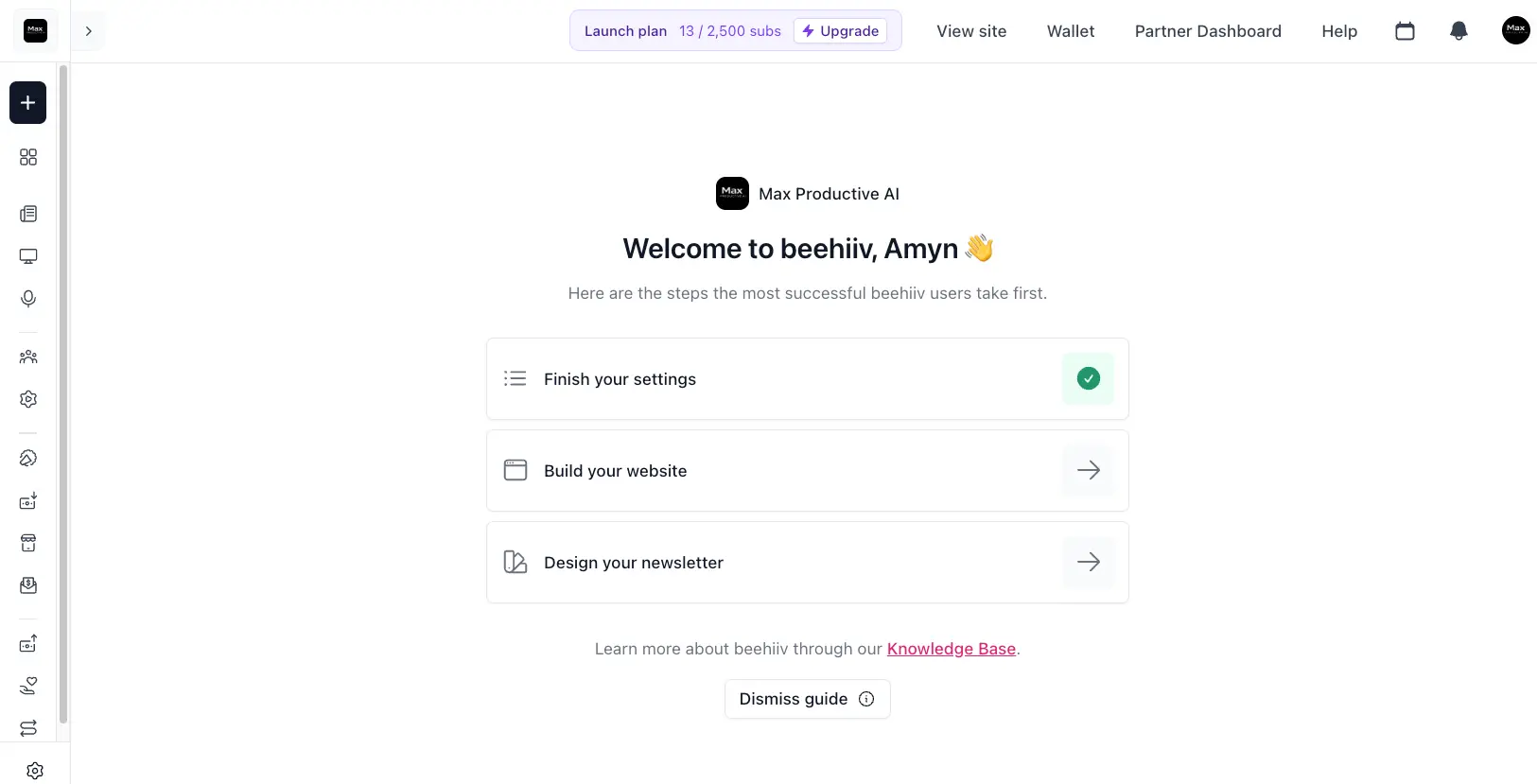
A Newsletter Business Engine
for Creators & Media Publishers
Beehiiv treats a newsletter the way Morning Brew's growth team treated theirs: as a business with multiple revenue lines. Paid subscriptions, an ad network, paid cross-promotion, digital products, podcasts, and webinars all run natively from one dashboard — and Beehiiv doesn't take a cent of any of it, just a flat monthly fee. Add the most usable free plan in the category and growth tools nobody else has, and the 4.1 starts to look conservative. What holds it back: deliverability that depends on you setting up a custom sending domain, thin email design, and support that's slower than it should be.
✓ What We Love
- Flat fees and zero revenue share across every income stream
- A free tier you can build a serious list on before paying
- Boosts, referrals, and cross-promotion no competitor matches
- Every issue doubles as an SEO-indexable web post
! Could Be Better
- Deliverability can swing until you set up a custom sending domain
- Email design is thin — few templates, no drag-and-drop layouts
- No live chat or phone support; the free plan gets a chatbot
What Is Beehiiv?
Who built it, what problem it solves, and why this Beehiiv review treats it as more than an email tool.
Beehiiv is a newsletter platform built for creators who treat their email list as a business — not just a broadcast channel. It was founded in 2021 by Tyler Denk, who was the second employee at Morning Brew and built much of the growth engineering that took that newsletter to millions of readers, together with co-founders Benjamin Hargett and Jake Hurd. That origin story matters: the referral program, the cross-promotion network, and the ad monetization tools at the heart of Beehiiv are productized versions of the exact systems that made Morning Brew work.
That focus is what separates it from general-purpose email tools like Mailchimp or Brevo. Those platforms treat email as one marketing channel among many; Beehiiv treats your newsletter as a full media property. Every issue you send is simultaneously published as a web post on your own domain. Subscriptions, ads, paid cross-promotion, digital products, podcast episodes, and — since April 2026 — live webinars all run from the same dashboard. And the platform takes no percentage of any of it: you pay a flat monthly fee and keep what you earn.
The scale backs up the pitch. As of early 2026, Beehiiv hosts more than 130,000 newsletters, is backed by NEA and Lightspeed, and its native ad network — with advertisers like Nike, Netflix, HubSpot, and Notion — was paying creators seven figures every month. The company has also been shipping at a pace that's honestly hard to track: the Winter 2025 release alone bundled 30+ features, including an AI website builder (built on its acquisition of Typedream), digital product sales, and native podcast hosting.
How We Tested Beehiiv
Max Productive AI's own newsletter runs on Beehiiv, and the screenshots throughout this page are pulled straight from our live account: the onboarding flow, the template library, our welcome email, the website overview with its SEO settings, and the Ad Network dashboard. We built the publication on the free Launch plan — where most readers will start too. For monetization features locked behind Scale, we've combined what's visible in the product with Beehiiv's documentation and reports from creators running them at volume — and flagged where we're leaning on research rather than firsthand use.
It's not all upside, and this review wouldn't be much use if it pretended otherwise. The email editor is deliberately writer-first, with a thin template library and limited layout control that design-heavy brands will find restrictive. Support is gated behind paid plans. And the platform's biggest structural weakness — deliverability on the default shared sending domain — deserves its own discussion (we'll get there). None of these are deal-breakers for the core audience, but they shape who should and shouldn't sign up.
Who Is Beehiiv Best For?
Independent newsletter creators, journalists, and media publishers whose newsletter is the business itself — monetized through subscriptions, sponsorships, and reader revenue. Particularly strong for Substack creators ready to outgrow the 10% revenue share, operators who want growth mechanics (referrals, cross-promotion, paid acquisition) built in rather than bolted on, and anyone consolidating newsletter + website + podcast into one platform.
See Beehiiv in Action
Real screenshots from our own Beehiiv account — the actual dashboard, editor, and monetization screens you'll be working in.
Dashboard & Onboarding
The guided checklist that takes a new publication from zero to live
This is what you see after signing up: a three-step checklist (finish settings, build your website, design your newsletter) instead of a wall of menus. The top bar keeps your subscriber count against your plan limit visible at all times, alongside the Wallet and Partner Dashboard — a small detail that tells you a lot about how money-forward this platform is. Our publication went from signup to live in a single sitting.
Post Template Library
Quick-start layouts for editorial posts, interviews, roundups, and promos
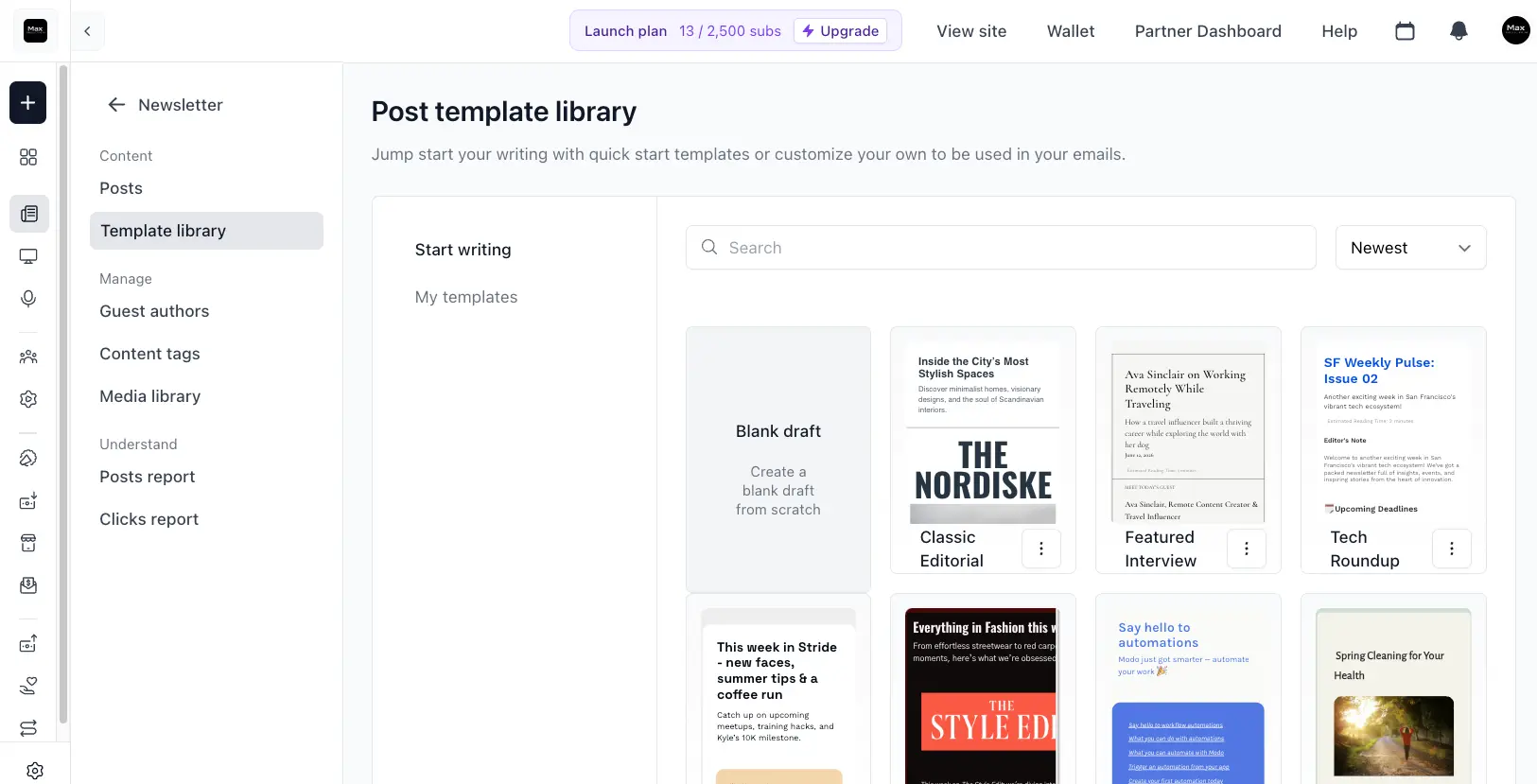
The template library covers the common newsletter formats — classic editorial, featured interview, tech roundup — and you can save your own layouts under My Templates for repeat use. Fair warning, though: this is a library of content structures, not a visual design playground. If you're coming from a drag-and-drop builder with hundreds of branded layouts, the selection here will feel sparse. For text-first publications, it's all you need.
The Editor
Writing our welcome email in Beehiiv's text-block editor
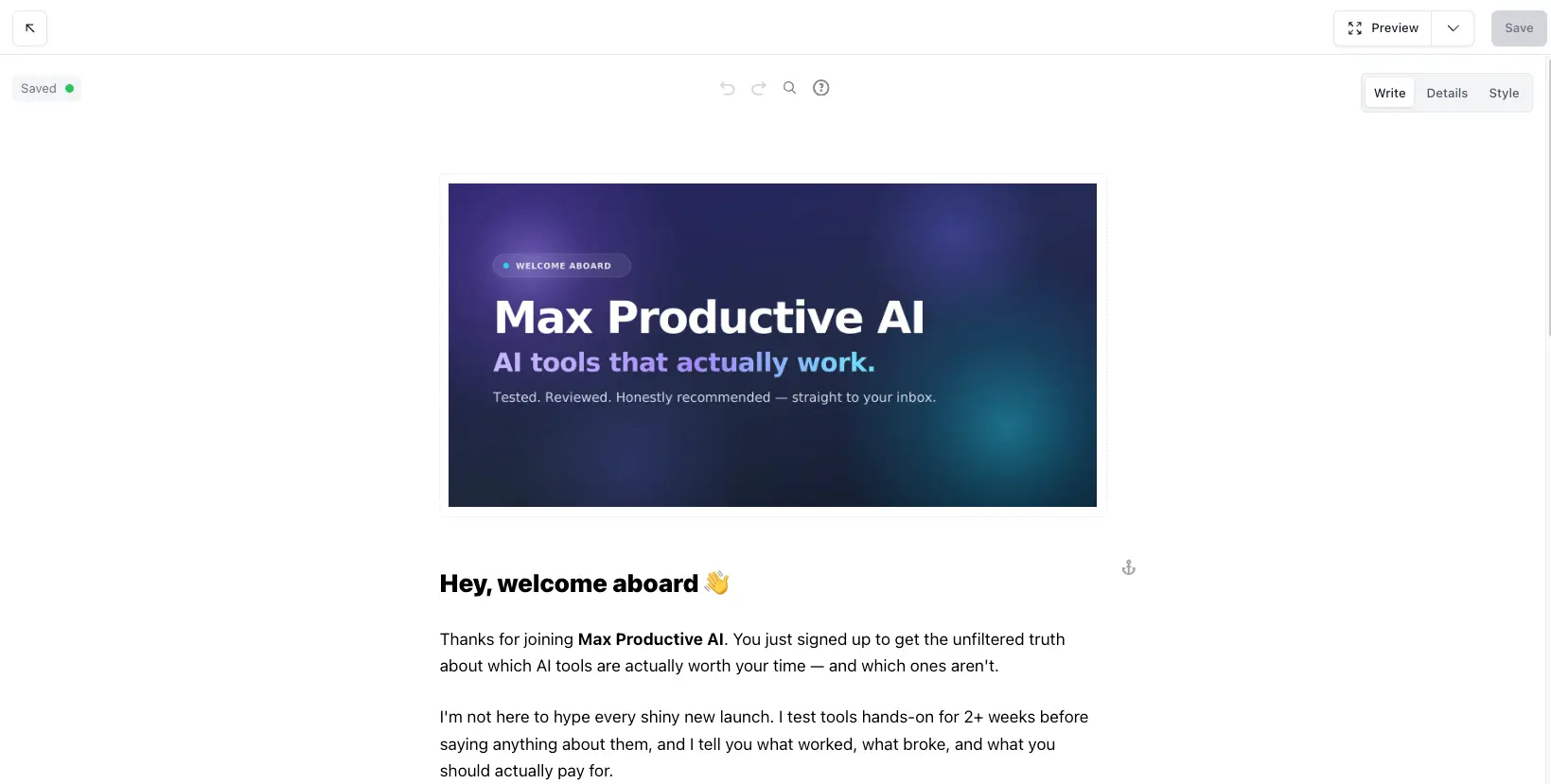
Here's our actual welcome email mid-draft. The editor feels like writing in Notion or Ghost — clean blocks, no fiddly columns, with Details (SEO metadata, web settings) and Style tabs alongside the writing view. The AI assistant, polls, and dynamic free/paid blocks all live behind slash commands. We had the welcome email written, styled, and previewed in under twenty minutes, and that's the point: this editor optimizes for shipping words, not perfecting pixels.
Want to poke around the dashboard yourself?
Try Beehiiv Free →Launch plan is free forever • No credit card requiredAutomation Workflow Editor
Building a signup-triggered welcome flow on the visual canvas
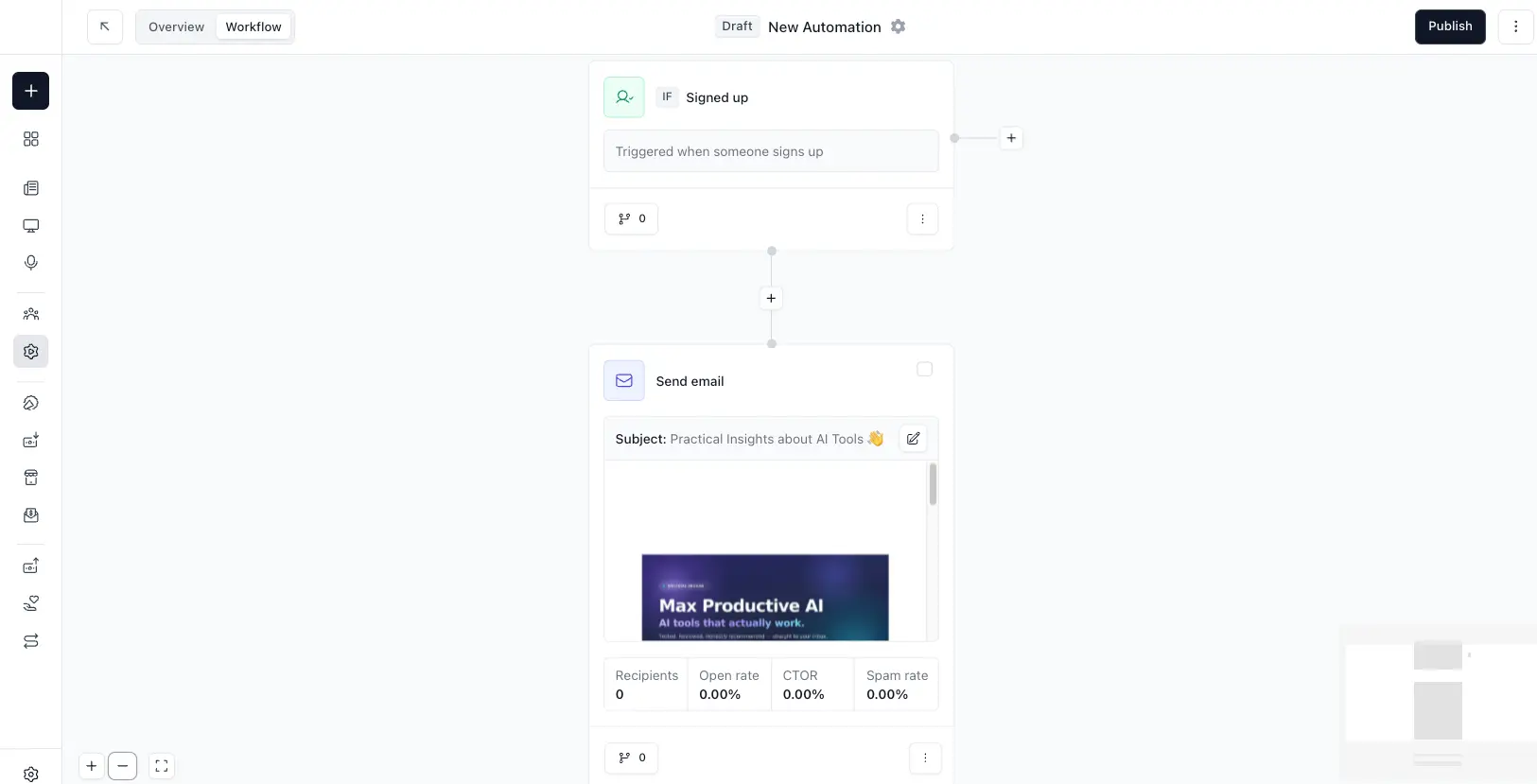
The automation canvas is clean: a trigger node ("Signed up") connects to action steps, and each email step shows its own recipients, open rate, click-to-open rate, and spam rate once live. Building this welcome flow took minutes. What you won't find here is multi-path conditional branching — the if-this-then-that-else logic that CRM-grade tools offer. For newsletter work — welcome flows, re-engagement, upgrade nudges — it's plenty; for funnel architecture, it isn't trying to be.
Website Overview & SEO Settings
Your publication's web presence, search preview, and site analytics in one screen
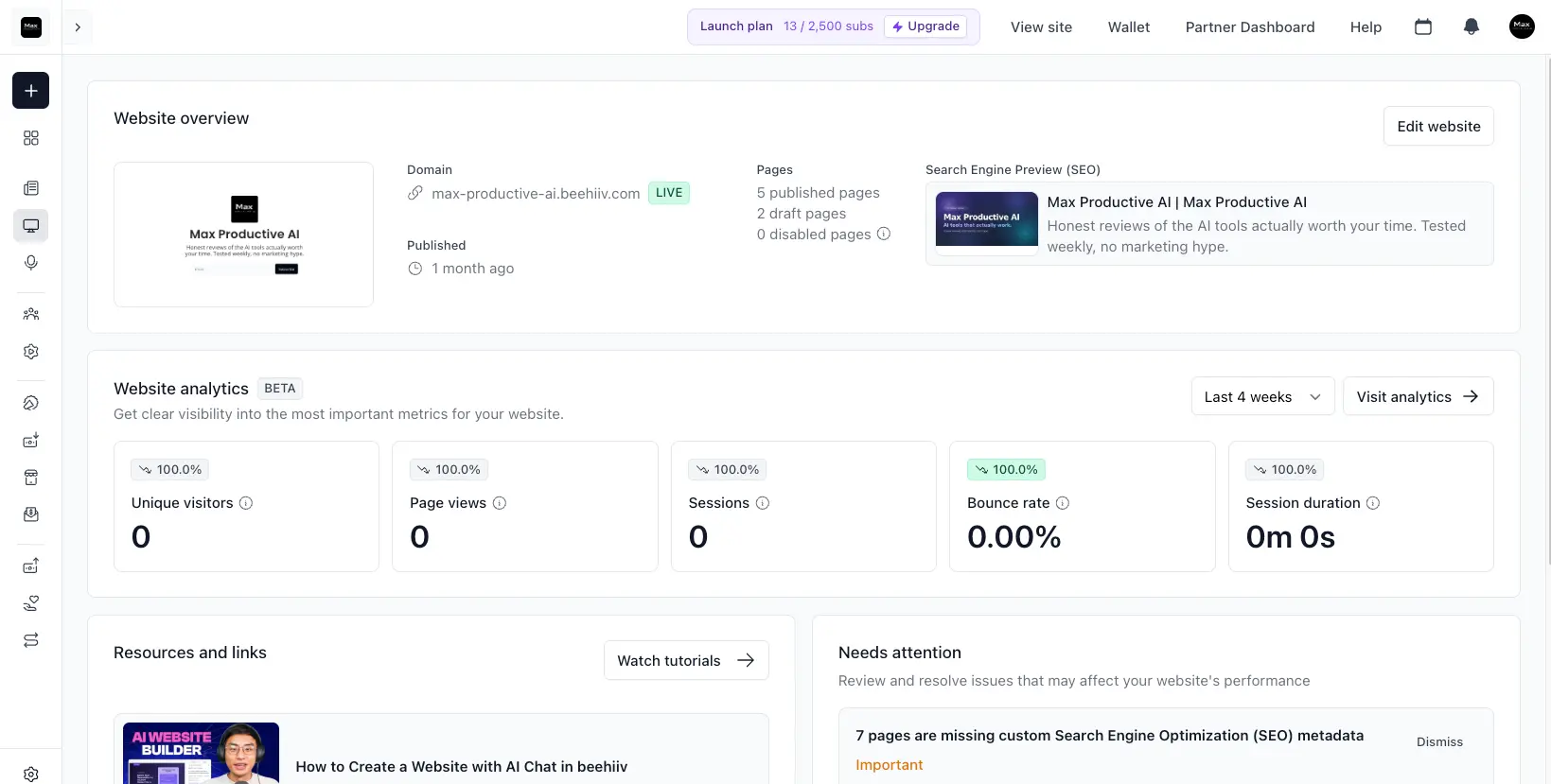
This screen sold us on the web side of the platform. You get a live search-engine preview of how your publication appears on Google, real-time website analytics (visitors, page views, sessions, bounce rate), and — usefully — a "Needs attention" panel that flagged 7 of our pages as missing custom SEO metadata. That's the kind of nudge most newsletter tools never give you, because most newsletter tools don't treat your archive as a search asset.
Ad Network Dashboard
Pre-negotiated sponsorships waiting to be claimed, with the payout flow spelled out
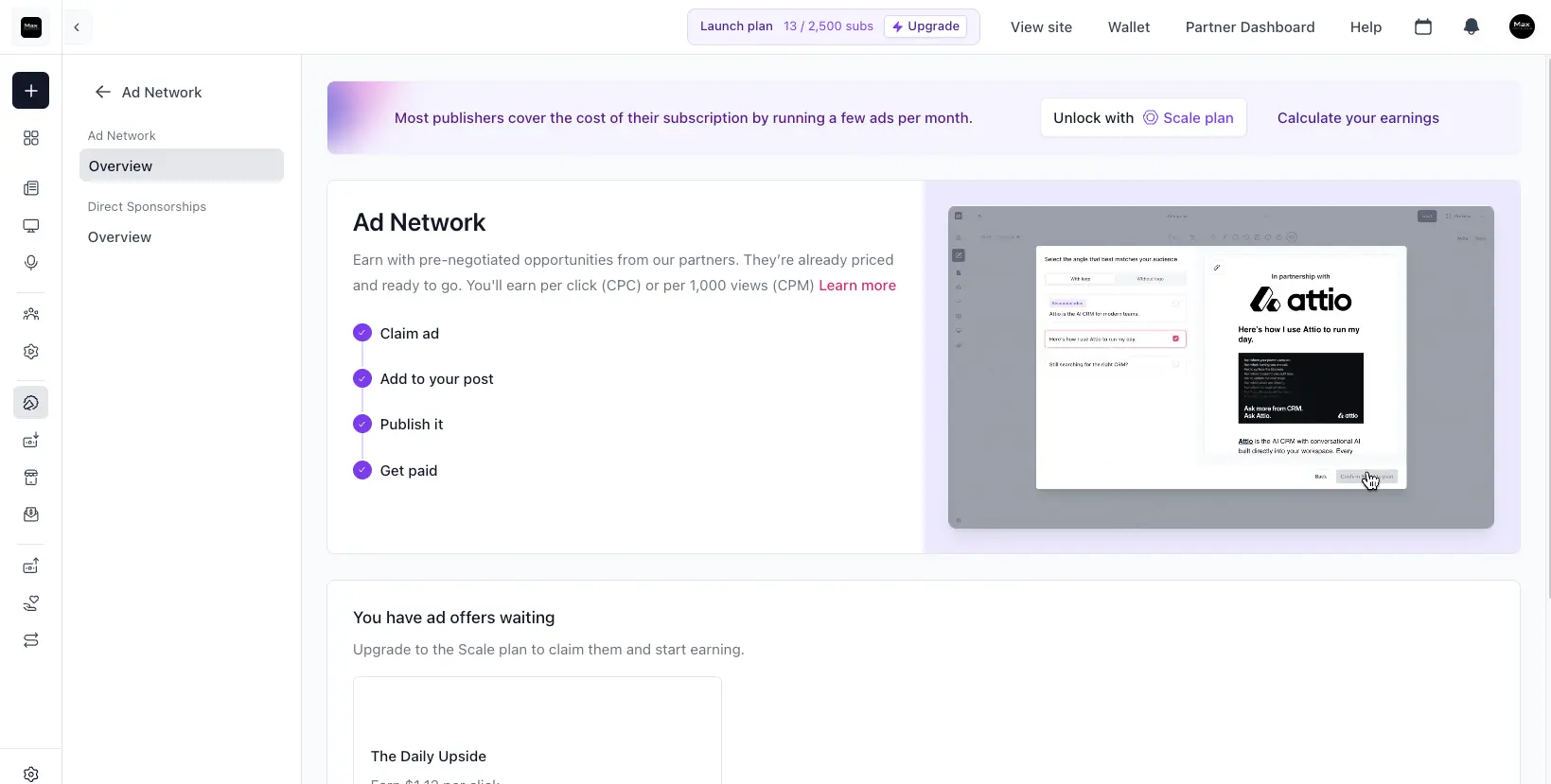
Here the money model turns concrete: claim ad → add to your post → publish → get paid. Even on our free plan, ad offers were already waiting (a finance newsletter offering per-click payouts), visible but locked until Scale. Worth noting the framing Beehiiv itself uses here — most publishers cover their plan cost by running a few ads a month. Based on creator reports, that's plausible once your list has real engagement; it's not magic money at 200 subscribers.
How Beehiiv Works
From free signup to a monetized publication in four stages.
Create Your Publication (Free)
Sign up and Beehiiv walks you through the basics — account settings, your site, your newsletter's look. That's the whole setup; ours was live the same afternoon. You can import an existing list (every import runs through automatic email validation to keep bounces down) and host up to 3 publications on one account. One thing to do immediately, even before your first send: configure a custom sending domain. More on why below.
Write Once, Publish Twice
Every issue you write leaves as an email and lands on your website as a post — one click, two channels. The editor is text-block based — closer to a blogging CMS than a drag-and-drop email designer — with merge tags, polls, dynamic free/paid content blocks, and an AI assistant for drafting, tone shifts, and translation. You can A/B test up to 4 subject lines per send. Writers tend to love it; visual designers will hit walls.
Turn On the Growth Loops
This is where Beehiiv pulls away from every other newsletter platform. Recommendations gets you free cross-promotion from other publications. The referral program rewards readers for sharing, straight out of the Morning Brew playbook. Magic links let partner newsletters subscribe their readers to you in one click. And when you're ready to spend, Boosts buys verified subscribers from other newsletters at a CPA you control: The Rundown AI famously added over 10,000 subscribers this way at about $2 each.
Switch On Monetization
Upgrading to Scale unlocks the money features: paid subscription tiers with metered paywalls and free trials, the Ad Network once you pass roughly 1,000 subscribers, and the earning side of Boosts. Max adds a sponsorship storefront where brands book placements directly at your rates. Digital products, podcast monetization, and paid webinars round it out — and across all of it, Beehiiv's cut is zero. You pay the plan fee; the revenue is yours (minus Stripe's standard processing fee).
The Custom Domain Rule
Out of the box, your emails go out on Beehiiv's shared mail domain. That gets you decent placement on day one, but it ties your inbox rates to the behavior of every other sender on that infrastructure — and independent reports have documented painful swings when bad actors hit the shared pool. Setting up a custom sending domain makes your reputation entirely your own, and Beehiiv's Smart Warming ramps your volume automatically over 6–8 weeks. Do this in week one. It's the single highest-impact deliverability decision on the platform.
A Platform in a Hurry
Beehiiv shipped more in the last 12 months than most email platforms ship in three years: an AI website builder, digital products, podcast hosting, webinars, metered paywalls, conversational AI analytics. If you're picking a platform to build on for years, that momentum is worth something. The flip side, which users do report: moving this fast occasionally breaks things. Expect the odd bug.
Key Features
What you're actually getting — and which plan each piece lives on.
Writer-First Editor + AI
A clean, text-block editor with merge tags, polls, surveys, and dynamic blocks that show different content to free vs. paid readers. The built-in AI handles drafts, tone changes, translation, and even header images, and you can split-test subject lines. The trade-off is design control — this is a tool for writing, not for intricate visual layouts.
SEO-Ready Web Publishing
Every send becomes an indexable post on your own domain, with control over titles, meta descriptions, slugs, sitemaps, and canonical URLs, plus direct Google Search Console integration. The AI website builder (from the Typedream acquisition) generates full publication sites from a prompt. For content creators, the archive quietly becomes a second acquisition channel.
Referrals & Recommendations
Readers earn rewards at milestones for bringing in new subscribers, the Recommendations network swaps free promotion between publications, and magic links add one-click signups from partner newsletters. Almost none of this exists natively in traditional email tools.
Boosts Marketplace
Growth as a marketplace: pay other newsletters per verified subscriber they send you (typically $1.50–$3.00 each), or flip sides and earn by recommending theirs. The 10–17 day verification window filters bots and dead signups before money moves — which is the part that makes paid newsletter growth worth trusting.
Native Ad Network
Once your list clears four figures, you can claim pre-negotiated, pre-priced sponsorships from household-name brands, drop them into a post, and get paid per click or per thousand views. No pitching, no invoicing — Beehiiv handles the demand side. Direct-sold deals through the Max plan's sponsorship storefront typically out-earn the automated network once your audience has real scale.
Paid Subscriptions & Paywalls
Monthly and annual tiers, multiple premium levels, metered paywalls (the NYT model — a few free posts, then a prompt), and paid trials that auto-convert. Stripe handles payments at its standard 2.9% + $0.30; Beehiiv adds nothing on top. Substack charges 10% for the same job.
Automations v3.0
A visual workflow builder with 8 pre-built templates and behavioral triggers — link clicks, referral activity, survey responses, upgrade events. It covers the day-to-day newsletter sequences well. What it won't do is branch into conditional paths or CRM-style funnels; if that's your world, you want ActiveCampaign.
Podcasts, Webinars & Products
Native podcast hosting, paid live webinars with ticketing in multiple currencies (recordings convert into sellable digital products in a click), and a digital products storefront for ebooks, templates, and consulting — all with no platform commission. Conversational AI analytics let you ask plain-language questions about performance. Ambitious scope; the newest pieces still feel new.
The integration story is the thin spot. Native connections are limited to Zapier, Make, and a handful of tools, with an API on Scale and an app marketplace still in its early days — so if your stack leans on Shopify or a CRM, plan for middleware. On the other end of the spectrum, there's a custom mobile app builder that packages your publication into a subscriber-facing app with push notifications, something you won't find in any mainstream email tool.
Every plan starts free — upgrade when you're ready to monetize:
See Beehiiv Pricing →No revenue share on any planBeehiiv Pricing
Flat monthly fees that scale with your list size — and no share of your revenue.
Launch
- ✓ Up to 2,500 subscribers
- ✓ Unlimited email sends
- ✓ Website + custom domain
- ✓ Up to 3 publications
- ✓ Recommendations network
- ✓ AI writing assistant
Scale
- ✓ Everything in Launch
- ✓ Paid subscriptions — no revenue share
- ✓ Ad Network + Boosts
- ✓ Automations + A/B testing
- ✓ 3D analytics & cohort tracking
- ✓ Email support
Max
- ✓ Everything in Scale
- ✓ Remove Beehiiv branding
- ✓ Up to 10 publications
- ✓ Dynamic content personalization
- ✓ Sponsorship storefront
- ✓ Priority support
Also available: Enterprise plans with dedicated support for publications beyond 100,000 subscribers
Pricing last verified June 2026. Visit Beehiiv for current rates.
Is It Worth the Money?
The math against Substack's 10% cut is blunt. At $1,000/month in paid subscriptions, Substack keeps $100 while Beehiiv Scale costs a flat $49 — and the gap only widens as you grow. Break-even lands around $490 a month: below that, Substack's free hosting wins on cost; above it, every additional dollar of subscription revenue makes Beehiiv cheaper.
For context across the category: Mailchimp runs roughly $385/month at 10,000 contacts — more than triple Beehiiv's Scale tier at the same list size. ActiveCampaign starts around $189/month at 10K, GetResponse lands between $79 and $134 depending on plan, and budget options like Moosend sit near $88. Beehiiv's awkward spot is at the entry point: there's no step between the free plan and $49/month, so creators who outgrow the free tier before monetizing face a hard jump — the one place where cheaper tools like Brevo or Moosend earn a serious look.
Detailed Pros & Cons
The full picture after running our own publication on the platform and digging through independent creator reports.
✓ The Pros
! The Cons
Beehiiv vs Substack & Other Alternatives
The comparison everyone asks about first — then how Beehiiv stacks up against the email tools in our directory.
Let's deal with the big one. Beehiiv vs Substack is less a feature comparison than a philosophy choice. Substack is a writing platform with a social network attached: its Notes feed and recommendation algorithm can grow a small publication organically, the setup is instant, and it costs nothing upfront — because Substack takes 10% of every dollar of paid subscription revenue, forever. Beehiiv flips that: flat monthly fees, no revenue share, and a toolset built for operating a newsletter like a business — automation, A/B testing, segmentation, real analytics, and more native ways to earn.
Our honest read: if you're a writer with no audience and no immediate monetization plan, Substack's built-in discovery is a legitimate reason to start there. The moment your newsletter earns real money — the crossover is just shy of $500 a month in paid subscriptions — Beehiiv's economics win, and keep winning harder as you grow. Beehiiv also wins on SEO (your domain, your authority) and on nearly every operational tool. What you give up is Substack's social layer; Beehiiv has no equivalent of Notes.
| Feature | ReviewedBeehiiv | Substack | Mailchimp | Brevo |
|---|---|---|---|---|
| Revenue share | 0% | 10% on paid subs | 0% | 0% |
| Free tier | 2,500 subs, unlimited sends | Unlimited (10% cut on paid) | 500 contacts | 300 emails/day |
| Starting paid price | $49/mo | $0 (rev share) | $13/mo | $9/mo |
| Native ad network | ✓ | ✗ | ✗ | ✗ |
| Growth tools (referrals, Boosts) | ✓ Best-in-class | Notes & recommendations | ✗ | ✗ |
| Automation | Newsletter workflows | Welcome email only | Advanced | Advanced |
| Template library | Small (7) | Minimal | 100+ | Large |
| Best for | Newsletter businesses | Writers seeking discovery | Ecommerce & SMBs | Multi-channel SMBs |
Which Tool Is Right For You?
Best for: Creators, journalists, and media publishers running a newsletter as the core business. The sweet spot: you're monetizing (or planning to) through subscriptions, sponsorships, and reader revenue, you want the growth machinery included rather than stitched together from add-ons, and you'd rather pay a flat fee than a percentage. Start free, prove the model, upgrade when the money shows up.

Best for: Businesses where email supports product sales rather than being the product. You get 100+ designed templates, a built-in CRM, and deep ecommerce integrations that Beehiiv simply doesn't have — at a price several times higher per subscriber. For pure newsletter publishing it's rarely the right pick; for a store or service business it often is.
Best for: SMBs that want email, SMS, WhatsApp, and a CRM in one place from $9/month. Volume-based pricing (unlimited contacts) suits big lists with infrequent sends, and transactional email is included — two things Beehiiv doesn't do at all. No newsletter monetization, though: no ad network, no referrals, no paid subscriptions.

Best for: Marketers building full funnels — landing pages, email sequences, courses, and webinars under one roof. Its webinar tooling is years more mature than Beehiiv's April 2026 launch, with proper registration flows and follow-up sequences. The trade: none of Beehiiv's newsletter-native monetization, and it gets pricey at scale.

Best for: B2B teams that live in automation — multi-path conditional workflows, lead scoring, deal pipelines, and 900+ integrations. It runs 2–6× Beehiiv's price at comparable list sizes, and it's worth it only if automation complexity is your ROI driver. For publishing and reader monetization, it offers essentially nothing.

Best for: Budget-conscious senders who care about inbox placement above all. From $9/month with strong automation, 130+ templates, and CSA-certified deliverability reported around 98% — a pointed contrast to Beehiiv's shared-domain variability. The trade is total: zero growth or monetization tools for newsletters.
Frequently Asked Questions
Direct answers to the questions people actually ask about Beehiiv.
Yes — Beehiiv's Launch plan is free forever, with no credit card required. It covers up to 2,500 subscribers with unlimited email sends, a hosted website on your own custom domain, up to 3 publications, the AI writing assistant, and access to the Recommendations network. What it doesn't include: monetization features (paid subscriptions, the ad network, Boosts), automations, A/B testing, and advanced analytics — those unlock on the Scale plan. New accounts also get a trial of the paid tiers, so you can test the locked features before committing.
Beehiiv pricing starts at $0 on the Launch plan, with Scale from $49/month and Max from $109/month (about $43 and $96 respectively when billed annually, saving roughly 13%). Both paid plans scale with list size — Scale runs about $109/month at 10,000 subscribers and around $329/month at 100,000, with custom Enterprise pricing beyond that. Pricing was last verified June 2026; check Beehiiv's pricing page for current rates.
For creators running their newsletter as a business, yes — Beehiiv keeps 0% of your revenue while Substack takes 10% of every paid subscription. The crossover sits around $490/month in subscription revenue: above it, Beehiiv's $49/month Scale plan costs less than Substack's cut, and at $5,000/month you'd keep roughly $451 more every month. Beehiiv also wins on automation, A/B testing, analytics, and SEO. Substack still makes sense for writers in the 0–5,000 subscriber range with no immediate monetization plan — its Notes feed drives organic discovery that Beehiiv has no equivalent for.
Beehiiv earns through flat monthly plan fees, not a percentage of what creators make. The business logic is simple: creators who earn more stay longer and upgrade to bigger tiers, so the platform grows by helping publishers succeed rather than skimming their revenue. The only other costs you'll see are Stripe's standard 2.9% + $0.30 payment processing fee on paid subscriptions (that's Stripe's fee, not Beehiiv's) and a 20% marketplace fee on Boosts payouts.
Beehiiv's Ad Network places pre-negotiated, pre-priced sponsorships from brands like Nike, Netflix, HubSpot, and Notion directly into your newsletter. The workflow is four steps: claim an ad, add it to your post, publish, get paid — either per click (CPC) or per 1,000 views (CPM). You become eligible at roughly 1,000 subscribers on the Scale plan, and Beehiiv handles all sales and invoicing. As of early 2026 the network was paying creators over $1 million per month. On Max, a sponsorship storefront also lets brands book placements directly from you at rates you set.
Boosts is Beehiiv's two-sided growth marketplace: pay other newsletters to send you subscribers, or earn by recommending theirs. On the growth side you set a cost per acquisition — typically $1.50–$3.00 per subscriber in 2026 — and only pay for signups that pass a 10–17 day engagement verification window, which filters out bots and one-and-done subscribers. On the earning side you keep the CPA minus Beehiiv's 20% marketplace fee, so a $2.00 offer pays $1.60 per verified subscriber you deliver.
Yes — Beehiiv is one of the strongest newsletter platforms for SEO, because every issue you send is also published as an indexable web post on your own domain. You control title tags, meta descriptions, and URL slugs per post, with Google Search Console integration, sitemap and robots.txt customization, and canonical URL support built in. Since you publish on your own domain rather than a shared one, every post builds authority for your publication — over time the archive compounds into a real organic traffic channel.
Beehiiv's deliverability is solid once you configure a custom sending domain — but the default shared-domain setup is the platform's biggest structural risk. New accounts send from Beehiiv's shared infrastructure, so a bad actor elsewhere on the platform can drag down your inbox placement; independent reports have documented swings from 99% down to 14% in extreme cases. The fix: set up a custom sending domain from day one and let Smart Warming build your sender reputation automatically over 6–8 weeks. With your own domain, a clean list, and a consistent sending cadence, placement holds up well.
Upgrade to Beehiiv's Scale plan the moment you're ready to earn money from your newsletter — paid subscriptions, the ad network, and Boosts are all gated behind it, along with automations, A/B testing, and 3D analytics. The break-even is lower than it looks: at $10/month per paid subscriber, 5 paying readers cover Scale's monthly cost. Other upgrade signals: your list is approaching the free-tier ceiling, your list has grown big enough to qualify for the ad network, or you need a real welcome sequence instead of a single manual email.
Beehiiv is the wrong tool for ecommerce brands, B2B sales teams, and businesses where email is just one marketing channel. There's no Shopify integration, product catalog, or cart-abandonment automation — Klaviyo or Omnisend handle that world far better. There's no CRM, lead scoring, or multi-path conditional automation — that's ActiveCampaign territory. And if you just need occasional, nicely designed marketing emails for a service business, Brevo or Moosend cost less and ship with far bigger template libraries. Beehiiv is built for one profile: creators and publishers whose newsletter is the product.
Should You Try Beehiiv?
If your newsletter is — or is becoming — a business, Beehiiv is the most complete platform you can run it on in 2026. Nothing else combines subscriptions, an ad network, paid growth, digital products, podcasts, and webinars natively, and nothing else does it on flat fees with no revenue share. The free plan means the cost of finding out whether it fits you is exactly zero.
The weaknesses are real, and they're concentrated in three places: deliverability that demands a custom sending domain (set one up immediately — it's non-negotiable), email design that will frustrate visual brands, and support that can leave you waiting. If consistent inbox placement with zero configuration is your top requirement, or email is just one channel in a wider marketing stack, a traditional tool like Brevo or Moosend will serve you better.