
Shopify Alternatives in 2026: 8 Places to Move Your Store, and the Bill for Leaving
As of September 21, 2026, four of the best-known store platforms charge the same $29 a month on annual billing: Shopify Basic, BigCommerce Core, Squarespace Core, and Ecwid Venture. So the subscription is rarely a good reason to move. We read every pricing page and fee schedule below on the same day, went through Shopify's own documentation on what you can take with you, and followed a dozen dated threads from merchants who weighed leaving. Most of them did not go through with it. Here is how to tell whether you are the exception, where to go if you are, and what the move will cost you.
The short answer, as of September 2026: if your store already runs on Shopify and your complaint is the monthly bill, moving will probably not fix it. Entry plans on the big hosted platforms now cost the same, card rates start at 2.9% + 30¢ almost everywhere, and the work of rebuilding redirects, customer logins, and app functions lands on you. Leave when the reason is structural. You want to own the software and the data (WooCommerce). You need a payment gateway Shopify charges extra for (BigCommerce). Your site is mostly content with a small shop attached (Squarespace, Wix, or Ecwid). Or you sell mainly face to face (Square). The numbers behind each of those are worked through below.
Best if you want to own the store: WooCommerce
WooCommerce is free, open-source software that runs on WordPress, so there is no platform subscription to rise and no cut of your sales beyond what your payment processor charges. You pay for hosting and any paid extensions, and you take on the updates, backups, and security Shopify handles for you. We would not do that on bare hosting. 10Web (4.4 in our reviews) builds and hosts the WordPress site for you, and Hostinger sells managed WooCommerce hosting.
Best reason to stay: Shopify still does the most out of the box
Shopify holds a 4.6 in our reviews, and its September 2026 pricing page backs that up. Basic is $29 a month on yearly billing with unlimited products, no cap on sales, no platform fee if you use Shopify Payments, and the Sidekick assistant and AI store builder included on every plan. The trade: app subscriptions stack up, Basic includes no extra staff accounts, and checkout customization stays limited until Plus.
| Platform | Best For | Entry Price | Platform Fee on Sales |
|---|---|---|---|
| WooCommerce | Owning the software and the data | Free software; hosting extra | None |
| BigCommerce | A like-for-like swap with more gateway choice | Core $29/mo annual | 2% only for gateways off its exempt list |
| Squarespace | Content-first sites with a shop | Core $29/mo annual | 0% on Core, 2% on Basic |
| Square | Selling mostly in person | Free $0 | None; online cards 3.3% + 30¢ on Free |
| Shopify | Staying put and growing online | Basic $29/mo annual | 0% with Shopify Payments, 2% without |
Prices read from each vendor's live pricing or help pages on September 21, 2026, in US dollars, excluding tax. Promotions and regional pricing change, so confirm your exact price at checkout.
One thing to know before you scroll: the eight alternatives below are not ranked best to worst. They are ordered by how many Shopify stores each one realistically suits, and the section that follows them, on what leaving costs, will tell you more than any single pick.
A Shopify alternative is any platform that can run the same store: a catalog, a checkout, payments, and orders. The realistic options fall into four groups. There is open-source software you host yourself (WooCommerce, PrestaShop), hosted rivals built for the same job (BigCommerce, Shift4Shop), website builders with commerce attached (Wix, Squarespace), and sell-anywhere tools that bolt onto what you already have (Ecwid, Square). Which group you belong in matters more than which logo you pick inside it.
We run an independent AI tools review site and hold accounts on Shopify, 10Web, and Hostinger. This piece follows our Squarespace alternatives article, and it is built around the question the pages ranking for this search mostly skip: what it costs to leave, in data, in fees, and in your own time.
Why Store Owners Look for Shopify Alternatives in 2026, and Why Many Stay
Shopify's list prices are not the story this year. On September 21, 2026 its pricing page showed Basic at $39 monthly or $29 on yearly billing, Grow at $105 or $79, Advanced at $399 or $299, and Plus from $2,300. The Basic figures match what we recorded in mid-August. Around it, almost everyone else changed something. Ecwid raised three of its four plans on March 2. BigCommerce rewrote its plans and added a gateway fee on June 1. Square moved its free plan's online card rate to 3.3% + 30¢ over the winter. Squarespace's prices went up over the summer, which is the wave our Squarespace article was written for. So when merchants talk about leaving Shopify in 2026, the subscription is rarely the complaint.
Four other things come up in the threads we read. App bills that creep: an October 2025 r/shopify poster wanted out over an app-heavy stack whose charges kept climbing. Support and value at scale: in May 2025 a merchant turning over roughly $1 to 2 million said service had slipped and Plus no longer felt worth it. Paying for more store than you need: a June 2025 poster whose site was about 90% informational was spending hundreds of dollars a month. And control: in September 2025 a seller had a product pulled over a copyright complaint they considered baseless, and said it took 20 days to get it back.
Read to the end of those threads and a pattern shows. The May 2025 merchant stayed, and updated the post to concede that another platform would not necessarily be simpler. The top reply to the September 2025 seller pointed out that takedown notices and payment holds follow you to any platform, and that seller stayed too. The best-supported answer to the app-bill complaint agreed the creep is real, then listed what WooCommerce would hand back in exchange: hosting, security, updates, plugin conflicts, redirects. The informational-site owner was told, fairly, that a cheaper Shopify plan would cover a site like theirs. People do have good reasons to leave. They are just narrower than the angry ones, and the rest of this article is organized around them.
Two recent changes deserve a minute even if you stay. On September 8, 2026 Shopify's changelog announced Meta as an AI channel inside Agentic Storefronts, with your products shared through Shopify Catalog by default; you can manage that access in the agentic settings. Its developer changelog also says every Liquid storefront now exposes tools that let an AI agent search the catalog, fill the cart, and head to checkout in the shopper's own browser tab, adding: "There's nothing to install or configure." That is where Shopify's effort went this year while its prices stood still. The other change is housekeeping. On August 24 Shopify told developers that apps can no longer create or update script tags from October 1, 2026, and that storefront script tags stop running on March 1, 2027. Fixing that is your app vendors' job, but it is fair to ask any older app on your store whether it is ready.
Shopify Alternatives at a Glance
| Platform | Entry price (Sept 21, 2026) | Fees and caps beyond card processing | Getting your Shopify data in |
|---|---|---|---|
| Shopify (the baseline) | Basic $29/mo yearly, $39 monthly | 2% on Basic, 1% on Grow, 0.6% on Advanced if you do not use Shopify Payments. No sales or product caps | Not applicable |
| 1. WooCommerce | Free software. Hosting, domain, and paid extensions are extra | None from WooCommerce. No caps | Products by CSV. Customers and orders through plugins or Woo's paid migration extension |
| 2. BigCommerce | Core $29/mo annual, $39 monthly | 2% on Core only for gateways off its exempt list. Automatic upgrade past $30,000, then $100,000, in trailing 12-month sales | Migration page and paid data-migration services. Self-serve scope unconfirmed |
| 3. Wix | Core is the first plan that accepts payments. See our review for current prices | Wix Payments: 2.9% + 30¢ on most US cards, 3.7% + 30¢ on American Express | Cart2Cart app: products, orders, coupons, up to 1,000 products and 1,000 orders. Free CSV for products only |
| 4. Squarespace | Basic $19/mo, Core $29/mo, both annual | 2% store fee on Basic, 0% from Core. Digital products: 7%, 5%, 1%, 0% by plan | Import scope unconfirmed |
| 5. Square | Free $0. Plus $49/mo per location | No platform fee. Online cards 3.3% + 30¢ on Free, 2.9% + 30¢ on Plus | Unconfirmed |
| 6. Ecwid | Starter $5/mo. Venture $29/mo annual, $35 monthly | No platform fee. Product caps of 10, 100, 2,500, then unlimited | Unconfirmed |
| 7. Shift4Shop | Free with Shift4 Payments. Basic $29/mo | Paid plans cap yearly online sales at $100,000, $250,000, and $1 million | Unconfirmed |
| 8. PrestaShop | Free download. Hosted from €24/mo excl. VAT, annual | None listed | MigrationPro module on its Addons marketplace (paid) |
1. WooCommerce: The Ownership Route, Best Done on Managed Hosting
WooCommerce is the only option here with no subscription to raise, because there isn't one. It is a free, open-source plugin that turns a WordPress site into a store. You pay for hosting, a domain, and whichever paid extensions you add. WooCommerce takes no cut of your sales, and card fees are whatever your payment processor charges.
The bill you stop paying in dollars, you start paying in attention. Updates, backups, security, and the occasional plugin that breaks another plugin are yours now. The most-upvoted reply in that October 2025 r/shopify thread made exactly this case to the merchant fed up with app fees: the hidden labor can eat the savings. That is why we point people to managed routes instead of a bare server.
The managed route we know best: 10Web
10Web generates the WordPress site with AI and hosts it for you, which takes most of the setup pain out of a WooCommerce move. It holds a 4.4 in our 10Web review, where we keep its current plans and prices, and our 10Web vs Shopify piece walks through the WooCommerce-or-Shopify decision in detail. Below is a page 10Web's AI builder produced in our own account from a short brief, before any manual editing.

The cheaper door: Hostinger's WooCommerce hosting
Hostinger sells managed WooCommerce hosting and suits you if you are comfortable setting the store up yourself. It prices by term length, so look at the renewal rate as well as the intro price.
Getting your Shopify data into WooCommerce
WooCommerce's own Shopify migration guide, last modified on September 16, 2026, is frank about what a do-it-yourself move loses. Products travel by CSV. For customers and orders it sends you to free third-party plugins or to Woo's paid migration extension, and it lists what a CSV import drops: passwords, payment details, and sometimes the link between a customer and their past orders. There is a wrinkle, though. The same guide says passwords cannot be exported, then credits the paid extension with preserving them "through account invites", which in plain terms means your customers still set a new one. It also reminds you that Shopify's /products/ URLs become /product/ on WooCommerce, so every product page needs a redirect.
The free core keeps absorbing things that used to be add-ons. Version 11.1, released on September 1, 2026, made variation image galleries a built-in feature and retired the separate extension that used to provide them.
Choose WooCommerce if you want to own the code and the customer data, your business leans on content as much as on the catalog, and someone on your side is comfortable in WordPress. Skip it if the reason you picked Shopify was never having to think about hosting.
2. BigCommerce: The Like-for-Like Swap, Now at Shopify's Exact Prices
BigCommerce is the closest thing to Shopify that is not Shopify, and since June 1, 2026 that includes the price list. Core, Growth, and Scale cost $29, $79, and $299 a month on annual billing, or $39, $105, and $399 monthly, dollar for dollar what Shopify charges for Basic, Grow, and Advanced.
The same June update ended BigCommerce's old line about having no transaction fees, though less dramatically than some coverage suggested. Its new Open Payment Provider Fee is 2% on Core, 1% on Growth, and 0.6% on Scale, the same three percentages Shopify charges when you skip Shopify Payments. The difference is the exemption. Shopify waives its fee for one processor, its own. BigCommerce waives it for twenty-one, including Stripe, PayPal, Adyen, Klarna, Affirm, and Worldpay, so a store on any of those pays nothing extra. The fee lands on gateways outside that list and on offline orders such as purchase orders, which the notice says are covered.
The part to read twice is the sales cap, because Shopify has none. BigCommerce moves a Core store up to Growth once trailing twelve-month sales pass $30,000, and a Growth store up to Scale past $100,000. Before June those lines sat at $50,000 and $180,000. It measures sales with its own figure, gross order value minus 10%. Run that on a store selling $10,000 a month: $120,000 a year, $108,000 after the reduction, over the Growth line. That store pays $299 a month on BigCommerce's annual billing and could still sit on Shopify Basic at $29.
To BigCommerce's credit, it gave merchants 60 days' notice, put the whole change on one plain page, and wrote of the forced upgrades, "we want to be direct about that." Core also loses phone support, with a paid add-on promised.
Merchant talk is mixed. The Reddit thread that still tops Google for this search is four years old, and its top answer favors BigCommerce. Newer threads are cooler. In August 2025 commenters pushed back on a poster who believed BigCommerce had no revenue-linked charges, nine months before the company formalized them. An October 2025 reply came from someone whose employer was moving its last BigCommerce site to Shopify. The parent company now trades as Commerce.com, and in April 2026 it turned down an unsolicited takeover approach from Rezolve Ai, so check who owns it before you sign an annual plan.
Its site has a migration page for stores coming from Shopify and sells data-migration services. We could not confirm on the day exactly what the self-serve path carries over, so ask before you commit.
Choose BigCommerce if you need to keep a payment gateway that Shopify would charge 2% for and that sits on BigCommerce's exempt list, or you sell wholesale and want to look at its B2B tooling. Skip it if your sales sit between $30,000 and a few hundred thousand dollars a year, where the caps make it the more expensive of the two.
3. Wix eCommerce: When the Website Comes First
Wix earns its place when the website comes first and the shop second. Payments switch on from the Core plan upward; the Light and free plans cannot take them. Wix Payments charges US merchants 2.9% + 30¢ on most cards, the same as Shopify Basic, with one exception: American Express runs 3.7% + 30¢.
We are not printing Wix's plan prices. When we loaded its plans page on September 21 it showed regional pricing with tax included and a note that US dollar figures were for reference only, and we would sooner send you to the live page than guess. Our Wix review (4.5) tracks them.
Wix's official route from Shopify runs through the Cart2Cart app and moves products, orders, and coupons, capped at 1,000 products and 1,000 orders. There is a free CSV import as well, for products only. If your catalog or order history is bigger than that, plan for a paid migration or a clean start on order history.
In a March 2025 r/WIX thread, a merchant tempted by Wix's discount and design freedom got the most-upvoted reply from someone who works as both a Wix and a Shopify partner. Their advice for a store: stay on Shopify, because the savings are small and the time cost is not. For a brochure site that sells a handful of things, the same logic runs the other way.
Choose Wix if your catalog is small, design freedom matters, and most visitors come for the content. Skip it if you run a large catalog or need serious in-store selling.
4. Squarespace Commerce: The Plan Matters More Than the Platform
On Squarespace the plan you pick decides the economics. Basic, at $19 a month on annual billing, adds a 2% fee to every store sale. Core, at $29, drops that to zero. The gap between them is $10 a month, which a 2% fee eats at $500 in monthly sales, so anyone selling more than that should start on Core. At that point you are paying exactly what Shopify Basic costs, with the same 2.9% + 30¢ card rate through Squarespace Payments.
Sellers of digital products should look harder. Squarespace's help center lists a separate fee on digital sales: 7% on Basic, 5% on Core, 1% on Plus ($49), and nothing on Advanced ($99). Card rates fall as you climb, to 2.7% on Plus and 2.5% on Advanced.
These prices are higher than they were in spring. We covered the summer increase in our Squarespace alternatives article, and yes, there is some irony in recommending Squarespace here while recommending ways out of it there. Both can be true. It is a fine home for a content-led business with a small shop, and an expensive one for a big catalog. An oddity turned up in our checks, too. Squarespace's machine-readable pricing file described Core as carrying a 3% fee, while its rendered pricing page and its Help Center both say 0%. We have gone with the two pages a customer would actually see.
The June 2025 poster with the mostly informational site was weighing exactly this move. The top reply argued a cheaper Shopify plan would do the job, and another warned that Squarespace's ad-conversion tracking is clumsy for a store that lives on paid traffic. We could not confirm from Squarespace's documentation what its Shopify import covers, so check that before you plan around it.
Choose Squarespace if your site is mostly pages, portfolio, or bookings, with a shop on the side. Skip it if you sell digital products at volume or your store depends on ad tracking.
5. Square: For Stores That Sell Mostly in Person
Square is the pick when most of your sales happen across a counter or a market table and the website is the side channel. It announced unified Free, Plus, and Premium plans on October 6, 2025, and the old standalone Square Online tiers have been folded into them. A June 2026 help article walks legacy Square Online subscribers through the switch, with a prorated refund on the old plan.
Free costs $0 a month and charges 3.3% + 30¢ on online card payments. Plus is $49 a month per location and brings that down to 2.9% + 30¢; Premium is $149. In person, Free charges 2.6% + 15¢ a tap. Shopify Basic charges 2.6% + 10¢ for the same tap, so Shopify is a nickel cheaper at the counter, which surprised us. Square's October press release did not mention the online rate change. The date we have for it, January 13, comes from a Square staff reply on its community forum in November 2025.
That 0.4-point gap on online sales is the number to watch. It adds up to Shopify Basic's $29 a month at $7,250 in monthly online sales. Below that, Square's free plan is the cheaper way to sell online. Above it, you are paying more in processing than a Shopify subscription would cost. Inside Square, the same gap pays for the $49 Plus plan at $12,250 a month.
A February 2026 r/CraftFairs thread shows who Square suits. One commenter had moved from Square to Shopify and regretted it for fast price changes and on-the-spot discounts at fairs; another tried Shopify and went back. The top reply favored staying with Square for its offline card handling, while granting that Shopify builds the better website.
Choose Square if you sell at markets, pop-ups, or a counter, and the online store is there to catch repeat orders. Skip it if you are online-first and already past about $7,000 a month.
6. Ecwid: A Cart for the Site You Already Have
Start with a correction, because plenty of lists still get this wrong: Ecwid no longer has a free plan. Its billing documentation describes four paid tiers. Starter is $5 a month for 10 products. Venture is $35 monthly or $29 on annual billing for 100 products, Business is $65 or $49 for 2,500, and Unlimited is $149 or $119. The three upper prices date from an increase on March 2, 2026. A caveat on our side: the $5 Starter figure came from Ecwid's own blog, because its pricing page would not show us the number, so confirm it at checkout.
What Ecwid does that the others do not is embed. It drops a store into a WordPress, Wix, or Squarespace site, or a plain HTML page, without rebuilding anything, and it charges no platform transaction fee on any plan. If you like your current website and only want out of Shopify's storefront, this is the least disruptive route on the list.
One thread runs against it. In June 2025 a merchant who had been on Ecwid for seven years, with a multimillion-dollar business, was weighing a move to Shopify, because the TikTok, Walmart, and other connector apps they relied on were ending Ecwid support. The top reply called those disappearing integrations the real warning sign. If selling across marketplaces is central to your business, check every connector you need before you move.
Choose Ecwid if you already have a site you like and a catalog under a few hundred products. Skip it if multichannel connectors are what keeps your business running.
7. Shift4Shop: Free, on One Condition
Shift4Shop's free plan is real, and the condition is the whole point. The End-to-End plan costs $0 with unlimited products and staff accounts, provided you process payments through Shift4. Its support documentation adds that a free store stays closed to visitors until the payment account application is complete. That documentation, incidentally, still lives on a 3dcart.com address, the product's name before Shift4 bought it.
If you want to choose your own processor, the paid plans list more than 100 gateways: Basic at $29 a month for up to $100,000 in yearly online sales, Plus at $79 up to $250,000, and Pro at $229 up to $1 million. Like BigCommerce, then, it prices by revenue in a way Shopify does not.
Two things we could not settle from official pages: a minimum monthly processing volume that third parties report for the free plan, and what happens to an account that stops processing through Shift4. Get both answers in writing, and confirm Shift4 Payments will approve your business type, before you build anything. We found no 2025 or 2026 threads from merchants who had moved from Shopify to Shift4Shop, and we will not substitute generic reviews for them.
Choose Shift4Shop if you are a US store happy to commit your card processing to one provider in exchange for free software. Skip it if processor freedom matters to you.
8. PrestaShop: Open Source Without WordPress, Strongest in Europe
PrestaShop is a free, open-source store you download and host, built as a store from the ground up instead of as a WordPress plugin. Its center of gravity is Europe, and the pricing shows it. The Hosted offer starts at €24 a month excluding VAT on annual payment, or €29 with no commitment, and includes hosting with Gandi, installation, and a 14-day trial. Neither the offers page nor the help center says whether US merchants can buy it, so US readers should assume the self-hosted download is their route.
It has a new owner. cyber_Folks, a Polish hosting group, completed the purchase of 100% of PrestaShop SA from MBE Worldwide through a subsidiary on February 18, 2026, according to its own half-year report. Development has kept a steady pace since: version 9.1 is current, and patch 9.1.5 shipped on August 18, 2026.
For a Shopify move, its Addons marketplace lists a MigrationPro module for the purpose. The price was not visible on the listing we could load. As with Shift4Shop, we found no recent threads from Shopify merchants who made this switch.
Choose PrestaShop if you are based in Europe, have a developer on call, and want open source without WordPress. Skip it if you are in the US and not technical.
The Real Cost of Leaving Shopify
The vendor pages ranking for this search mostly pass over this part, which is understandable: they would like you to arrive without thinking about it. The cost comes in three pieces: what you can carry out, what stays behind, and what the fees look like once you land.
What Shopify lets you take
Quite a lot, as it happens. Shopify's help center documents CSV exports for the three things that matter most, and it is generous about keeping your data after you go.
| What | Does it leave with you? | The catch |
|---|---|---|
| Products | Yes, as a CSV | Images are not in the file. They are referenced by link and only re-import if those links stay publicly reachable, so keep the Shopify store up until the new one has its images |
| Customers | Yes, as a CSV, up to 15 MB per file | No passwords. Shopify's documentation says passwords cannot move by CSV, so every customer sets a new one |
| Orders | Yes, as a CSV, with optional transaction histories | Transaction histories include captured payments only. Exports above 50 orders arrive by email |
| Theme | Downloadable as a zip | It is written in Liquid, Shopify's template language, so it works as a reference for the rebuild and nothing more |
| Reviews, subscriptions, loyalty points | Depends on the app | This data lives inside each app, not in Shopify's exports. Ask every app vendor for an export before you cancel it |
| URLs and search rankings | No | Shopify's /products/ and /collections/ paths will not match your new platform's structure. Map every URL to a 301 redirect before you switch the domain |
What Shopify holds for you after you go
A deactivated store closes at the end of the current billing cycle, and Shopify's help center says store information is guaranteed for two years, during which you can reactivate. Few people expect a safety net that long, and it means a failed migration is reversible. A few practical details from the same pages. Custom domains disconnect when the store deactivates, and a domain bought through Shopify can be transferred to another registrar, but domain renewals are not cancelled when you cancel the store. Shopify keeps a security setting called HSTS on your domain for 90 days, which in practice means your new host must serve the site over HTTPS from the first minute. Pending Shopify Payments payouts still arrive on schedule. And if you pause the store instead of closing it, third-party apps may keep charging, so uninstall them first.
The fee math, line by line
Here are two stores run through the platforms whose card rates we could verify on September 21, 2026. One sells $2,000 a month across 50 orders, the other $10,000 across 250. Subscriptions are on annual billing, payments run through each platform's own processor on standard US cards, and apps are left out.
| Platform and plan | $2,000 a month, 50 orders | $10,000 a month, 250 orders |
|---|---|---|
| Shopify Basic ($29, 2.9% + 30¢) | $102 | $394 |
| Squarespace Core ($29, 2.9% + 30¢) | $102 | $394 |
| Squarespace Basic ($19, 2% store fee, 2.9% + 30¢) | $132 | $584 |
| Square Free ($0, 3.3% + 30¢) | $81 | $405 |
| Square Plus ($49, 2.9% + 30¢) | $122 | $414 |
| BigCommerce (gateway fees are your processor's) | $29 on Core, plus processing | $299 on Scale, plus processing, because $120,000 a year crosses the Growth cap |
Two things fall out of that table. At $2,000 a month, Square's free plan wins by about $20, and that is the case for it. At $10,000 a month, Shopify Basic is tied for cheapest, and BigCommerce, long marketed on having no transaction fees, costs the most because of its sales cap. When someone tells you Shopify is the expensive option, they are usually describing their app bill. For completeness, Shopify now lists a separate rate for premium cards, 3.5% + 30¢ on Basic, and adds 1% for international cards, so your blended rate will sit a little above the headline.
So, the apps. We checked the Shopify App Store listings for one well-known app in each of the usual categories on September 21. Judge.me for reviews is free or $15 a month. Privy's email plan starts at $30. ReConvert's upsells are free up to 50 orders, then from $9.99. PageFly's page builder is free or $24. ShipX shipping rules start at $9.99. Take the first paid tier of all five and you are at about $89 a month, roughly three times what Basic costs on yearly billing. Add subscriptions through Recharge and its Starter tier alone is $99 a month plus 1.49% + 19¢ per transaction.
Leaving does not make those needs go away. Reviews, email, upsells, and shipping rules all need a replacement wherever you land, sometimes cheaper, sometimes not. Before you migrate over app costs, do the boring audit first. Shopify's pricing page lists email campaigns, abandoned checkout recovery, discount codes, and gift cards as included on every plan. If you are paying an app for something on that list, cancelling the app is a lot less work than moving the store.
The order to do it in
- Export products, customers, and orders as CSV files, download the theme, and copy your media files.
- Request an export from every app that holds data: reviews, subscriptions, loyalty, wishlists.
- Build the new store on a staging address and import a small test batch before the full one.
- Map every old URL to its new one and load the 301 redirects.
- Write the customer email in advance: new site, same business, please set a new password.
- Make sure SSL is live on the new host, then switch the domain.
- Uninstall paid apps, then pause or deactivate Shopify. Keep the exports somewhere safe.
If the data side worries you, migration services such as Cart2Cart and LitExtension price by the number of products, customers, and orders. Both use on-site estimators instead of a fixed price list, so run your real counts through them before you budget.
Who Should Stay on Shopify
More people than an article with this title is supposed to admit. If you sell mainly online, your catalog is growing, and you would rather spend your week on products than on plugins, Shopify is still the default for good reasons. There are no sales caps at any tier, which the BigCommerce and Shift4Shop sections show is not something to take for granted. There is no platform fee as long as you use Shopify Payments. Basic gives you unlimited products, ten inventory locations, the Sidekick assistant, the AI store builder, and selling inside AI chats for $29 a month on yearly billing. And it is the platform the app developers, agencies, and freelancers build for first, which matters on the day something breaks.
This is the Shopify admin in our own account, with Sidekick docked beside the setup guide, as it looked in February 2026. Sidekick is included on every plan, Basic too.

Know its limits too. Basic includes no additional staff accounts, live third-party shipping rates are missing from Basic and an add-on on Grow, and deep checkout customization is reserved for Plus. If one of those is your actual problem, an upgrade to Grow at $79 may cost less than a migration.
If you are reading this before you have picked a platform at all, the cheapest way to find out whether Shopify suits you is its own offer: three days free, then $1 a month for the first three months. Our Shopify review has the longer version, or you can start the $1 trial and build a test store alongside whichever alternative tempted you here.
Free Shopify Alternatives: What $0 Actually Buys in 2026
Free is the most searched modifier on this topic and the one where old lists mislead most. As of September 21, 2026, this is where things stand.
Square Free is the most complete free option: $0 a month, paid for through the 3.3% + 30¢ online card rate covered above. Big Cartel has a free Gold plan limited to 5 products with one image each, then $15 a month for 50 products and $30 for 500, with 20% off for annual billing. It imports Shopify's product CSV directly, though not customers or orders, and it suits artists and makers with a handful of items. In a June 2025 r/ClothingStartups thread, the practical advice to a new brand was to start on Big Cartel for the low cost and move to Shopify if the brand outgrew it. Shift4Shop's free plan comes with the processing condition described above. WooCommerce and PrestaShop are free software on paid hosting. Ecwid is off the list, since its cheapest plan is now $5.
Shopify has joined this group in its own way. Its pricing page now shows an Agentic plan at $0 a month for selling only through AI channels, paid per sale at card rates from 2.9% + 30¢. The $5 Starter plan, meanwhile, no longer appears on the pricing page, and the Starter address now shows the standard $1-a-month offer.
Hostinger's AI website builder, if a simple site with a few products will do
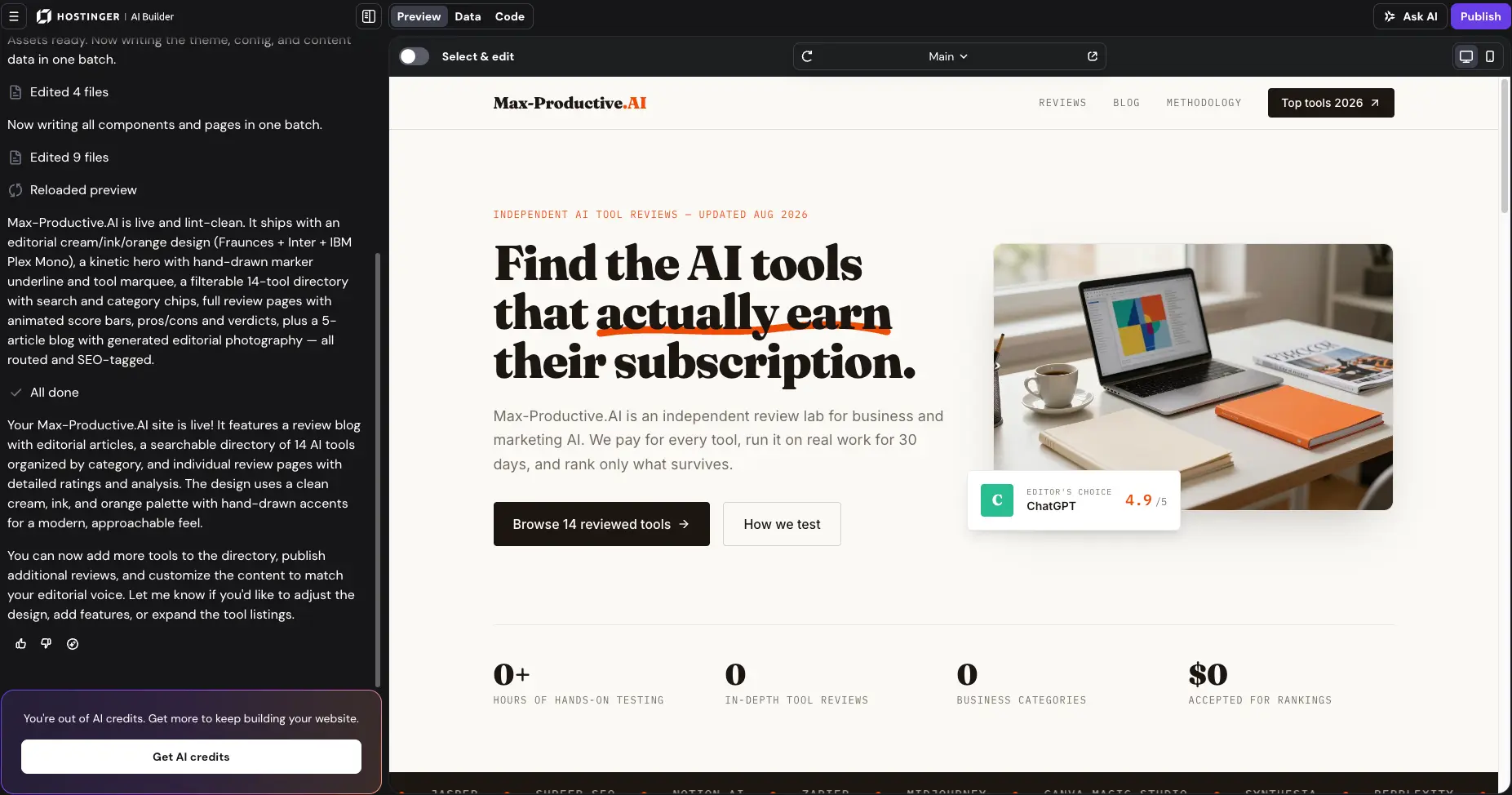
Hostinger's AI builder is our top-rated builder at 4.8 (full review here), and Hostinger's help center has an article on connecting payment gateways to it. The screenshot shows it finishing a complete content site for us in August 2026, chat on the left and live preview on the right. We have not built a store with it, and we could not confirm its store limits from official pages on the day, which is why it sits here and not in the numbered lineup. If it fits, try it on an annual plan, where the pricing is best. For builder-side free plans in general, see our free AI website builders roundup.
Durable, if you do not need a cart at all
Some people land on this search because Shopify was more platform than their business needed: a consultant, a trades business, a studio that takes bookings and sends invoices. Durable (4.5 in our review) is built for that case. It is not a store platform and we are not presenting it as one. What it gives you is an AI-built website with customer records and invoicing in the same dashboard, which you can see in the left-hand menu of our own account below, with the editor rewriting a text block on request.

What Reddit Says About Leaving Shopify, With the Replies That Pushed Back
Search this topic with Reddit on the end and you get strong opinions with no dates attached. On platforms that reprice every few months, the date is half the information, so these are the threads we kept, in order.
March 2025: the Wix partner telling a merchant to keep their store on Shopify. May 2025: the $1 to 2 million merchant who wanted out over support and cost, looked at WooCommerce and Squarespace, and stayed. June 2025: the informational-site owner eyeing Squarespace, and separately the seven-year Ecwid merchant heading the other way, toward Shopify. July 2025: a store owner announcing a move to a custom-built storefront after three years, met by a top reply warning that the rebuild and upkeep could cost more than Shopify ever did. August and October 2025: two BigCommerce threads, both cooler on it than the old thread Google still ranks first. September 2025: the 20-day takedown dispute. October 2025: the app-bill thread.
The most useful one for anyone who is set on going came in December 2025, when an r/ecommerce poster asked people who had migrated off Shopify what surprised them. Almost nobody answered with a number. They talked about the invisible work: rebuilding inventory rules, tax settings, redirects, URLs, integrations, and customer accounts, all the things Shopify had been doing without being asked. The best-supported reply put it as merchants underestimating how much operational work the platform performs until it becomes theirs.
Where we found nothing, we will say so. No qualifying 2025 or 2026 threads turned up from merchants who moved from Shopify to Shift4Shop, PrestaShop, Ecwid, or Big Cartel, and nothing specific to 10Web's or Hostinger's WooCommerce hosting. What holds up across all of them is simple enough. People leave over apps, support, and control. People stay because of everything Shopify does in the background. And the ones who sound happiest afterward had a structural reason to go.
A Note on the Pages That Rank for This Search
When we checked Google from a US connection on September 21, 2026, five of the seven written results on the first page came from software vendors, and at least three of those recommend their own product. Lovable, an AI app builder, ranks second with a January 2026 guide that places itself fourth, for custom storefronts. BigCommerce's own page lists BigCommerce first, and its snippet still reads "for 2025". Salesforce has a December 2025 post for small businesses that includes Salesforce. OptinMonster, which makes marketing tools, and Shift4Shop round it out, the latter with a list of free alternatives. The one independent review on the page, from EXPERTE.com, covers thirteen platforms and scores Shopify highest of them. Google's AI summary recommends WooCommerce, Wix, and BigCommerce and cites a YouTube video and Reddit. Shopify itself buys an ad on the query, and so does Square.
There is nothing sinister in this. A vendor writing about its competitor is doing marketing, and most of these pages are useful within that frame. Keep one blind spot in mind, though. None of the snippets we saw mentions BigCommerce's June 2026 pricing changes, BigCommerce's own included, so a page can look current and still be quoting last year's fee structure. If building a custom storefront with an AI app builder is what caught your eye on that results page, our Lovable alternatives roundup covers that category properly.
How to Choose a Shopify Alternative, or Decide Not To
Start from your reason for leaving and work outward. Your app bill is the problem: audit the apps first, then consider WooCommerce on managed hosting if the numbers still do not work. You want to own the code and the customer data: WooCommerce, or PrestaShop if you are in Europe with a developer. You need a payment gateway Shopify charges extra for: BigCommerce, provided your sales sit comfortably inside one of its caps. Your site is mostly content, bookings, or portfolio: Squarespace on Core, or Wix. You sell at markets, fairs, or a counter: Square. You like your current website and only want a cart: Ecwid. You sell digital products: avoid Squarespace's lower plans, where the digital fee is 5% to 7%, and look at platforms with no platform fee, such as Ecwid or WooCommerce. You dropship: check which platforms your supplier's integration supports before anything else, because that will decide it for you. You have five products and no budget: Big Cartel or Square Free. You sell mainly online and are growing: stay on Shopify.
A word for stores at the top end. Shopify Plus starts at $2,300 a month, and its third-party gateway fee drops to 0.2%. BigCommerce's Performance tier starts from $1,499. If you have outgrown both, the next step is a platform such as Adobe Commerce or commercetools, where pricing is a negotiated quote and the project runs through an agency. That is a different decision from the one this article covers, and it deserves a consultant.
Final Verdict — Shopify Alternatives in 2026
| Best for most stores already on Shopify | Stay on Shopify (Basic $29/mo yearly, no sales caps, no platform fee with Shopify Payments, our 4.6/5) |
| Best if you want to own the store | WooCommerce on managed hosting through 10Web or Hostinger (free software, no platform fee) |
| Closest like-for-like swap | BigCommerce (same prices as Shopify, twenty-one fee-exempt gateways, but sales caps at $30,000 and $100,000) |
| Best for content-first sites | Squarespace Core ($29/mo annual, 0% store fee) or Wix from its Core plan |
| Best for in-person sellers | Square (Free $0, cheapest online below about $7,250 a month) |
| Best add-on for an existing website | Ecwid (from $5/mo, no platform fee, no longer free) |
| Best free start | Square Free, or Big Cartel for up to 5 products |
| Best open source for Europe | PrestaShop (free download, Hosted from €24/mo excl. VAT) |
Bottom line: the best Shopify alternatives in 2026 are good at specific things, and none of them is cheaper across the board. At $10,000 a month in sales, Shopify Basic ties for the lowest total cost of anything we could price. Move to WooCommerce if ownership is the point, to BigCommerce for gateway freedom, to Squarespace, Wix, or Ecwid if the shop is a side room of your website, and to Square if your customers mostly stand in front of you. For everyone else, the better use of an afternoon is an app audit. Whichever way you go, export your data first and decide second.