
Clean Email
Clean Email bundles thousands of messages by sender and type so you can trash, archive or unsubscribe in bulk, then turns those choices into rules that keep the clutter from coming back. It runs behind Gmail, Outlook, Yahoo, iCloud or any IMAP inbox, so you keep the email app you already use.
Try Clean Email →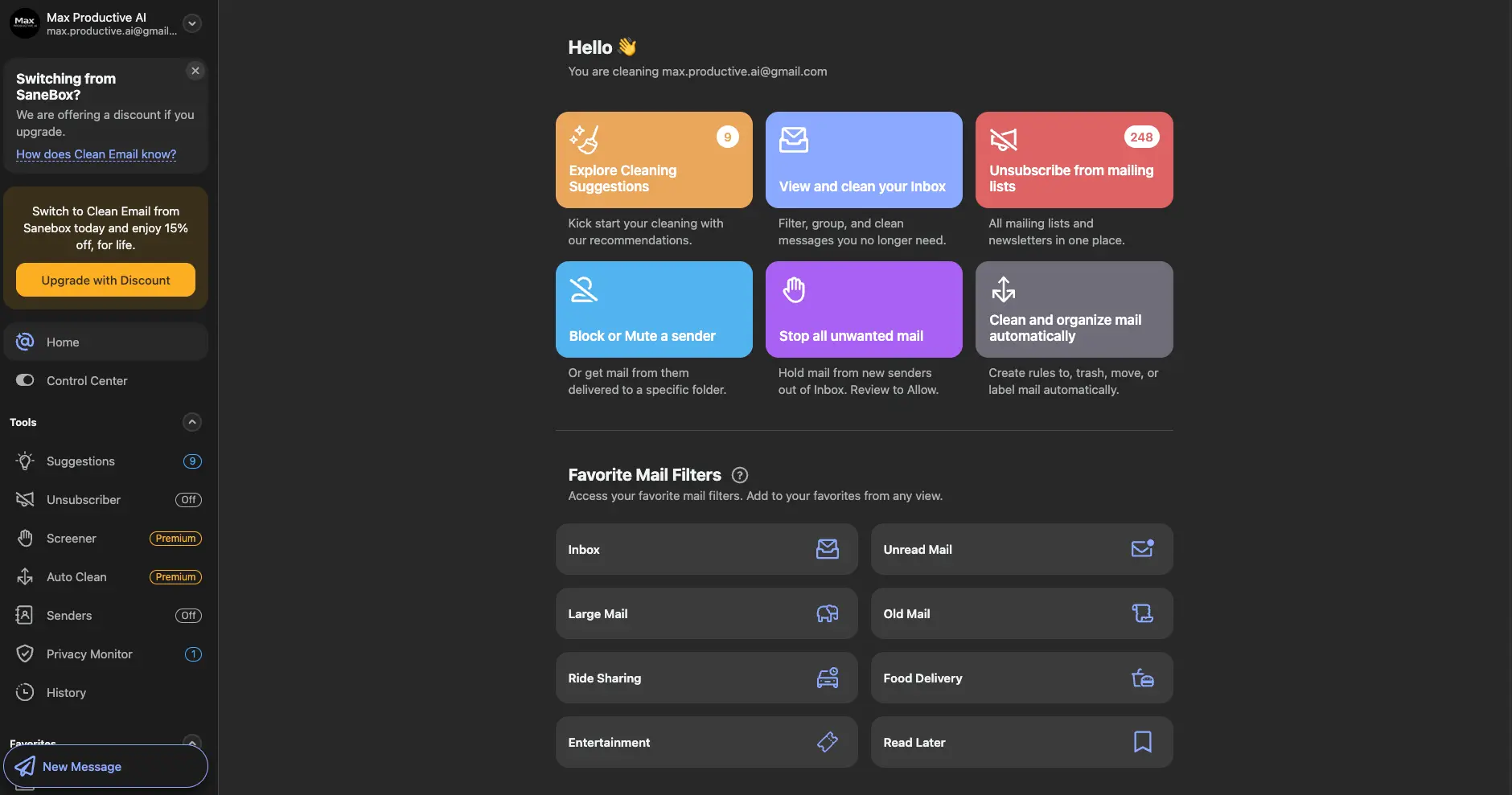
Built to Clear the Backlog,
Not to Write Your Emails
As of October 2026, Clean Email is the tool I'd hand to anyone whose inbox has got away from them. It sorts thousands of messages into groups you can trash, archive or unsubscribe from in a few clicks, then turns those choices into rules so the mess stays gone. It sits behind Gmail, Outlook, iCloud or any IMAP account, and every paid plan includes every feature, from $29.99 a year for one mailbox. Just don't come here for AI. Clean Email deliberately doesn't analyze what your messages say, so there's no AI search, no summaries and no reply drafting. For a cleanup tool, that's a fair trade.
✓ What We Love
- Bulk cleanup that turns thousands of emails into a few dozen decisions
- An Unsubscriber that goes far beyond a link, with Pause and Read Later
- All features on every paid plan, with room for up to ten accounts
- Keeps your current email app and works with almost any provider
! Could Be Better
- No AI search, summaries or reply drafting
- Auto Clean rules need care, since a sloppy one can bin mail you wanted
- Android app trails the iPhone app in stability and ratings
What Is Clean Email?
A cleanup and automation layer that sits behind your inbox. It doesn't replace your email app, and it doesn't try to.
Clean Email is an inbox cleanup and email automation service. You connect a mailbox (Gmail, Google Workspace, Outlook, Microsoft 365, Yahoo, AOL, iCloud, Fastmail or pretty much anything that speaks IMAP) and it builds an index of your mail: who sent it, when it arrived, the subject line, the folder or label, the size, the attachments. From that index it groups related messages so you can act on hundreds at once, and it runs rules in the background that keep acting on new mail as it lands. You still read and write email in Gmail, Outlook or Apple Mail. Clean Email works on the mailbox underneath. The company has been around since 2014, is now based in Los Angeles, and says around 1.5 million people have used it.
The tool it gets compared with most is SaneBox, and on paper the two look alike. Both connect to your existing mailbox, both screen new senders, both move newsletters out of the way. But they start from different questions. SaneBox tries to work out which emails deserve your attention, and learns from where you move things. Clean Email asks you to decide what should happen to everything else, then does it, every time, exactly as you told it. One is a filter that learns. The other is a set of controls. Which you need depends on whether your problem is the flow of new mail or the pile you already have. Our SaneBox vs Clean Email comparison goes through it side by side.
I'll be straight about the AI question, given where this review sits. Clean Email isn't an AI email assistant. Its Cleaning Suggestions draw on patterns from what you've cleaned before and from what other users clean often, which is clever, but it's pattern-matching on metadata, not a model reading your mail. There's no chat box, no summaries, no drafted replies, and search can't look inside message bodies. That's by design: Clean Email doesn't analyze the content of your emails for any of its sorting or automation. You get a better privacy story and a narrower tool.
How We Evaluated Clean Email
For this Clean Email review, I connected the app to the Max Productive AI Gmail account, a real inbox that collects onboarding emails, product newsletters and notifications from the software we test. I worked through the dashboard, Cleaning Suggestions and the Unsubscriber, and looked at what the account can and can't do once the Premium trial ends. I didn't build Auto Clean rules during that trial, so what I say about Auto Clean and Screener comes from Clean Email's own documentation and from user feedback, not from weeks of my rules running. Prices are Clean Email's U.S. list prices as of late September 2026. The privacy details come from its privacy policy, updated September 23, 2026, and its help center.
So who is it for? Anyone whose inbox count runs to five figures and who has no idea where to start. People subscribed to more newsletters than they could read in a year. Families or freelancers juggling several addresses across different providers, since one plan covers up to ten. And anyone who'd rather their inbox followed fixed rules than guesses. If writing replies is what eats your day, look at Fyxer or Superhuman instead. If you want AI that understands your email, Shortwave or Spark Mail are closer to what you're after.
See Clean Email in Action
Screenshots from our own Gmail account, taken after the Premium trial ended.
Dashboard Overview
Six shortcuts to the main jobs, with saved mail filters underneath
The home screen is a menu of what the product does. Explore cleaning suggestions, view and clean your inbox, unsubscribe from lists, block or mute a sender, stop unwanted mail with Screener, and set up automatic rules. The red Unsubscribe tile counted 248 mailing lists in our account, which tells you what testing software for a living does to an inbox. Below the tiles sit Favorite Mail Filters, ready-made views like Large Mail, Old Mail, Ride Sharing and Food Delivery that pull matching messages together so you can clear a whole category in one go. One more thing on the left caught my eye: a "Switching from SaneBox?" panel offering 15% off for life, with a link asking "How does Clean Email know?". Presumably it spotted the SaneBox emails sitting in the inbox. Handy if you're moving across, and a live example of what the app works from: who emails you, not what they wrote.
Cleaning Suggestions
Ready-made cleanup actions, grouped by how many messages they touch
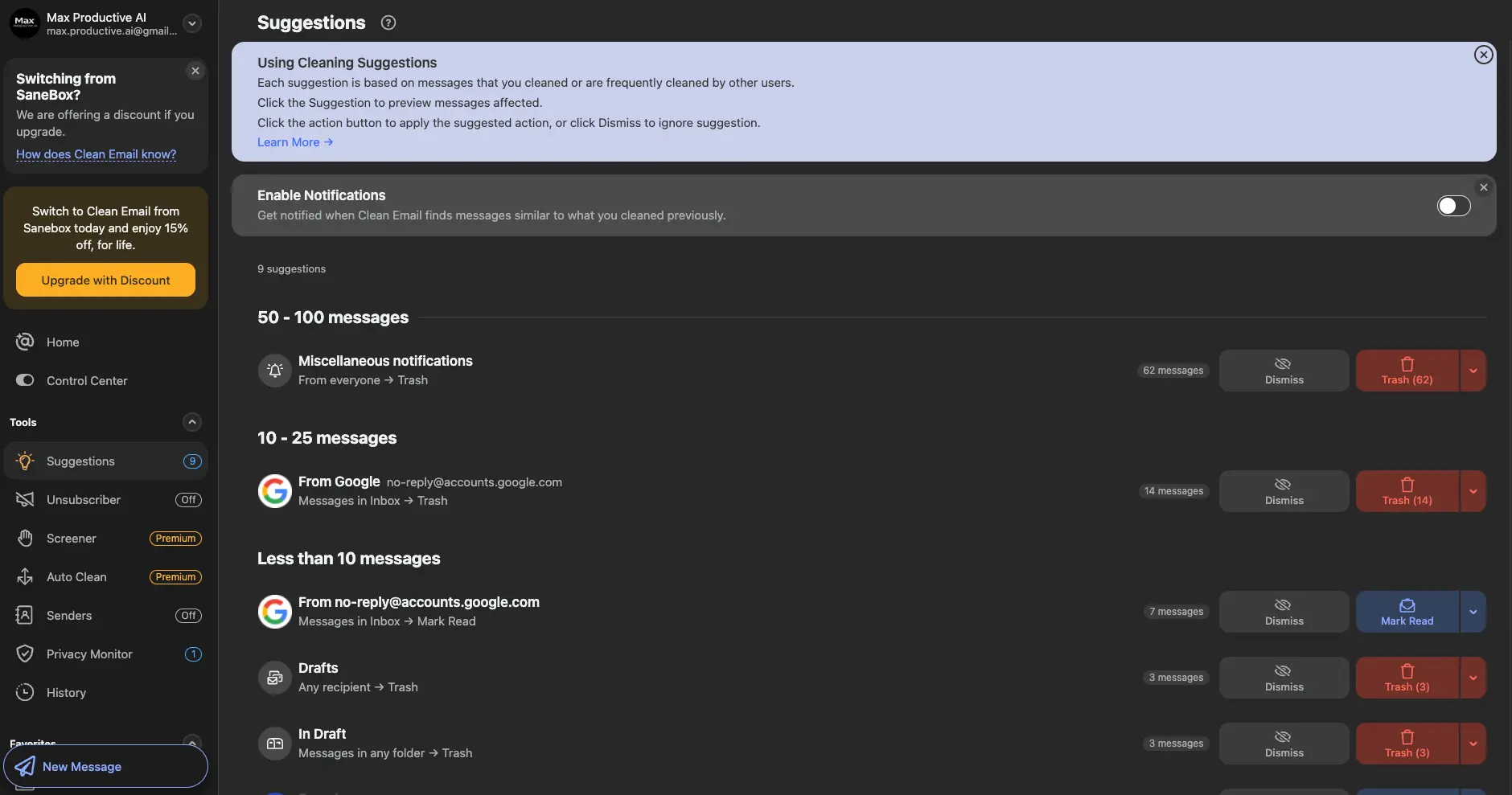
Clean Email found nine suggestions in our inbox and sorted them by size. The biggest was 62 miscellaneous notifications headed for Trash. Each row has a Dismiss button, a main action button and a menu of other actions, and clicking the suggestion itself shows you exactly which emails it covers. The banner explains where the ideas come from: mail you've cleaned before, and mail other users clean often. That second source is why you should preview before you click. One suggestion here wanted to trash 14 emails from Google's no-reply accounts address, which can include sign-in and security alerts I'd rather keep, and another wanted to bin drafts. Good suggestions, mostly. Not ones to accept blind.
Sitting on thousands of emails you'll never read?
Try Clean Email →Free account available • 14-day Premium trial, no cardUnsubscriber
Every mailing list in one place, newest first
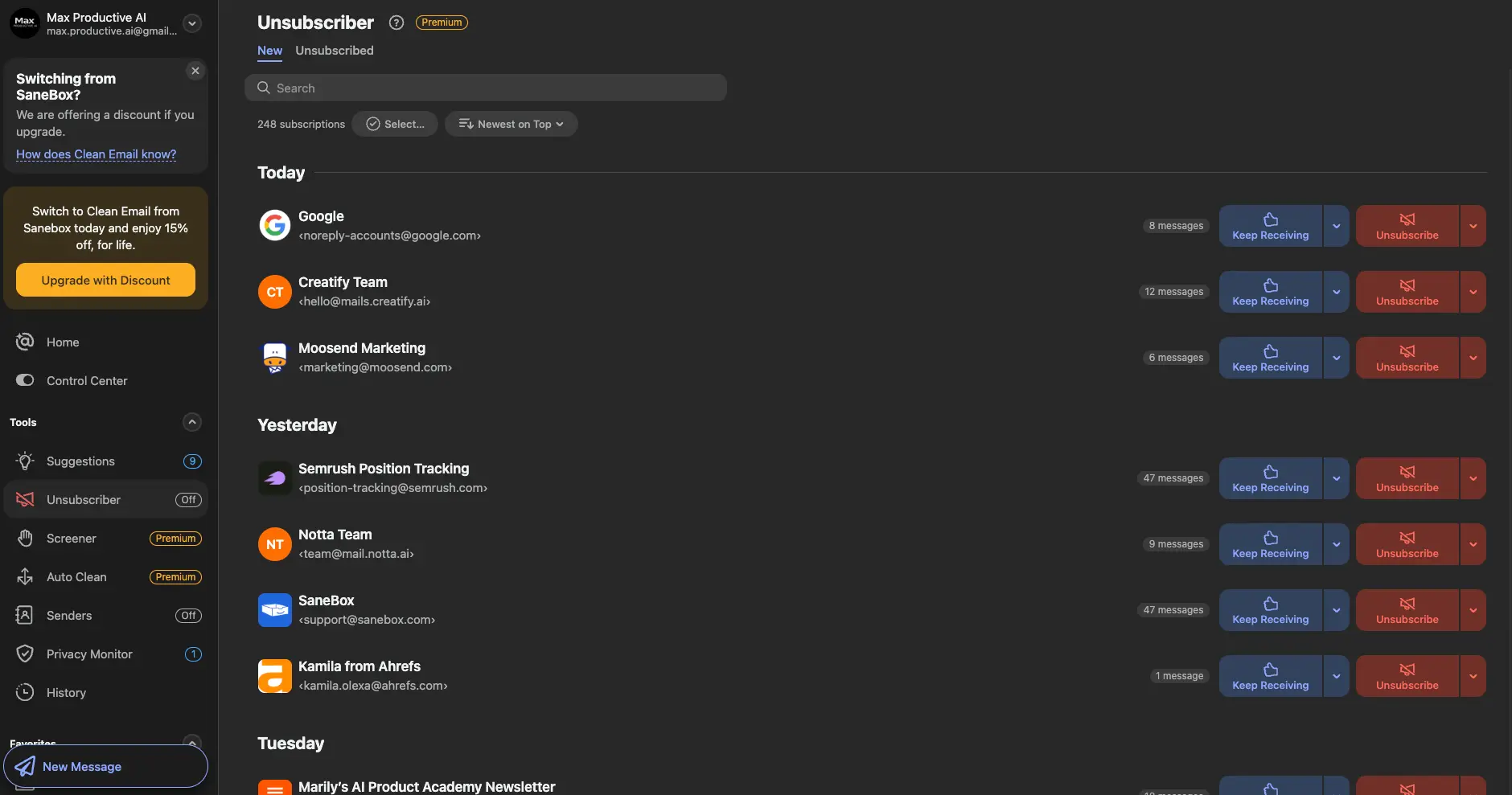
This is the screen that sells Clean Email. Every mailing list in the account, sorted newest first and grouped by day, with a message count beside each sender. Semrush position tracking alerts and SaneBox's own emails each showed 47 messages; Notta's team had 9. For each list you pick Keep Receiving or Unsubscribe, and the small menus next to those buttons hold the more useful options: pause a list for a while, send it to Read Later, or deliver it to a folder. Unsubscribe requests go out from Clean Email, and if a sender keeps mailing after that, Clean Email can send what follows straight to Trash. The Unsubscribed tab keeps the record. The Premium tag at the top is the catch: this is a paid feature, and the free trial gives you 25 unsubscribe actions to try it.
Control Center
One page to switch every automation on or off
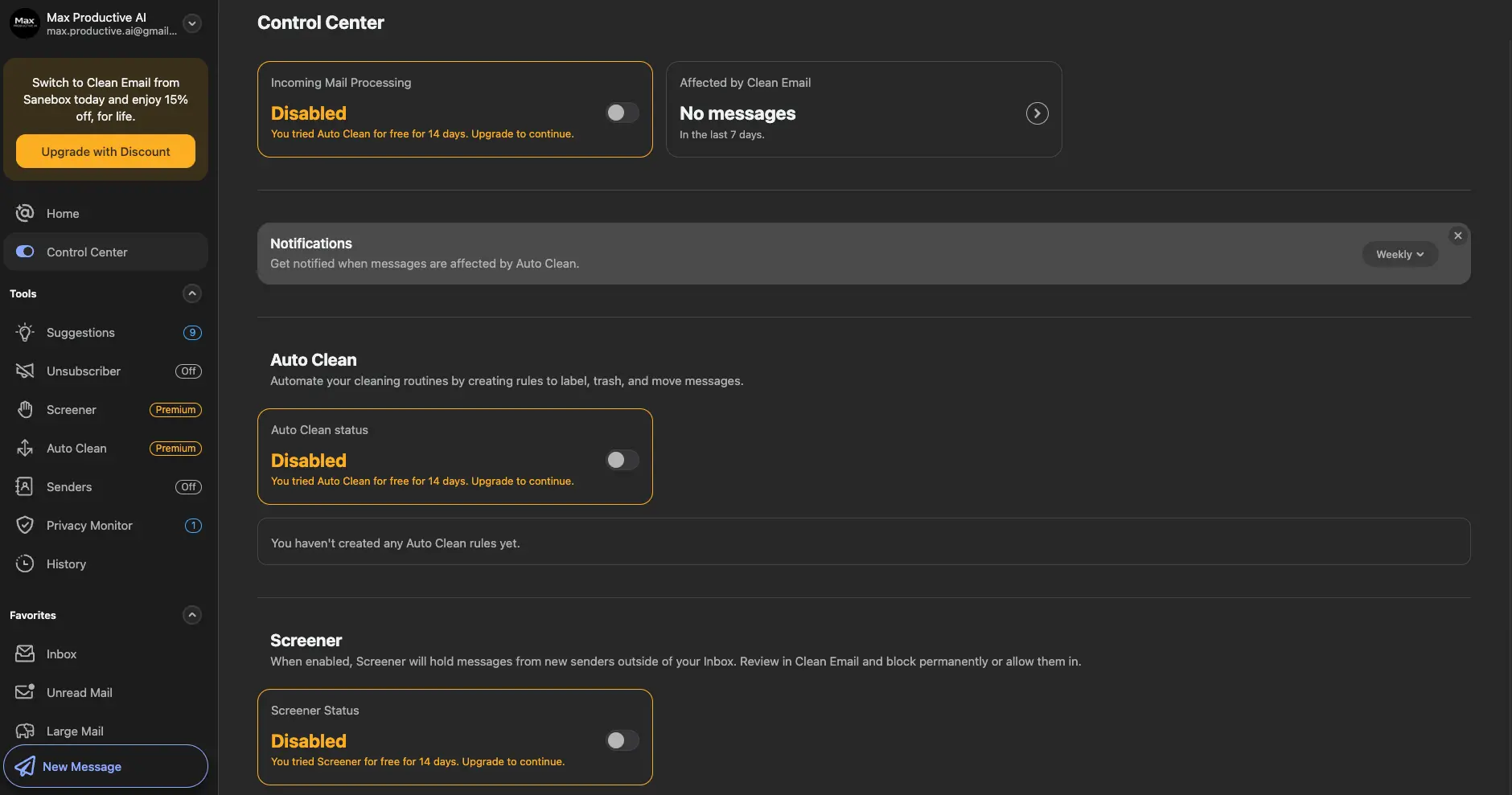
Control Center is where the automation lives. A single Incoming Mail Processing switch pauses everything Clean Email does to new mail without deleting your rules, and separate switches cover Auto Clean and Screener. A panel counts the messages Clean Email touched in the last seven days, and notifications can tell you weekly what Auto Clean has done. In our screenshot everything reads Disabled, with a plain note that the free trial of Auto Clean and Screener has ended. That's the free account after the trial: the cleanup tools stay, the automation stops. I like that the off switch is this easy to find. Software with permission to bin your mail should make stopping it this simple.
How Clean Email Works
Four steps from cluttered to controlled. The first two clean up the past, the last two look after the future.
Connect Your Mailbox
Sign in with Google, Microsoft, Yahoo or AOL and Clean Email gets access through the provider's own authorization screen, so it never sees your password. iCloud and Fastmail need an app-specific password, and other IMAP providers ask for your login details, which Clean Email says it stores securely. POP-only accounts won't work. Clean Email then indexes the mailbox. On a big one that takes a while, and the company says so up front, so connect it and come back later.
Clear the Backlog
Start with Cleaning Suggestions or the Smart Views, or filter the inbox yourself by sender, date, size or label. Clean Email bundles matching messages so you act on the whole group: trash, archive, move, label, mark read, star, send to Read Later, or keep only the newest message and bin the rest. The free account lets you clean up to 1,000 messages this way. Anything heavier needs Premium.
Sort Out Your Subscriptions
Open the Unsubscriber and work down the list. Unsubscribe from what you never read, pause what you only want now and then, route the good newsletters to Read Later with a daily or weekly digest, and keep the rest coming as normal. This is the step that changes how your inbox feels the next morning, and most people get through the bulk of it in one sitting.
Set the Rules
Turn the decisions you just made into automation. A cleanup action or a suggestion can become an Auto Clean rule: delete a shop's promotions after seven days, move receipts to a folder, mark notifications as read. Sender Settings covers one sender at a time with Block, Mute, Deliver To, Trash After and Keep Newest. Switch on Screener if you want first-time senders held until you approve them. From then on Clean Email works in the background, and the History view shows what it did over the last 30 days.
Is Clean Email Safe?
Clean Email's sorting and automation run on metadata: sender and recipient, subject line, dates, folders, sizes and attachment details. It doesn't analyze or index the text of your emails to decide what to do with them. That isn't quite the same as never touching message content. If you open a preview inside Clean Email, it fetches the body to show you, and it can temporarily cache the bodies of messages Auto Clean removes so you can check what went. Beyond that, Clean Email says it doesn't sell or rent personal data, doesn't use Gmail data for advertising, follows Google's Limited Use requirements, goes through annual external security assessments and runs a vulnerability disclosure program. For a service with this much mailbox access, it's a sound, well-documented setup. And if you ever change your mind, you can revoke its access from your Google Account's third-party connections page, or the equivalent settings at your provider.
Set a Safety Net Before You Automate
Give any tool permission to delete mail on its own and sooner or later it will catch something you wanted. Clean Email gives you the guards, and I'd set them up before writing a single rule. Pinned Messages protects chosen senders, groups, folders, recipient addresses or recent mail (everything from the last three days, say) from every rule. Trusted addresses, domains and keywords keep important mail out of automated processing. And the Control Center switch stops all automation at once if something looks off. Two habits help too: use Trash rather than any delete option for your first big cleanups, because trashed mail sits in your mailbox's Trash folder (Gmail keeps it for 30 days), and check History daily for the first week.
Key Features
Clean Email features at a glance, and which ones need Premium.
Bulk Cleanup & Smart Views
The heart of the product. Clean Email groups your mail by sender, type and age so you act on a bundle instead of one message at a time. Smart Views gather social notifications, shopping, travel, finance, old mail and large messages. Keep Newest is the quiet hero: hold on to this week's report and bin every older copy.
Cleaning Suggestions
Ready-made cleanup ideas built from what you've cleaned and what other users commonly clean, ranked by how many messages each would affect. Apply once, dismiss, or turn a suggestion into an Auto Clean rule. It's the quickest way into a first session, as long as you preview before accepting.
Unsubscriber, Pause & Read Later
Unsubscribe, pause a list for a while, send it to a Read Later folder with a digest on your schedule, or move it elsewhere. If a sender ignores your request, Clean Email can trash whatever they send next. That last part is what a plain unsubscribe link can't do for you.
Auto Clean Rules
Rules based on sender, domain, status or age that move, archive, star, mark or delete matching mail as it arrives. Predictable is the point: a rule does exactly what you wrote, every time, with no learning period. The flip side is that a badly written rule does too.
Sender Settings
Per-sender controls without building a full rule. Block sends future mail to Trash, Mute marks it read, Deliver To files it in a folder, Trash After deletes it at an age you choose, Keep Newest keeps one copy. You can also star or pin a sender, or turn the setting into an Auto Clean rule later.
Screener
Holds email from first-time senders outside your inbox until you approve or block them. Approved senders come through normally from then on, blocked ones stay blocked. Same idea as SaneBox's SaneScreener, and a good fit for anyone whose address attracts cold pitches.
Pinned Messages, History & Control Center
The features that make the automation safe to use. Pin senders, folders or recent mail so no rule can touch them, review 30 days of manual and automatic actions in History, and pause all incoming-mail processing from one switch without losing your setup.
Apps, Providers & Privacy Monitor
Web, iPhone and iPad, Android and Mac, with support for every major provider plus IMAP. Privacy Monitor checks your address against known data breaches, a useful extra. The iPhone app is well rated; Android reviews mention freezes and awkward account switching.
Two limits shape everything above. The first is search. Clean Email's search operators are sharper than most people expect (older:, larger:, before: and friends), but they only cover metadata: senders, recipients, subjects, dates, sizes. You can't search the text of an email or an attachment. The second is Premium. The free account handles basic cleanup, but Auto Clean, Screener, Sender Settings and the Unsubscriber are what make Clean Email worth having, and those need a paid plan. The good news is that you don't climb tiers to get them: the cheapest paid plan has the lot, which is rarer in this category than it should be.
See what's included on every plan:
Check Clean Email's pricing →Free account • Same features on all paid plansClean Email Pricing
Every paid plan includes every feature. You're paying for the number of mailboxes, and you'll pay far less if you bill annually.
Free
- ✓ Clean up to 1,000 messages
- ✓ Bulk trash, delete, move, label and star
- ✓ Cleaning Suggestions and Smart Views
- ✓ 14-day Premium trial, no card needed
- ✗ No Auto Clean, Screener or Sender Settings
- ✗ No Unsubscriber after the trial
1 Account
- ✓ One email account
- ✓ All Premium features
- ✓ Auto Clean rules & Sender Settings
- ✓ Unsubscriber, Pause & Read Later
- ✓ Screener & Pinned Messages
- ✓ Or $9.99/month billed monthly
5 Accounts
- ✓ Up to five email accounts
- ✓ Mix providers on one plan
- ✓ All Premium features on every account
- ✓ Unused slots can go to family or friends
- ✓ Or $19.99/month billed monthly
- ✓ 10-account plan also available
Monthly vs annual: one account billed monthly costs $119.88 over a year, so annual billing saves about 75%
Cancellation: your plan stays active until the end of the paid period. I found no published money-back guarantee, so use the trial before you commit
Pricing last verified October 2026 (U.S. prices). Visit Clean Email for current rates.
Is It Worth the Money?
On annual billing, one mailbox costs about $2.50 a month. The five-account plan works out to roughly $10 per mailbox per year. Set that against the hours of scrolling and deleting it replaces and it pays for itself in the first sitting. The maths only goes wrong on monthly billing, which costs four times as much over a year.
Here's what I like about Clean Email's pricing: there's no feature ladder. On a lot of email tools, the features you actually want sit on the top tier. Here, the one-mailbox plan gets Auto Clean, Screener, the Unsubscriber and everything else, and the bigger plans only add mailboxes. That makes one decision easy: if you have two addresses, skip the single plan. Two one-account subscriptions cost $59.98 a year, while the five-account plan costs less and leaves room for a partner's inbox. The free account is a genuine one, too. A thousand messages is enough for a proper first cleanup, and the two-week Premium trial asks for no card at all, so there's nothing to remember to cancel.
Against SaneBox, Clean Email is the cheaper buy, especially if you have several addresses. On its cheapest two-year billing, SaneBox works out to $4.54 a month for Snack (one account, two features of your choice), $7.46 for Lunch (two accounts) and $22.04 for Dinner (four accounts, every feature), as listed in late September 2026. Clean Email's one-account plan costs about half of Snack's monthly equivalent, and even its five-account plan, at about $4.17 a month, comes in under Snack's single account. The fairer question is which job you're paying for. If you want new mail triaged for you every day, SaneBox's price buys something Clean Email doesn't do. If you want the backlog gone and fixed rules in place, Clean Email is the better value. The one thing I'd avoid is monthly billing, which makes a cheap tool expensive for no good reason.
Detailed Pros & Cons
The full picture, including the parts Clean Email's own site doesn't dwell on.
✓ Pros
Clean Email is at its best on the inbox most tools pretend doesn't exist: years of old messages and no plan. Grouping by sender and type turns that into a list of decisions you can get through in an afternoon. SaneBox and the AI email apps are mostly about what arrives next. Clean Email deals with what's already there.
Unsubscribe, pause, Read Later with a digest, deliver to a folder, or keep. Add automatic trashing for senders who ignore your request and a record of every list you've left. Most email tools give you an unsubscribe button. Clean Email gives you a newsletter policy.
Auto Clean and Sender Settings are deterministic. Write a rule that deletes a store's promotions after seven days and that's what happens, every time, with no training period. If you like knowing exactly why an email ended up where it did, that's more reassuring than a filter that guesses.
Every major provider works, from Gmail and Microsoft 365 to iCloud and Fastmail, plus anything on IMAP, and you keep reading mail wherever you read it now. For someone with a work Outlook and a personal iCloud, that alone rules out most of the competition.
Clean Email decides what to do with your mail from the envelope, not the letter: who sent it, when, how big. It doesn't sell data, follows Google's Limited Use rules, and is unusually clear about the few moments it does fetch a message body. For a tool with this much access to your mail, that's the right posture.
No tiers to decode. One mailbox gets the full product, and the five- and ten-account plans simply add mailboxes for very little extra. Throw in a free account and a no-card trial and it's one of the easiest tools in this category to try properly before paying.
✗ Cons
Clean Email can't summarize a thread, draft a reply, or tell you what a client said about pricing back in March. Its search can't read message bodies. On an AI tools directory, that's the obvious gap. It's a deliberate choice tied to the privacy model, but if AI help is what you're after, this isn't your tool.
Rules that delete mail are only as good as the person writing them. A September 2026 user complaint described messages being deleted unexpectedly. One report doesn't prove a pattern, and the tools to prevent it (Pinned Messages, trusted senders, History, the Control Center switch) are all there. Use them before you trust a rule.
Auto Clean, Sender Settings, Screener, Read Later, Smart Views, Unsubscriber, Pinned Messages, Control Center. Each one is simple. Together they overlap, and some users say the advanced setup takes effort to understand. Start with suggestions and the Unsubscriber, and add rules once you know what you want.
The iPhone app holds about 4.5 stars from roughly 3,800 ratings. The Android app sits at 3.7 from about 3,100, with complaints about freezing, odd subscription counts and clumsy switching between accounts. Clean Email says recent updates improved performance. If you mainly use Android, do the heavy lifting in the web app.
Indexing a very large mailbox isn't instant, and Clean Email warns about this itself. Some users also mention slow processing on huge accounts. Connect it, let it finish, and come back later rather than judging it in the first ten minutes.
Paying month to month for one account costs four times the annual price. I also couldn't find a published money-back guarantee, and one September 2026 user complained of a refund refused after about a month. Use the free trial properly, then go annual if it sticks.
Clean Email vs Alternatives
The Clean Email alternatives most people shortlist, and the job each one does best.
| Feature | Reviewed Clean Email | SaneBox | Shortwave | Superhuman | Fyxer | Spark Mail |
|---|---|---|---|---|---|---|
| Main Job | Cleanup + automation | Priority filtering | AI-first Gmail app | Fast AI email for pros | AI email + meeting assistant | Modern AI email app |
| Keep Your Current Email App | ✓ | ✓ | ✗ | ✗ | ✓ | ✗ |
| Bulk Cleanup of Old Mail | Excellent | Good | Moderate | Moderate | Limited | Moderate |
| Unsubscribe Tools | Excellent (Pause, Read Later) | Good | Good | Moderate | Limited | Good |
| New-Mail Sorting | Rules you set | Learns from you | AI | AI | AI | AI |
| AI Reply Drafting | ✗ | ✗ | ✓ Advanced | ✓ Advanced | ✓ Core strength | ✓ Advanced |
| AI Search Across Email | ✗ Metadata search only | ✗ | ✓ Excellent | ✓ Excellent | ✓ | ✓ |
| Providers | Gmail, Outlook, Yahoo, iCloud, IMAP | Most providers | Gmail-centric | Gmail, Outlook | Gmail, Outlook | Most providers |
| Best For | Clearing backlogs, rule-based control | Hands-off prioritization | Deep AI inside Gmail | Email-heavy professionals | Replies and meetings | All-purpose modern email |
Clean Email vs SaneBox: The Short Version
This is the comparison most people are really making, and the honest answer is that each is better at a different thing. Clean Email is the stronger tool for clearing years of old mail, managing subscriptions and writing exact rules. SaneBox is the stronger tool for mail that hasn't arrived yet: it learns who matters, moves the rest out of your inbox without being told, and adds follow-up reminders and digests on top. SaneBox does have a Deep Clean tool for old mail, but bulk cleanup isn't what it's built around. Picture your instructions. "Work out what's important and keep everything else away from me" is a SaneBox job. "Delete promotions from these shops after a week, send these newsletters to Read Later, never touch mail from my accountant, and get me off seventy lists today" is a Clean Email job. Some people use Clean Email once to clear the backlog and SaneBox to keep things sorted after, though running both long term means paying twice for features that overlap. On price, Clean Email is cheaper, and much more so across several accounts. Our SaneBox vs Clean Email comparison has the full breakdown, and our SaneBox review covers its filters in detail.
Do You Need Clean Email If Gmail or Outlook Can Unsubscribe?
Fair question, and for some people the answer is no. Gmail now has a Manage subscriptions page on the web, Android and iPhone that lists your mailing lists by how often they email you, with an unsubscribe button next to each. Outlook on the web has Sweep, which can clear out everything from one sender, keep only their latest message, or remove their mail once it's ten days old. Both are free. If you have a single Gmail address and a few dozen newsletters to drop, try Gmail's page before you pay for anything.
Clean Email earns its price when you need more than that. The built-in tools work one sender at a time, inside one provider, with a short list of options: Gmail's page unsubscribes or blocks, and Sweep's age rule is fixed at ten days. Clean Email bundles mail across every sender and category at once, lets you pick any age for a rule, adds Pause, Read Later, Screener and Cleaning Suggestions, and runs a Gmail, an Outlook and an iCloud address from the same dashboard. If your clutter is a handful of newsletters, use what's free. If it's years of mixed mail across several accounts, that's the job Clean Email exists for.
Which Tool Is Right For You?
Clean Email
ReviewedBest for: Anyone with a huge backlog, too many subscriptions, or several mailboxes across different providers, who wants fixed rules rather than guesswork. The bulk cleanup and the Unsubscriber are the reasons to choose it. The all-features pricing is the reason you'll keep it. Start on the free account, then use the trial to set up your rules.

SaneBox
Closest RivalBest for: People who'd rather not build rules at all. SaneBox learns which senders matter from where you move mail, keeps low-priority messages out of the inbox, and adds follow-up reminders and a daily Digest of everything it filed. Like Clean Email, it works with almost any provider and leaves your email app alone. It's weaker at clearing years of old mail and costs more, with some tools reserved for higher tiers. See how it compares with Gmail's AI Inbox →

Shortwave
AI SearchBest for: Gmail users who want AI to understand their email: search years of mail in plain English, summarize threads, write replies and work across attachments. It's a full email app, so you switch clients, and it's built around Gmail. Shortwave and Clean Email take opposite positions on reading your mail, which is exactly why they suit different people.

Superhuman
Power UsersBest for: Professionals whose day runs through email and who want to get through the important messages faster, with keyboard shortcuts, AI writing, Ask AI search and calendar features. It costs far more than Clean Email and solves a different problem: working faster with the mail you need, not getting rid of the mail you don't. If you're buried in unwanted newsletters, start with Clean Email.

Fyxer
AI AssistantBest for: People whose bottleneck is writing replies and handling meetings. Fyxer sorts incoming mail into categories, drafts replies in your style and takes meeting notes, working inside Gmail or Outlook. It isn't built for bulk cleanup of an old mailbox or detailed retention rules, so the two tools barely overlap. Clutter points to Clean Email; time spent writing points to Fyxer.

Spark Mail
Full Email AppBest for: Anyone who wants a modern email app with an AI assistant that searches mail and attachments, summarizes, drafts, rewrites and translates. Because it works with the content of your mail, it can do far more with AI than Clean Email. Because Clean Email doesn't make you switch apps, the two can even work together: Spark to read and write, Clean Email to keep the mailbox underneath tidy.
Frequently Asked Questions
Should You Try Clean Email?
Clean Email does one job better than any other tool we've reviewed in this category: it takes an inbox that's out of control and gets it back. Bulk cleanup clears the backlog, the Unsubscriber deals with the lists, and Auto Clean, Sender Settings and Screener stop it filling up again. It does all that without asking you to change email apps or providers, it keeps its hands off the content of your mail, and its cheapest paid plan already includes everything, for less than most rivals charge for the basics.
It isn't an AI tool, and it doesn't pretend to be. No summaries, no drafted replies, no search inside messages. Automation needs care, the Android app is weaker than the iPhone one, and monthly billing is poor value. If you want software to decide what matters for you, SaneBox is the better fit, and if you want AI to help you write and search, look at Shortwave or Superhuman. But if your problem is clutter and you want control, Clean Email is the one I'd pick in 2026.
Our Recommendation
Start on the free account and work through the Cleaning Suggestions, previewing each one before you apply it. If that helps, start the Premium trial (no card needed), clear your subscriptions in the Unsubscriber, then pin your important senders before you write any Auto Clean rules. Check History after the first week. If it's working, pay annually. And if you run more than one address, the five-account plan is the best deal on the page.