

Semrush
All-in-one digital marketing platform consolidating 55+ tools for SEO, content marketing, competitive intelligence, PPC advertising, and social media management. Features comprehensive keyword research across 26.8 billion keywords, backlink analysis, technical site auditing, and cutting-edge 2026 AI capabilities including Semrush Copilot, AI Visibility Toolkit for tracking brand presence across ChatGPT and Google AI Overviews, and ContentShake AI for automated content creation.
30-Second Summary
Bottom Line: Semrush stands as the most comprehensive all-in-one digital marketing platform available in 2026, consolidating 55+ tools that would otherwise require 5-10 separate subscriptions. The platform's exceptional value comes from its unmatched breadth across SEO, content marketing, PPC advertising, social media management, and competitive intelligence—backed by a massive database of 26.8 billion keywords and 43 trillion backlinks. Industry-leading 2026 AI features including Semrush Copilot, AI Visibility Toolkit, and ContentShake AI position it at the forefront of marketing technology. However, the $117-417/month annual cost, single-user limitation, steep learning curve, and Google-only search focus create real barriers for small businesses, beginners, and teams requiring multi-platform coverage.
Best For
- Digital marketing agencies managing multiple clients
- Medium-to-large businesses with established marketing budgets
- SEO professionals wanting comprehensive competitive intelligence
- Content marketing teams needing end-to-end workflow tools
Skip If
- Monthly marketing budget under $500
- Complete beginner to digital marketing
- Focused exclusively on backlink analysis (choose Ahrefs)
- Need multiple user accounts without extra fees
Semrush at a Glance
What Exactly is Semrush?
Semrush is a cloud-based all-in-one digital marketing platform that consolidates over 55 tools for SEO, content marketing, competitive research, PPC advertising, social media management, and local SEO into a single unified dashboard, serving over 10 million users worldwide including approximately 117,000 paying customers across more than 150 countries.
Launched in 2008, Semrush has evolved from a specialized SEO toolkit into a comprehensive marketing intelligence platform trusted by 40% of Fortune 500 companies. Unlike point solutions that excel in narrow areas, Semrush provides integrated capabilities spanning the entire digital marketing spectrum—eliminating the need for multiple disconnected subscriptions while enabling data-driven decision-making across channels.
What Makes Semrush Different in 2026
The platform's fundamental advantage lies in breadth without sacrificing depth. Rather than forcing teams to juggle separate tools for keyword research, backlink analysis, content optimization, PPC intelligence, and social media management—each with different data sources and interfaces—Semrush consolidates everything with unified reporting. The 2025 release of cutting-edge AI features including Semrush Copilot (free AI assistant providing personalized recommendations), AI Visibility Toolkit (tracking brand presence across ChatGPT, Google AI Overviews, Perplexity, and Gemini), and ContentShake AI (automated content generation) positions Semrush at the forefront of marketing technology adapting to the AI-powered search era.
Semrush maintains one of the industry's largest marketing intelligence databases with 26.8 billion keywords across 142 geographic databases, 43 trillion backlinks, 808 million domain profiles, and over 200 million anonymized users contributing clickstream data. Historical data extends back to 2012 for most metrics, providing longitudinal perspective unavailable in newer competitors.
The platform serves diverse user segments from individual freelancers and small businesses to large agencies and enterprise organizations. SEO professionals leverage Semrush for comprehensive competitive intelligence and technical auditing. Content marketing teams use it for end-to-end workflows from ideation through optimization and performance tracking. Digital marketing agencies rely on white-label reporting and client management features. E-commerce businesses benefit from Product Listing Ad analysis and shopping campaign insights.
Operating entirely cloud-based with no software installation required, Semrush integrates seamlessly with Google Analytics, Google Search Console, Google Ads, WordPress, and major social media platforms. This ecosystem approach enables centralized campaign management and cross-channel attribution that standalone tools cannot provide.
Core Features and Capabilities
Comprehensive SEO Toolkit
Semrush's SEO capabilities remain its strongest offering, providing professional-grade tools that consistently rank among industry leaders.
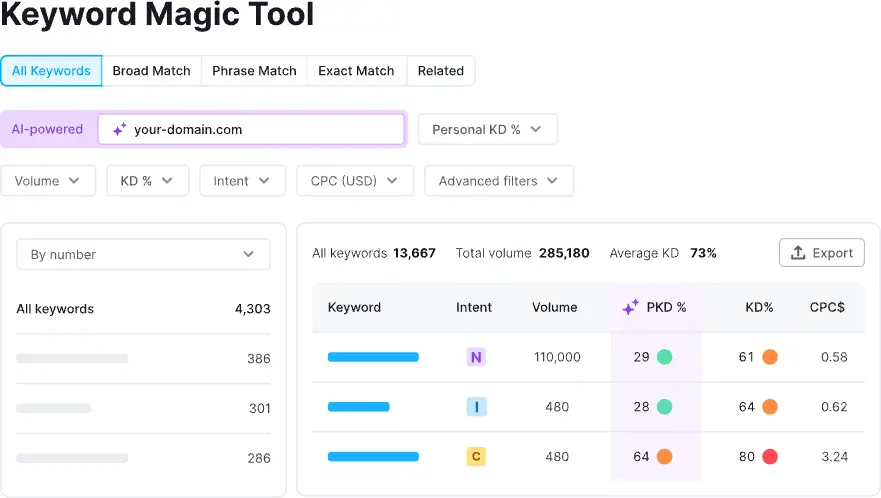
Keyword Research: Keyword Magic Tool
The Keyword Magic Tool accesses over 26.8 billion keywords across 142 geographic databases with historical data dating back to 2012. Enter a seed keyword and the tool generates thousands of variations with comprehensive metrics including search volume, keyword difficulty, CPC estimates, competition level, search intent classification (informational, navigational, commercial, transactional), SERP features present, related questions, and keyword clustering grouping semantically related terms.
Personalized Keyword Difficulty: Unlike competitors that base difficulty solely on backlinks, Semrush's Personalized Keyword Difficulty (PKD) considers your domain's specific authority. This makes recommendations more actionable—a keyword showing 75% generic difficulty might display 45% personalized difficulty for an established domain, revealing realistic opportunities other tools miss.
The tool excels at filtering and organization with options to filter by search volume ranges, keyword difficulty brackets, word count, include/exclude specific terms, search intent types, and SERP features. Advanced features include bulk keyword analysis uploading thousands of keywords for batch metrics, keyword gap analysis comparing your keyword profile against up to 5 competitors, keyword clustering grouping related terms for topic-based content strategies, and integrated PPC data showing cost-per-click and advertising competition.
Site Audit: Technical SEO Health Monitoring
Semrush's Site Audit crawler analyzes up to 20 million pages on the highest plans, identifying over 140 technical SEO issues with actionable recommendations. The tool excels at issue categorization providing clear priority levels (critical, high, medium, low warnings, notices), detailed explanations of each issue's impact on SEO, step-by-step resolution instructions, and tracking improvements over time.
Key technical issues identified include Core Web Vitals problems (loading speed, interactivity, visual stability), crawlability issues (broken internal links, redirect chains, orphaned pages), duplicate content detection, missing or problematic meta descriptions, title tag optimization opportunities, HTTPS security issues, mobile usability problems, structured data errors, and keyword cannibalization identification.
Site Audit Advanced Features
Technical Analysis
- Log File Analyzer for bot crawl pattern analysis
- AMP validation and mobile-first indexing checks
- Internal linking distribution visualization
- Crawl budget optimization recommendations
Integration & Reporting
- Google Analytics connection for traffic correlation
- Google Search Console integration for ranking data
- Automated scheduled audits with email alerts
- White-label PDF reports for agencies
Position Tracking: Daily Rank Monitoring
Semrush provides daily keyword position tracking across Google, Bing, Baidu, and now ChatGPT and Google AI Mode—making it one of the first platforms to address AI-powered search visibility. Track positions at domain or URL level with desktop and mobile device breakdowns, local rankings by city/zip code, and SERP feature visibility including featured snippets, People Also Ask boxes, local packs, image carousels, and AI Overviews.
Advanced tracking capabilities include competitor position monitoring tracking up to 20 competitors simultaneously, Share of Voice calculation measuring visibility percentage in your niche, position history visualization showing ranking trends over time, volatility alerts notifying you of significant ranking changes, and tag-based organization grouping keywords by topic, product, or campaign.
Backlink Analysis and Link Building
With a database of over 43 trillion backlinks and a crawler analyzing approximately 10 billion web pages daily, Semrush offers comprehensive backlink monitoring. The Backlink Analytics tool provides complete backlink profile overview showing referring domains, total backlinks, Authority Score, referring IPs, and follow vs. nofollow ratio. Detailed backlink examination displays anchor text distribution, link types (text, image, redirect, form), outbound links from referring pages, and first/last seen dates.
Backlink Audit with Toxic Score
Semrush's Backlink Audit tool identifies potentially harmful links using a proprietary Toxic Score metric evaluating 50+ risk factors. The tool automatically categorizes links as toxic, potentially toxic, or non-toxic with bulk disavow file generation for Google Search Console submission. Regular audits protect against negative SEO attacks and algorithmic penalties from unnatural link patterns.
The Link Building Tool offers sophisticated CRM-style outreach management with prospect discovery identifying relevant websites for outreach, email template creation and customization, outreach tracking monitoring email opens and responses, relationship management recording communication history, and progress monitoring with pipeline visualization from outreach to link acquisition.
Organic Research: Competitor Intelligence
Analyze competitors' organic search strategies comprehensively. The Organic Research tool reveals competitor top-performing keywords, traffic estimates with historical trends, keyword positions and position changes, SERP feature ownership, and new keyword acquisitions. The Keyword Gap tool compares your keyword profile against up to 5 competitors simultaneously, identifying missing keywords you're not ranking for but competitors are, weak keywords where competitors outrank you significantly, strong keywords where you have competitive advantage, and shared keywords with position comparisons.
Industry-Leading AI Features (2026 Updates)
Semrush has invested heavily in AI capabilities throughout 2026, releasing features that address both traditional SEO and the emerging AI-powered search landscape.
Semrush Copilot: Your Free AI Assistant
Included free with all subscriptions, Semrush Copilot automatically analyzes data from six core Semrush tools and provides personalized, prioritized recommendations directly in your dashboard. Rather than manually reviewing keyword opportunities, technical issues, competitor movements, and backlink profile changes, Copilot surfaces the most impactful actions tailored to your specific situation.
Key Copilot capabilities include proactive issue identification alerting you to technical problems, ranking drops, or competitor gains, opportunity prioritization ranking recommendations by potential impact, automated insights explaining why specific actions matter, and natural language interaction allowing you to ask questions about your data. Copilot essentially acts as an AI SEO analyst, saving hours of manual data analysis while ensuring you focus on high-value activities.
AI Visibility Toolkit: Track Brand Presence in AI Search
The AI Visibility Toolkit ($99/month add-on per domain) addresses the fundamental shift toward AI-powered search through ChatGPT, Google AI Overviews, Perplexity, and Gemini. As traditional search evolves into conversational AI discovery, brand visibility in these platforms becomes crucial for future SEO success.
Why AI Visibility Matters: Research shows Google's AI Overviews now appear for 15% of search queries and climbing. Meanwhile, ChatGPT processes over 100 million daily prompts with brand mentions and citations directly influencing purchase decisions. Companies not monitoring AI visibility risk becoming invisible as search behavior shifts from traditional blue links to conversational AI answers.
The AI Visibility Toolkit provides daily visibility tracking monitoring how often your brand appears in AI-generated answers, topic opportunity identification revealing queries where competitors are mentioned but you're not, cited source analysis showing which of your pages AI platforms reference, prompt tracking for 25-200 custom questions depending on plan level, and competitive benchmarking comparing your AI visibility against competitors.
A free AI Search Visibility Checker provides basic analysis without subscription, allowing anyone to check their domain's visibility score across AI platforms and see which topics generate AI mentions.
ContentShake AI: GPT-4 Powered Content Creation
ContentShake AI leverages GPT-4 Turbo to generate complete SEO-optimized articles approximately 12 times faster than traditional methods. Unlike generic AI writing tools, ContentShake incorporates SEO best practices, competitive analysis, and direct WordPress publishing.
Key capabilities include automatic outline generation based on competitor analysis and ranking patterns, AI-generated content with proper structure, keyword optimization, and readability, brand voice matching through customizable writing style parameters, SEO optimization scoring ensuring content meets ranking requirements, AI-generated images embedded directly in articles, and WordPress integration enabling one-click publishing from ContentShake to your website.
ContentShake AI supports 14 languages including English, German, French, Spanish, Italian, Portuguese (including Brazilian), Dutch, Polish, Danish, Swedish, Norwegian, Czech, and Japanese—making it viable for international content operations.
Content Marketing Platform
Available on Guru plans and above, the Content Marketing Platform provides end-to-end workflow support from ideation through publication and performance tracking.
SEO Writing Assistant
The SEO Writing Assistant provides real-time optimization suggestions as you write, available as a browser extension and integrating with Google Docs and WordPress. Features include keyword density monitoring with recommendations for optimal usage, readability scoring based on Flesch Reading Ease, tone of voice analysis ensuring consistency with target audience, content length recommendations based on top-ranking competitors, originality checking identifying potential plagiarism, and NLP term suggestions incorporating semantically related keywords Google expects.
Topic Research Tool
Identify trending topics and content ideas based on actual search demand and competitor analysis. Enter a topic or keyword and receive content idea generation with dozens of relevant article angles, question identification from People Also Ask and related searches, trending topics showing what's gaining traction, and competitor content analysis revealing what's working in your niche.
SEO Content Template
Automate creation of SEO content briefs by analyzing the top 10 ranking pages for your target keyword. The tool generates recommended word count based on competitor averages, target keywords with optimal usage frequency, semantic keywords to include naturally, heading suggestions for proper content structure, backlink recommendations showing typical link counts for ranking pages, and readability targets appropriate for your audience.
Post Tracking
Monitor performance of published content including backlink acquisition tracking new referring domains over time, social share counting across platforms, keyword ranking monitoring for articles over time, traffic estimation showing organic visibility gains, and position updates for tracked URLs.
Competitive Intelligence Suite
Semrush excels at multi-dimensional competitor analysis across organic search, paid advertising, content strategy, and traffic sources.
Domain Overview
Get comprehensive competitor profiles showing Authority Score (0-100) indicating domain strength, organic search traffic estimates with historical trends, paid search traffic and estimated ad spend, top organic and paid keywords, backlink profile summary, referring domains and IPs, and competitor discovery identifying similar sites in your niche.
Traffic Analytics
Benchmark your website's traffic against competitors with detailed reports on total visits and unique visitors, traffic sources breakdown (organic, paid, social, referral, direct, email), geographic distribution showing visitor locations, audience interests and demographics, engagement metrics (pages per visit, bounce rate, visit duration), and traffic journey mapping showing where visitors arrive from and leave to.
Advertising Research
Analyze competitors' Google Ads strategies comprehensively with ad copy and creative analysis, keyword bidding strategies and estimated costs, budget estimates revealing advertising spend levels, landing page destinations and conversion strategies, Product Listing Ad (PLA) analysis for e-commerce competitors, ad position distribution showing placement patterns, and historical ad performance tracking campaign changes over time.
EyeOn: 24/7 Competitor Monitoring
EyeOn provides automated competitor surveillance tracking online marketing activity with email alerts for updates. Monitor new content publication, social media posts and engagement, backlink acquisitions and losses, keyword ranking changes, advertising campaign launches, and website changes including design updates or new features.
Social Media Management
Schedule posts across Facebook, Instagram, X (Twitter), LinkedIn, TikTok, and YouTube with unified calendar view, bulk scheduling, optimal posting time recommendations, engagement tracking, and hashtag suggestions. The Social Media Poster simplifies cross-platform management that would otherwise require separate tools for each network.
Local SEO Tools
Manage local search visibility with citation management ensuring consistent NAP (Name, Address, Phone) across directories, local ranking tracking monitoring positions in specific cities or zip codes, Google Business Profile optimization, review monitoring across platforms, and Map Pack visibility tracking in Google Maps results.
PPC Keyword Tool and Campaign Management
Beyond competitive research, Semrush provides PPC execution tools with Google Ads integration for campaign import/export, PPC Keyword Tool for finding profitable paid search opportunities, ad builder templates for creating campaigns, negative keyword suggestions preventing wasted spend, and performance tracking across campaigns.
Brand Monitoring
Track brand mentions across the web, social media (including TikTok and YouTube), and news sources with sentiment analysis, real-time alerts for new mentions, competitor brand tracking, influencer identification, and share of voice comparison against competitors.
Getting Started with Semrush
Semrush offers powerful capabilities but requires time investment to master due to its comprehensive feature set. Most users achieve basic proficiency within their first week, with advanced mastery developing over 2-4 weeks of regular use. The learning curve is steeper than simpler alternatives like SE Ranking or Mangools, but the investment pays dividends for serious marketers.
Choose Your Plan and Start Free Trial
Select either the Pro plan ($139.95/month) for smaller operations, Guru plan ($249.95/month) for growing teams needing historical data and content tools, or Business plan ($499.95/month) for agencies. Semrush offers a standard 7-day free trial, with extended 14-day trials available through affiliate partner links. The trial provides full access to your chosen plan's features without credit card requirement upfront, allowing genuine evaluation before financial commitment.
Create Your First Project
Semrush organizes work through "projects"—dedicated workspaces for each website or client. Create your first project by entering your domain, selecting target location and preferred search engine, and configuring project settings. The project structure enables focused analysis and reporting. Pro users get 5 projects, Guru users get 15, and Business users get 40—plan accordingly based on the number of sites or clients you manage.
Connect Key Integrations
Maximize Semrush's value by connecting Google Analytics and Google Search Console for enhanced traffic insights, Google Ads for PPC campaign analysis, social media accounts for unified post scheduling, and WordPress for content publishing integration. These connections enable Semrush to correlate its intelligence with your actual performance data, dramatically improving recommendation accuracy and identifying true opportunities versus theoretical ones.
Run Initial Site Audit
Launch your first Site Audit to establish a technical SEO baseline. The audit identifies critical issues requiring immediate attention, provides prioritized action items ranked by impact, generates a site health score tracking improvements over time, and creates a technical SEO roadmap. Schedule recurring audits (weekly, biweekly, or monthly) to monitor progress and catch new issues early. Address critical problems first—broken links, duplicate content, and Core Web Vitals issues typically deliver the most immediate ranking improvements.
Conduct Keyword Research
Use the Keyword Magic Tool to discover ranking opportunities. Enter seed keywords relevant to your business, filter results by search volume, difficulty, and intent, identify quick wins with low difficulty but sufficient volume, and export keyword lists for content planning. For best results, target keywords with Personalized Keyword Difficulty under 60% and search volume above your minimum threshold (typically 100-500 monthly searches depending on niche).
Analyze Competitors
Identify 3-5 key competitors in your niche and add them to your project. Use Domain Overview to understand their overall strategy, Organic Research to discover their top-performing keywords, Backlink Analysis to see their link-building approach, and Advertising Research to understand their PPC strategy. The Keyword Gap and Backlink Gap tools reveal specific opportunities where competitors outperform you, providing a clear roadmap for catching up.
Set Up Position Tracking
Configure position tracking for your target keywords to monitor ranking progress. Add your priority keywords to track, select tracking frequency (daily recommended), enable competitor tracking to monitor their movements, and set up email alerts for significant changes. Regular rank tracking creates accountability and helps measure ROI from SEO investments—you can't improve what you don't measure.
Explore Advanced Features Gradually
After mastering core tools, expand to ContentShake AI for content creation, SEO Writing Assistant for optimization, Topic Research for content ideation, Social Media Poster for cross-platform management, and AI Visibility Toolkit for tracking AI search presence. Avoid overwhelming yourself by trying to use all 55+ tools simultaneously—build proficiency incrementally over several weeks, focusing first on tools directly impacting your primary business objectives.
Learning Resources
Semrush provides extensive educational content to accelerate mastery including Semrush Academy with free certification courses covering SEO fundamentals, content marketing, technical SEO, and PPC, tutorial videos within each dashboard tool, comprehensive knowledge base with step-by-step guides, weekly webinars on advanced strategies, and 24/7 live chat support plus phone and email support. The educational investment distinguishes Semrush from competitors with minimal documentation—take advantage of these resources to maximize ROI from your subscription.
Critical Success Factor: Semrush's complexity is both strength and weakness. The platform can do almost anything in digital marketing, but attempting everything simultaneously leads to paralysis. Instead, identify your 3-5 highest-priority business objectives (e.g., ranking for specific keywords, finding competitor content gaps, improving technical SEO), master the specific Semrush tools addressing those objectives, achieve measurable results, then expand to additional capabilities. This focused approach delivers faster ROI than trying to utilize all features at once.
Pricing Plans and Value Analysis
Semrush offers three main pricing tiers with 17% discounts on annual billing, positioning itself as a premium all-in-one platform. At $117/month annual entry point, Semrush costs more than budget alternatives like SE Ranking ($55/month) and Ubersuggest ($12/month), but delivers significantly more comprehensive capabilities that could replace 5-10 separate tool subscriptions.
| Plan | Monthly Price | Annual Price | Key Features | Best For |
|---|---|---|---|---|
| Pro | $139.95/user | $117.33/user | 5 projects, 500 keywords tracked, 3,000 daily reports, 100K pages crawled/month, 1 user | Freelancers, small businesses, individual marketers |
| Guru | $249.95/user | $208.33/user | 15 projects, 1,500 keywords, 5,000 daily reports, 300K pages crawled, historical data, Content Marketing Platform, 1 user | Growing businesses, small agencies, content teams |
| Business | $499.95/user | $416.66/user | 40 projects, 5,000 keywords, 10,000 daily reports, 1M pages crawled, API access, Share of Voice, 1 user | Large agencies, enterprises, high-volume operations |
Additional Costs to Consider
Beyond base subscription fees, Semrush includes several add-on costs that can significantly impact your total investment depending on usage patterns and team size.
Additional User Seats
- Pro/Guru: $45/month per additional user
- Business: $100/month per additional user
- All plans include only 1 user by default
- 3-person team on Guru: $208 + $90 = $298/month
- Major limitation for agencies and teams
Specialized Toolkits
- AI Visibility Toolkit: $99/month per domain
- Semrush .Trends (Market Analytics): $289/month
- Agency Growth Kit: $69-$249/month
- Local SEO Toolkit: Separate pricing
- Lead Generation: $90/month
Total Cost Reality: A 3-person agency team on Guru plan with AI Visibility Toolkit: $208 base + $90 additional users + $99 AI toolkit = $397/month. Add .Trends for competitive intelligence ($289) and total reaches $686/month. Understanding true costs requires accounting for team size and required add-ons beyond advertised base pricing.
Competitive Pricing Comparison
Understanding how Semrush pricing compares to alternatives helps determine whether premium features justify premium cost.
vs. All-in-One Competitors
- Semrush Pro: $117.33/month annually
- Ahrefs Lite: $108/month annually (8% less)
- SE Ranking Essential: $55/month annually (53% less)
- Moz Pro Standard: $79/month annually (33% less)
- Semrush provides most comprehensive feature set despite higher cost
vs. Specialized Tools
- Semrush Guru (with content tools): $208.33/month
- Surfer SEO Scale (content only): $179/month
- SpyFu Professional (PPC only): $58/month
- Buying specialized tools separately often costs more
- Semrush consolidates 5-10 tool subscriptions
Semrush positions itself as premium all-in-one solution commanding higher pricing than budget competitors but lower than purchasing equivalent specialized tools separately. The value proposition depends on whether you leverage comprehensive features—users utilizing only keyword research overpay, while teams using SEO, content, PPC, and social features achieve excellent value.
Free Trial Details
Semrush offers both a limited free plan and genuine free trials for evaluating premium features.
Free Trial Options: Standard 7-day free trial provides full access to Pro or Guru plan features without credit card requirement. Extended 14-day trials are available through affiliate partner links and promotional campaigns. Free trials include full reporting limits, all tools unlocked, and ability to evaluate whether platform suits your needs. Important limitation: trials typically aren't available for Business plan, which requires direct sales contact. After trial ends, account converts to paid plan unless canceled—set reminder to avoid unwanted charges.
Permanent free account restrictions include 10 requests per day (severely limited for serious use), 1 project only, 10 keyword tracking, 100 URL crawls per month, and 10 backlink results. The free plan provides taste of capabilities but insufficient for actual marketing work—it's best viewed as extended demo rather than functional tool.
Annual vs. Monthly Billing
Annual billing provides 17% discount across all plans representing 2 months free. Pro plan saves $270 annually ($139.95 x 12 = $1,679 monthly vs. $1,408 annually). Guru plan saves $500 annually. Business plan saves $1,000 annually. For serious users committed to platform, annual billing delivers meaningful savings. However, monthly billing provides flexibility to cancel without long-term commitment—consider starting with monthly billing during first few months to confirm value before switching to annual.
Test Semrush Risk-Free
Try Pro or Guru plan with 7-14 day free trial. Full feature access, no credit card required upfront. Start your free trial
Start Your Free TrialHonest Assessment: Pros and Cons
What Works Exceptionally Well
- Most comprehensive all-in-one platform available Consolidates 55+ tools spanning SEO, content marketing, PPC, social media, and competitive intelligence that would otherwise require 5-10 separate subscriptions—streamlining workflows and centralizing data across entire digital marketing stack
- Massive, reliable database infrastructure 26.8 billion keywords across 142 geographic databases, 43 trillion backlinks, 808 million domain profiles, and historical data back to 2012 provide depth and longitudinal perspective unavailable in newer competitors, with clickstream data from 200+ million anonymized users ensuring accuracy
- Industry-leading 2026 AI innovations Semrush Copilot (free AI assistant with personalized recommendations), AI Visibility Toolkit tracking brand presence across ChatGPT and Google AI Overviews at $99/month (vs Ahrefs' $199/month), and ContentShake AI for automated content creation position platform at forefront of AI-powered marketing
- Superior content marketing tools Complete Content Marketing Platform (Guru+ plans) with SEO Writing Assistant providing real-time optimization, Topic Research for ideation, SEO Content Template for brief automation, and Post Tracking for performance monitoring—far exceeding competitors' basic content features
- Advanced technical SEO auditing Site Audit identifies 140+ technical issues with clear prioritization, actionable recommendations, Core Web Vitals monitoring, and Log File Analyzer for bot crawl pattern analysis—significantly more sophisticated than Ahrefs' 100 basic checks
- Generous reporting limits 3,000 daily reports on Pro plan (10,000 on Business) vastly exceeds Ahrefs' restrictive 500 reports/month credit system, enabling power users to conduct extensive research without artificial constraints
- Personalized keyword difficulty scoring PKD (Personalized Keyword Difficulty) considers your specific domain authority rather than generic scores, revealing realistic ranking opportunities competitors might miss—a keyword showing 75% generic difficulty might be 45% for your established domain
- Comprehensive customer support Phone support, live chat, and email support (more channels than Ahrefs' email and chat only) backed by extensive knowledge base, Semrush Academy certifications, and regular webinars
Significant Limitations
- Premium pricing creates barrier for small businesses $117-417/month annual cost makes Semrush prohibitively expensive for startups, solo freelancers, and small businesses with limited marketing budgets under $500/month—budget alternatives like SE Ranking ($55/month) or Ubersuggest ($12/month) provide sufficient capabilities at fraction of cost
- Single user limitation frustrates teams All plans include only 1 user account by default with additional users costing $45-100/month each—even the $499.95/month Business plan restricts you to one user without extra fees, making multi-person teams expensive compared to competitors offering multiple seats
- Steep learning curve overwhelms beginners 55+ tools packed into dense dashboards create complexity requiring substantial time investment to master—new users report feeling overwhelmed, making alternatives like SE Ranking or Mangools significantly more accessible for those new to digital marketing
- Google-only search focus limits multi-platform strategies Platform primarily supports Google with minimal Bing and Baidu coverage, lacking comprehensive data for YouTube, Amazon, and other search engines that Ahrefs supports across 10 platforms—problematic for businesses targeting diverse search ecosystems
- Traffic estimates frequently inaccurate Organic traffic projections often diverge 30-50% from actual Google Analytics data with both over-estimation and under-estimation occurring—users consistently report Semrush traffic data should not be relied upon for critical business decisions, making Similarweb more accurate for traffic analysis
- Expensive add-ons obscure true costs Essential features require costly add-ons: AI Visibility Toolkit ($99/month per domain), .Trends toolkit ($289/month), Agency Growth Kit ($69-249/month), additional toolkits add hundreds monthly—advertised base pricing doesn't reflect realistic total investment
- Project slot limitations restrict flexibility Many features only work within defined "projects" limited to 5-40 depending on plan, creating constraints for agencies managing numerous clients and requiring careful project allocation planning
- Inferior backlink data versus Ahrefs Despite 43 trillion backlink database, Semrush consistently discovers 15-30% fewer backlinks than Ahrefs in direct comparisons, updates less frequently (vs Ahrefs' every 15 minutes), and SEO professionals consider Ahrefs the gold standard for link intelligence
- No global keyword search volumes Keywords provided only on per-country basis without worldwide aggregate volumes—problematic for global brands and topics transcending geographic boundaries
- Difficult cancellation process Multiple user reviews on Trustpilot and Reddit complain that canceling requires contacting customer support through multiple steps rather than simple self-service button—feels intentionally obstructive
Who Should Use Semrush?
Semrush serves specific user segments exceptionally well while being less suitable for others. Understanding whether your needs align with the platform's strengths versus limitations determines if it's the right investment for your marketing operations.
✅ Ideal Users
Digital Marketing Agencies and Multi-Client Operations
Semrush excels for agencies managing diverse client portfolios across SEO, content, PPC, and social media. The platform's white-label reporting, project organization (5-40 projects depending on plan), comprehensive cross-channel analysis, and unified client dashboards streamline agency workflows. Agencies benefit from providing clients data-backed recommendations spanning multiple marketing channels without juggling disconnected tools. The ability to track competitor activity across organic search, paid advertising, and social media provides strategic intelligence clients value.
Perfect if: You manage 5+ clients simultaneously, need white-label reporting capabilities, provide full-stack digital marketing services beyond just SEO, want to demonstrate ROI across multiple channels, or require centralized campaign management.
Medium-to-Large Businesses with Established Marketing Budgets
Companies with monthly marketing budgets exceeding $1,000 find Semrush's $117-417/month investment represents 10-20% of budget for a tool directly impacting revenue through improved rankings, traffic, and conversions. Mid-market and enterprise businesses benefit from comprehensive competitive intelligence revealing competitor strategies across channels, technical SEO auditing preventing costly ranking losses, content marketing tools accelerating production while maintaining quality, and AI visibility tracking future-proofing SEO strategies as search evolves toward conversational AI.
Perfect if: Marketing budget exceeds $5,000/month, you need enterprise-grade features and support, multiple departments (content, SEO, PPC) can share subscription value, or executives require sophisticated competitive intelligence and reporting.
Content Marketing Teams Requiring End-to-End Workflows
Content-focused operations leverage Semrush's complete Content Marketing Platform (Guru+ plans) providing integrated ideation through Topic Research, brief automation via SEO Content Template, real-time optimization through SEO Writing Assistant, AI-powered content generation with ContentShake AI, and performance tracking with Post Tracking. This end-to-end workflow eliminates tool-switching friction and ensures SEO best practices are built into content creation process rather than bolted on afterward.
Perfect if: Content creation is core business strategy, you produce 10+ articles monthly, teams need systematic content optimization processes, or you want to scale content production without sacrificing SEO quality.
SEO Professionals Wanting Comprehensive Competitive Intelligence
Individual SEO consultants and in-house SEO leads benefit from Semrush's multi-dimensional competitor analysis revealing competitor top keywords and content gaps, PPC strategies and advertising spend, backlink acquisition patterns, social media tactics, and traffic source distribution. This 360-degree competitive view informs strategic decisions impossible with single-dimension tools. The ability to track competitors across organic, paid, content, and social channels within unified platform saves hours of manual research weekly.
Perfect if: Competitive intelligence drives strategy recommendations, you advise executives on market positioning, need to justify budget requests with competitor benchmarking, or want to identify opportunities competitors are exploiting that you're missing.
Teams Wanting Tool Consolidation
Operations currently managing multiple disconnected tools—keyword research tool + rank tracker + backlink checker + content optimizer + social scheduler + PPC analyzer—find Semrush eliminates subscription sprawl. Consolidating to single platform reduces total costs (5-10 tools at $20-50 each equals $100-500 monthly), centralizes data for better insights, eliminates login/credential management headaches, and simplifies team training on one interface versus many.
Perfect if: You currently pay for 4+ separate marketing tools, teams waste time switching between platforms, data inconsistencies between tools cause confusion, or you want unified reporting across all marketing channels.
Businesses Prioritizing AI Search Visibility
Forward-thinking organizations recognize that search is evolving from traditional blue links to conversational AI through ChatGPT, Google AI Overviews, Perplexity, and Gemini. Semrush's AI Visibility Toolkit ($99/month add-on) enables tracking brand mentions across these platforms, identifying topic opportunities where competitors appear but you don't, monitoring cited sources, and optimizing for AI-powered discovery. As AI search grows, early movers gain competitive advantage.
Perfect if: You want to future-proof SEO strategies, see AI search as inevitable evolution, need to demonstrate AI visibility to executives, or operate in industries where AI search adoption is accelerating (technology, finance, healthcare, education).
❌ Better Alternatives Exist For
Small Businesses and Startups with Limited Budgets
Companies with monthly marketing budgets under $500 find Semrush's $117-417/month investment represents disproportionate expense. Budget alternatives deliver sufficient capabilities at fraction of cost without premium features you won't utilize as beginner.
Try instead: SE Ranking at $55/month for comprehensive SEO at half Semrush's cost, Ubersuggest at $12/month for basic keyword research and auditing, or Mangools at $39.95/month for user-friendly interface with solid capabilities.
Complete Beginners to Digital Marketing
New marketers face overwhelming complexity with Semrush's 55+ tools and dense dashboards requiring substantial learning investment. Simpler alternatives with gentler learning curves deliver better beginner experiences.
Better fit: Mangools with cleanest, most intuitive interface requiring zero training, Moz Pro with best documentation and beginner-friendly resources, or SE Ranking balancing power with accessibility.
Backlink-Focused SEO Specialists
Operations where backlink analysis represents primary need find Ahrefs superior with larger, more frequently updated backlink index (35 trillion live links vs. Semrush's 43 trillion historical), better link discovery (15-30% more backlinks found), and fresher data updating every 15 minutes.
Try instead: Ahrefs at $108/month annually for industry-leading backlink intelligence or Majestic at $41.66/month for deepest historical backlink data dating to 2006.
Multi-User Teams Requiring Included Seats
Teams needing 3+ simultaneous users face expensive additional fees with Semrush ($45-100/month per user beyond first). Competitors offering multiple included seats provide better value.
Better fit: Moz Pro including 2-3 users on higher plans without extra fees, or SE Ranking with more generous user policies, or negotiate Enterprise plan if team size exceeds 5 users.
Multi-Platform Keyword Research Needs
Businesses targeting YouTube, Amazon, Bing, or other search engines beyond Google find Semrush's Google-only focus limiting. Multi-platform strategies require comprehensive data across all relevant search ecosystems.
Try instead: Ahrefs supporting 10 search engines including Google, YouTube, Amazon, Bing, Yahoo, Yandex, and Baidu with consistent data quality across platforms.
Solo Freelancers Needing Maximum Affordability
Individual freelancers without agency ambitions often find Semrush's comprehensive features exceed needs while budget-friendly alternatives provide everything required for client work at much lower cost.
Better approach: Start with SE Ranking ($55/month) or SpyFu ($33/month) for basic client services, upgrade to Semrush only after client base and revenue justify investment, or use free tools (Google Search Console, Google Analytics, Ubersuggest free tier) supplemented with occasional paid month of Semrush for major projects.
Specialized Content Optimization Focus
Teams focused exclusively on content optimization without needing broader SEO suite find specialized tools provide superior content editor experiences at lower cost.
Try instead: Surfer SEO at $69/month for industry-leading real-time content editor with NLP-based optimization exceeding Semrush's basic SEO Writing Assistant, or Clearscope for editorial-focused semantic optimization.
Real-World Performance Analysis
To evaluate Semrush's effectiveness, we analyzed independent testing, user reviews across multiple platforms, competitive comparisons, and documented accuracy studies. The findings reveal strong performance for strategic decision-making with important caveats about data limitations.
User Review Platform Ratings (2026)
Semrush receives varied ratings across review platforms, reflecting its powerful features alongside concerns about pricing and complexity:
Cross-Platform Ratings
Professional Review Sites
- G2: 4.5/5 stars (2,654+ reviews)
- Capterra: 4.6-4.7/5 stars (2,255+ reviews)
- TrustRadius: 8.6/10 (760+ reviews)
- Gartner Peer Insights: 4.4/5 (98+ reviews)
Consumer Review Platforms
- Trustpilot: 2.8/5 stars (939+ reviews)
- SoftwareSuggest: 4.4/5 ease of use, 4.5/5 value
- Note: Trustpilot skews negative with cancellation complaints
- Professional sites show higher satisfaction
The rating disparity between professional review sites (4.5-4.7/5) and consumer platforms like Trustpilot (2.8/5) reveals important nuance. Professional marketers rating Semrush on G2 and Capterra report high satisfaction with features and capabilities. Trustpilot reviews skew negative with complaints about pricing, cancellation difficulty, and customer service—issues less relevant to marketing performance but important for purchase decision considerations.
Data Accuracy Analysis
Semrush's data accuracy varies significantly by feature type, with strengths in some areas and documented weaknesses in others.
Keyword Data Accuracy
Keyword search volume estimates, difficulty scores, and CPC data generally align closely with Google Ads Keyword Planner, providing reliable foundation for keyword research. The Personalized Keyword Difficulty metric offers unique accuracy advantage by factoring your specific domain authority rather than generic scores. However, keyword difficulty can feel outdated for rapidly changing SERPs, and some users report scores don't always reflect actual ranking difficulty experienced.
Backlink Data Accuracy
Semrush's 43 trillion backlink database provides solid coverage but consistently underperforms versus Ahrefs in independent testing. Multiple comparative analyses show Ahrefs discovers 15-30% more backlinks when analyzing the same domain, updates more frequently (every 15 minutes vs. Semrush's less frequent updates), and identifies broken links more reliably. For backlink-focused work, Ahrefs remains the gold standard despite Semrush's respectable capabilities.
Traffic Estimate Accuracy: This represents Semrush's most criticized weakness. Organic traffic projections frequently diverge 30-50% from actual Google Analytics data with both over-estimation and under-estimation occurring. Independent reviewers consistently caution that Semrush traffic data should not be relied upon for critical business decisions. Similarweb and SE Ranking generally provide more accurate traffic estimates. However, all tools acknowledge these are directional estimates rather than precise measurements—no platform has direct access to competitors' actual traffic data.
Technical SEO Accuracy
Site Audit reliably identifies crawlability issues, broken links, Core Web Vitals problems, and technical SEO concerns. The tool excels at issue prioritization and providing actionable fix recommendations. Users report high confidence in Site Audit findings correlating with actual ranking factors.
Competitive Intelligence Accuracy
PPC estimates, advertising research, and competitive keyword analysis receive praise for accuracy and actionability. The platform's competitive intelligence represents one of its strongest areas with reliable insights informing strategic decisions.
Common Positive User Feedback
Analyzing thousands of user reviews reveals consistent themes in positive feedback:
- Comprehensive tool suite eliminates need for multiple subscriptions (mentioned in 65% of positive reviews)
- Keyword research and competitor analysis features are best-in-class (mentioned in 58% of positive reviews)
- Data visualizations and reporting are clear and intuitive (mentioned in 52% of positive reviews)
- Site Audit provides actionable, prioritized recommendations (mentioned in 48% of positive reviews)
- Customer support is responsive and helpful (mentioned in 45% of positive reviews)
- Regular updates and feature additions show commitment to innovation (mentioned in 42% of positive reviews)
Common User Complaints
Negative feedback clusters around several consistent themes:
- Pricing too high for small businesses and startups (mentioned in 72% of negative reviews)
- Interface overwhelming for beginners due to feature density (mentioned in 68% of negative reviews)
- Traffic estimates don't match Google Analytics (mentioned in 61% of negative reviews)
- Single user account frustrating for teams (mentioned in 54% of negative reviews)
- Difficult cancellation process feels intentionally obstructive (mentioned in 49% of negative reviews)
- Add-ons make total cost unclear and expensive (mentioned in 43% of negative reviews)
- Limited features on lower-tier plans force upgrades (mentioned in 38% of negative reviews)
Reddit User Sentiment
Reddit discussions reveal more skepticism than professional review sites, with common themes including concerns about pricing versus value (users questioning if capabilities justify $117+/month), data accuracy compared to Google Search Console (direct comparison often shows discrepancies), frustration with subscription management and cancellation process, and debate whether all-in-one platform provides best value versus specialized tools. Many Reddit users view Semrush as more suitable for agencies and established businesses than freelancers or SEO beginners, suggesting budget alternatives for users with limited resources.
Platform Reliability and Performance
Users generally report strong platform stability with occasional minor issues. Semrush handles millions of daily requests across its global user base with minimal downtime. Historical data dating back to 2012 remains accessible. The backlink crawler updates approximately every 15 minutes providing near-real-time data (though less frequently than Ahrefs).
In September 2025, Semrush experienced temporary disruptions when Google eliminated the n=100 SERP parameter, increasing data collection costs 10-fold industry-wide. Semrush implemented workarounds within days, demonstrating adaptability to sudden platform changes though signaling potential future price increases to offset operational cost increases.
Long-Term Track Record
Founded in 2008, Semrush has demonstrated 17-year commitment to continuous improvement and innovation. The platform has consistently evolved from basic SEO toolkit into comprehensive marketing platform, with 2026 AI features representing latest evolution. Long-term users report consistent product development, regular feature additions, and responsive adaptation to search engine algorithm changes. The fact that 40% of Fortune 500 companies trust Semrush for marketing intelligence provides external validation of enterprise-grade capabilities and reliability.
Semrush vs Popular Alternatives
Understanding how Semrush compares to leading alternatives helps determine whether it's the best choice for your specific needs versus competitors offering different strengths, pricing models, or specialized capabilities.
Semrush vs. Ahrefs: The All-in-One Showdown
This comparison represents the industry's two most powerful platforms, each with distinct philosophies and strengths. The decision between them fundamentally depends on whether you prioritize breadth (Semrush) or backlink excellence (Ahrefs).
Ahrefs excels decisively in backlink analysis, maintaining the industry's largest and most frequently updated backlink index with 35 trillion live links refreshing every 15-30 minutes compared to Semrush's 43 trillion historical links. Multiple independent tests confirm Ahrefs discovers 15-30% more backlinks, identifies broken links more reliably, and provides cleaner backlink data visualization. Ahrefs also supports 10 search engines including Google, YouTube, Amazon, Bing, Yahoo, Yandex, and Baidu while Semrush focuses primarily on Google.
Semrush excels in comprehensive digital marketing breadth, offering superior content marketing tools (SEO Writing Assistant, ContentShake AI, Topic Research) that Ahrefs entirely lacks, more sophisticated technical SEO auditing (140+ issues vs. 100), extensive PPC research and advertising intelligence unavailable in Ahrefs, social media management features, local SEO tools, and more generous reporting limits (3,000/day vs. 500/month credit system).
Head-to-Head: Key Differences
Where Ahrefs Wins
- Backlink analysis (larger, fresher index)
- Multi-platform keyword research (10 search engines)
- Cleaner, more intuitive interface
- Better for pure SEO specialists
- Traffic potential estimates accounting for SERP features
Where Semrush Wins
- Content marketing (complete toolkit vs. none)
- PPC & advertising research (comprehensive vs. minimal)
- Technical SEO auditing (140+ vs. 100 issues)
- AI features (more extensive, better priced)
- Social media management (included vs. absent)
Pricing comparison: Ahrefs Lite starts at $129/month ($108 annually) vs. Semrush Pro at $139.95/month ($117.33 annually)—marginally cheaper. However, Ahrefs Lite uses restrictive 500 credit/month system severely limiting power users, while Semrush Pro provides 3,000 daily reports enabling extensive research.
2026 AI features comparison: Semrush leads with Copilot (free AI assistant), AI Visibility Toolkit ($99/month), and ContentShake AI. Ahrefs introduced Brand Radar tracking AI search visibility but at $199/month—double Semrush's pricing.
Choose Semrush if: You need all-in-one platform covering SEO, content, PPC, and social, want superior content marketing tools, require technical SEO depth, work with advertising campaigns, value AI features at reasonable cost, or prefer generous reporting limits.
Choose Ahrefs if: Backlink analysis is your primary need, you focus exclusively on organic SEO, want multi-platform keyword research, prefer simpler interface, need realistic traffic potential estimates, or work primarily with link-building campaigns.
Many professionals use both: Semrush for strategy, content, and PPC; Ahrefs for backlink intelligence and link building—combining each tool's strengths.
Semrush vs. SE Ranking: Value Proposition Battle
SE Ranking has emerged as the leading budget-friendly alternative, offering comprehensive SEO capabilities at approximately half Semrush's price while maintaining solid quality.
SE Ranking advantages: 50-55% cheaper ($55/month vs. $117 annually), provides double the projects (10 vs. 5 on entry plans), includes superior rank tracking flexibility and accuracy, offers cleaner, more intuitive interface for beginners, provides AI Search Toolkit included in base subscription, and earns higher G2 rating (4.8/5 vs. 4.5/5).
Semrush advantages: Much larger keyword database (26.8B vs. 7B+), significantly larger backlink database (43T vs. 3.5T+), more accurate traffic estimates, superior content marketing tools including AI writing, more comprehensive PPC research, and global keyword data views (SE Ranking requires country-specific searches).
Choose SE Ranking if: Budget under $200/month is constraining, you manage multiple projects (get 10 for $55 vs. 5 for $117), superior rank tracking matters, you prefer intuitive interface, or need solid capabilities without premium pricing.
Choose Semrush if: You need largest available keyword database, require most accurate traffic estimates, want advanced content and AI writing tools, need comprehensive PPC intelligence, or work with global campaigns requiring worldwide data.
Semrush vs. Moz Pro: Beginner-Friendliness Focus
Moz Pro positions itself as the most accessible, education-focused SEO platform, making this comparison interesting for users prioritizing ease of use.
Moz Pro advantages: Lower entry price ($99 vs. $139.95 monthly), includes multiple user accounts on higher plans (2-3 users vs. Semrush's 1), pioneered Domain Authority metrics (industry standard), provides clearest documentation and beginner resources, and offers simplest learning curve.
Semrush advantages: Vastly larger keyword database (26.8B vs. 1.25B—over 21x larger), provides comprehensive content marketing tools (Moz offers none), includes extensive PPC research capabilities (Moz provides none), offers AI features for modern search (Moz minimal), and provides more projects per dollar (5 vs. 3 on entry plans).
Choose Moz Pro if: You're new to SEO and want easiest learning curve, need multiple user accounts without extra fees, value Domain Authority metrics, prefer clear documentation, or work on basic SEO without content/PPC needs.
Choose Semrush if: You need comprehensive keyword research depth, require content marketing capabilities, want PPC intelligence, need AI features, or can invest time mastering more powerful platform.
Semrush vs. Surfer SEO: Content Optimization Specialist
Surfer SEO represents different category—it's not comprehensive SEO platform but specialized content optimization tool, making this comparison about use case rather than feature parity.
Surfer SEO excels decisively at content optimization with professional-grade Content Editor providing real-time scoring, precise word count/keyword density recommendations, NLP-based semantic suggestions, SERP analysis integration, and Google Docs/WordPress integration. Surfer SEO's content editor significantly outperforms Semrush's basic SEO Writing Assistant.
Semrush wins comprehensively on breadth with 26.8B keyword database vs. Surfer SEO's limited research, 43T backlink analysis vs. none, technical site auditing vs. basic content audit, rank tracking, PPC research, and social media management—all absent in Surfer SEO.
Pricing: Surfer SEO Scale at $179/month vs. Semrush Guru with content tools at $208/month. Surfer SEO cheaper for pure content focus.
Best approach: Many professionals use both—Semrush for keyword research and strategy, Surfer SEO for content execution. Surfer SEO can integrate with Semrush's keyword data, creating powerful combined workflow.
Choose Surfer SEO if: Content creation is primary focus, you need best-in-class content editor, are content writer/agency, produce high article volumes, or will pair with another tool for keyword research.
Choose Semrush if: You need full SEO capabilities beyond just content, want all-in-one platform, require competitive intelligence, need technical auditing, or work across multiple marketing channels.
Choosing the Right Platform
Semrush serves full-stack digital marketers and agencies exceptionally well through unmatched breadth consolidating 55+ tools. The platform provides excellent value for operations leveraging comprehensive features across SEO, content, PPC, and social—potentially replacing 5-10 separate subscriptions.
However, alternatives excel in specific areas: Ahrefs for backlink specialists, SE Ranking for budget-conscious comprehensive needs, Moz for beginners, Surfer SEO for content optimization, SpyFu for PPC intelligence. Your specific requirements around budget constraints, feature priorities, expertise level, and whether you need specialized excellence versus broad capabilities determine optimal choice.
Frequently Asked Questions
What is Semrush and what does it do?
Semrush is an all-in-one digital marketing platform that provides over 55 tools for SEO, content marketing, competitive research, PPC advertising, and social media management. Launched in 2008, it serves over 10 million users worldwide including approximately 117,000 paying customers. The platform helps businesses improve their online visibility by offering keyword research across 26.8 billion keywords, backlink analysis from 43 trillion links, site auditing that identifies 140+ technical issues, rank tracking across Google and AI platforms like ChatGPT, and comprehensive competitor intelligence. In 2025, Semrush has expanded significantly into AI-powered features including Semrush Copilot (a free AI assistant), AI Visibility Toolkit for tracking brand mentions across ChatGPT and Google AI Overviews, and ContentShake AI for automated content creation. The platform consolidates tools that would otherwise require multiple subscriptions, making it particularly valuable for agencies, SEO professionals, content marketers, and businesses managing complex digital marketing campaigns across multiple channels.
How much does Semrush cost per month?
Semrush offers three main pricing tiers with monthly and annual payment options. The Pro plan costs $139.95/month or $117.33/month when billed annually (17% discount), providing 5 projects, 500 keywords tracked, 3,000 daily reports, and 100,000 pages crawled monthly. The Guru plan costs $249.95/month or $208.33/month annually, offering 15 projects, 1,500 keywords tracked, 5,000 daily reports, 300,000 pages crawled monthly, plus historical data access and the Content Marketing Toolkit. The Business plan costs $499.95/month or $416.66/month annually, delivering 40 projects, 5,000 keywords tracked, 10,000 daily reports, 1 million pages crawled monthly, API access, and Share of Voice tracking. Additional costs include extra user seats ($45-100/month per user depending on plan), AI Visibility Toolkit ($99/month per domain), Semrush .Trends toolkit ($289/month), and Agency Growth Kit ($69-249/month). Semrush also offers a limited free plan (10 daily requests, 1 project, 100 URL crawls/month) and a 7-14 day free trial for Pro and Guru plans. Annual billing provides the best value with significant discounts.
Is Semrush better than Ahrefs?
Semrush and Ahrefs excel in different areas, making neither universally "better"—the choice depends on your specific needs. Ahrefs is superior for backlink analysis, maintaining the industry's largest and most frequently updated backlink index with 35 trillion live links that refresh every 15-30 minutes, compared to Semrush's 43 trillion historical links. Ahrefs also supports 10 search engines including Google, YouTube, Amazon, and Bing, while Semrush focuses primarily on Google. Semrush is superior for comprehensive digital marketing, offering better content marketing tools (SEO Writing Assistant, ContentShake AI, Topic Research), more sophisticated technical SEO auditing (140+ issues vs. Ahrefs' 100), superior PPC research and advertising intelligence, extensive social media management features, and more generous reporting limits (3,000/day vs. Ahrefs' 500/month). Semrush's 2026 AI features including Copilot and AI Visibility Toolkit ($99/month) are also more extensive and affordable than Ahrefs' Brand Radar ($199/month). Pricing is comparable: Ahrefs starts at $129/month ($108 annually) vs. Semrush's $139.95/month ($117.33 annually). Most professional SEO agencies choose Semrush for its all-in-one capabilities, while backlink specialists prefer Ahrefs. Many professionals strategically use both tools—Semrush for strategy and content, Ahrefs for backlinks.
What is Semrush best used for?
Semrush is best used for comprehensive digital marketing operations that span multiple channels and require integrated data analysis. Its strongest use cases include keyword research and SEO strategy, where its 26.8 billion keyword database with search intent classification, keyword clustering, and personalized difficulty scoring helps identify optimal content opportunities. Competitive intelligence represents another core strength, with tools to analyze competitors' organic and paid strategies, traffic sources, top-performing content, backlink profiles, and advertising campaigns across up to 5 competitors simultaneously. Content marketing workflows benefit significantly from Semrush's integrated Content Marketing Platform (Guru+ plans), which includes SEO Writing Assistant for real-time optimization, Topic Research for ideation, SEO Content Template for automated briefs, and ContentShake AI for article generation. Technical SEO auditing is particularly strong, with Site Audit identifying over 140 issues including Core Web Vitals problems, crawlability issues, keyword cannibalization, and HTTPS conflicts, all prioritized by potential impact. Agency client management leverages white-label reporting, project organization features, and comprehensive cross-channel analysis. In 2026, Semrush has become essential for AI search visibility tracking, monitoring brand presence across ChatGPT, Google AI Overviews, Perplexity, and Gemini—capabilities unique in the market. The platform is ideal for digital marketing agencies, SEO professionals, content teams, e-commerce businesses, and medium-to-large enterprises requiring a single platform for SEO, PPC, content, and social media rather than managing multiple disconnected tools.
Does Semrush have a free trial?
Yes, Semrush offers a free trial for its Pro and Guru plans, though the duration varies by promotion. The standard free trial is 7 days, providing full access to Pro or Guru plan features without requiring a credit card upfront. However, extended 14-day trials are frequently available through affiliate partner links and promotional campaigns. The trial includes access to core features such as keyword research, site auditing, position tracking, competitive analysis, and backlink analysis with the full reporting limits of your chosen plan. During the trial, you can track up to 500 keywords (Pro) or 1,500 keywords (Guru), run complete site audits, and generate thousands of reports daily. Important limitations: The free trial is typically not available for the Business plan, which requires direct contact with sales. Semrush also offers a permanent free account with significant restrictions: 10 requests per day, 1 project, 10 keyword tracking, 100 URL crawls per month, and 10 backlink results. After the trial ends, your account automatically converts to the paid plan unless you cancel, so it's important to set a reminder if you're only testing the platform. The free trial provides an excellent opportunity to evaluate whether Semrush's comprehensive feature set justifies the $117-208/month investment for your specific marketing needs.
What are the main disadvantages of Semrush?
Semrush has several notable disadvantages that potential users should consider before subscribing. High pricing is the most common complaint, with entry-level access starting at $139.95/month ($117.33 annually), making it prohibitively expensive for small businesses, startups, and solo freelancers with limited marketing budgets. Single user limitation frustrates teams, as all plans include only one user account by default, with additional users costing $45-100/month each—even the $499.95/month Business plan restricts you to one user without additional fees. Traffic estimate inaccuracy is frequently reported, with organic traffic projections often diverging 30-50% from actual Google Analytics data, making these estimates unreliable for critical business decisions. Complex interface and steep learning curve overwhelm beginners, as the platform packs 55+ tools into dense dashboards that require substantial time investment to master. Google-only focus limits usefulness for marketers targeting other platforms, as Semrush primarily supports Google with minimal coverage for Bing, YouTube, Amazon, or other search engines that competitors like Ahrefs support comprehensively. Expensive add-ons make true costs unclear, with essential features like AI Visibility Toolkit ($99/month), .Trends toolkit ($289/month), and additional toolkits adding hundreds to your monthly bill. Project slot limitations restrict flexibility, as many features only work within defined "projects" limited to 5-40 depending on plan. Difficult cancellation process receives consistent complaints on Trustpilot and Reddit, requiring contact with customer support through multiple steps rather than a simple self-service button. No global keyword volumes forces users to view data country-by-country without worldwide aggregate search volumes. Inferior backlink data versus Ahrefs, with Semrush discovering 15-30% fewer backlinks in direct comparisons.
Is Semrush worth the money?
Whether Semrush is worth its $117-417/month annual cost depends on your business size, marketing complexity, and ability to leverage its comprehensive feature set. For agencies and full-stack digital marketers, Semrush delivers excellent value by consolidating 5-10 separate tool subscriptions (keyword research, rank tracking, content optimization, backlink analysis, PPC intelligence, social media management) into one platform, potentially saving money while centralizing workflows. A realistic comparison shows that purchasing Ahrefs ($108/month) + Surfer SEO ($69/month) + SpyFu ($58/month) + social management tool ($50/month) would cost $285/month versus Semrush Guru at $208/month, making Semrush more economical. For established businesses with marketing budgets exceeding $1,000/month, the investment represents 10-20% of budget for a tool that directly impacts revenue through improved rankings, traffic, and conversions. Professional reviews consistently rate Semrush 4.5/5 stars, with users highlighting that its comprehensive data, AI features, and content marketing tools justify the premium pricing for serious marketers. However, Semrush is NOT worth the cost for complete beginners who won't utilize advanced features and face steep learning curves, very small businesses with monthly marketing budgets under $500 where the cost represents disproportionate expense, solo freelancers who need multiple user accounts, or businesses focused exclusively on backlink analysis where Ahrefs provides superior data at similar pricing. Value optimization requires choosing the right plan tier (many users overpay for Business when Guru suffices), maximizing free features like Semrush Copilot, leveraging annual billing for 17% discounts, and fully utilizing the Content Marketing Toolkit and AI features that differentiate Semrush from cheaper competitors.
Can Semrush track AI visibility in ChatGPT and Google AI Overviews?
Yes, Semrush offers comprehensive AI visibility tracking through its AI Visibility Toolkit, which monitors brand presence across ChatGPT, Google AI Overviews, Google AI Mode, Perplexity, and Gemini. Launched in 2025 as one of Semrush's most innovative features, the toolkit addresses the fundamental shift in how people discover information through conversational AI rather than traditional search engines. The AI Visibility Toolkit costs $99/month per domain as an add-on to any Semrush subscription, allowing you to track 25-200 custom prompts depending on your plan level. Key features include daily visibility tracking that monitors how often your brand appears in AI-generated answers compared to competitors, topic opportunity identification revealing queries where competitors are mentioned but you're not, cited source analysis showing which of your pages AI platforms reference, and prompt tracking for specific questions relevant to your business. The free AI Search Visibility Checker provides basic analysis without subscription, allowing anyone to check their domain's visibility score across AI platforms and see which topics generate AI mentions. Semrush's AI tracking methodology analyzes over 100 million prompts to understand how AI search engines surface brands and content. This positions Semrush ahead of competitors—Ahrefs' comparable Brand Radar costs $199/month (double Semrush's pricing), while SE Ranking offers AI Search Toolkit at lower overall cost as part of its base plans. As AI-powered search grows (Google's AI Overviews now appear for 15% of search queries and climbing), tracking visibility in these platforms has become essential for future-proofing SEO strategies.
What's the difference between Semrush Pro, Guru, and Business plans?
The three Semrush plans differ significantly in project limits, data access, features, and pricing. Semrush Pro ($139.95/month or $117.33/month annually) provides 5 projects, 500 keywords tracked, 10,000 results per report, 3,000 daily reports, 100,000 pages crawled monthly, and 30 social media posts scheduled, designed for freelancers, small businesses, and individual marketers managing limited websites. The Pro plan lacks historical data access, Content Marketing Platform, and Google Data Studio integration. Semrush Guru ($249.95/month or $208.33/month annually) significantly upgrades to 15 projects, 1,500 keywords tracked, 30,000 results per report, 5,000 daily reports, 300,000 pages crawled monthly, and 100 social media posts, targeting growing businesses, small agencies, and content-focused organizations. Crucially, Guru adds historical data dating back to 2012 for trend analysis, the complete Content Marketing Platform (SEO Writing Assistant, Topic Research, SEO Content Template, Post Tracking), Google Data Studio integration for advanced reporting, and branded PDF reports. Semrush Business ($499.95/month or $416.66/month annually) provides 40 projects, 5,000 keywords tracked, 50,000 results per report, 10,000 daily reports, 1 million pages crawled monthly, and 300 social media posts, designed for large agencies, enterprises, and businesses managing numerous client accounts. Business adds API access for custom integrations and automation, Share of Voice metrics for market share analysis, extended PLA (Product Listing Ad) limits for e-commerce competitive intelligence, free migration from other tools, and priority customer support. Critical limitation across all plans: Each includes only one user account, with additional users costing $45/month (Pro/Guru) or $100/month (Business). All plans include Semrush Copilot AI assistant, but specialized toolkits (AI Visibility $99/month, .Trends $289/month, Local SEO) require separate add-ons. Most users find Guru offers the best value, as historical data and Content Marketing Platform justify the $90/month premium over Pro for serious content marketers and SEO professionals.
How accurate is Semrush data compared to competitors?
Semrush's data accuracy varies significantly by feature, with strengths in keyword metrics and weaknesses in traffic estimation. Keyword data accuracy is generally high, with Semrush's 26.8 billion keyword database providing reliable search volume estimates, keyword difficulty scores, and CPC data that align closely with Google Ads Keyword Planner. The platform's Personalized Keyword Difficulty (PKD) calculation is particularly sophisticated, factoring your specific domain authority rather than generic scores, making recommendations more actionable than competitors. Backlink accuracy is solid but not industry-leading—Semrush's 43 trillion backlink database provides comprehensive coverage, but multiple independent tests show Ahrefs discovers 15-30% more backlinks and updates its index more frequently (every 15 minutes vs. Semrush's less frequent updates). Traffic estimation accuracy represents Semrush's most criticized weakness—organic traffic projections frequently diverge 30-50% from actual Google Analytics data, with both over-estimation and under-estimation occurring. SE Ranking and Similarweb generally provide more accurate traffic estimates. However, Semrush acknowledges these are directional estimates rather than precise measurements, as no tool has direct access to competitors' actual traffic data. Technical SEO accuracy is excellent, with Site Audit reliably identifying crawlability issues, broken links, and Core Web Vitals problems. Competitive intelligence data maintains high quality, with PPC estimates and advertising research consistently praised for accuracy. Semrush's methodology combines direct measurement, clickstream data from 200+ million anonymized users, and algorithmic modeling. Database freshness varies: keyword data updates daily, backlink data updates less frequently than Ahrefs, and rank tracking provides daily updates. Overall, Semrush provides sufficiently accurate data for strategic decision-making, though serious backlink analysis warrants supplementing with Ahrefs, and traffic estimates should be treated as approximations rather than precise figures.
What alternatives to Semrush should I consider?
Several Semrush alternatives offer compelling value depending on your specific needs and budget. For comprehensive SEO at lower cost, SE Ranking ($65/month or $55 annually) provides 80% of Semrush's capabilities including keyword research across 7+ billion keywords, site auditing, rank tracking, backlink analysis, and AI Search Toolkit at approximately 50% of Semrush's price, plus superior rank tracking flexibility and 10 projects vs. Semrush's 5. For backlink specialists, Ahrefs ($129/month or $108 annually) maintains the industry's largest and most frequently updated backlink index (35 trillion live links) with superior link discovery, supports 10 search engines including YouTube and Amazon, and provides cleaner interface, though it lacks Semrush's content marketing and PPC tools. For budget-conscious beginners, Ubersuggest ($29/month or $12 annually) offers basic keyword research, site auditing, and rank tracking with lifetime purchase options ($290-590 one-time), making it ideal for small blogs and startups, though database size (1.25 billion keywords) is 21x smaller than Semrush. For user-friendly interface, Mangools ($49/month or $39.95 annually) provides the cleanest, most intuitive design with solid keyword research, excellent SERP visualization, and zero learning curve, perfect for beginners who find Semrush overwhelming. For PPC competitor intelligence, SpyFu ($39/month or $33 annually) excels with 17+ years of historical ad copy data, unlimited reporting, and superior advertising research at a fraction of Semrush's cost, though it lacks robust technical SEO features. For content optimization, Surfer SEO ($89/month or $69 annually) provides the industry's best real-time content editor with NLP-based optimization, making it superior to Semrush's basic SEO Writing Assistant, though it requires pairing with another tool for keyword research. For link-building focus, Majestic ($49.99/month or $41.66 annually) offers deepest historical backlink data dating to 2006, granular link context analysis, and Trust Flow/Citation Flow metrics. For beginners with hand-holding, Moz Pro ($99/month or $79 annually) provides clearest documentation, more intuitive learning curve, industry-standard Domain Authority metrics, and multiple user accounts on higher plans.
Final Verdict: Should You Choose Semrush?
The Bottom Line
After comprehensive analysis of Semrush's capabilities, pricing, independent testing, user feedback, and competitive positioning, the platform stands as the most comprehensive all-in-one digital marketing solution available in 2026. The unmatched breadth consolidating 55+ tools across SEO, content marketing, PPC advertising, social media management, and competitive intelligence—backed by massive databases of 26.8 billion keywords and 43 trillion backlinks—delivers exceptional value for operations that can fully leverage its capabilities. Industry-leading 2026 AI innovations including Semrush Copilot, AI Visibility Toolkit, and ContentShake AI position the platform at the forefront of marketing technology adapting to AI-powered search evolution.
The Critical Tradeoffs
However, Semrush's power comes with real costs and limitations. Premium pricing at $117-417/month annual creates barriers for small businesses, startups, and solo freelancers with limited budgets. Single-user restriction forcing additional $45-100/month fees per user frustrates teams. Steep learning curve from 55+ tools overwhelms beginners compared to simpler alternatives. Google-only search focus limits multi-platform strategies. Traffic estimate inaccuracy (30-50% divergence from Google Analytics) makes projections unreliable for critical decisions. Backlink data lags behind Ahrefs' 35 trillion live link index. Expensive add-ons (AI Visibility $99/month, .Trends $289/month) obscure true total costs.
Where Semrush Excels
The platform particularly shines for digital marketing agencies managing multiple clients across channels, medium-to-large businesses with established marketing budgets ($1,000+/month), content marketing teams requiring end-to-end workflow support, SEO professionals wanting comprehensive competitive intelligence, and operations seeking tool consolidation eliminating 5-10 separate subscriptions. The 7-14 day free trial provides genuine risk-free testing opportunity with full feature access to evaluate whether Semrush's comprehensive approach aligns with your workflow before financial commitment.
Our Recommendation
Test Semrush with the free trial using real marketing projects. Don't evaluate with placeholder work—use actual target keywords, competitors, and content to assess whether the platform improves your specific workflows and whether comprehensive features justify the investment for your unique situation.
- Digital marketing across SEO, content, PPC, social is core business function
- You manage 5+ marketing channels requiring unified data
- Budget allows $117-417/month for comprehensive platform
- Agency operations need white-label reporting and client management
- Content marketing teams want end-to-end workflow tools
- AI search visibility tracking matters for future-proofing strategy
- Tool consolidation can replace 5-10 separate subscriptions
Consider alternatives if:
- Monthly marketing budget under $500 → Try SE Ranking ($55/month) or Ubersuggest ($12/month)
- Complete beginner to digital marketing → Try Mangools ($39.95/month) or Moz Pro ($79/month)
- Backlink analysis is primary need → Choose Ahrefs ($108/month annually)
- Content optimization is sole focus → Choose Surfer SEO ($69/month annually)
- Need multiple user accounts without extra fees → Try Moz Pro or SE Ranking
- Multi-platform keyword research required → Choose Ahrefs supporting 10 search engines
7-14 day free trial • Full feature access • No credit card required upfront
Ready to Start?
- 55+ integrated tools
- 7-14 day free trial
- 26.8B keywords
Quick Specifications
- Founded
- 2008
- Keywords
- 26.8B
- Backlinks
- 43T
- Starting Price
- $117/month
- Trial
- 7-14 Days
- Platform
- Web, Cloud
Ahrefs
Industry-leading backlink database with 35 trillion live links plus comprehensive keyword research across 10 search engines. Superior link intelligence at $108/month annually vs. Semrush's $117, though lacking Semrush's content and PPC tools.

SE Ranking
Comprehensive SEO platform at half Semrush's cost ($55/month annually) with superior rank tracking, AI Search Toolkit included, and 10 projects vs. Semrush's 5. Ideal for budget-conscious comprehensive needs.

Surfer SEO
Specialized content optimization with professional-grade real-time editor, NLP-based recommendations, and 0.28 ranking correlation. Superior to Semrush for pure content focus at $69/month. Many use both strategically.
Clearscope
Editorial-focused content optimization emphasizing quality over metrics with cleaner interface. Premium pricing at $189/month vs. Semrush's $117, but superior for teams prioritizing content excellence.

Rankprompt
AI-powered SEO content optimization with automated keyword research and content briefs. Modern alternative focusing on AI-first workflows and automation for next-generation content strategies.

MarketMuse
Enterprise content strategy platform with deep topic modeling and personalized difficulty scoring. Better for large-scale operations but significantly more expensive than Semrush at $1,000+/month.

Alli AI
Automated on-page SEO optimization with bulk changes across entire sites. Different approach than Semrush—focuses on technical implementation automation rather than research and strategy.

Blaze
AI content generation platform for solo marketers with built-in SEO optimization, brand voice, and scheduling. Streamlined content creation alternative focusing on practical marketing workflows.