Ahrefs
Ahrefs is the SEO platform most professionals reach for when they need to know why a competitor ranks: its backlinks, its keywords, its top pages, and now its share of ChatGPT and Google AI answers. The data is the deepest in the category. The bill climbs fast once you add seats.
Try Ahrefs →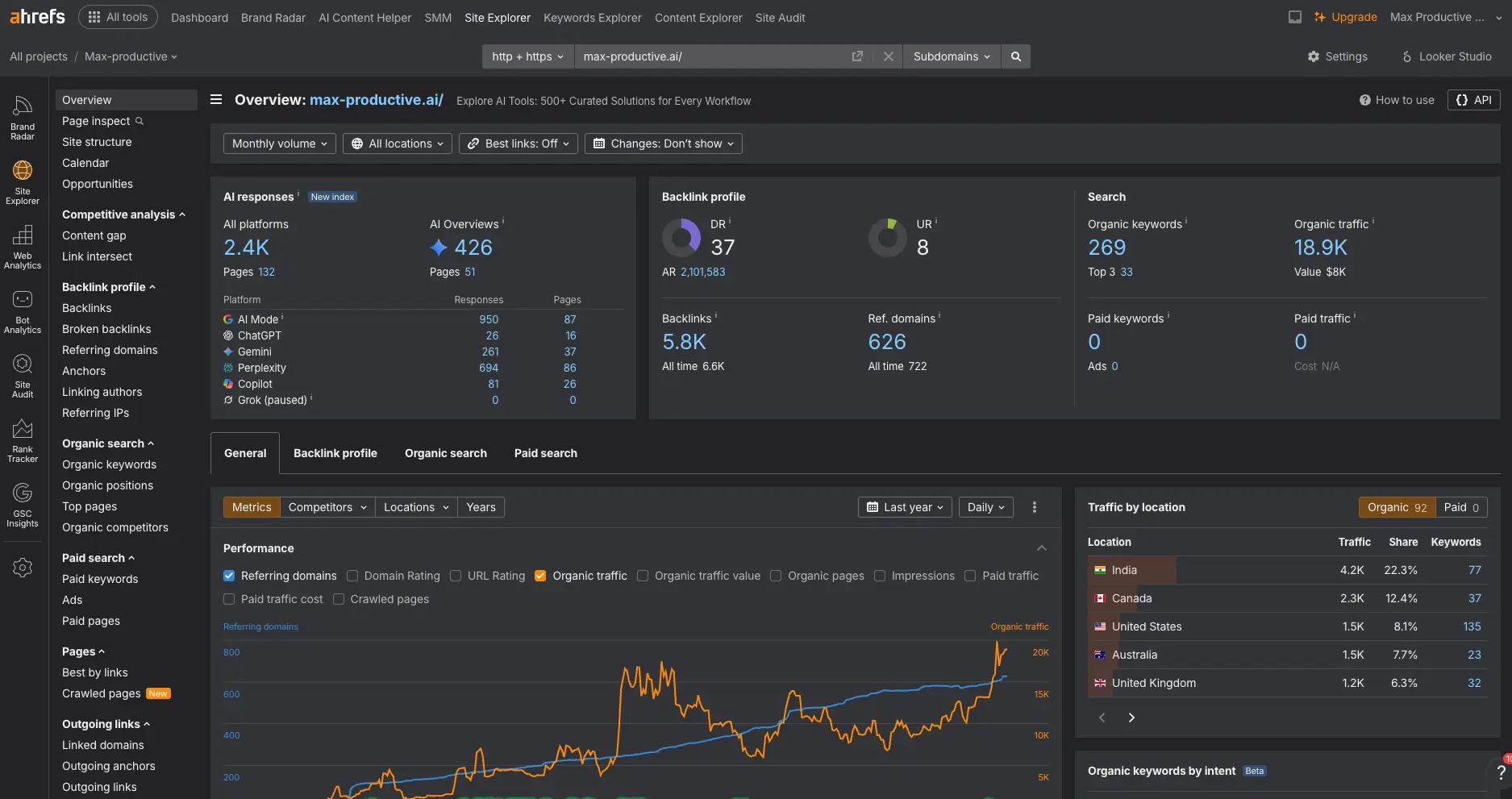
The Research Benchmark for SEO,
Now Tracking AI Answers Too
Ahrefs still has the dataset everyone else gets measured against: a backlink index that refreshes every few minutes, keyword data for more than 200 countries, and a Site Audit that flagged things on my own site I hadn't thought to check, including slow server responses to AI crawlers. Brand Radar folds AI visibility into the same workflow. For anyone who researches competitors every week, it's the most useful $129 to $249 a month you'll spend on SEO software. The catch is what happens after that: one seat per plan, credits metered on Lite, and a Brand Radar index that can cost more than the subscription it sits on.
✓ What We Love
- Backlink and competitor data nothing else quite matches
- Site Explorer ties keywords, links, pages and AI visibility to one domain
- Site Audit checks 170+ issues, AI-crawler response included
- Free tools for any site you can verify, API and MCP from Lite up
! Could Be Better
- One user per plan; extra seats run $40 to $100 a month
- Lite meters report credits and leaves out Content Explorer
- No full free trial, and the full Brand Radar index is a $199+ add-on
What Is Ahrefs?
A research and measurement platform, not an SEO service. That distinction decides whether it's worth your money.
Ahrefs is an SEO platform built around its own web crawler. It started life in 2011 as a backlink checker, and that origin still shows in the best possible way: the backlink index is the part of the product people compare everything else against. Over the years it has grown into six main tools. Site Explorer analyzes any domain's traffic, keywords, links and pages. Keywords Explorer finds and clusters keyword ideas. Site Audit crawls your site for technical problems. Rank Tracker monitors positions. Content Explorer searches a database of billions of pages for topics and link prospects. And Brand Radar, the newest of the six, measures how often a brand shows up in AI-generated answers.
The company is based in Singapore and, unlike most of its rivals, runs its own crawler rather than buying clickstream data. Ahrefs says that crawler processes five million pages a minute, has indexed 493.9 billion pages, and holds 35 trillion historical external backlinks. Keywords Explorer draws on 28.7 billion keywords filtered from 110 billion discovered across 217 locations. Those are vendor figures, so treat them as a rough sense of scale rather than an audited count. What matters is the practical result: when I look up a competitor in Site Explorer, the referring domains, top pages and keyword lists are fuller and fresher than what I get from most other tools.
One thing to understand before paying. Ahrefs tells you what's happening and why. It doesn't do the work. Search Atlas and Alli AI will push on-page changes to your site. Ranked AI assigns humans to write content and build links for you. Ahrefs does neither. It hands you the list of gaps, broken links, ranking pages and AI citations, and expects you to have the time and skill to act on it. For a consultant or an in-house team, that's exactly right. For a business owner hoping the tool will fix their SEO, it's the wrong purchase.
How We Evaluated Ahrefs
The screenshots on this page come from my own Ahrefs account with max-productive.ai set up as a verified project on the free tier. That gave me Site Audit, Web Analytics, GSC Insights and a limited view of Site Explorer on my own domain, and I've used Ahrefs' paid plans in previous roles for competitor and backlink research. Plan limits and pricing come from Ahrefs' pricing page and help documentation as of September 2026. The user-sentiment picture comes from public review platforms, not from a survey of my own.
So who is it for? SEO consultants and agencies who spend most of their week inside competitor data. Content strategists who need to know which topics a rival ranks for before commissioning an article. Link builders and digital PR teams, for whom Link Intersect and the broken-backlinks report are daily tools. In-house teams at brands that care about showing up in ChatGPT and Google's AI Mode as much as in blue links. If you fit one of those, Ahrefs is a very easy recommendation. If you're a solo creator who checks a keyword now and again, the free tier and Google Search Console will get you a long way before you need to pay.
See Ahrefs in Action
Screenshots from my own account, with max-productive.ai as the verified project.
Project Overview Dashboard
One row per project: health, authority, links, traffic and keywords with 30-day trends
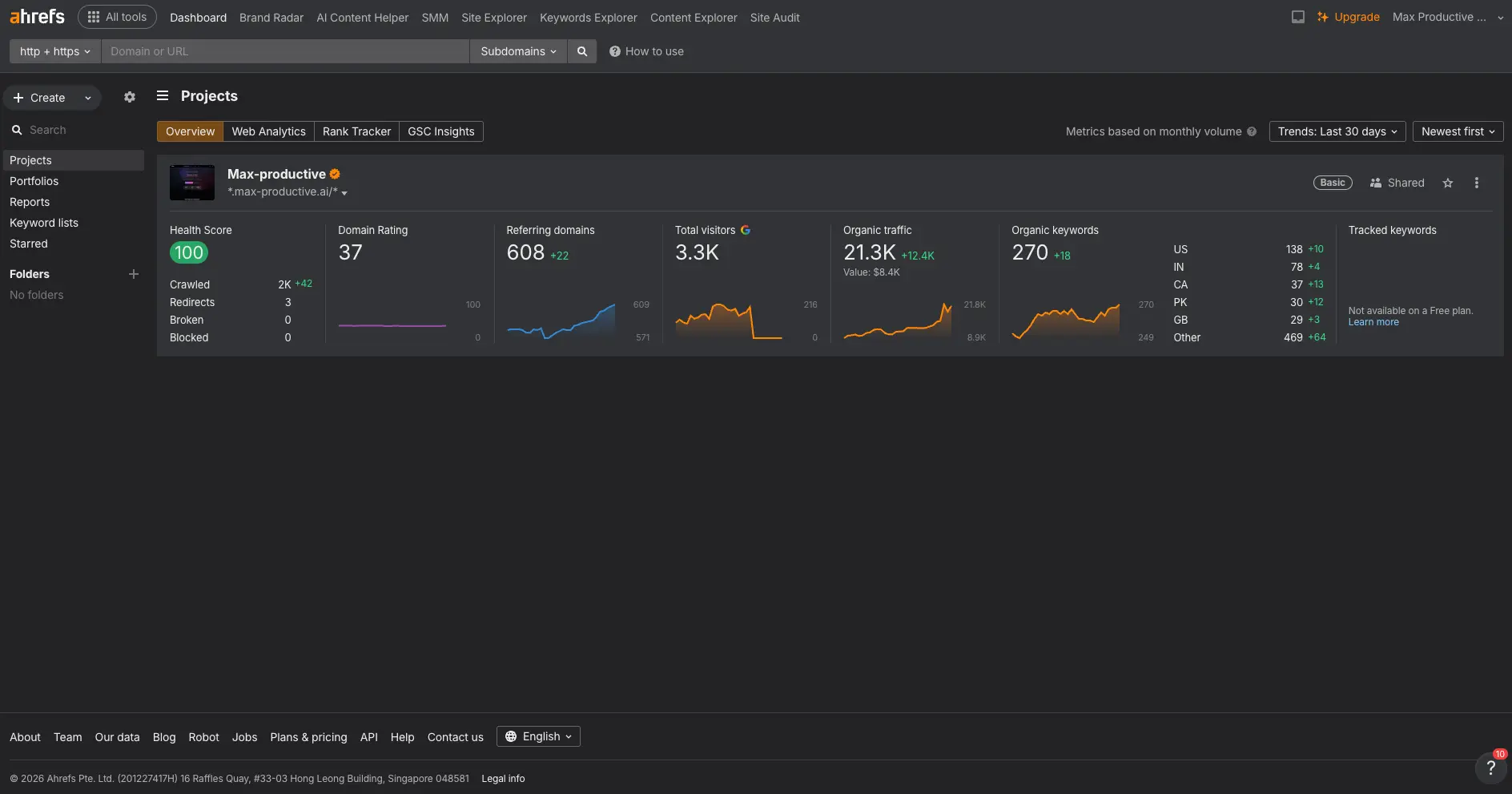
This is the screen you land on. Every verified project gets a single row with Health Score, Domain Rating, referring domains, total visitors, organic traffic and organic keywords, each with a sparkline for the last 30 days. Two details stood out. The "Total visitors" figure carries a Google icon because Ahrefs now pulls Google Analytics data into Web Analytics, so first-party numbers sit right next to Ahrefs' own estimates. And the "Basic" badge next to the project name is a polite reminder of what the free tier leaves out: Tracked keywords reads "Not available on a Free plan". Rank tracking is a paid feature, no exceptions.
Site Explorer with AI Visibility
The overview report now opens with AI responses before backlinks or search
Ahrefs has moved AI visibility to the front of Site Explorer. The first panel breaks down how many AI responses cite the site and on which platform: AI Mode, ChatGPT, Gemini, Perplexity, Copilot, with Grok marked as paused. For a directory like mine, seeing that Perplexity and Google's AI Mode cite far more of my pages than ChatGPT does is exactly the kind of thing I couldn't learn anywhere else without a dedicated tracker. Below that, the familiar backlink profile and search panels. One more thing: the organic traffic estimate here differs from the one on the projects dashboard, and both differ from what analytics reports. Ahrefs is upfront that these are estimates. I'll come back to that in the How It Works section.
Site Audit Overview
Health Score, issue distribution and a "What's new" table comparing two crawls
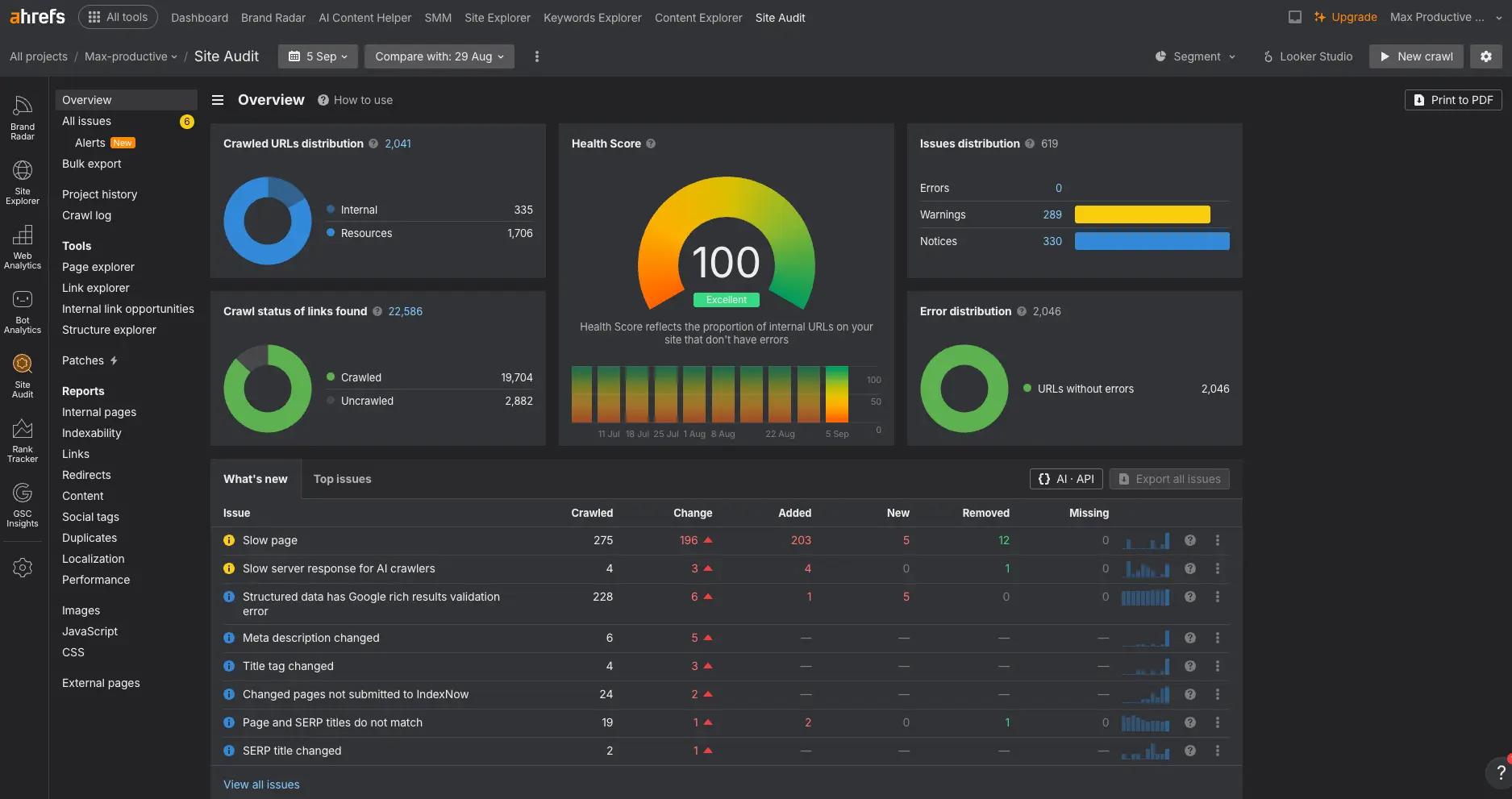
This is where the free tier earns its keep. Site Audit crawled just over 2,000 URLs on my site, found 22,586 links, and gave me a Health Score of 100 with zero errors. Which sounds great until you read the warnings: 275 slow pages, 228 structured-data validation errors, 24 changed pages not yet submitted to IndexNow. A perfect Health Score simply means no page is broken, not that nothing needs fixing. I like that the "What's new" table compares the current crawl with the previous one, so you see what got worse since last week rather than a static list. The "AI · API" button in the corner is new and lets you pull issues into an AI assistant or a script.
Want to run Site Audit on your own site?
Try Ahrefs →Free for verified sites • Paid plans from $29/moAI Crawler Performance Issue
A single issue drilled down to the URL level, with every header and timing exposed
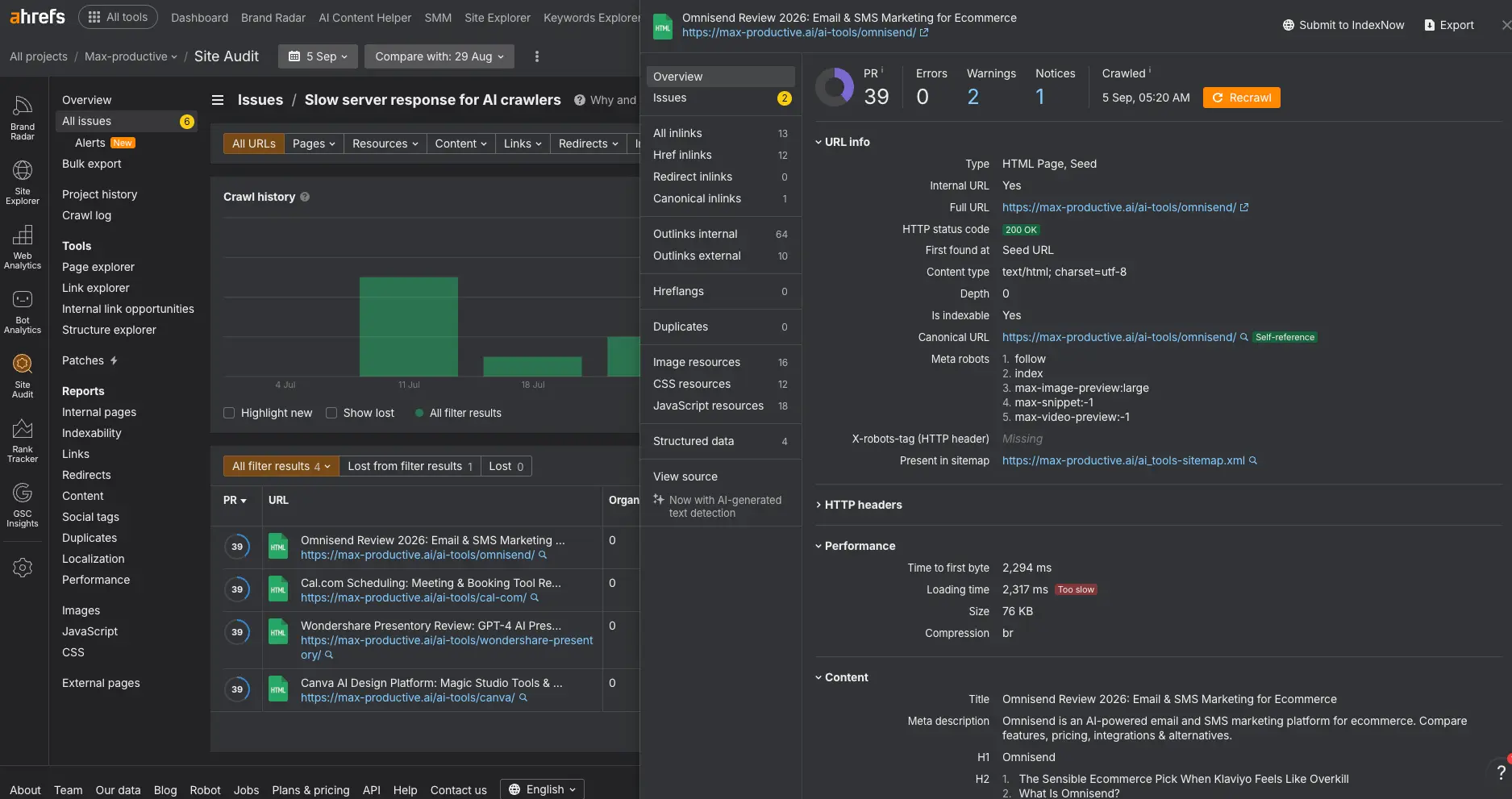
Click any issue and Ahrefs lists the affected URLs, then opens a detail panel for each one: status code, canonical, meta robots, sitemap membership, structured data count, HTTP headers and a performance block with time to first byte and total load time. Four of my tool pages take over two seconds to respond, and Ahrefs now frames that specifically as a problem for AI crawlers, not just for Google. That's a 2026 check I haven't seen elsewhere. The "Submit to IndexNow" button and the "AI-generated text detection" note in the sidebar show how quickly the product is moving; both are recent additions. If I have a criticism, it's that the panel is dense. Marketers will want the "Why and how to fix" link; developers will be happy.
AI Content Helper
Keyword, article URL, location, brand kit and competitors go in; a coverage-scored document comes out
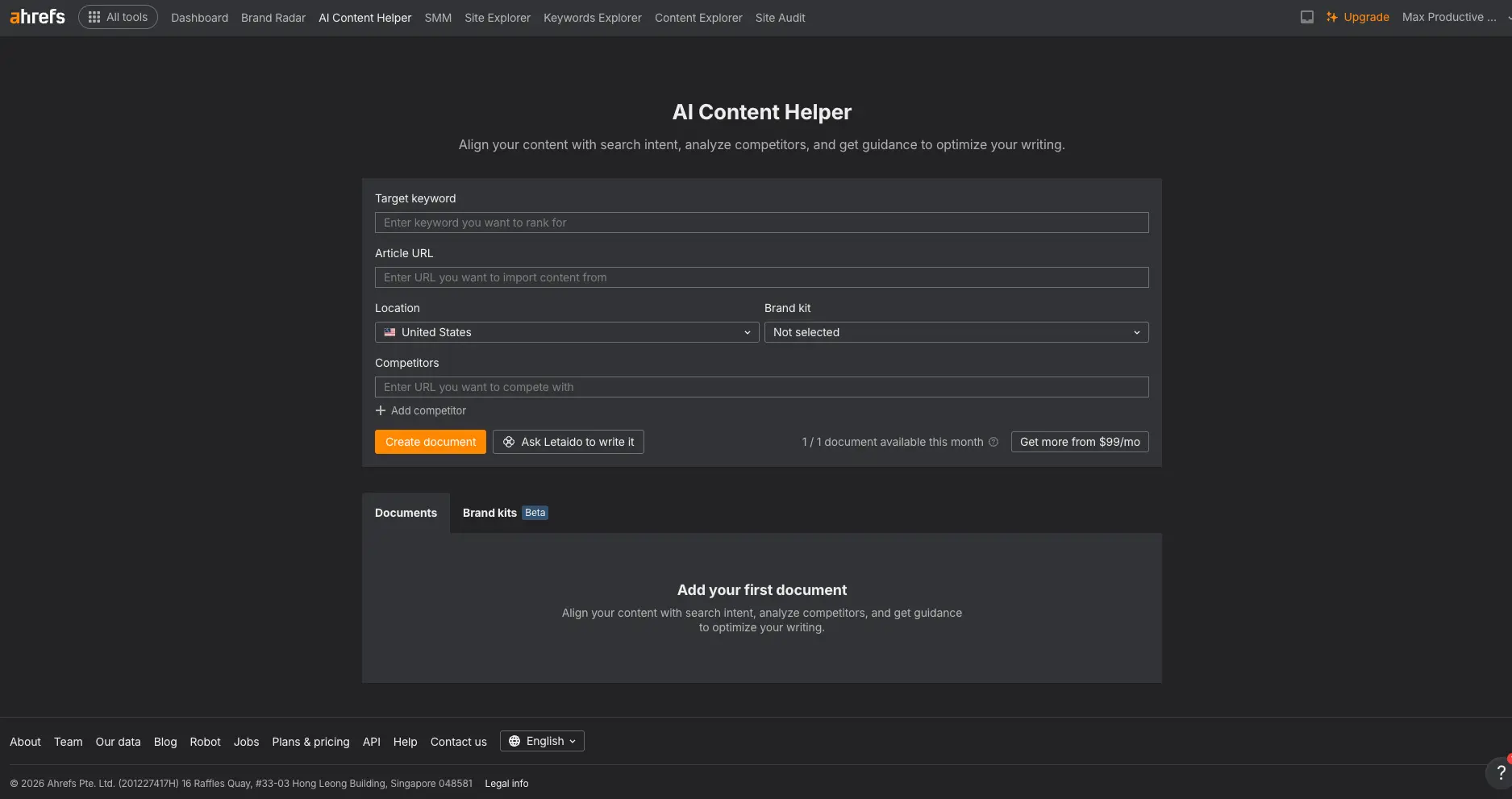
AI Content Helper is Ahrefs' answer to Surfer SEO and Clearscope. You enter a target keyword, optionally import an existing article by URL, set the location, pick a brand kit and add competitor URLs. It then scores your draft on how well it covers the topics the ranking pages cover, rather than counting keyword occurrences. The setup is quick and the competitor selection is a nice touch. The limitation is right there in the corner of the screen: one document a month on the free plan, and the "Get more from $99/mo" button points to the Content Kit add-on. Surfer's Standard plan costs about the same on annual billing and is a more mature writing environment, so I'd think of Content Helper as a convenience for existing Ahrefs users rather than a reason to buy.
How Ahrefs Works
A typical week in Ahrefs, from your own site to your competitors' and back.
Verify Your Site and Connect Google
Create a project, verify ownership through DNS, an HTML file or Google Search Console, and Ahrefs starts crawling. Connecting GSC and Google Analytics matters more than it sounds: it unlocks GSC Insights, feeds first-party visitor numbers into the dashboard, and gives you a truth source to check Ahrefs' estimates against. On the free tier this step gets you Site Audit, Web Analytics and a limited Site Explorer view. It's the best free SEO audit setup I know of, and you should do it even if you never pay.
Research Competitors in Site Explorer
This is the paid part, and the reason most people subscribe. Drop in a competitor's domain and you get their top pages by traffic, every keyword they rank for, referring domains, new and lost links, paid landing pages and, now, which of their pages AI platforms cite. Competitive analysis tools sit alongside: Content Gap shows keywords they rank for and you don't; Link Intersect shows sites linking to several competitors but not to you. Everything cross-links, so a competitor's top page leads to its keywords, which lead to the SERP, which leads to who links to the winners.
Find Keywords and Prioritize Content
Keywords Explorer turns a seed term or a competitor's keyword list into clusters with volume, Keyword Difficulty, traffic potential, intent and SERP history. The "traffic potential" number is the one to watch; it estimates the traffic of the current top-ranking page across all its keywords, which is a far better guide than raw volume. From here you can open AI Content Helper for a brief or, on Standard and above, use Content Explorer to find proven articles and link prospects in the topic. Keyword Difficulty is an estimate. It can't see intent mismatch or brand strength, so check the SERP yourself before committing to a topic.
Audit, Track and Report
Site Audit runs on a schedule and shows you what changed between crawls. Rank Tracker monitors positions on desktop and mobile down to city level, though the base plans update weekly, which is slower than SE Ranking's daily default. Brand Radar tracks mentions and citations across AI platforms. Reporting comes through exports, Looker Studio connectors (Advanced and up), the API and an MCP server that lets an AI assistant query your data directly. If you need always-on auditing and instant recrawls, that's a Project Boost add-on rather than part of the plan.
Estimates Are Not Analytics
On my own dashboard, Ahrefs estimates 21.3K monthly organic visits, Site Explorer says 18.9K, and the Google Analytics-connected "Total visitors" figure in the same row shows 3.3K. That gap isn't a bug. Ahrefs models traffic from ranking positions and keyword volumes; analytics counts real sessions. Use Ahrefs numbers to compare sites against each other and to spot trends, and use Search Console or analytics for anything that ends up in a report to a client or a boss.
Credits, Checks and Crawl Credits
Ahrefs meters usage in several currencies. Report credits are consumed when you open or filter reports on Starter (200 a month) and Lite (1,000 per user); Standard and above are unlimited under fair use. Crawl credits cover Site Audit pages. Brand Radar "checks" are one prompt run on one platform in one location. API units are billed per row returned. None of it is hidden, but new users regularly get caught out, and it's the single most common complaint in public reviews. Read the limits before you pick a plan.
Key Features
Six core tools, a couple of add-ons, and the plumbing that connects them.
Site Explorer & Backlink Index
The centerpiece. Enter any domain and see its organic keywords, top pages, paid traffic, referring domains, anchors, new and lost links and AI citations. The backlink index is what Ahrefs built its name on and it's still the best reason to choose it over Semrush. Users in some smaller markets report gaps in referring-domain coverage, so cross-check important findings with Search Console.
Keywords Explorer
Keyword ideas with volume, difficulty, traffic potential, intent, parent topic, clustering and SERP history across 217 locations. Its best trick is starting from a competitor rather than a seed phrase. Difficulty scores are directional; the SERP is the final judge.
Site Audit
More than 170 checks across indexability, redirects, canonicals, duplicates, structured data, images, localization, Core Web Vitals and, new in 2026, server response times for AI crawlers and IndexNow submission. Available free for verified sites. Scheduled crawls compare against the last run; always-on auditing needs Project Boost.
Rank Tracker
Desktop and mobile positions in 190+ locations down to city and ZIP level, with SERP features and Share of Voice against competitors. Allowances run from 50 keywords on Starter to 5,000 on Advanced. The base cadence is weekly. If you need daily movement for launches or news, SE Ranking does it for less.
Brand Radar
Mentions, citations, AI Share of Voice and estimated impressions across Google AI Overviews, AI Mode, ChatGPT, Perplexity, Gemini and Copilot. Two modes: a pre-collected index of 459M+ prompts for instant benchmarking, and custom prompts you track by model, country and cadence. Paid plans include a handful of custom prompts; the full index starts at $199 a month per platform.
AI Content Helper
Scores a draft on topical coverage against the ranking pages, suggests titles, metadata and headings, and now supports custom competitor selection and Google Docs export. One document a month is free; the Content Kit starts at $99 a month. Fine for existing subscribers, not a match for a dedicated optimizer.
Content Explorer
A searchable database of billions of pages filtered by traffic, referring domains, social shares, publish date and Domain Rating. Use it to find proven linkable assets, unlinked brand mentions, declining pages worth refreshing and outreach targets. Not included on Lite, which is one of the main reasons Standard is the better professional tier.
Web Analytics, API & MCP
A cookie-free analytics tool that's free for up to a million events per project a month, a Google Search Console integration, Looker Studio connectors on Advanced and up, and API v3 with unit allowances from Lite upward. The MCP server means you can ask an AI assistant questions about your Ahrefs data. Web Analytics won't replace GA4 for ecommerce funnels, but for a content site it's plenty.
The feature list is long, and it's worth being clear about what's bundled and what isn't. Lite gets you Site Explorer, Keywords Explorer, Site Audit, Rank Tracker and a small Brand Radar allowance. Content Explorer needs Standard. Looker Studio needs Advanced. The Content Kit, Report Builder, Project Boost and the Brand Radar index are all separate line items. Is that unreasonable? Not for a tool with this much data behind it. But the headline price and the price a busy agency actually pays can be a few hundred dollars apart, and Ahrefs' marketing doesn't go out of its way to say so.
See which features come with each plan:
Check Ahrefs' pricing →Free tier • Starter $29/mo • Lite $129/moAhrefs Pricing
Six tiers from free to Enterprise. The three below are the ones most readers will choose between.
Free
- ✓ Unlimited verified projects
- ✓ Site Audit with 5,000 crawl credits per project
- ✓ Web Analytics & GSC Insights
- ✓ Limited Site Explorer on your own site
- ✓ 1 AI Content Helper document/month
- ✗ No competitor research or rank tracking
Lite
- ✓ 5 projects, 6 months history
- ✓ 750 tracked keywords (weekly)
- ✓ 5 AI prompts / 150 Brand Radar checks
- ✓ 100,000 crawl credits
- ✓ 1,000 report credits per user
- ✗ 1 user; no Content Explorer
Standard
- ✓ 20 projects, 2 years history
- ✓ 2,000 tracked keywords
- ✓ 10 AI prompts / 300 Brand Radar checks
- ✓ 500,000 crawl credits
- ✓ Unlimited report credits
- ✓ Content Explorer, Batch Analysis, Portfolios
Extra users: $40/mo on Lite (max 2), $60 on Standard (max 5), $80 on Advanced (max 10), $100 on Enterprise
Add-ons: Content Kit from $99/mo • Report Builder $99/mo • Project Boost $20 or $200/mo per project • Brand Radar AI index $199/mo per platform or $699/mo for all platforms • Custom prompt packs from $50 for 2,500 checks
Annual billing: saves up to 17% on Lite, Standard and Advanced, roughly two months free
Pricing last verified September 2026. Visit Ahrefs for current rates.
Is It Worth the Money?
For a consultant, one hour of billable work a month covers Lite and most of Standard. The better test is how often you open it. If you're in Site Explorer most days researching other people's sites, the subscription pays for itself in the first client brief. If you open it twice a month to check your own rankings, you're paying $129 for something the free tier plus Search Console does almost as well.
Two things about the free tier. First, it's better than most people expect. Verify a site and you get a proper technical audit, analytics, GSC insights and a look at your own backlinks and keywords, with no card required. Second, it's deliberately useless for the thing that makes Ahrefs Ahrefs: looking at sites you don't own. That's what the $29 Starter plan is for, and I'd treat it as the trial Ahrefs doesn't otherwise offer. Two hundred credits and one month of history won't last a working week, but they're enough to decide whether the data is worth the Lite price. Refunds on monthly plans are only considered if you haven't materially used the service, so don't count on one.
Against the competition, Ahrefs sits at the premium end of the mid-market. Lite at $129 lines up almost exactly with SE Ranking Core ($129, or $103.20 annual), but SE Ranking gives you 10 projects, 2,000 daily-tracked keywords and 100 daily AI prompts for that money, against Ahrefs' 5 projects, 750 weekly keywords and 5 prompts. What SE Ranking doesn't have is Ahrefs' backlink depth. Semrush One starts at $199 and Pro+ at $299, so Ahrefs Standard at $249 lands between them with a narrower toolset and deeper link data. Search Atlas starts at $99 and includes automation Ahrefs will never offer. And where seats matter, Ahrefs loses: a three-person team on Standard pays $369 a month before add-ons, which is where SE Ranking or Semrush start to look sensible.
Detailed Pros & Cons
The full picture, including the parts the pricing page doesn't lead with.
✓ Pros
Ahrefs runs its own crawler and refreshes the live backlink index every 15 to 30 minutes, so new links show up faster and referring-domain lists are fuller than in most competing tools. Link Intersect, broken backlinks, new/lost links and anchor reports turn the raw index into workflows a link builder uses daily. This is the feature you're paying for, and it justifies the price on its own for link-heavy work.
A competitor's top page leads to its keywords, which lead to the SERP, which leads to who links to the winners, which leads to a Content Helper brief. Few tools let you move from discovery to prioritization without exporting a spreadsheet. Semrush has more tools; Ahrefs has fewer that fit together better.
Beyond the standard checks, the crawler now flags slow server responses to AI crawlers, pages not submitted to IndexNow and Google rich-results validation errors, and it compares each crawl with the previous one so you see what changed. It's free for verified sites, which makes it the best no-cost technical audit available.
Dedicated trackers like Rankscale cover more engines for less, but they can't show you that the page ChatGPT keeps citing is also one of your top organic pages, or which sites link to it. Ahrefs can, because it's all one dataset. The pre-collected prompt index means you can benchmark a market immediately instead of waiting weeks for custom prompts to accumulate history.
Site Audit, Web Analytics, GSC Insights, limited Site Explorer and one Content Helper document a month, for any site you can verify, with no card. Small site owners can run on this indefinitely. It's a more useful free tier than Semrush's, which caps you at a handful of searches a day.
API v3 access now starts at Lite rather than Enterprise, with unit allowances scaling by tier, and the MCP server lets an AI assistant pull Ahrefs data into a conversation. For agencies building dashboards or internal tools, that's a meaningful change from a year ago.
✗ Cons
Lite, Standard and Advanced each include a single user. Adding people costs $40, $60 or $80 a month per seat, with caps of 2, 5 and 10. A three-person agency on Standard is at $369 before any add-on. SE Ranking and Semrush charge for seats too, but with Ahrefs the plan price understates the team cost more than most, and the pricing page makes it easy to miss.
The entry professional plan gives you 1,000 report credits a month, and opening or filtering a report spends them. Heavy users hit the ceiling. Lite also leaves out Content Explorer, Batch Analysis and Portfolios, so the "$129 plan" is more of a stepping stone to Standard than a home. I'd like Ahrefs to either drop the metering on Lite or price it lower.
You can use the free tier on your own site or pay $29 for Starter, but there's no way to test the full professional toolset without paying for Lite. Refunds on monthly plans are discretionary and only considered if you haven't materially used the service. In 2026, when Clearscope gives you 14 days and HubSpot AEO 28, this feels dated.
Full Brand Radar index access is $199 a month per platform or $699 for all six. Content Kit is $99. Report Builder is $99. Always-on audits need Project Boost at $20 or $200 per project. A subscriber who wants Ahrefs to do everything it advertises can end up paying more for extras than for the plan. Budget the real number, not the one on the plan card.
The base plans refresh Rank Tracker weekly. For a content site that's fine. For ecommerce launches, news or a site mid-migration, it's too slow, and Ahrefs doesn't sell daily updates as a simple toggle. SE Ranking tracks daily on its cheapest plan.
Public sentiment splits sharply by platform. Professional software reviewers rate Ahrefs highly on data and usability; consumer review sites are far harsher, and the complaints cluster around credit consumption, unexpected charges, plan changes and slow support rather than the product itself. I haven't run into this personally, but the volume is high enough that I'd set a reminder before any renewal.
Ahrefs vs Alternatives
How Ahrefs compares with the SEO platforms and AI-visibility tools people shortlist alongside it.
| Feature | Reviewed Ahrefs | Semrush | SE Ranking | Search Atlas | Surfer SEO |
|---|---|---|---|---|---|
| Entry Professional Plan | $129/mo (Lite) | $199/mo (One Starter) | $129/mo (Core) | $99/mo (Starter) | $99/mo annual (Standard) |
| Backlink Index | Best in class | Strong | Good | Good | None |
| Rank Tracking Cadence | Weekly (base plans) | Daily | Daily | Included | Page-level only |
| AI Visibility Tracking | 6 platforms; full index from $199/mo | Included in Semrush One | 100 daily prompts on Core | From Growth plan | 25–50 prompts on Standard/Pro |
| Executes Changes | ✗ | Limited workflows | ✗ | ✓ OTTO SEO | Content only |
| Best For | Backlinks & competitor research | All-in-one marketing suite | Value-led agency tracking | Automated implementation | Content optimization |
Ahrefs vs Semrush: The Short Version
This is the comparison most people are making. Ahrefs wins on backlink depth, organic competitor research and a cleaner specialist workflow. Semrush wins on breadth: PPC intelligence, local SEO, social scheduling, content tools and AI visibility bundled into Semrush One, all in one login. On price, Ahrefs Lite at $129 undercuts Semrush One's $199 Starter, though Semrush's SEO-only Classic plan at $139.95 narrows the gap. So the question is what your week looks like. If it's mostly links and organic content, Ahrefs is the tighter fit. If you're running paid campaigns and client reporting alongside SEO, Semrush consolidates more. Our Semrush vs Search Atlas comparison covers the automation angle in more detail.
Which Tool Is Right For You?
Ahrefs
ReviewedBest for: SEO consultants, agencies and in-house teams whose work depends on understanding competitors' backlinks, keywords and top pages, and who want AI visibility measured against the same data. The research depth is the reason to choose it; the connected workflow is the reason you'll keep it. Start on the free tier with a verified site, use Starter as your trial, and go straight to Standard if you're buying for professional use.

Semrush
Closest RivalBest for: Teams that want SEO, PPC, local, social and AI visibility in one platform rather than a specialist SEO tool. Semrush One starts at $199 a month and Pro+ at $299, with daily rank tracking and stronger client reporting than Ahrefs. The interface is denser and the seat and add-on costs are similar, so the decision comes down to breadth versus link depth.

SE Ranking
Best ValueBest for: Agencies and in-house teams that need daily rank tracking, multiple projects and client reporting more than elite backlink forensics. Core at $129 a month ($103.20 annual) includes 10 projects, 2,000 daily-tracked keywords, 100 daily AI prompts and API credits, which is far more allowance than Ahrefs Lite at the same price. The backlink index is shallower. Many small agencies run SE Ranking full-time and buy Ahrefs for a month when a link project comes up. See how it compares with Surfer SEO →

Search Atlas
AutomationBest for: Agencies whose bottleneck is implementing changes, not finding them. Search Atlas pairs a full research suite with OTTO SEO, which can recommend and deploy technical, on-page, content and local fixes. Plans start at $99 a month. Ahrefs has the safer, deeper research data; Search Atlas has the execution loop. Pilot OTTO on one low-risk site before letting it loose on a client's.

Surfer SEO
Content CompanionBest for: Writers and content teams who want a live editor that scores drafts against the SERP as they type. It isn't an Ahrefs replacement, as there's no backlink or keyword database of the same depth, but it's a better writing environment than Ahrefs' Content Helper. Standard is about $99 a month on annual billing and includes AI visibility tracking for 25 prompts. The usual pairing: Ahrefs decides what to target, Surfer helps write it.

Rankscale
AI Visibility PickBest for: Anyone who wants broad AI-engine monitoring without paying $199 to $699 for the Brand Radar index. Rankscale tracks 17+ engines from $20 a month with no per-engine surcharge, plus citation analysis and an AI-readiness audit. It has no backlink, keyword or classic rank data, so it complements Ahrefs rather than replacing it. See it alongside other AI visibility trackers →
Frequently Asked Questions
Should You Try Ahrefs?
Ahrefs is the best research tool in SEO, and in 2026 that now includes AI search. The backlink index, Keywords Explorer and Site Explorer are the standard everything else gets compared to, Site Audit has kept pace with a web full of AI crawlers, and Brand Radar shows you where a brand appears in ChatGPT, Perplexity and Google's AI answers using the same data you already work in. For a consultant, an agency or an in-house team that studies competitors every week, there's nothing I'd recommend ahead of it.
The reservations are all about money. One user per plan. Report credits metered on Lite. No proper trial. Add-ons that can double the bill, with the full Brand Radar index the biggest of them. Weekly rank updates when rivals do daily. And enough billing complaints in public reviews to make me set a calendar reminder before renewal. If you need many seats or a marketing suite that also runs PPC and social, Semrush or SE Ranking will fit better. For research depth, Ahrefs still wins, and it's the tool I'd pay for first.
Our Recommendation
Verify your site on the free tier today and run Site Audit; it's the best free technical audit available and you'll learn something. When you need competitor data, pay $29 for a month of Starter and treat it as your trial. If it earns its keep, skip Lite and go to Standard on annual billing for Content Explorer and unmetered reports. Price seats and the Brand Radar index before you commit, and put the renewal date in your calendar.