

Rank Prompt
Rank Prompt is an AI visibility platform that tracks how ChatGPT, Perplexity, Google AI Mode, Claude, Gemini and Grok talk about your brand, shows you which sources they cite, and gives you the tools to change the answer. If AI search is where your buyers now start, this is the specialist tool to look at first.
Get your free AI visibility report →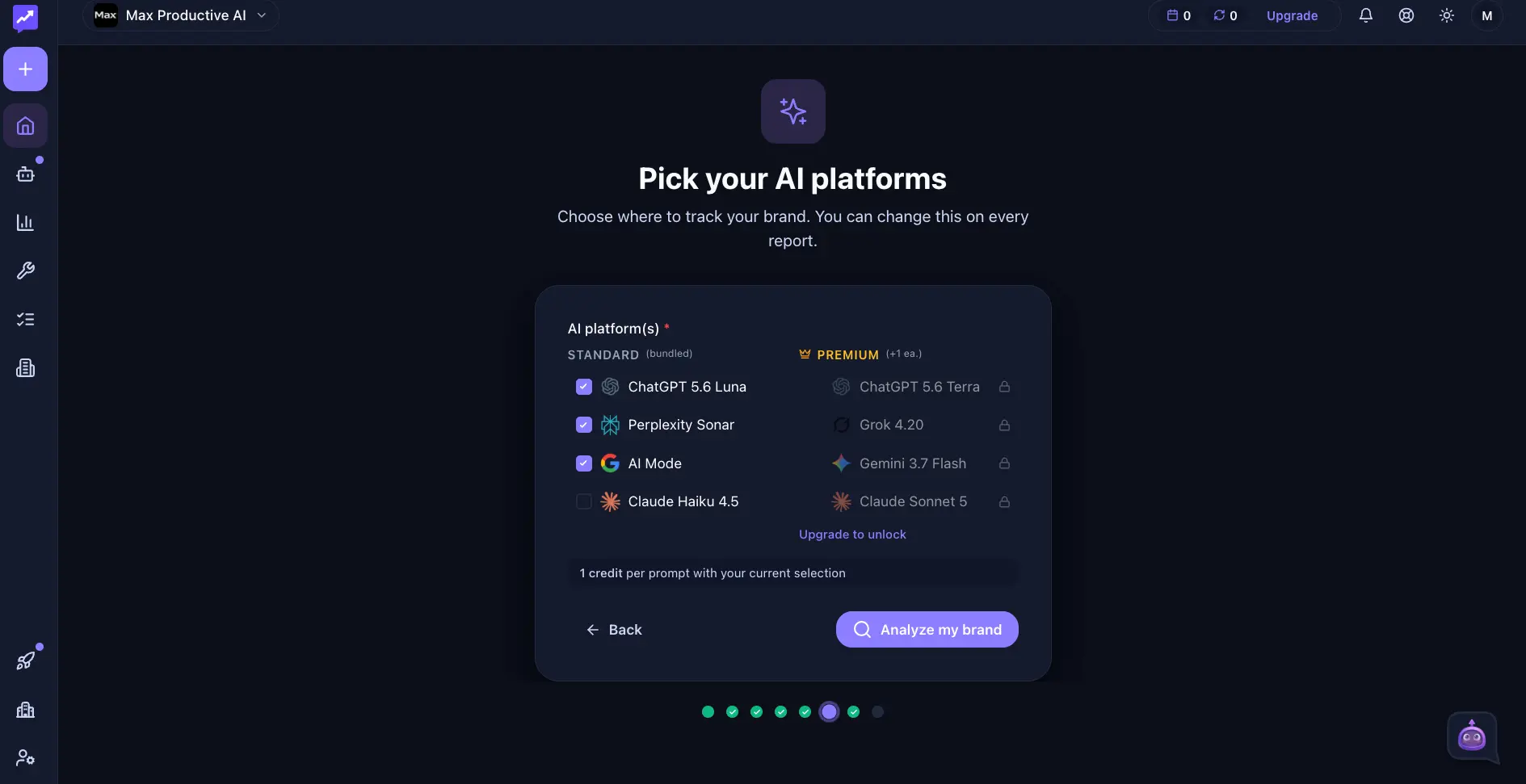
The Most Complete AEO-Native Platform,
Priced for Small Teams
Most AI visibility tools stop at a score. Rank Prompt shows the score, then shows you the pages the AI models cite when they answer, then hands you a content studio and an outreach tool to go after those citations. Six AI engines on every plan, Starter from $39.17 a month, and a free first report with no card. The trade-offs are a credit system that doesn't roll over, premium models that cost an extra credit each, and a publishing flow built around WordPress. For solo marketers and agencies who want one tool for the whole AEO job, it's the best value I've found in this category.
✓ What We Love
- Six AI engines tracked with a separate score for each
- Citation Audit shows which sources drive AI recommendations
- Content studio, outreach and Agent Mode in the same subscription
- White-label reports, client portal, REST API and MCP server
! Could Be Better
- Credits reset monthly and premium models cost extra credits
- Native publishing covers WordPress or a hosted blog only
- Six engines is narrower than Rankscale's 17+
What Is Rank Prompt?
An AI visibility tracker first, an AEO workbench second. That combination is the whole point.
Rank Prompt, also written RankPrompt, is an Answer Engine Optimization (AEO) platform, or a Generative Engine Optimization (GEO) tool if you prefer that label. Where a classic SEO tool tracks where you rank on Google, Rank Prompt tracks what happens when someone asks an AI assistant a buying question in your category. It writes or accepts a set of buyer-style prompts ("which AI productivity tools should a small team use?"), runs them through ChatGPT, Perplexity, Google AI Mode, Claude, Gemini and Grok on a schedule, and reports back: were you mentioned, were you recommended, where did you sit relative to competitors, and which websites did the AI lean on when it answered. Each engine gets its own visibility score, tracked week by week.
The company is young. It was founded in mid-2025 in Miami by a group of agency marketers who built it as an internal tool and then opened it up. Since then it has shipped at a pace that's quick even by AI software standards. When I first reviewed it in October 2025 it was a visibility tracker with a content generator attached. The changelog since then runs to seven major releases: Google Analytics and Search Console integration and technical SEO audits in December 2025, a backlink outreach and email hub in January 2026, Google Business Profile management in April, a rebuilt AI agent and a full agency suite in June, and Google keyword tracking plus ChatGPT Ads audiences in September 2026. Its site lists customers including Mastercard, P&G and Lenovo. Not bad for a product that is barely fifteen months old.
What separates Rank Prompt from most of its peers is that it doesn't stop at measurement. The Citation Audit tells you which domains the AI models cite when they recommend brands like yours. The content studio drafts the comparison pages, ranked lists and FAQs that AI engines tend to pull from. The outreach tool finds the people behind those cited pages and runs email campaigns to earn a mention. Agent Mode sits over all of it and answers plain-language questions like "what should I do next to improve my score?" Whether that loop works for you depends on how much of the work you're willing to do. But the tool closes the loop, which is more than most rivals manage. They hand you a dashboard and leave the to-do list to you.
How We Evaluated Rank Prompt
I set up a free account for this site, Max Productive AI, and went through the full onboarding: brand aliases, business categories, prompt generation, AI platform selection and the Brand Audit flow. I also opened the Content, Outreach and Agent Mode tools, read the full product changelog, and checked pricing against Rank Prompt's own plans page in September 2026. The picture of user sentiment comes from independent hands-on reviews and verified user feedback on business-software review sites. I did not run a controlled accuracy test, and like every tool in this category, Rank Prompt's scores come from simulated prompt scans rather than real query volume from the AI platforms. Treat them as directional.
So who is it for? Three groups. Solo founders and small marketing teams who want to know if AI assistants recommend them, at a price that doesn't require a budget line. In-house marketers at mid-sized companies who need per-engine tracking, competitor benchmarking and a way to brief content that AI engines will cite. And agencies, which is clearly where Rank Prompt is putting its effort, with white-label reports, a client portal and multi-brand dashboards that make AEO monitoring a service you can resell. If you only want the widest possible list of AI engines, Rankscale tracks more. If you want someone else to do the work, Ranked AI is a managed service. Rank Prompt sits in the middle: a serious self-serve platform that gives you the tools and expects you to use them.
See Rank Prompt in Action
Screenshots from our test account, from onboarding through to the content and agent tools.
Brand Setup & Business Categories
Aliases, an AI-written overview, and up to five categories to generate prompts from
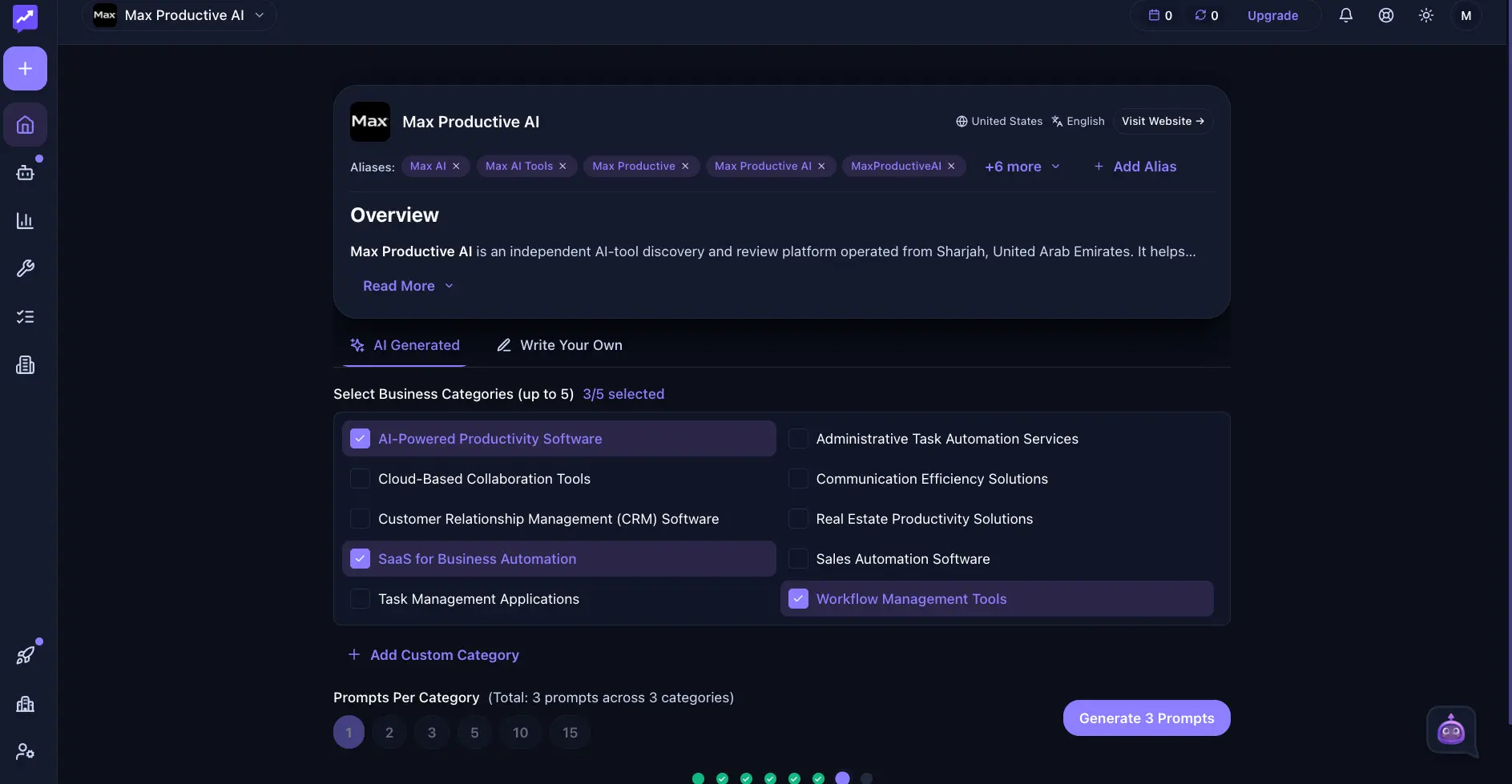
Onboarding is an eight-step wizard, and this is the step that matters most. Rank Prompt read my domain and pulled out eleven aliases (Max AI, Max AI Tools, MaxProductiveAI and so on), which is how it catches mentions that don't use your exact brand name. It also wrote a short overview of the business, which you can edit or replace with your own. Then it proposed ten business categories and asked me to pick up to five. The prompts-per-category slider runs from 1 to 15. On a free account with zero credits, I stayed at 1 per category; on a paid plan this is where you decide how much of your monthly allowance a report will consume.
Pick Your AI Platforms
A standard bundle plus premium models, with the credit cost shown before you run anything
This is the screen that explains Rank Prompt's credit maths better than any pricing page. The standard bundle, which on my account showed a ChatGPT model, Perplexity Sonar, Google AI Mode and a Claude model, runs at one credit per prompt. Each premium model you add costs one more credit per prompt. The premium column showed a larger ChatGPT model, Grok, Gemini and Claude Sonnet, all locked with an "Upgrade to unlock" link on the free account. I like that the cost is shown in plain text before you commit. I'd like it more if the pricing page spelled out the bundle-versus-premium split as clearly as this dialog does.
Review Your Prompts
The exact questions Rank Prompt will ask the AI engines, editable before you spend a credit
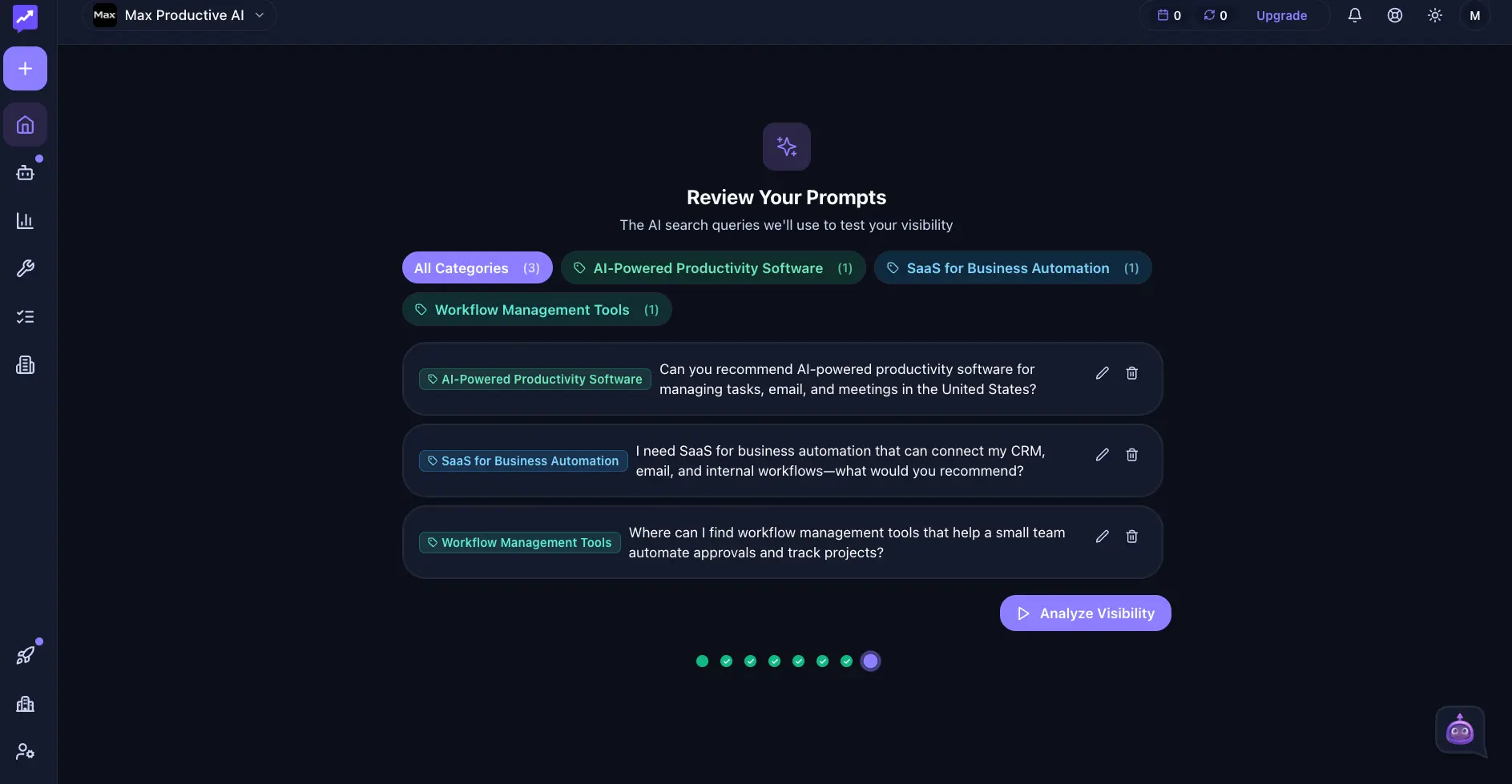
The prompts it generated for me were sensible. "Can you recommend AI-powered productivity software for managing tasks, email, and meetings in the United States?" is the kind of thing a real person types into ChatGPT, and it's a long way from a keyword list. Each prompt is tagged with its category and can be rewritten or deleted before you run the scan. Don't skip the editing step. The quality of everything downstream, from your visibility score to the citation map, depends on whether these questions match what your buyers actually ask.
Want to see how AI assistants describe your brand right now?
Run your free report →No card needed • Paid plans from $39.17/moBrand Audit
A five-step sentiment audit that shows how AI platforms describe your brand in a given market
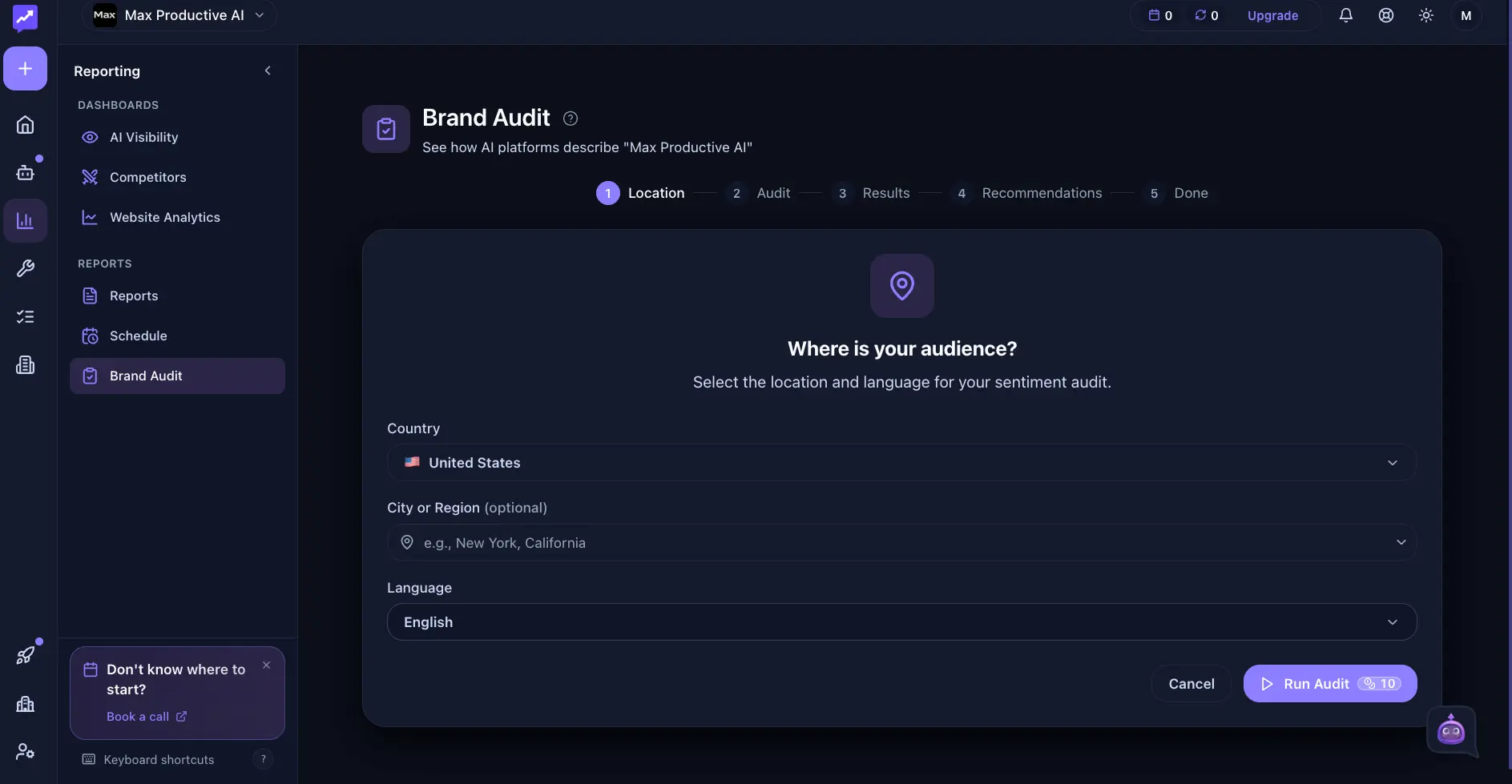
The Brand Audit is separate from the visibility report. Instead of asking whether you show up, it asks how the AI platforms describe you, in a chosen country, city and language, and then produces recommendations. It costs ten credits, which is where the Starter plan's 150 credits start to feel tight if you run one for every client. The Reporting sidebar on this screen also shows the shape of the platform: AI Visibility, Competitors and Website Analytics dashboards, plus Reports, Schedule and Brand Audit. Schedule is the one to set early. Rank Prompt is at its most useful when scans run automatically and you watch the trend.
Agent Mode
A chat assistant that knows your brand's data and can run tasks, not just answer
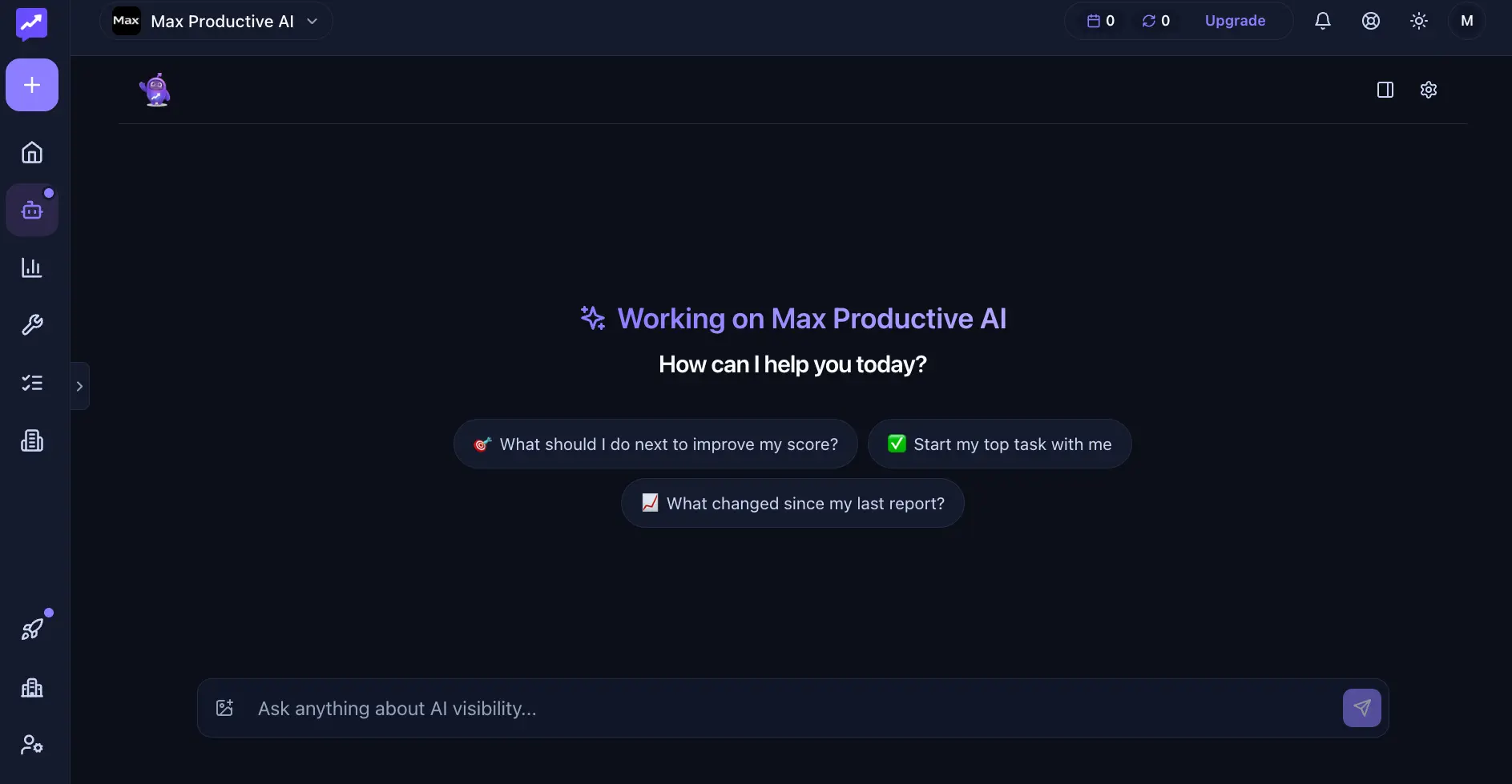
Agent Mode opens with three prompt chips, and they tell you what it's for: explain my score, run my top task, tell me what changed. According to the changelog, the June 2026 rebuild gave the agent memory, a persistent dock, access to more than fifty tools inside the platform, and the option to bring your own OpenAI key so agent usage doesn't eat credits. On a free account with no reports yet it had little to say, which is fair. I'd read this as the intended front door for non-specialists: rather than learning what Share of Voice or Absolute Prominence Score mean, you ask the agent why visibility dropped and it points at the prompts and sources responsible.
Content Studio & Tools Menu
Article generation next to Site Health, Keywords, Outreach and Business Profile tools
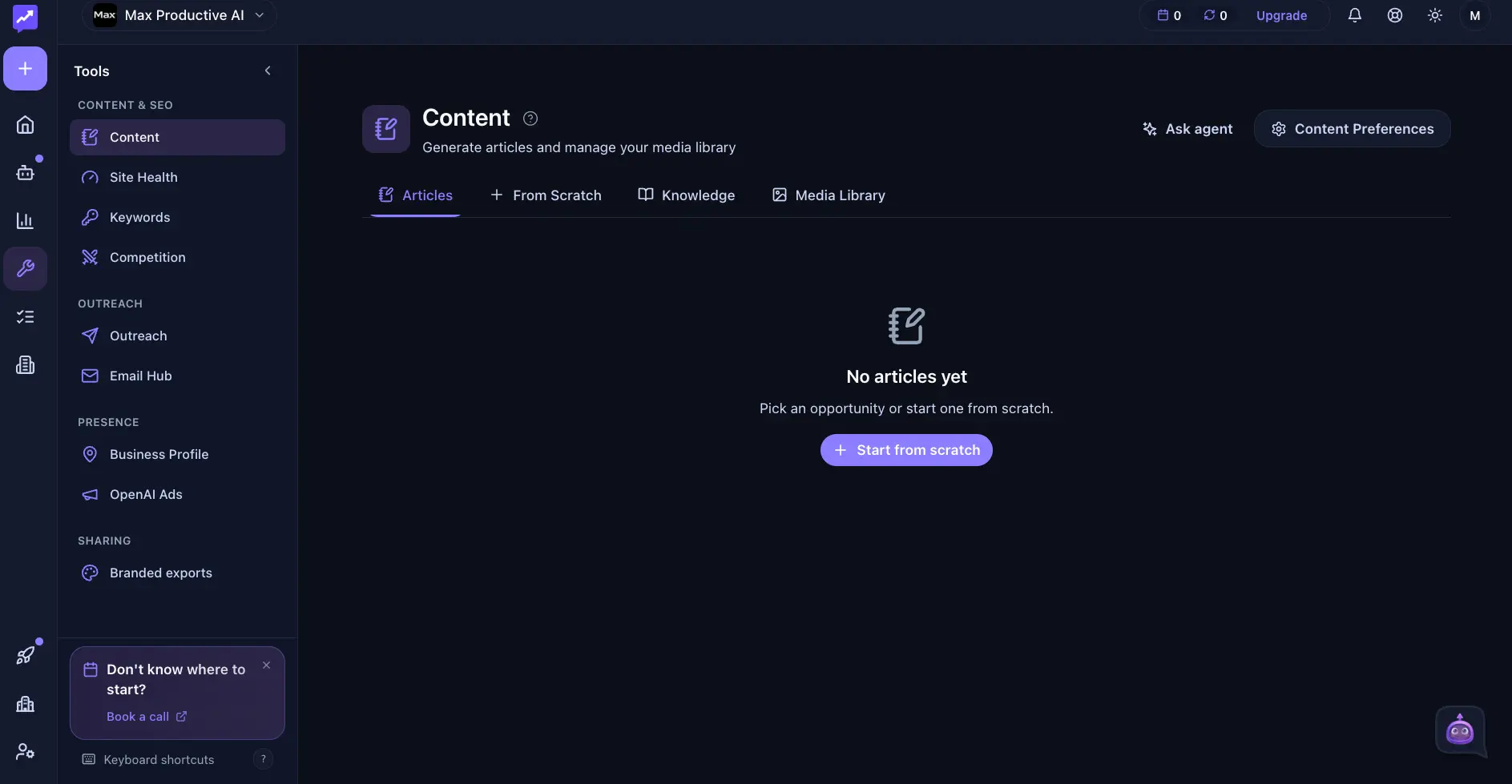
The Tools section is where Rank Prompt stops being a tracker. Content generates articles in six AEO formats and keeps a Knowledge tab so the AI writes from your own facts rather than guessing. Site Health runs technical and Lighthouse audits. Keywords and Competition are the Google-side additions from the September 2026 release. Outreach and Email Hub handle the citation-building campaigns. Business Profile manages Google Business Profile listings from inside the app. It's a lot of surface area for a $39 plan. Each of these tools is lighter than a dedicated product, and you should go in expecting that. The content editor won't replace Surfer SEO. But having them in one place, tied to the visibility data, is the point.
How Rank Prompt Works
From a domain name to a plan of action in four steps.
Set Up Your Brand
Enter a domain. Rank Prompt pulls aliases, writes an overview, suggests business categories and detects competitors. Correct anything it gets wrong, because these details shape every prompt that follows. You can add several brands to one workspace, and agencies can run hundreds. The free first report covers up to three brands, which is enough to benchmark yourself against two rivals before spending anything.
Choose Engines, Location and Prompts
Pick the AI platforms to scan. The standard bundle costs one credit per prompt; each premium model adds one. Set the country, city and language, which matters more than it sounds, because an assistant answering in Lisbon cites different sources than one answering in Chicago. Then review the generated prompts and edit them until they read like the questions your customers ask. This step is the one most people rush and the one that decides whether the data is useful.
Read the Report
Results come back in a couple of minutes. You get a visibility score per engine and a blended score, plus mention rate, citation share, share of voice and a prominence score that weights where in the answer you appeared. The Citation Audit lists the domains the AI models drew on, which is the part I'd spend the most time with. The competitor view flags prompts where a rival was recommended and you weren't. Schedule the scan to repeat so the trend line means something.
Act on It
This is where Rank Prompt differs from a pure tracker. Turn a gap into a brief in the content studio, which drafts a comparison page, ranked list or FAQ with schema and publishes to WordPress. Send the cited pages to Outreach to find their authors and pitch a mention. Ask Agent Mode what to do next, or let it start the top task for you. Agencies package the whole thing into a white-label report and schedule it to land in the client's inbox each month.
A Note on What the Scores Mean
Every AI visibility tool works from the outside in. Rank Prompt asks the AI engines your prompts and records the answers; it can't see how many real people asked something similar. So two tools can give the same brand different scores for the same week, and both can be right about the direction. Use Rank Prompt to watch trends, spot which competitors and sources dominate, and test whether your changes move the needle. Don't treat a 42% visibility score as a precise measurement.
Credits, in Plain Terms
One credit runs one prompt across the standard engine bundle. Each premium model adds one credit per prompt. A brand audit or an AI article costs ten. A Lighthouse audit costs five. Credits reset monthly and don't carry over. If you track 20 prompts weekly across the standard bundle, that's roughly 80 credits a month before any content or audits. Size your plan to that number, not to the headline price.
Key Features
What's in the box, and what's reserved for the agency tiers.
Six-Engine AI Visibility Tracking
ChatGPT, Perplexity, Google AI Mode, Claude, Gemini and Grok, each with its own score, all available from the Starter plan. HubSpot AEO tracks three. Surfer's entry tier tracks one. Multi-location tracking goes down to city or ZIP level in 50+ languages, which matters for anyone selling across regions.
Citation Audit
The feature that makes the rest worthwhile. It maps the domains and pages AI models cite when recommending brands in your category, and reports mention rate, citation share, share of voice and prominence. It tells you where to earn a mention instead of leaving you to guess. Reviewers consistently single this out, and I agree.
Competitor Benchmarking
Rank Prompt auto-detects rivals, tracks them side by side, and flags the prompts where a competitor is recommended and you're absent. Head-to-head comparisons and a keyword-gap view came in the September 2026 release. It's the quickest way to turn a vague "we should do AEO" into a specific list of gaps.
AI Content Studio
Six AEO formats: comparison articles, ranked lists, location pages, case studies, product pages and FAQs, with schema included. A Knowledge base keeps the AI writing from your facts. Inline AI edits, versioning and client approvals are built in. Publishing is native to WordPress or a Rank Prompt-hosted blog; anything else means export and paste.
Outreach & Email Hub
Takes the sources from your Citation Audit, finds the decision-makers behind them, and runs multi-step email sequences with templates, scheduling and reply tracking. No other tool in this comparison builds outreach in. It won't write a great pitch for you, but it removes most of the admin between "this page gets cited" and "let's ask for a mention".
Agent Mode
An AI assistant with memory that knows your brand's reports, can run scans, edit articles, manage schedules and answer "why did visibility drop this week?" in plain English. Bring your own OpenAI key and the agent's usage is free. For non-specialists this is the easiest way into a category full of new metrics.
Agency Suite & White Label
Branded reports with your logo and colours on Agency. Agency Plus adds a client portal on your own domain, client logins, automated recurring reporting, content approvals, a prospecting tool that finds businesses invisible to AI, and up to 1,000 brands. This is the clearest sign of where Rank Prompt is heading: a platform agencies build a service line on.
API, Webhooks & MCP Server
A public REST API from 10,000 requests a month on Starter, outbound webhooks, and an MCP server so Claude Code, Cursor or ChatGPT can query your visibility data directly. Rankscale gates its API to a $385 tier; Ahrefs reserves it for Enterprise. Getting it on a $39 plan is unusual, and developers in user reviews mention it often.
Around those eight, there's a second ring of features that arrived through 2026: Google Analytics 4 and Search Console integration so AI traffic sits next to organic traffic, technical SEO and Lighthouse audits, Google Business Profile management, Google keyword tracking and a keyword-gap view, ChatGPT Ads audiences, branded PDF and PowerPoint exports, and a task board that turns audit findings into dated action items. None of these replaces a specialist tool. Together, they mean a small team can run its AEO programme from one login, and for most of Rank Prompt's audience that trade is the right one.
See which features come with each plan:
Check Rank Prompt's pricing →Free first report • Starter from $39.17/mo billed annuallyRank Prompt Pricing
Four credit-based plans plus Enterprise. Work out your credit needs before you pick one.
Starter
- ✓ 150 credits/month
- ✓ All six AI engines
- ✓ Citation Audit & competitor tracking
- ✓ Content studio, outreach & Agent Mode
- ✓ REST API (10,000 requests/mo)
- ✗ No white-label reporting
Pro
- ✓ 500 credits/month
- ✓ Everything in Starter
- ✓ Room for weekly scans plus content
- ✓ Share & present reports
- ✓ Higher API limits
- ✓ 7-day free trial (50 credits)
Agency
- ✓ 1,000 credits/month
- ✓ White-label branded reports
- ✓ Automated client reporting
- ✓ Cross-brand agency dashboard
- ✓ Everything in Pro
- ✓ Priority support
Agency Plus: $239.17/mo billed annually, 2,000 credits, client portal on your own domain, client logins, content approvals, prospecting tool, up to 1,000 brands
Enterprise: Custom pricing for large networks and franchises. Contact Rank Prompt for a quote
Credits: 1 per prompt on the standard engine bundle, +1 per premium model, 10 per AI article or brand audit, 5 per Lighthouse audit. No rollover
Pricing last verified September 2026. Visit Rank Prompt for current rates.
Is It Worth the Money?
At $39.17 a month, Starter works out to about 26 cents each time you check one buyer question across ChatGPT, Perplexity, Google AI Mode and Claude. Twenty prompts scanned weekly uses roughly 80 credits, leaving enough for a brand audit and a few articles. Agencies charging clients a few hundred dollars a month for AEO reporting cover the Agency plan with one account. The maths only goes wrong if you buy Starter and then run daily scans with premium models on. Count your credits first.
A word on the free options, because there are two and they're different. The free first report needs no card and covers up to three brands. It's a real report, not a teaser, and it's the right way to find out whether AI assistants mention you at all. The 7-day trial on paid plans gives you 50 credits to test the content studio, outreach and agent, but it asks for a card up front. Nothing is charged until day eight, so set a reminder if you're not sure. Rank Prompt also publishes free standalone tools on its site, including an AI Visibility Checker and a GEO Prompt Generator, which are handy for a quick look without creating an account.
Against the competition, Rank Prompt is priced at the accessible end. Rankscale starts lower at $20 a month and tracks more engines, but you'll want its $99 Pro tier for serious use and its API sits on a $385 plan. HubSpot AEO is $50 standalone but tracks three engines. Surfer's AI Tracker covers ChatGPT only on its $99 plan and needs $182 for all five engines. The SEO suites bundle AI tracking into subscriptions that start at $99 to $139 and rise fast. If you want a purpose-built AEO platform with content and outreach included, Pro at $71.25 is very good value.
Detailed Pros & Cons
The full picture, including the parts you'll only notice after a month of use.
✓ Pros
ChatGPT, Perplexity, Google AI Mode, Claude, Gemini and Grok, tracked separately rather than blended into one number. Grok and AI Mode are the two most competitors skip. All six are available on Starter, and you can change the mix on every report, so you're never paying for an engine your buyers don't use.
Knowing you're invisible in ChatGPT is only useful if you know why. The Citation Audit shows the domains and pages the AI models trust in your category, so the next step is obvious: get onto those pages, or publish the kind of page they are. This is the feature reviewers praise most, and it's the one that justifies choosing a specialist over a bundled module.
Content studio, outreach, Agent Mode, Google Business Profile management, technical audits, GA4 and Search Console. Most AI visibility tools hand you a dashboard. Rank Prompt hands you a dashboard and the tools to change what it shows. For a solo marketer or a small agency, that consolidation is worth more than any single feature.
White-label reports, a client portal on your own domain, client logins, approvals, prospecting and 1,000-brand support. An agency can package AEO monitoring and content as a monthly service and cover the platform cost with one client. The June 2026 agency suite is the most complete I've seen at this price.
REST API, webhooks and an MCP server from Starter upward. If you want visibility data inside Claude Code, Cursor, a custom dashboard or a Slack alert, you can have it without an Enterprise contract. Users on review sites mention the MCP integration as a reason they chose it.
Seven major releases in nine months, with a public changelog that shows exactly what shipped and when. Independent ratings moved from a thin handful of early reviews to a much larger base of positive verified feedback by August 2026. For a young vendor, that trajectory matters as much as the current feature list.
✗ Cons
Unused credits are gone at the end of the billing period. If your scanning is seasonal or you skip a few weeks, you've paid for capacity you didn't use. It's a common model in this category, but Ranked AI's unmetered tracking shows it isn't the only way. Size your plan to a real schedule.
The platform picker splits engines into a standard bundle and premium models that add one credit each per prompt. Track everything and a single prompt can cost several credits, which changes the Starter maths considerably. The app is upfront about it before you run a scan; the pricing page could be clearer.
The content studio publishes natively to WordPress or a Rank Prompt-hosted blog. Webflow, Shopify, Framer and headless CMS users export and paste. Given that the content studio is a big part of the pitch, this is the gap I'd most like to see closed.
The mainstream six are covered well. Copilot, Meta AI, DeepSeek and Mistral are not. For most Western B2B and consumer brands that's fine. If your market skews toward one of the assistants outside the six, Rankscale or OmniSEO reach further.
Founded in mid-2025, Rank Prompt ships quickly, and the flip side of that is a large product with many modules that are each lighter than a dedicated tool. The content editor is not Surfer. The outreach tool is not a full CRM. Early users also mentioned a learning curve with the new AEO metrics, which Agent Mode has softened but not removed.
The free first report needs nothing. The 7-day trial of the paid features does need a card, and the headline prices assume annual billing. Neither is unusual, and you can cancel before day eight, but if you prefer to try a product with no strings, HubSpot AEO's 28-day no-card trial is more relaxed.
Rank Prompt vs Alternatives
How Rank Prompt compares with the AI visibility tools most people shortlist alongside it.
| Feature | Reviewed Rank Prompt | Rankscale | HubSpot AEO | Surfer SEO | Semrush |
|---|---|---|---|---|---|
| Entry Price (annual) | $39.17/mo | $20/mo | $50/mo | $99/mo | ~$117/mo (bundled) |
| AI Engines Tracked | 6, all on every plan | 17+, all on every plan | 3 | 1 on Standard, 5 on Pro | Multiple, not listed publicly |
| Citation / Source Mapping | ✓ Citation Audit | ✓ | ✓ Basic | ✓ Top sources | Limited |
| AEO Content Generation | ✓ 6 formats + schema | ✗ | ✗ | ✓ Content Editor | ✓ Via wider suite |
| Built-in Outreach | ✓ | ✗ | ✗ | ✗ | ✗ |
| White Label / Client Portal | ✓ Agency tiers | $385+ tier | ✗ | ✗ | ✗ |
| API / MCP | ✓ From Starter | $385+ tier | Not published | Higher tiers | API, lightly documented |
| Free Option | Free first report, no card | Free tier | 28-day trial, no card | 7-day Pro trial | Free trial |
| Best For | One AEO-native platform for small teams and agencies | Widest engine coverage per dollar | Cheapest entry, HubSpot users | Content teams | Teams already on Semrush |
Rank Prompt vs Semrush: The Short Version
This is the comparison I'm asked about most, because many readers already pay for Semrush. The answer depends on what you need first. Semrush is a full SEO suite that added AI visibility to its regular plans in 2026, with 50 to 200 prompts a day depending on tier. If keyword research, backlinks and rank tracking are your daily work, that bundled module may be all the AI tracking you need, and it costs you nothing extra. Rank Prompt is the reverse: an AEO-native platform that added Google keyword data in 2026. Its Citation Audit, content studio, outreach and agency tools go deeper on AI answers than a bundled module does, and it starts at a third of Semrush's price. Plenty of teams run both: Semrush for search, Rank Prompt for AI. Our Semrush review covers the AI Toolkit in more detail.
Which Tool Is Right For You?
Rank Prompt
ReviewedBest for: Solo marketers, in-house teams and agencies that want one AEO-native platform covering tracking, citation intelligence, content, outreach and white-label reporting. Six engines on every plan and a Starter tier at $39.17 make it the most accessible complete option. Run the free report first, then use the 7-day trial to test the content and outreach tools before you commit.

Rankscale
Widest CoverageBest for: Teams that want visibility across the widest possible list of AI engines, including long-tail assistants like Mistral and DeepSeek, at a low starting price. Rankscale tracks 17+ engines on every tier from $20 a month and adds GEO site audits that score pages for machine readability. It's measurement and diagnostics only, with no content or outreach, and its API and white-label dashboards sit on the $385 tier.

HubSpot AEO
Cheapest EntryBest for: HubSpot customers and anyone who wants a no-commitment starting point. Launched in April 2026, it's $50 a month standalone or included with Marketing Hub Professional and Enterprise, with a 28-day trial that needs no card and a free AEO Grader for one-off audits. Coverage is limited to ChatGPT, Gemini and Perplexity, and prompt caps are low, so it suits a first look more than an ongoing programme.

Semrush
SEO SuiteBest for: Teams whose daily work is keyword research, backlinks and rank tracking, and who want AI visibility bundled into a subscription they already pay for. Semrush folded AI tracking into its plans in 2026, from 50 prompts a day on the entry tier to 200 on Advanced. It doesn't publish the list of AI models it queries and lacks the citation and outreach depth of a specialist. Our Semrush vs Search Atlas comparison weighs it against another suite.

Surfer SEO
Content LoopBest for: Content teams that want AI visibility gaps to flow straight into a content-optimisation workflow. Surfer's AI Tracker links flagged gaps to its Content Editor, which remains the stronger writing tool. The catch is coverage: Standard at $99 tracks 25 ChatGPT prompts weekly, and daily tracking across all five engines needs the $182 Pro tier. Claude and Grok aren't covered. See how it compares with SE Ranking →

SE Ranking
Bundled ValueBest for: Small agencies and in-house teams that want rank tracking, site audits and AI visibility in one affordable suite. Core at $129 includes 100 daily AI prompts across five engines, the API is included on every plan, and there's a 14-day trial with no card. A standalone product, SE Visible, exists for AI tracking without the full suite. Citation mapping is lighter than Rank Prompt's, and meaningful AI coverage nudges the real cost upward.

OmniSEO
Enterprise ReachBest for: Larger organisations that want the broadest engine list, including DeepSeek and Meta AI, and the option of a managed GEO service from the same vendor. Essentials starts at $89 with four channels; the full ten-engine set arrives on the $349 Professional tier. There's no free plan or trial, only a demo, and content and outreach are handled through the separately priced managed service.

Ranked AI
Managed ServiceBest for: Business owners who would rather have a team handle SEO and AI visibility than run a dashboard. Ranked AI pairs human strategists with automation, includes weekly content, outreach and technical fixes, and tracks AI visibility without credit metering, from $99 a month per site with no contract. Coverage is ChatGPT, Perplexity and Google AI Overviews, and you trade hands-on control for convenience.
Frequently Asked Questions
Should You Try Rank Prompt?
Rank Prompt is the most complete AEO-native platform I've used at this price. It tracks the six AI engines that matter for most brands, tells you which sources the models cite, and gives you the content, outreach and agent tools to do something about it. The agency suite and the developer access set it apart, and the pace of releases through 2026 suggests the gaps that exist today won't be there for long. For a solo marketer, an in-house team or an agency building an AEO offer, it's the first tool I'd shortlist.
My reservations are practical ones. Credits reset monthly and premium models cost extra, so read the credit rules before you pick a plan. Publishing is built around WordPress. Six engines is plenty for most, but not all. And the whole category, Rank Prompt included, measures AI visibility from the outside, so treat the scores as a trend to steer by rather than a number to report to the board. If your AI tracking needs are light and you already have a suite that bundles it, stay put. If AI answers are where your customers now start, Rank Prompt is one of the strongest options around in 2026.
Our Recommendation
Run the free report first. It needs no card and covers three brands, so benchmark yourself against two competitors and read the Citation Audit closely. If the sources it surfaces are ones you can realistically get onto, start the 7-day trial and test the content studio and outreach on one real gap. Choose your plan by counting credits, not by price: twenty prompts a week on the standard bundle plus a couple of articles fits Pro comfortably and squeezes Starter. Agencies should go straight to Agency and put the white-label report in front of one client.