
Base44 vs Lovable: The 7 Differences That Actually Decide It for Your App
As of September 14, 2026, we ran the same invoice-tracker prompt through both tools, checked both pricing pages the same afternoon, and read the developer docs on what actually leaves with you when you export. Both companies pay us a commission, so we have no reason to tilt this. The verdict is Lovable for most people building something they intend to keep, and Base44 for the builder who wants backend, hosting, and a mobile wrapper handled in one place without ever opening a repository. Here is what decides it.
The short answer, as of September 2026: Lovable is the better tool for most people reading this. Its code syncs to GitHub on every plan including the free one, its database and login can be moved to a Supabase project you control, new projects have shipped as server-rendered apps since May, and the front end it produces from a single prompt is the best-looking in this category. Base44 is the right call for a specific builder: you are not technical, you want the database, login, hosting, and an iOS or Android wrapper handled inside one product, and you can live with the data model staying on Base44's infrastructure. Its free plan also got further than Lovable's did in our same-prompt test, which we show below rather than talk around.
Best overall: Lovable
Lovable holds our highest rating in this category, 4.7 out of 5, and the reasons are checkable rather than a matter of taste. Git sync works on the free plan, code download and editing start on Pro at $21 a month on annual billing, and Lovable's own ownership documentation spells out how to move the backend to managed or self-hosted Supabase. The trade: each prompt tends to cost more credits than the same request on Base44, the free plan is a taster rather than a workbench, and there is no native mobile wrapper.
Best all-in-one: Base44
Base44 turned our prompt into a working app with login, a database, and a dashboard in about four minutes, on the free plan, then added a Clients page in four more. Database, auth, hosting, analytics, payments, and an app-store wrapper all live in one dashboard. The trade: GitHub sync starts at Builder, $40 a month on annual billing, the data model never joins the repository, and the front end is plainer than Lovable's.
| Tool | Best For | Free Plan | Entry Paid Plan | Rating |
|---|---|---|---|---|
| Lovable | Code you keep, polished output, products with a future | 5 credits/day, 30/month | Pro $21/mo annual ($25 monthly) | 4.7 / 5 |
| Base44 | All-in-one backend, hosting, and mobile wrapper | 25 message credits/month, max 5/day | Starter $16/mo annual | 4.0 / 5 |
Prices verified September 14, 2026 against each tool's live pricing page and documentation. Base44 advertises 20% off for annual billing, which puts Starter at about $20 on monthly billing. Confirm your exact price at checkout.
One thing worth knowing upfront: both tools pay this site a commission, so we get paid whichever one you choose. That is exactly why we can afford to tell you when a test result goes against our overall pick. Both link to our full, free reviews, so you can check the reasoning tool by tool.
Base44 and Lovable both turn a plain-English prompt into a working web app with a database and login. Base44, owned by Wix since June 2025, keeps that app inside its own backend, hosting, and app-store wrapper. Lovable generates a standard TypeScript codebase on a Supabase backend and syncs it to your Git provider. Almost every difference below follows from that one split.
Search for this comparison and count who is answering. Base44 has a comparison page, and its own text says the information is accurate as of September 29, 2025. Lovable has one from July 2026. Softr and Zite each publish a three-way that ends with themselves, and Emergent has its own take. The AI summary at the top of the results page is stitched together from Base44's blog and a YouTube video. None of that is dishonest, it is marketing, but it does leave the refereeing to you. We run an independent AI tools review site, we hold accounts on both tools, and this piece is the head-to-head follow-up to our Lovable alternatives roundup, where Base44 sits in the lineup. Here we settle the questions that roundup could only hedge on: what the export really contains, what the same prompt buys on each free plan, and which one you would want to be on a year from now. Whether you typed Base44 vs Lovable or Lovable vs Base44 into the search box, the answer is the same, and it depends on what you are building.
Base44 vs Lovable at a Glance
| What we compared | Base44 | Lovable |
|---|---|---|
| Owned by | Wix, since June 2025 | Independent, Series C in August 2026 |
| What one prompt produces | A React app on Base44's own backend, hosted by Base44 | A server-rendered TanStack Start app on Lovable Cloud |
| Database and login | Base44 entities and users, managed in the platform | Lovable Cloud, built on Supabase |
| Code sync to Git | Two-way GitHub sync from Builder ($40/mo annual) | GitHub, GitLab, or Bitbucket on every plan, free included |
| What lands in the repo | Front end and backend functions; entity schemas stay in Base44 | Front end, server, and Supabase migrations |
| Leaving with your data | The eject command copies schemas, not records | Documented migration to managed or self-hosted Supabase |
| Mobile | Native web-view wrapper with push; store files from Builder | Web only, installable as a progressive web app |
| Free plan | 25 message credits a month, max 5 a day, 5 apps | 5 credits a day, 30 a month, plus 20 Cloud and 4 AI credits |
| Entry paid plan | Starter $16/mo annual, about $20 monthly | Pro $21/mo annual, $25 monthly, 100 credits |
| Cost per prompt | Varies by scope, roughly 0.5 to 4 message credits | Varies by work done; shown live while building |
| Security scan | Built in since June 2026; code scanning from Builder | Pre-publish scanner; projects private by default |
| Our rating | 4.0 / 5 | 4.7 / 5 |
1. Build Philosophy: A Managed Box vs a Codebase That Is Yours
Base44 wants to own everything between your sentence and your users. It built its own backend before that was fashionable, it trained its own model (Base 1, available as an option in the chat since June 29, 2026), and its founder's pitch is that a Base44 builder should never need to know what an API key is. The Wix ownership shows in the details: Wix fonts in the font picker, Wix Payments alongside Stripe, a Wix store you can manage from inside the app editor.
Lovable wants to produce a codebase that is yours. Its stack is deliberately ordinary, TypeScript and React on a Supabase backend, and since May 13, 2026 every new project is a TanStack Start app that renders its pages on the server. Its documentation has a page on deployment, hosting, and ownership whose first principle is that you are never locked in. A managed platform cannot make that promise in the same words, and it is the axis this whole comparison turns on.
Both tools now think before they build. Base44's Plan mode turned into a conversation on September 10; in our test it went straight from the prompt to the app, but a vaguer brief gets questions. Lovable stopped us before writing a line, showed two rendered design directions, a cool blue-gray ledger and a warmer cream one, and asked which to build. Small tells, same story. Base44 called our app Lumen and put a dashboard on screen. Lovable called it Ridgeline and wrote a landing-page headline first.
Neither instinct is wrong. They are aimed at different people, which is why the six differences that follow are about consequences, not taste.
2. Backend and Data: Base44's Own Entities vs Lovable Cloud on Supabase
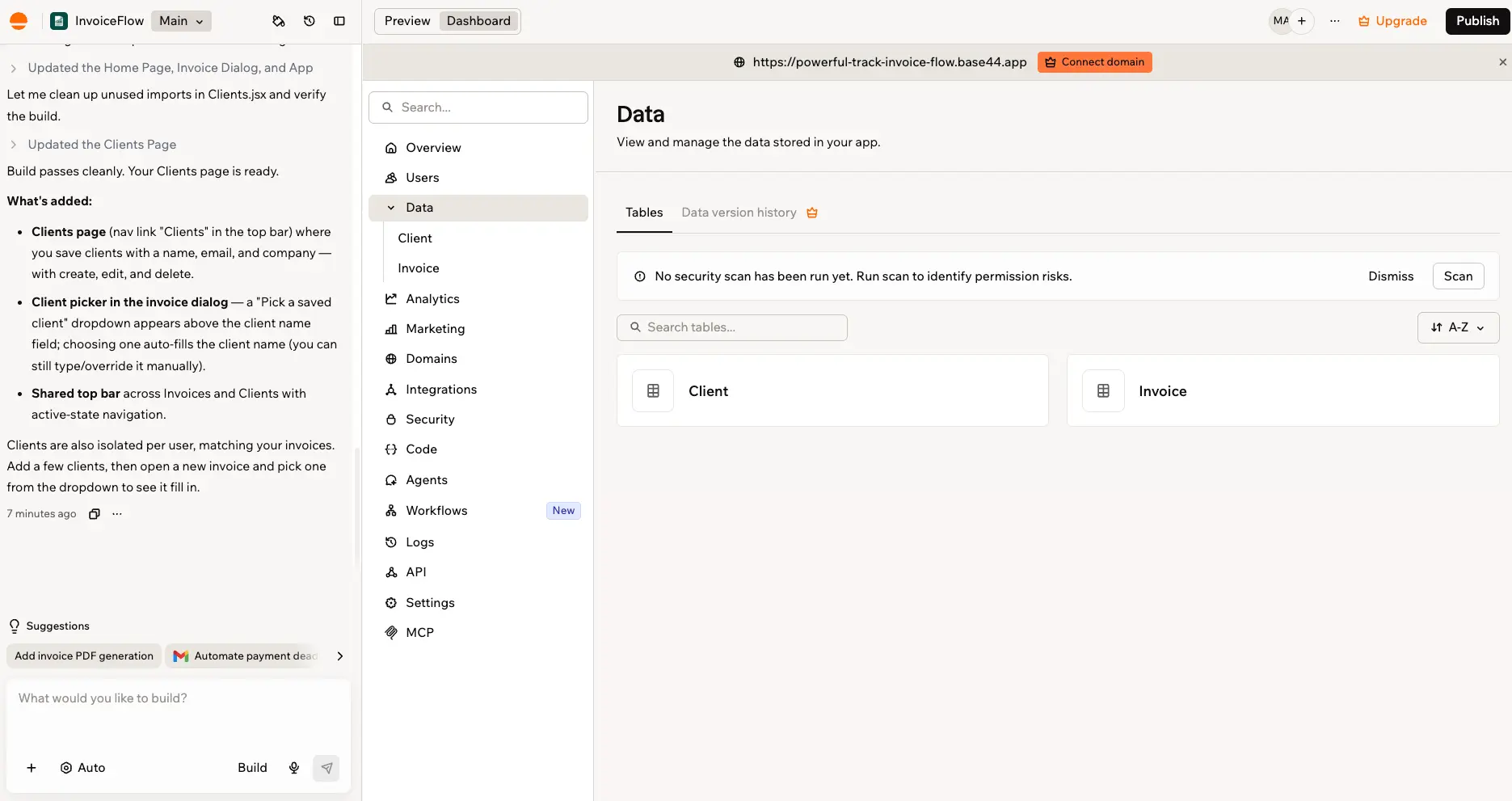
Ask either tool for a database and you get one, but they are different objects. On Base44 you get entities: tables the platform manages, a Users table beside them, access rules per entity, and a Data tab where you can view and edit records. Reading and writing that data costs nothing extra; Base44's integration credits only meter built-in services such as sending an email or running an AI call. Backend functions, the code that runs server-side, are a Builder-plan feature. Our test app's Data tab is below: two entities, Invoice and Client, created from two prompts, plus a nudge to run the security scan we had not run yet.
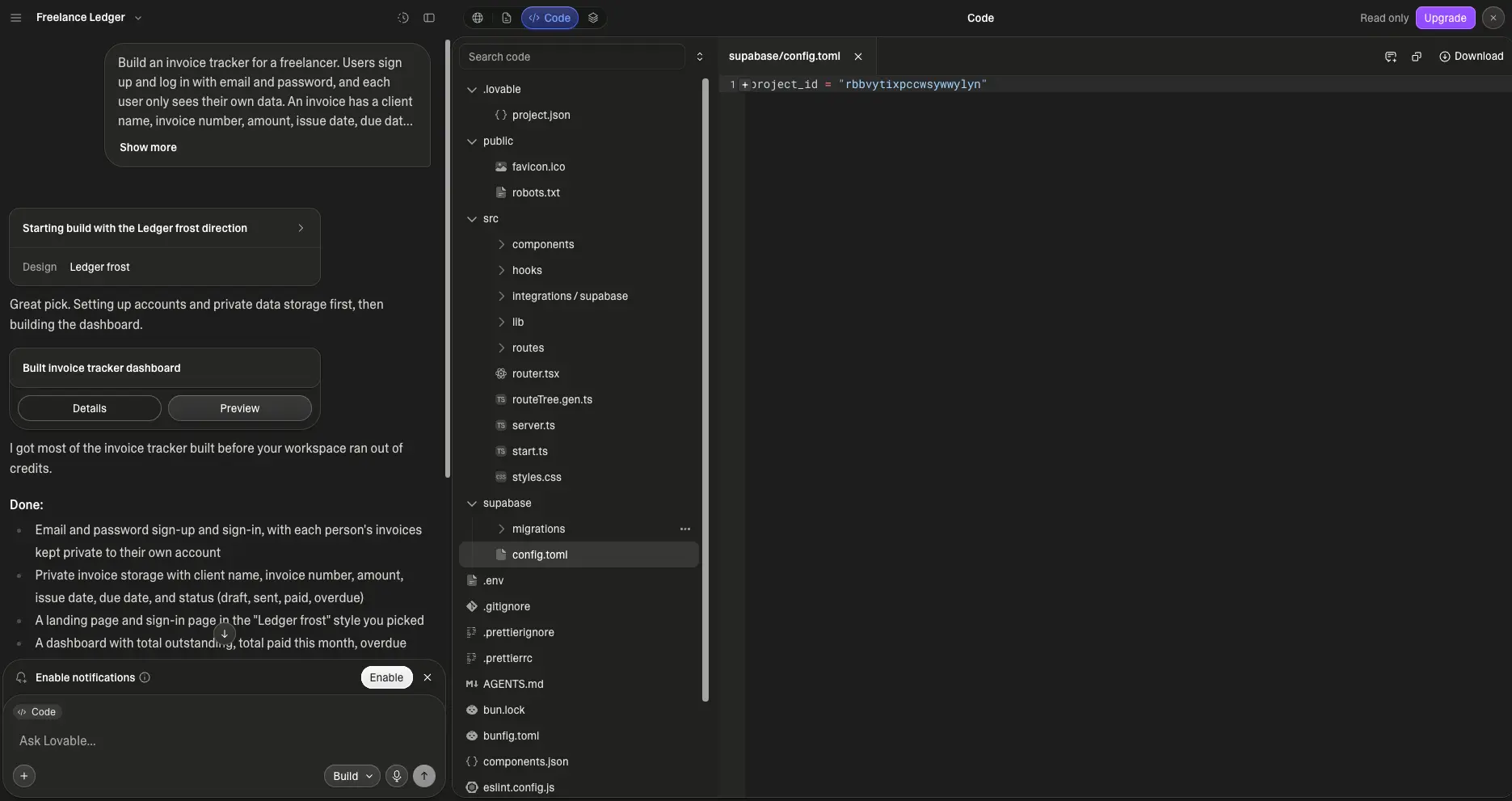
On Lovable you get Lovable Cloud, which is Supabase underneath: Postgres, auth, storage, edge functions. The difference you can see is in the repository. The screenshot below is our free-plan project's read-only code view, and the supabase folder with a migrations directory is right there in the tree. Your schema exists as SQL files you could run somewhere else, not as a platform setting. Cloud usage draws on the same credit balance as building, and the free plan sets aside 20 Cloud credits a month for it.
Both tools understood one sentence in our prompt, that each user only sees their own data, and enforced it. Base44's build summary reported row-level security on every invoice; Lovable's reported private invoice storage per account. On this axis the two are closer than the marketing suggests, and the practical difference is not what the backend does but where it lives. On Base44 the data model is a platform object. On Lovable it is a folder in your repo. That is the ownership question in miniature, and it gets the full treatment next.
3. Code Export and Ownership: What Actually Leaves With You
This is the question our roundup had to hedge on, because Base44's marketing and Base44's documentation say different things, and we can now show both.
As of September 14, 2026, Base44's pricing page says two-way GitHub sync exports the full source code, and adds: "Nothing is locked to the platform." The developer documentation is more careful. The repository contains the React and Vite front end and a functions folder for backend code. Entities, meaning the database schemas, "are not included in your local repository"; they stay managed in Base44. A local clone runs through a base44 dev command that starts a local Base44 backend, or connects to the hosted one. There is a base44 eject command that copies front-end code, entity schemas, and backend resources into a fresh project, but not your data: the new project starts with an empty database and a new Base44 app ID. And the sync itself requires the Builder plan or higher, so the free plan and Starter cannot sync at all. The Code tab sits in every dashboard, ours included; the GitHub connection inside it is gated.
So both statements are true in a narrow sense. The code you can see leaves. The data model and the records do not come with it in the ordinary flow, and the code that leaves still calls Base44's SDK for database, auth, and integrations. If you leave, you are rebuilding the backend.
Lovable's position is easier to state because its documents agree with each other. Git sync to GitHub, GitLab, or Bitbucket works on every plan including free, which is how we could see our own migrations folder on a free account. Downloading the code and editing it inside Lovable start on Pro. The ownership page describes three setups, everything on Lovable, a hybrid, and fully self-managed, and supports migrating the backend to managed or self-hosted Supabase. It is honest about the limit too: the app relies on Supabase-specific services for auth, storage, and edge functions, so moving to plain PostgreSQL is not supported out of the box. Leaving Lovable means running Supabase somewhere. Leaving Base44 means rebuilding.
That is the difference that makes Lovable our overall pick, and the one to weigh hardest if the thing you are building might matter in a year. One counterpoint in Base44's favor: since August 19 it can import an existing GitHub repository and send changes back as pull requests, a real step toward developers. It does not change what an exported Base44 app contains. Our Lovable review walks through the sync workflow, or you can connect a repo on the free plan and see the tree for yourself.
4. Pricing and the Real Cost of Credits (Verified September 14, 2026)
Base44 vs Lovable pricing looks similar on a plan table and behaves differently in practice, because the two meter work in different ways. The figures below come from each tool's live pricing page and documentation on September 14, 2026, annual billing unless stated.
| Tier | Base44 (annual billing) | Lovable (annual; monthly in parentheses) |
|---|---|---|
| Free | $0. 25 message credits a month, capped at 5 a day; 100 integration credits; 5 apps | $0. 5 credits a day, capped at 30 a month; plus 20 Cloud and 4 AI credits a month |
| Entry | Starter, $16/mo. 100 message and 2,000 integration credits, unlimited apps, in-app code edits, custom domain | Pro, $21/mo ($25). 100 credits, code download and editing, Git sync |
| Mid | Builder, $40/mo. 250 and 10,000 credits, two-way GitHub sync, model choice, backend functions, app-store files | Business, $42/mo ($50). 100 credits, team and admin controls |
| Upper | Pro, $80/mo. 500 and 20,000 credits | Larger tiers on both plans up to 10,000 credits a month; Pro tops out at $2,250 monthly, Business at $4,300 |
| Top | Elite, $160/mo. 1,200 and 50,000 credits, 7-day data version history | Enterprise, custom pricing |
| Top-ups | Sold, but prices are not on the public page | Pro $15 per 50 credits; Business $30 per 50 |
| Expiry | Unused monthly credits expire at the end of the cycle | Monthly-plan credits expire after two months; top-ups after twelve |
Base44 runs two meters. Message credits pay for building: every prompt, every applied fix, and on the free plan every automatic error fix too (paid plans get automatic fixes free). Integration credits pay for what your live app does through Base44's built-in services, roughly one credit per email or per basic AI call, while database reads and writes are free. There is no fixed cost per message; Base44's own guide puts a small visual tweak at about half a credit, a small feature at about one, a new module with entities and logic at about two, and an app-wide change at three or four. Top-up packs exist, but their prices are not on the public page, which is unusual for a tool that sells by the credit.
Lovable runs one balance. Since June 2026, rolled out gradually over the summer, the same credits pay for building, for Cloud usage, and for AI features your app calls, and since August 25 the editor shows the running time and credit cost of a request while it works. Pro is $25 a month, or $250 a year, for 100 credits, and both paid plans scale to 10,000 credits a month. Top-ups are $15 per 50 credits on Pro and $30 per 50 on Business. Monthly-plan credits expire two months after they are issued; top-ups last a year.
Here is what our test adds. Both free plans hand out five credits a day. Base44's five turned into a working app with login and a database, and then a Clients page. Lovable's five ran out before the dashboard could be verified. We did not capture per-message costs on either tool, so we are not going to print numbers we do not have. What we can say is that on Lovable Pro the same build finishes; the question is how many of your 100 credits it takes, and the editor now tells you as it goes. The pattern users describe in the Reddit section matches ours: Base44 is cheaper and more predictable per prompt, and Lovable's credits buy the polish and the portability. Budget more than you expect on either.
5. Mobile: Base44 Ships an App-Store Wrapper, Lovable Ships a Website
If you need an icon on a phone, this section ends the debate for you. Base44 ships an app-store wrapper. From the Publish menu you can scan your app against Apple's and Google's guidelines on any plan, free included; from Builder you can generate the App Store and Google Play files with push notifications switched on, upload them in your own developer accounts, and ship. The wrapper is a native shell around your published web app, which means most content and design changes go live without resubmitting. It also comes with limits you should know before planning a product around it: no offline mode, no HealthKit, and no in-app purchases of digital goods yet, because Apple's and Google's billing systems are not supported and Stripe is only allowed for physical goods and services. A May 2026 thread in our Reddit section is a user who stayed on Base44 for exactly this feature.
Lovable ships a website. A good one, server-rendered since May and installable as a progressive web app, but there is no wrapper, no store files, and no push notifications out of the box. If you want a store listing you are wrapping it yourself with a third-party tool, which is developer work, and at that point you are using the code ownership you paid for.
That is the honest shape of it. Base44 for anyone who needs to be in the App Store this quarter without hiring; Lovable if mobile means a web app on a phone, or if you have someone who can wrap it. If the store listing is the whole point, run the free store-readiness scan on Base44 before you commit to a plan.
6. What One Prompt Gets You: Polish vs Plumbing
Here is the same prompt, minutes apart, on the two free plans. Lovable's first move was a landing page: a headline, a subhead, three sample stat cards, and a call to action, in the design direction we picked. Base44's first move was the tool: a dashboard with real stat cards reading zero, status tabs with live counts, an empty state, and a New invoice button waiting to be pressed.
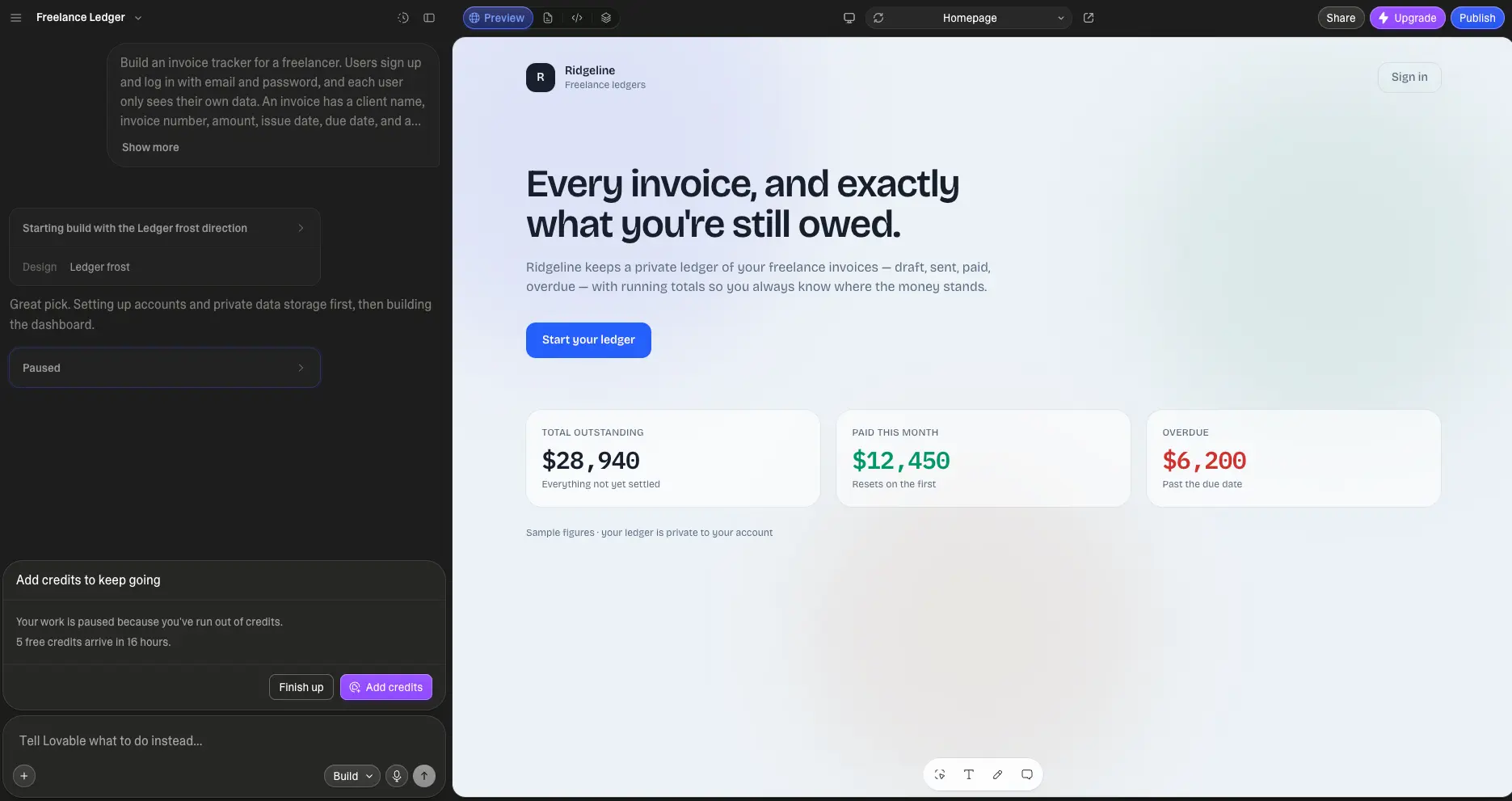
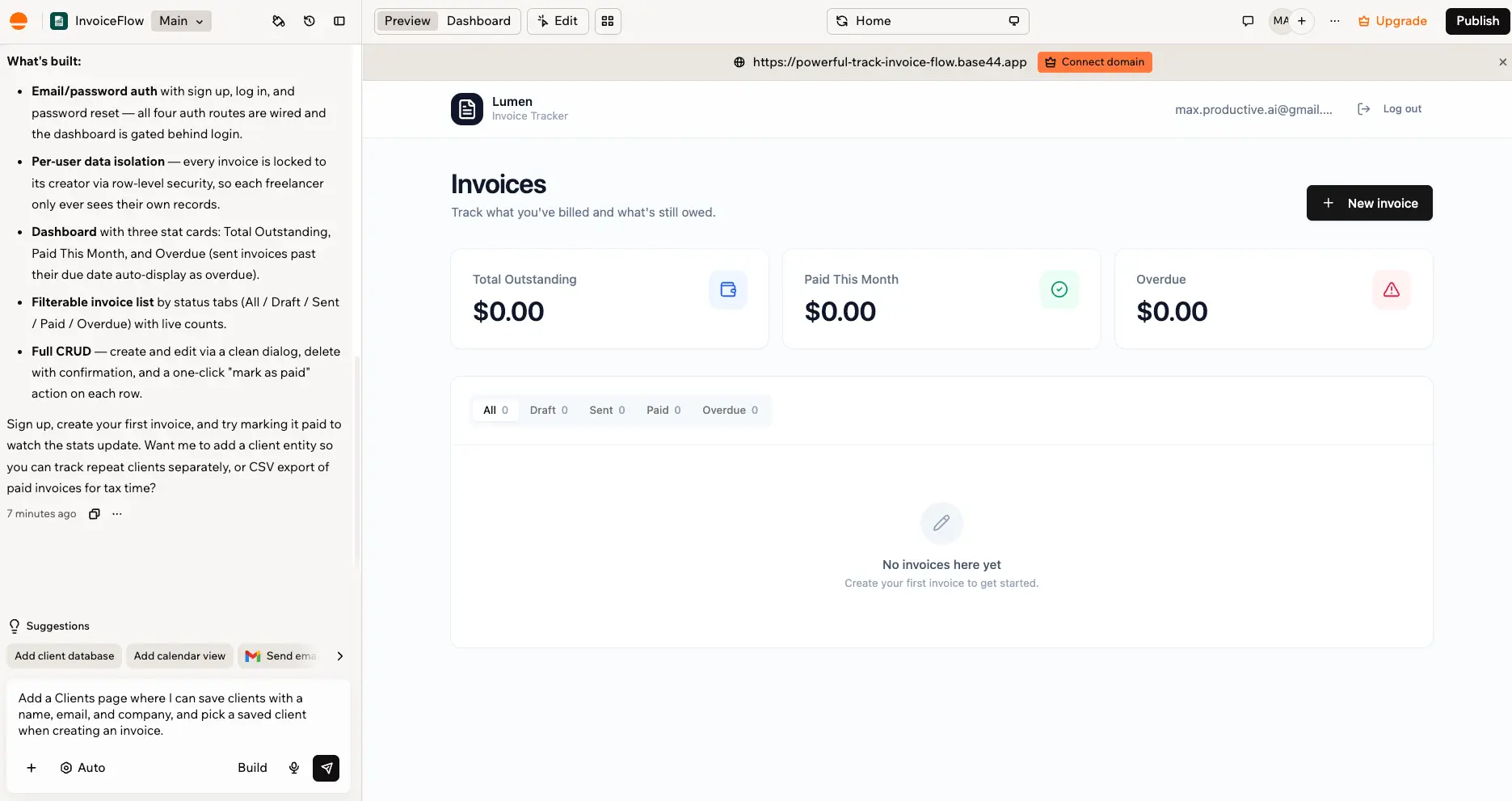
Neither screenshot is a trick. Lovable spends effort on the thing a customer sees first; Base44 spends it on the thing the user does. Two published tests found the same split before we did. Banani's February 2026 prompt test gave Lovable the edge on interface polish and interactivity and Base44 the edge on feature depth. The Digyet video that Google's AI summary now cites ran a one-prompt sheep-counting app through both in December 2025 and picked Base44 for beginners on the strength of its one-place workflow, while pointing developers who want the files at Lovable.
One thing has changed since both of those tests: since May 13, 2026 a new Lovable project renders on the server, which is the difference between a page a search engine or a link preview can read and one it cannot. For anything public, that plus the design work makes Lovable the pick. For an internal tool where working beats pretty, Base44's plainer output is not a weakness. It is the point.
7. Ecosystem and Trajectory: Base44 Goes Wide, Lovable Goes Deep
Both companies shipped a lot this summer, in opposite directions. Base44 went wide. Since late June it has added Workflows (July 6), its own Base 1 model (June 29), branches that behave like full copies of an app (August), importing an existing GitHub repository (August 19), a security scan that now reads your code as well as your permissions, payments through Wix or Stripe with a transactions view, Google Ads campaigns launched from the editor, and a Superagents product that answers on WhatsApp, Slack, and Telegram. On September 10 its Plan mode became a conversation. The through-line is that Base44 is becoming the place you run a small business from, with the app builder as one room in the house.
Lovable went deep. In the thirty days after its August Series C it shipped pause-and-resume for builds that run out of credits (August 18), live time and credit reporting (August 25), ten-hour builds and goal runs (August 26 and 30), Lovable in Slack, an official Figma plugin, drafts you can experiment in without touching the live project (September 9), Bitbucket two-way sync, domain purchase from chat, and custom REST connectors on every plan. The through-line is that Lovable is trying to be the best possible way to build the software, and leaving what you run it with up to you.
Which bet you want depends on whether you are building a product or running an operation. If the app is the business, Lovable's direction serves you. If the app is one part of a business that also needs payments, ads, agents, and a store presence, Base44's does. We keep vendors' financial results out of tool comparisons on principle; the shipping logs say enough.
Our Same-Prompt Test: One Invoice Tracker, Two Free Plans
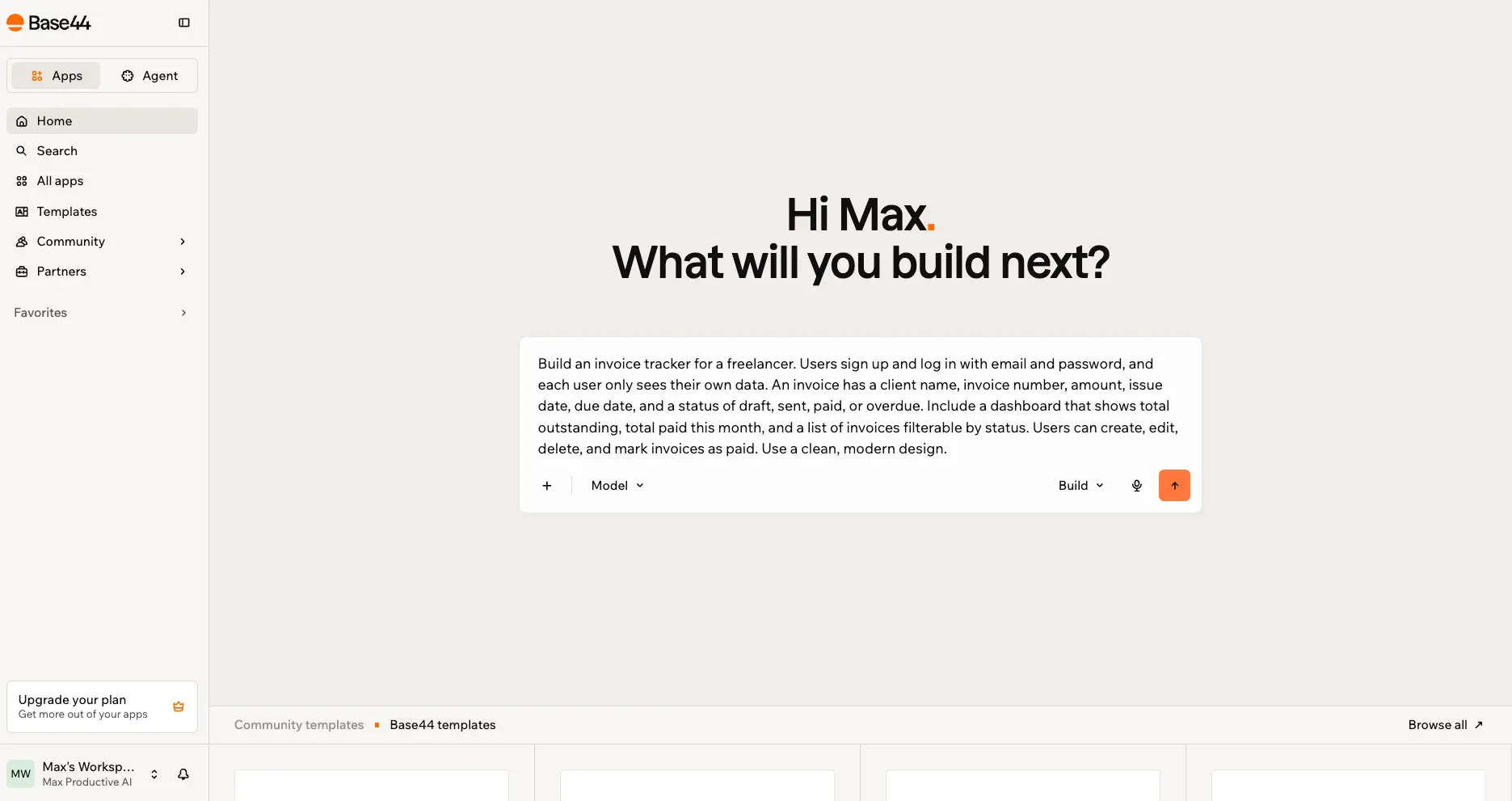
Everything above rests partly on this test, so here is exactly what we did. On September 14, 2026 we opened a new project on each tool's free plan and pasted the prompt below, unedited, with default settings. We touched nothing until each tool said it was done, or stopped.
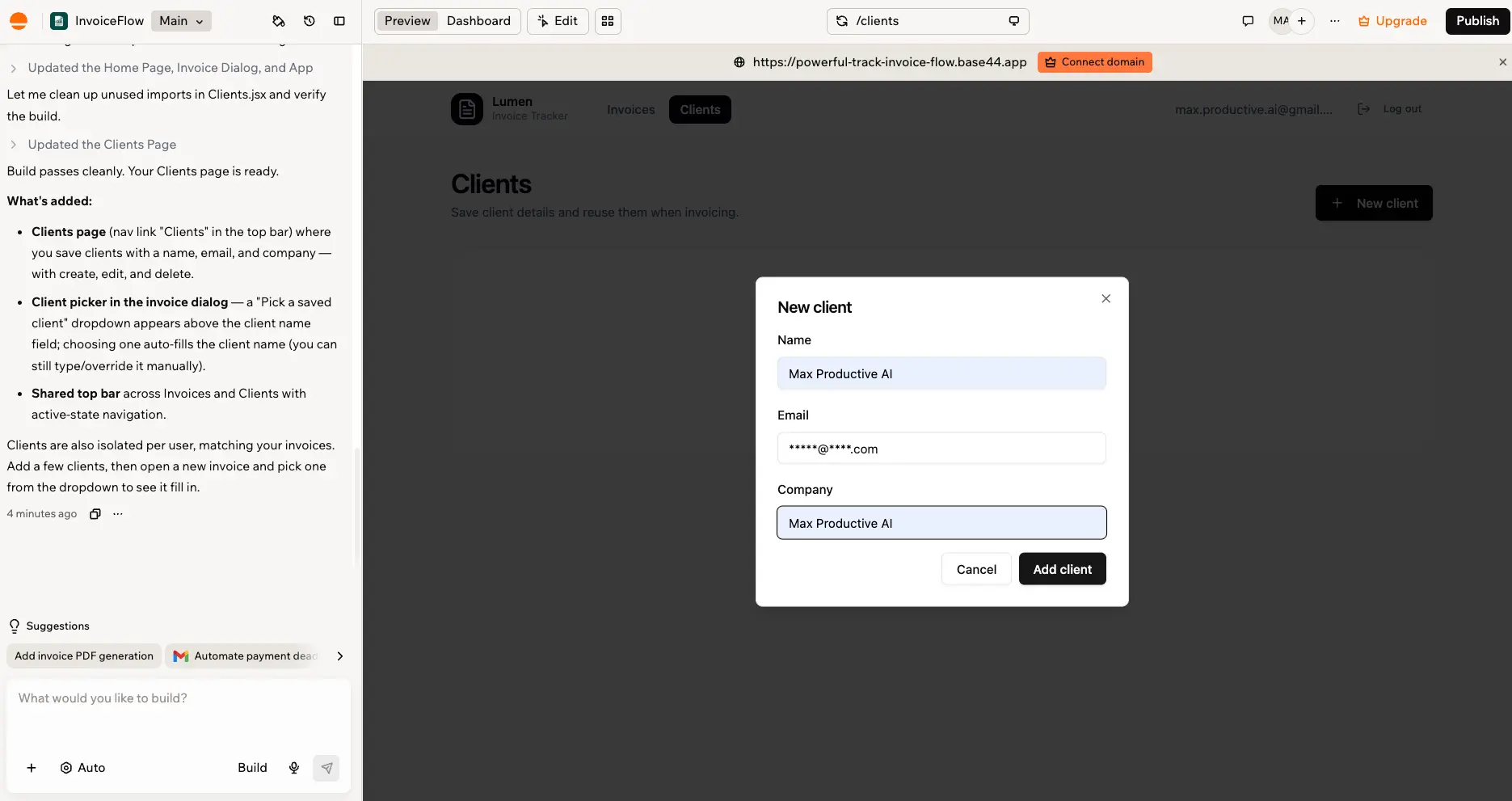
The follow-up, verbatim: Add a Clients page where I can save clients with a name, email, and company, and pick a saved client when creating an invoice.
Base44's run
Prompt in at 3:53 in the afternoon, default Automatic model, Build mode.
About four minutes later Base44 reported the build complete, and its summary matched the brief line for line: email and password sign-up, login, and password reset; every invoice locked to its creator; a dashboard with total outstanding, paid this month, and overdue; status tabs with live counts; create, edit, delete, and a one-click mark as paid. We signed up and landed on an empty dashboard waiting for its first invoice. Then we sent the follow-up, identical to the one we would send Lovable. Four minutes after that, Base44 said the build passed cleanly, the Clients page was there, and its summary described a picker in the invoice dialog that auto-fills the client name and lets you override it. We did not ask for the override. We would have.
Lovable's run
Lovable read the prompt and, before writing code, asked which of two design directions to build, each rendered as a full mockup with sample data. We chose the first.
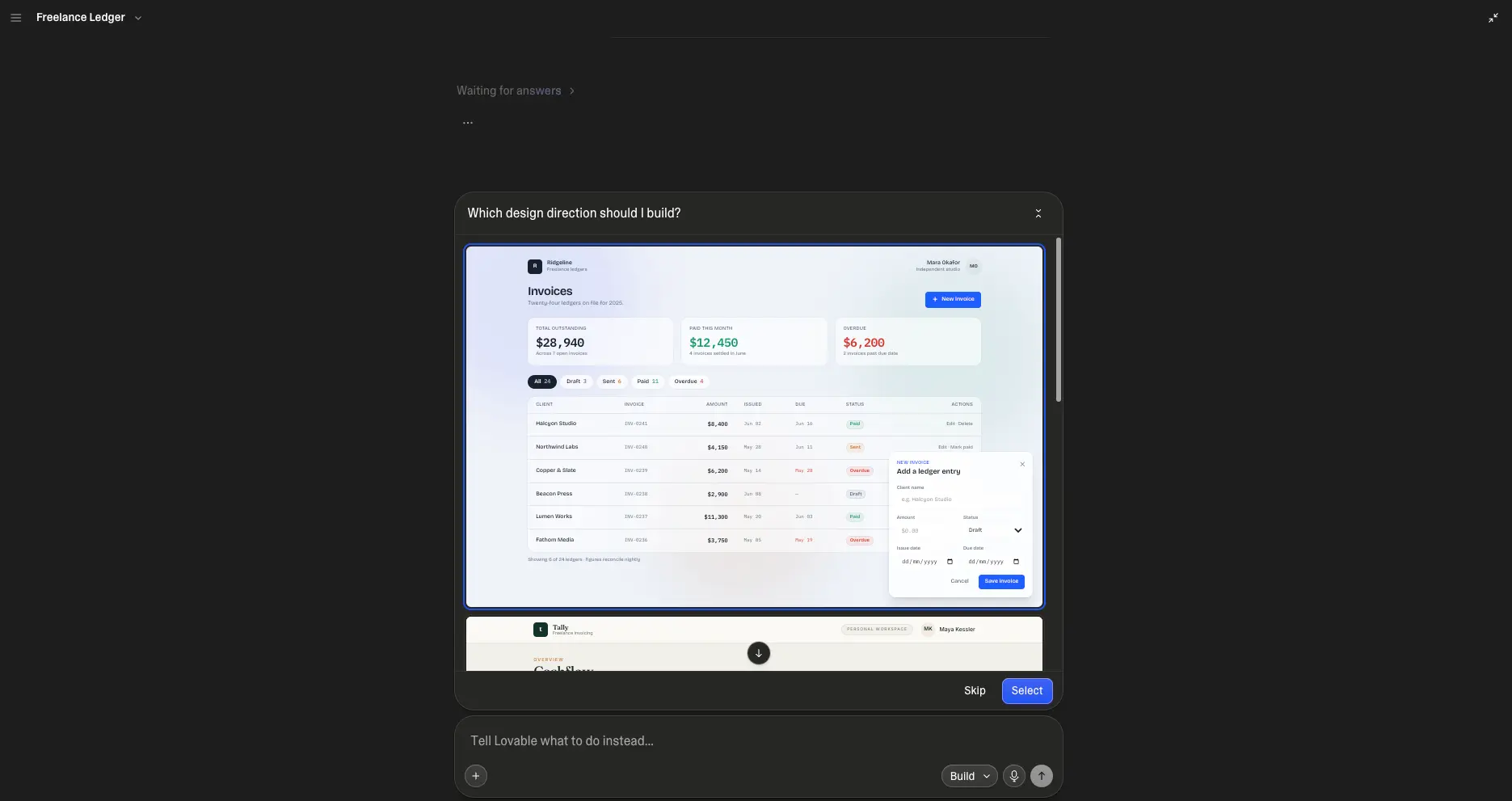
The chat narrated its plan in plain English, accounts and private storage first, then the dashboard, and got to work. It built a landing page, the sign-up and sign-in pages, the invoice model, and most of the dashboard, and then the workspace ran out of daily credits with the result, in Lovable's own words, unfinished and untested: it had not been able to run the app or click through it, so nothing past the sign-up page had been verified. The next five free credits were sixteen hours away. The follow-up never ran.
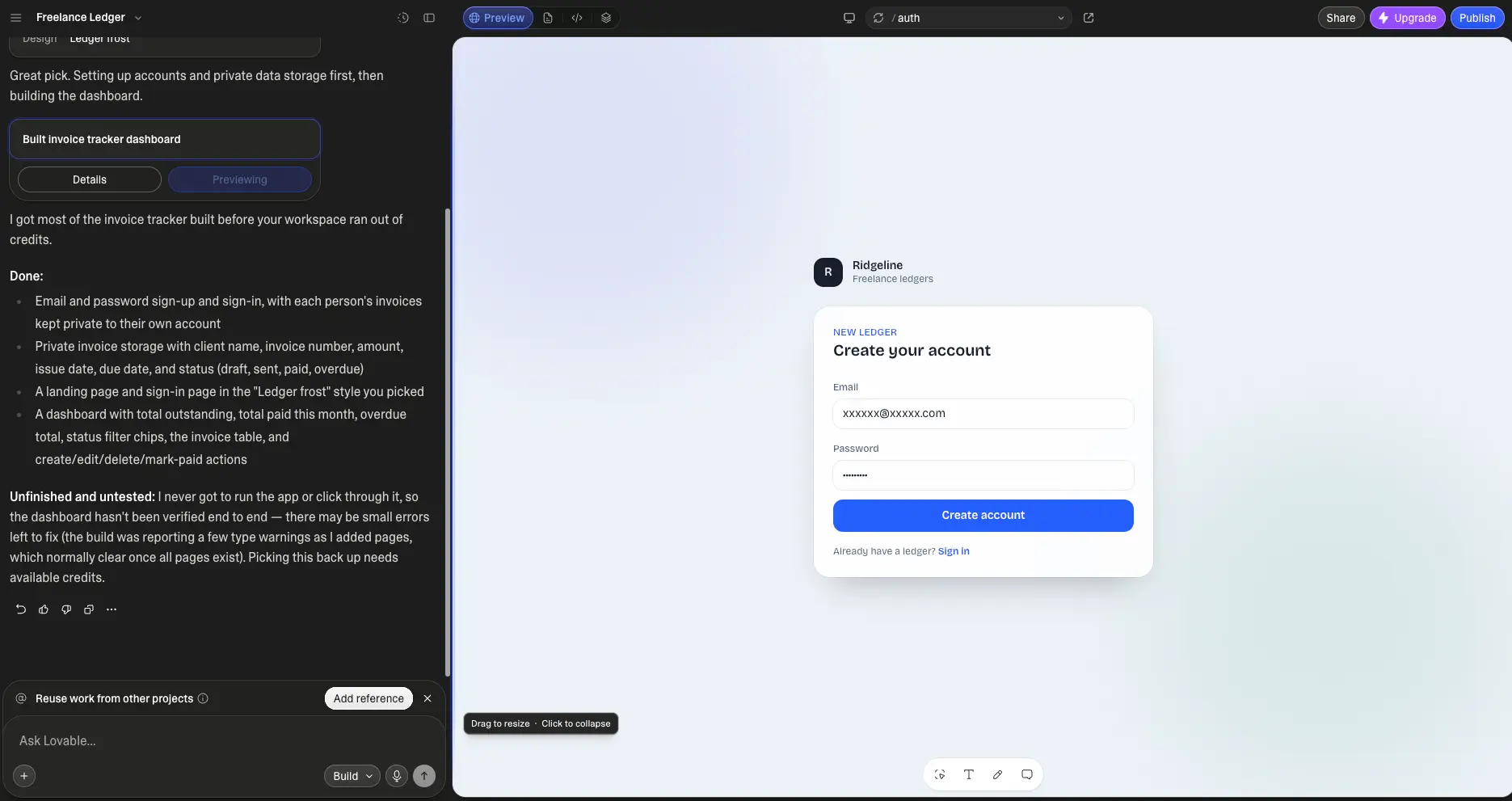
What that does and does not tell you
It tells you what five free credits buy on each tool for a real prompt: on Base44, a working multi-user app plus a feature; on Lovable, a well-designed app with the plumbing in place that Lovable itself had not yet been able to run. It does not tell you which tool builds the better app, because Lovable's build was interrupted rather than finished badly, and Lovable's pause feature, new since August 18, offers a Resume button the moment the next grant lands, so a patient free user can finish across days. On a $25 Pro plan the same build completes in one sitting. What we would want to know next, and could not measure on free tiers, is how many of those 100 credits it takes. Lovable now shows that live while it works, so for anyone on Pro it is a five-minute experiment, and that number is the one to compare.
What Reddit Says About Base44 vs Lovable (Dated, Both Directions)
If you have been reading Base44 vs Lovable Reddit threads, you already know the shape of the consensus. What the threads rarely carry is a date, and on tools that ship weekly the date is half the information. Here is the bank we kept, dated, both directions.
In October 2025 a builder left Base44 for Lovable over custom auth screens, which Base44's managed login would not let them restyle. A December 2025 thread in r/Base44 read Base44 as a strong first build with weaker follow-through afterward, a criticism that predates almost everything in the shipping list above. A January 19, 2026 thread reached the opposite conclusion from the crowd on nearly every point; we flag it as an outlier rather than averaging it in. In late February two threads went up in the same week, one built around why Base44 is better and one around why Lovable is, and the Base44 case was the most articulate we have seen: intricate apps with the backend and the front end in one place, no Supabase to think about. On April 22 a user timed the same feature at about 45 minutes in Lovable and two hours in Base44, which is the single data point people quote most. On May 19 a user who had been ready to leave stayed on Base44 because app-store wrapping had shipped.
The newer threads are less conclusive and more interesting. A June 9 r/vibecoding question, Base 44 or Lovable, drew the usual split. A July 29 thread asked what happened to Lovable and Base44, which is what a fast-moving category sounds like from the inside. On August 9 someone ran one booking-app prompt through Emergent, Lovable, Bolt, Replit, v0, and Base44 and posted the results, the closest thing to our test we have seen from a user. And the freshest, an August 2026 r/lovable thread with more than forty comments asking which one is better, has a most-upvoted reply that admits it had not used Base44 much lately. That is worth noticing. A lot of the Lovable consensus on Reddit was formed before Base44's summer, and a lot of the Base44 enthusiasm before Lovable's. Read the dates.
The shape that survives all of it: Base44 for an all-in-one backend and mobile, Lovable for front-end polish, speed of iteration, and code you keep. Our screenshots agree.
A Note on the Comparison Pages That Rank for This Search
Nearly every written page on the first screen of results for this comparison is by a company with a stake in the answer. Base44's own page ranks, and its text states that its information is accurate as of September 29, 2025, which predates Lovable's current credit model. Lovable's guide from July 2026 is the better-written of the two and, to its credit, says there is no universal winner before framing the choice as its own open stack against Base44's managed one. Softr and Zite each publish a three-way that ends with themselves, and Emergent has its own page on the pair. Banani ran a prompt test in February and reached roughly our conclusion. HostAdvice claims Base44 builds an app in six minutes to Lovable's ten; the direction matches ours, but the page does not say what was built or on which plans, so treat the numbers as a mood rather than a benchmark. Google's AI summary on this query is assembled from Base44's blog and a YouTube video.
None of this is deception. A vendor writing about a rival is doing marketing, and the careful ones, Lovable's included, say so in their framing. It does mean the refereeing falls to you, or to someone with no stake in which of the two you pick. For the record on our side: both tools pay this site a commission, our Lovable review is our highest-rated app builder at 4.7 and our Base44 review sits at 4.0, and both ratings were set before this article existed.
How to Choose Between Base44 and Lovable
Match the tool to what happens after the first working version, not to the demo. You are not technical and want to validate an idea this week: Base44. One prompt, one dashboard, hosting included, and a free plan that reached a working app in our test. You are a designer, product person, or founder who will show this to customers: Lovable. The output is the best in the category and it renders on the server. You are a developer, or you have one: Lovable, with Git sync switched on from day one. You need an App Store or Google Play listing without hiring: Base44, on Builder. You are building an internal tool for a team, with automations and maybe an agent answering on WhatsApp: Base44. You are building a product that might become a company: Lovable, because on the day you need to leave, you can. You are on Base44 and want to move: your front end and functions sync out from Builder, and the backend is a rebuild on Supabase, which Lovable's docs cover. You are on Lovable and want to move: pull the code from Git and use Base44's GitHub import, added in August, rather than re-prompting from scratch. You want mobile and code ownership: neither gives you both today. Lovable plus a wrapper you build, or Base44 accepting the entity gap.
How Base44 and Lovable Compare to Everyone Else
Neither tool exists alone, and the question box on Google now asks a three-way, so here is the rest of the field in one pass, with links to our reviews.
Emergent is the name Google appends to this pair, and the Emergent vs Lovable question has a clean answer: Emergent is the agentic option. It plans, writes, tests, and deploys with less of you in the loop, and in June 2026 it launched E3, an autonomous mode for longer phased builds, in beta on its Pro plan. Lovable gives you the cleaner codebase, the bigger ecosystem, and more control per step; Emergent does more of the build unattended. It also publishes its own Base44 vs Lovable page, which tells you how it sees the neighborhood. We do not have a full review yet, but you can try Emergent and judge the autonomy claim yourself.
Bolt.new (4.6) runs in the browser and is the developer-adjacent alternative to Lovable: fast, code-forward, and metered by tokens. Bubble (4.3) is a different species, visual logic rather than generated code, and our Lovable vs Bubble comparison is the place for that decision. Hostinger Horizons (4.2) bundles the builder with hosting and shows up in the three-way videos on this query. Softr (4.2) is not a code generator at all; it builds portals and internal tools on Airtable and Google Sheets, and ranks here because it wrote a comparison. Shipixen (4.2) generates Next.js starting points for developers who want a head start, not a builder. For the full nine-tool lineup, our Lovable alternatives roundup is the hub this article hangs off, and the app building directory has every review.
Final Verdict — Base44 vs Lovable in 2026
| Best overall | Lovable (code on every plan, portable data, server-rendered output, from $21/mo annual, our 4.7/5) |
| Best all-in-one for non-technical builders | Base44 (backend, hosting, payments, and mobile in one product, from $16/mo annual, our 4.0/5) |
| Best free plan for a working app | Base44 (login, database, and dashboard in roughly four minutes in our test) |
| Best code ownership | Lovable (schema in the repo, migration to your own Supabase documented) |
| Best for a store-listed mobile app | Base44 (web-view wrapper with push notifications, files from Builder) |
| Best output for customer-facing products | Lovable (design directions before the build, server rendering since May 2026) |
| Best for internal tools and operations | Base44 (Workflows, in-app agents, and payments in the same dashboard) |
| Mobile and code ownership together | Neither, yet. Lovable plus your own wrapper, or Base44 with the entity gap accepted |
Bottom line: Lovable is the better tool for most people, because the code, the schema, and the data can all leave with you, and because what it builds looks like something you would ship. Base44 is the better tool for a real and large group, the non-technical builder who wants one product to handle the backend, the hosting, the payments, and the phone, and its free plan will get you to a working app faster than anything else in this category. Whether you searched Base44 vs Lovable or Lovable vs Base44, the test is the same: paste one real prompt into both free plans, then ask which app you would still want to be running in a year. That answer beats any article, including this one.