
SE Ranking
SE Ranking tracks your rankings, audits your site, researches keywords and backlinks, and builds client reports, for less than Semrush or Ahrefs charge. In 2026 it also tells you whether ChatGPT, Gemini, Perplexity and Google's AI answers mention your brand at all. That last part is why it's back on my shortlist.
Try SE Ranking →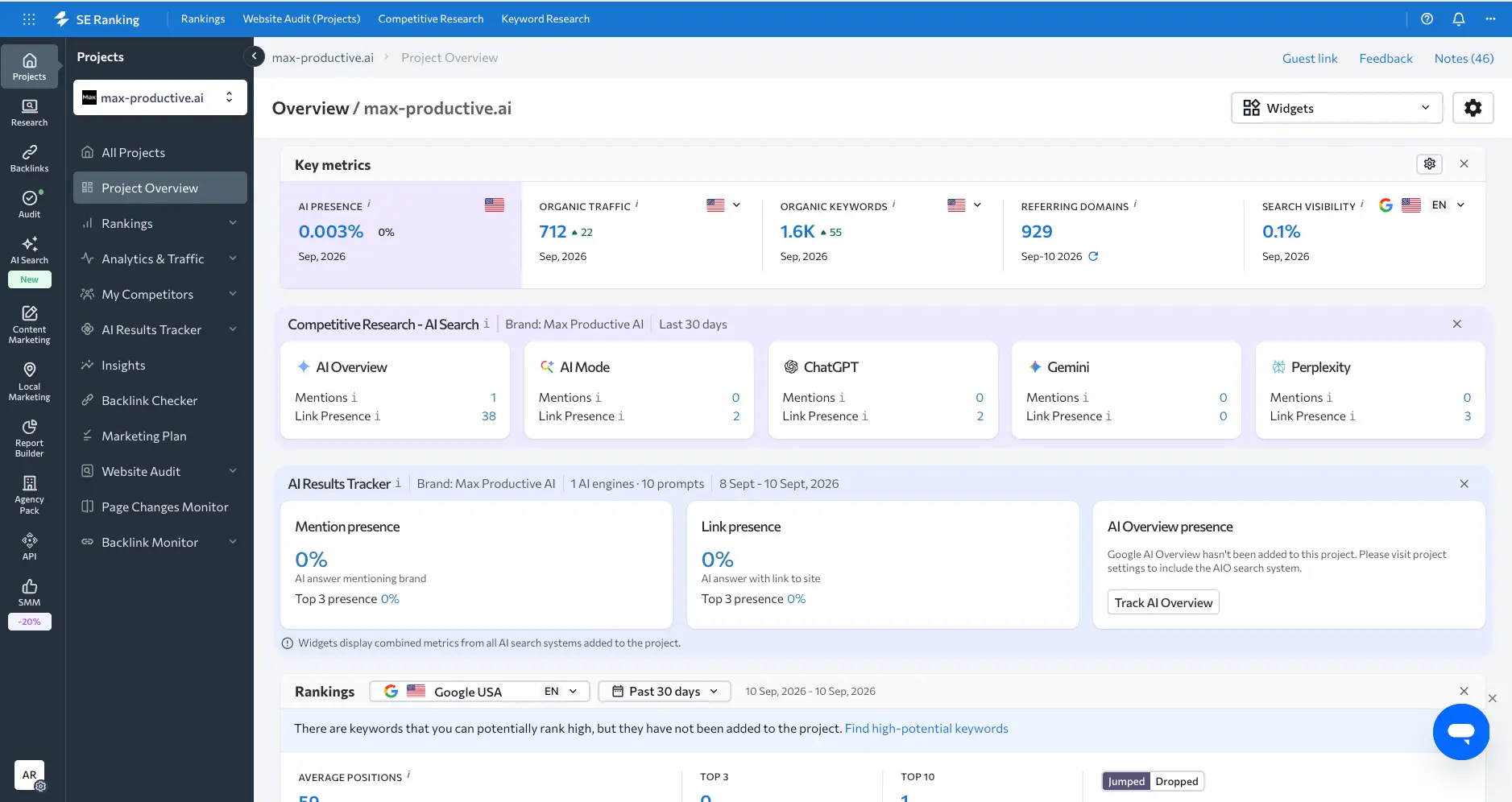
The Best-Value SEO Suite of 2026,
Now With Real AI Search Tracking
SE Ranking does the classic SEO jobs well and charges less for them than the two names everyone knows. Rank tracking down to ZIP code, an audit that tells you how to fix things rather than just listing them, keyword and backlink data deep enough for most small agencies. What moved it up my list this year is the AI Search Toolkit. It shows which prompts get your brand mentioned in ChatGPT, Gemini and Perplexity, which competitors take your place, and which pages those AI answers cite. The trade-offs: a backlink index smaller than Ahrefs, and a habit of putting the newest features behind add-ons. Budget for the AI Search add-on from day one, because that's the part you'll actually use.
✓ What We Love
- Same core toolset as Semrush and Ahrefs, at a lower price
- AI Results Tracker with per-prompt competitors and cited sources
- MCP connectors put live SEO data inside Claude, Cursor and Gemini
- White-label reports and Looker Studio connector agencies actually use
! Could Be Better
- Backlink and keyword databases are smaller than the premium tools
- AI Search, Content Marketing, API and Agency Pack all cost extra
- Keyword research, grouping and competitor tools live in separate modules
What Is SE Ranking?
An all-in-one SEO platform that decided, earlier than most, that AI answers are the new rankings.
SE Ranking is a project-based SEO platform. You add a website, connect Google Analytics and Search Console, load a keyword list, and from then on the platform tracks your positions every day, crawls the site for technical problems, monitors your backlinks, and reports on all of it. Rank tracking covers Google desktop and mobile, Bing, Yahoo and YouTube, with local targeting precise enough for single-neighbourhood tracking and multilingual support. Around that core sit the usual research tools: keyword difficulty, volume, intent and history back to early 2020; competitor domain analysis with share of voice; a backlink checker with its own Domain Trust and Page Trust scores.
For years that made it the sensible mid-priced choice next to Semrush and Ahrefs. Cheaper, easier to learn, good enough for most freelancers and small agencies. What changed in 2026 is the AI Search Toolkit. The company folded its standalone AI-visibility product (SE Visible) and the social scheduler Planable into the main platform, and the result is an AI Results Tracker that checks a list of prompts against ChatGPT, Gemini, Perplexity, Google's AI Overviews and AI Mode, then tells you whether your brand was mentioned, whether it was linked, which other brands were named instead, and which pages the AI engine cited. Semrush sells the equivalent as a separate product, billed per domain. Ahrefs charges more again for Brand Radar. SE Ranking prices it as an add-on too, but a cheaper one, and the core plan is already lower.
The other 2026 addition is MCP support. SE Ranking runs a Model Context Protocol server with one-click connectors for Claude, Claude Code, Cursor and Gemini, so you can ask an AI assistant about your rankings, backlinks or AI visibility and get live data back instead of pasting CSV exports into a chat window. Is this a gimmick? Not really. If you already spend half your day in Claude or Cursor, it's the difference between checking a dashboard and just asking. It does need the Data API add-on, which I'll come back to.
How We Evaluated SE Ranking
I connected max-productive.ai as a project on an SE Ranking trial account, loaded 20 keywords into the rank tracker, set up 10 ChatGPT prompts in the AI Results Tracker, went through the Competitors and Sources reports, generated an MCP endpoint, and started a brief in the Content Editor. The screenshots below come from that account. Pricing and plan limits are taken from SE Ranking's own plans page. The wider picture on data accuracy and long-term customer sentiment comes from independent reviews and public user feedback, not from a controlled benchmark, so treat accuracy claims as reviewer experience rather than lab results.
So who is it for? Small and mid-sized agencies that need white-label reporting and a lot of projects for the money. Freelancers and in-house marketers who want one login for tracking, audits and research. And, increasingly, anyone who has been asked "are we showing up in ChatGPT?" and had no answer. It's a weaker fit if your work lives and dies on backlink depth, where Ahrefs is still the reference, or if you want PPC, social and content tools in the same suite, which is Semrush's pitch. Dedicated AI trackers like Rankscale cover more engines, but they don't do any of the classic SEO work.
See SE Ranking in Action
Screenshots from our own project, from the overview dashboard through to the MCP setup and Content Editor.
Project Overview Dashboard
Key metrics, AI search presence and rankings on one screen
The overview puts AI presence first, before organic traffic and keywords, which tells you where SE Ranking thinks the attention is going. The Competitive Research widget splits AI search into five engines and shows mentions and link presence for each. For my directory, AI Overviews were the only place with any real link presence (38 links, 1 brand mention), while ChatGPT and Gemini had nothing. Below that, the AI Results Tracker widget reports mention and link presence for the prompts I'm tracking, and the Rankings block follows. It's a dense screen, but every block is a widget you can remove or drag, and the notes counter top right (46 on my project) shows how much context the platform logs against a site over time.
Keyword Rankings Table
Positions, search volume, SERP features and a content score per keyword
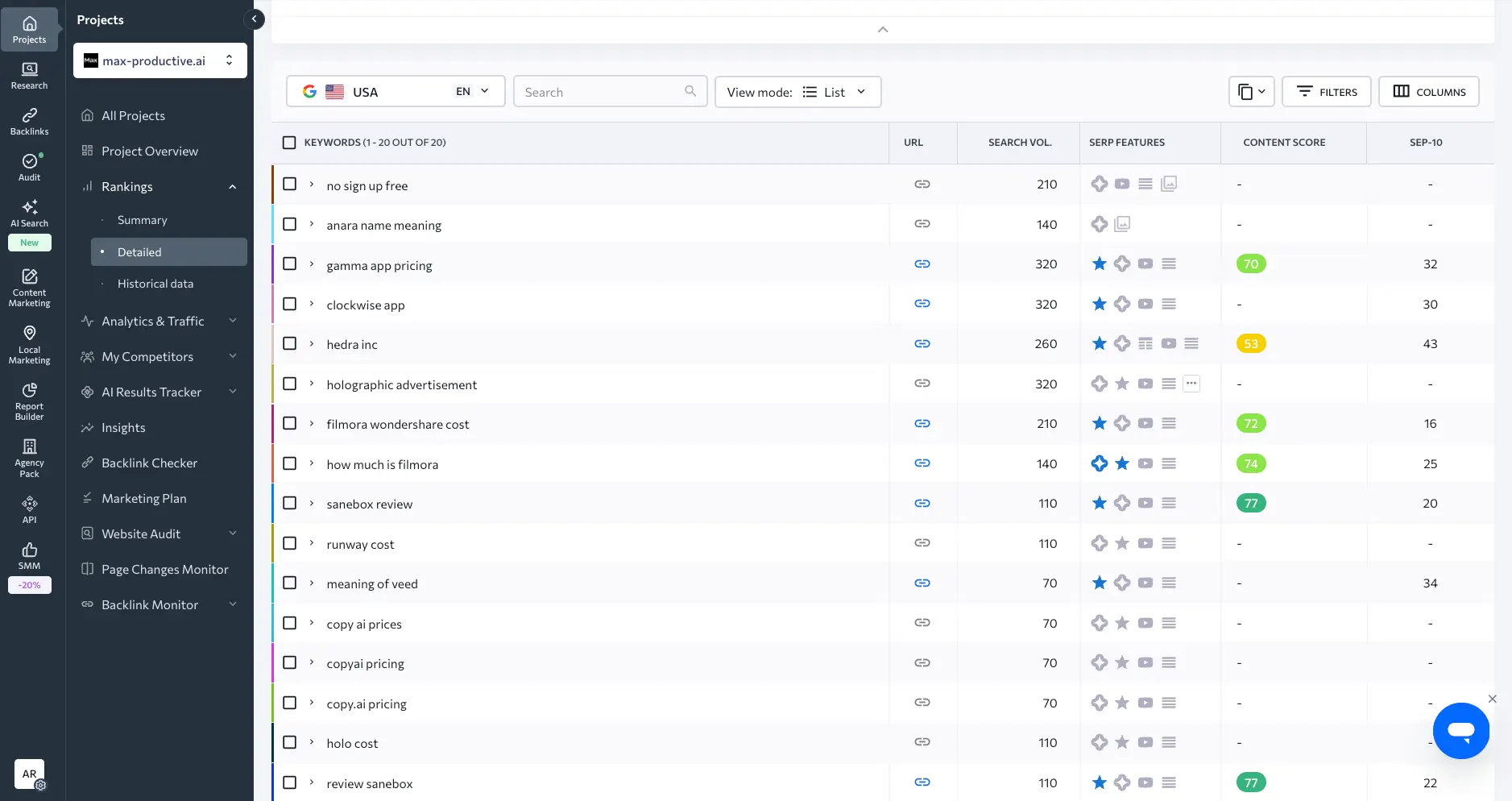
This is the bread-and-butter rank tracker, and there are no surprises here, which is what you want from a rank tracker. Each keyword shows the ranking URL, monthly volume, icons for the SERP features present, and today's position. The Content Score column is the clever bit: where SE Ranking has scored the ranking page against the top results, you get a number, and clicking through takes you into the Content Editor to improve it. Positions 16 to 43 on tool-pricing queries is roughly what I expected for a young directory, so the data passed the sanity check. One thing I'd flag: the tracker defaults to daily updates, and daily positions on low-volume keywords bounce around. Weekly averages tell a more honest story, and you'll find those in the Summary tab rather than here.
AI Results Tracker
Ten prompts, one engine, and a mention rate I'd rather not have seen
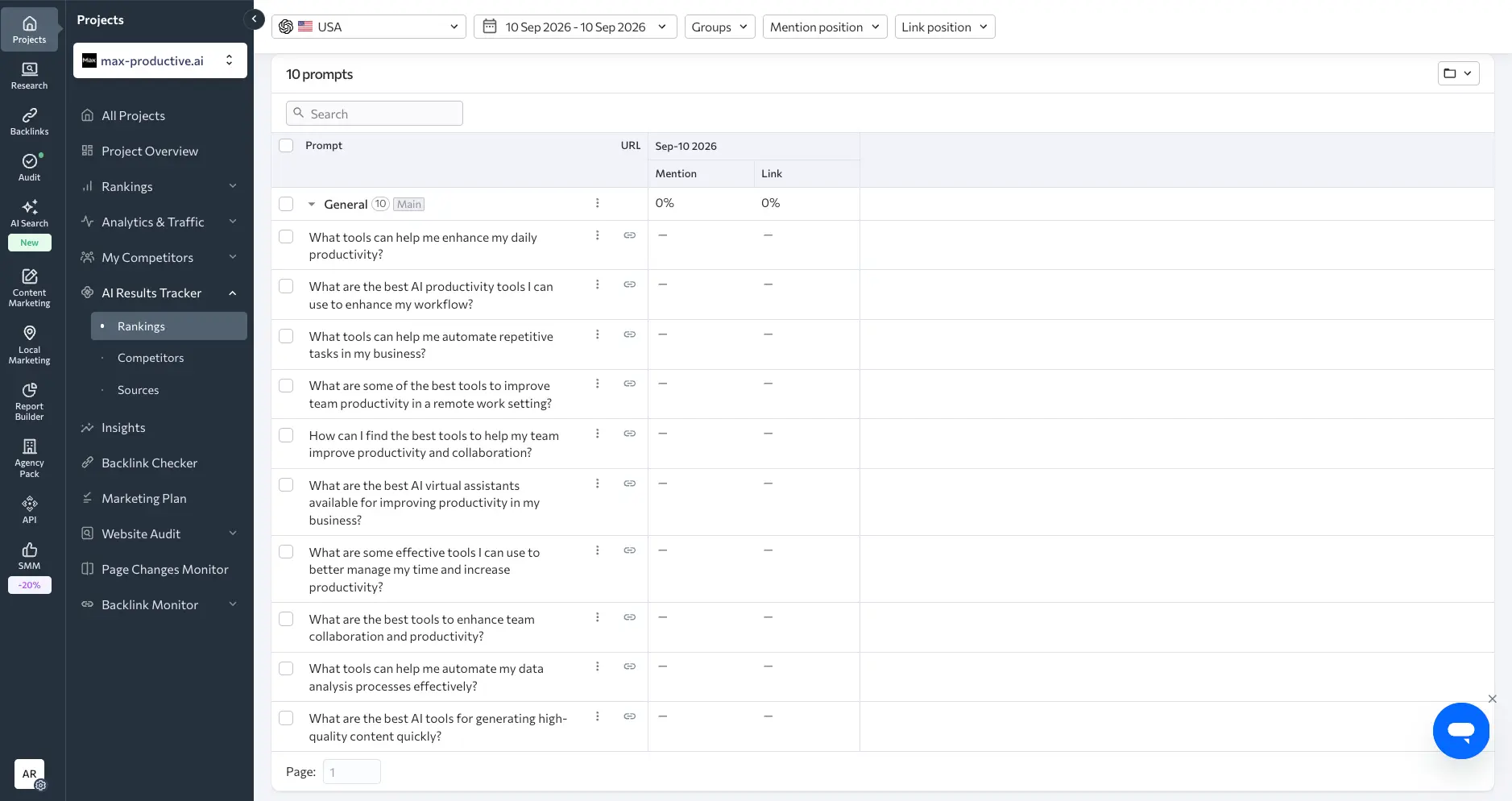
Here's the thing about AI visibility tools: the first report is usually bad news. I added ten prompts about productivity and AI tools, the exact questions my readers ask, pointed the tracker at ChatGPT in the US, and got 0% mentions and 0% links across the board. Uncomfortable, but that's the job. You can't fix what you haven't measured. The table works like the classic rank tracker: prompts in rows, dates in columns, a mention and link status per cell, grouped however you like. The trial caps you at 20 prompts a day, which is enough to prove the concept and not much more.
Curious whether your brand shows up in AI answers?
Try SE Ranking →The trial includes 20 AI prompts a dayAI Search Competitors
Every brand ChatGPT named in the answer, in order
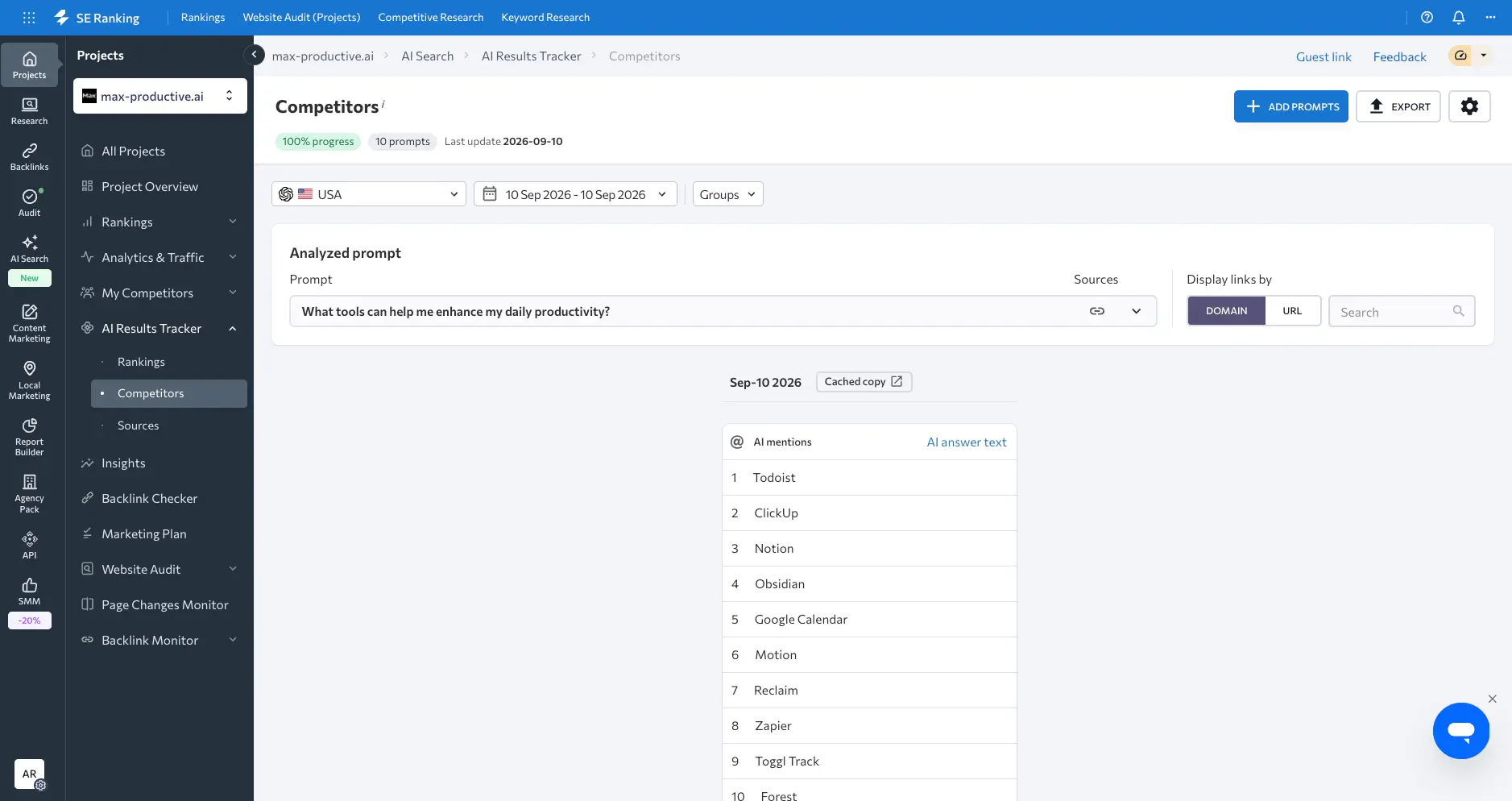
Pick a prompt and SE Ranking shows you who ChatGPT recommended instead of you. For "what tools can help me enhance my daily productivity?" the answer named Todoist, ClickUp, Notion, Obsidian and Google Calendar in that order, then Motion, Reclaim, Zapier, Toggl Track and Forest. The cached copy button opens the full answer text as it was captured on that date, which matters because AI answers drift week to week and you'll want the receipt. For a directory like mine the "competitors" are the products I review rather than rival sites, so the list is more useful as content research than as a threat map. For a SaaS brand it's a straight competitor report. Either way, it's the screen I kept opening.
AI Search Sources
Which pages the AI engines cite, and where your brand is missing
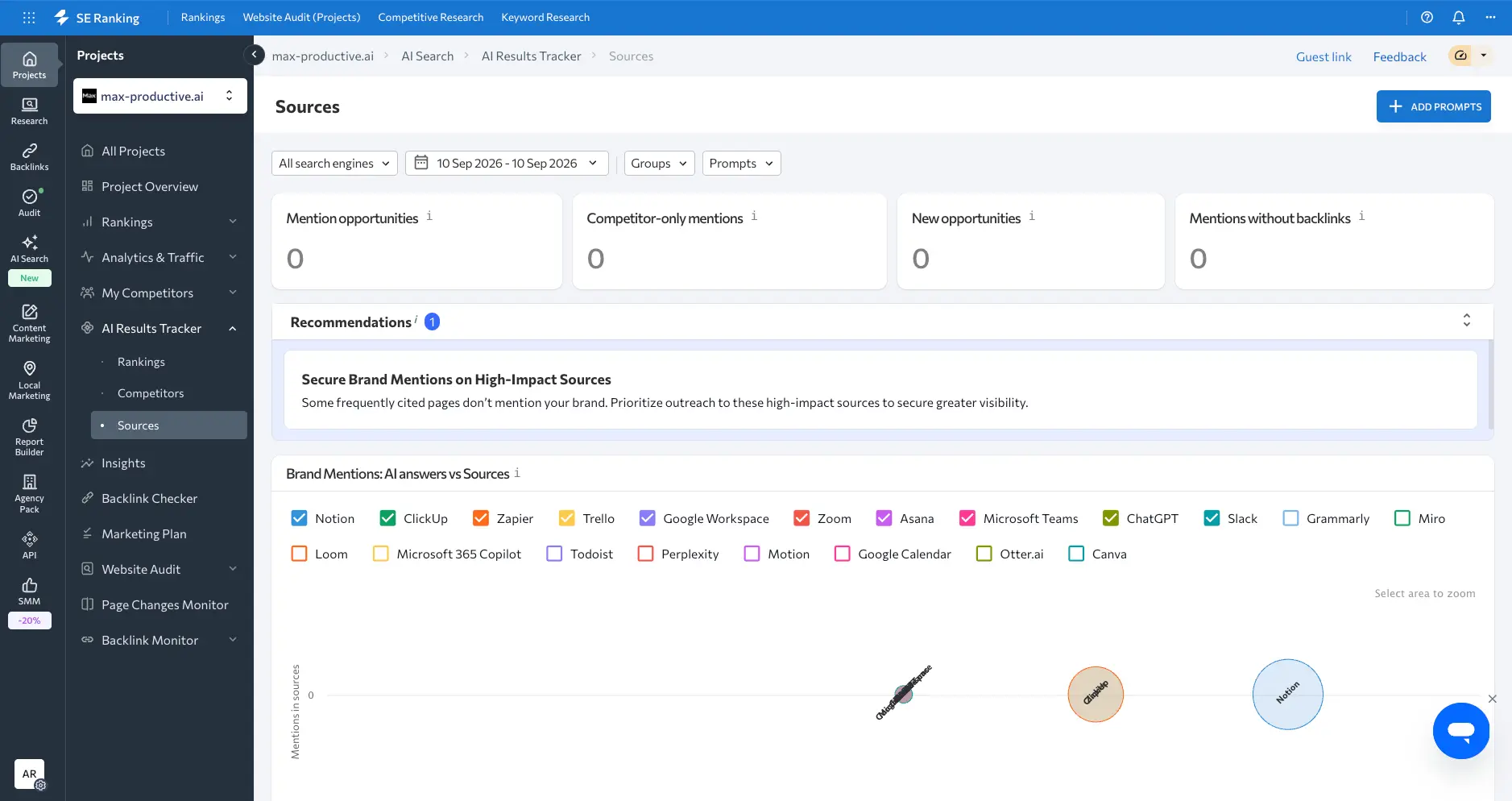
This report answers the question that leads somewhere: which third-party pages are the AI engines pulling from, and do they mention you? Four counters at the top track mention opportunities, competitor-only mentions, new opportunities and mentions without backlinks, and a recommendations panel spells out what to do about them. Mine read "secure brand mentions on high-impact sources", which is the polite way of saying the pages ChatGPT trusts have never heard of me. The bubble chart below plots each competitor by how often it appears in cited sources versus in the answers themselves. On a one-day-old project all my counters were zero, so give this a few weeks of data before you judge it. When it fills in, it's a digital PR target list.
API & MCP Integration
One endpoint, one-click connectors for Claude, Claude Code, Cursor and Gemini
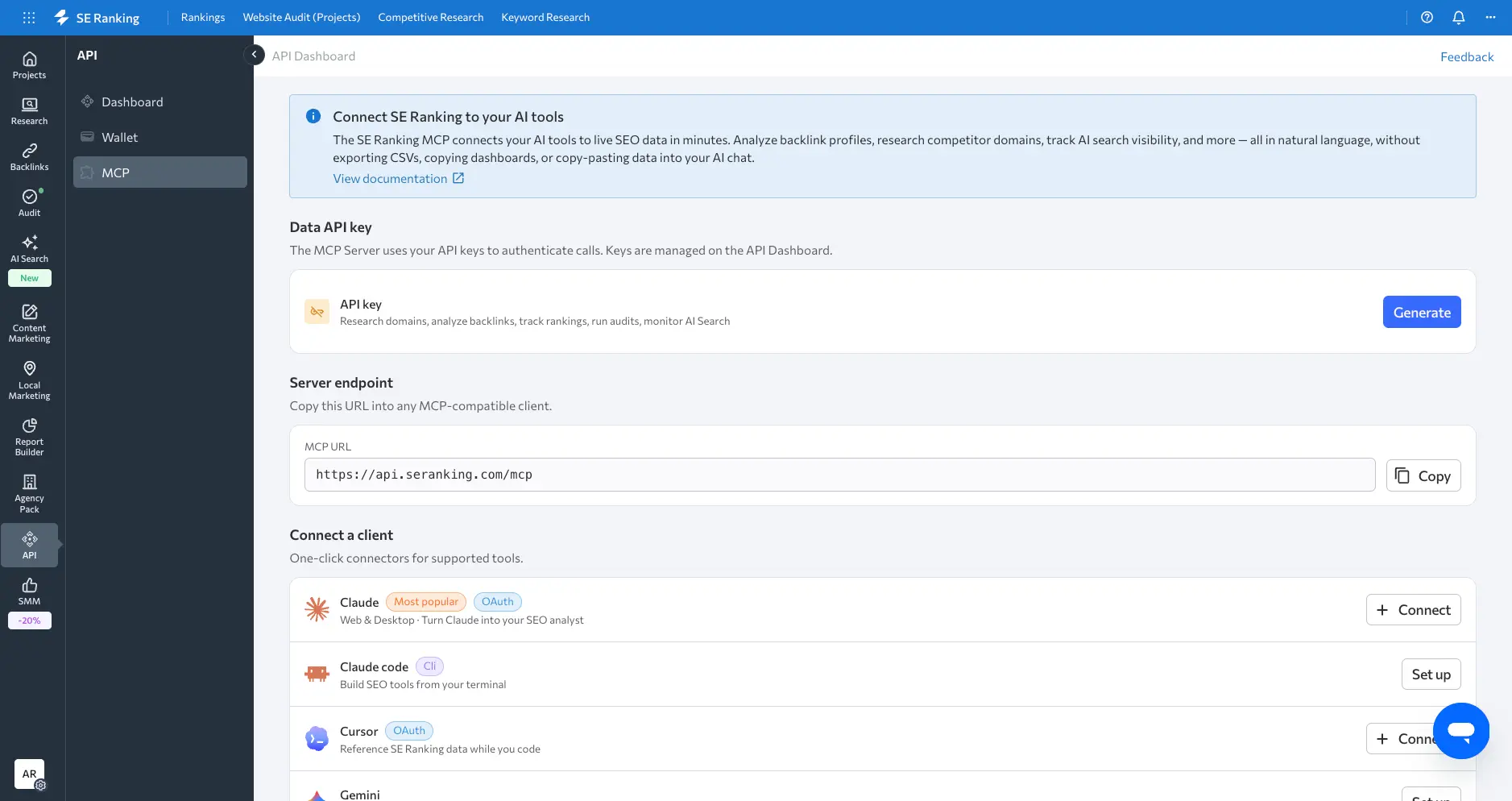
The MCP page is about as simple as it gets. Generate a Data API key, copy the server URL, or skip both and hit Connect next to Claude, Cursor or Gemini; Claude Code gets a CLI setup. Once connected, the assistant can pull backlink profiles, competitor domain data, rankings and AI visibility figures on request. Search Atlas ships an MCP server too, but SE Ranking's connector list is broader and the setup is faster. The catch sits one menu over: the MCP server authenticates with the Data API, and API access is a paid add-on on top of your plan. So the "connect in minutes" promise holds, but only after you've paid for the plumbing.
Content Editor
Briefs, content scores and a Google Docs add-on
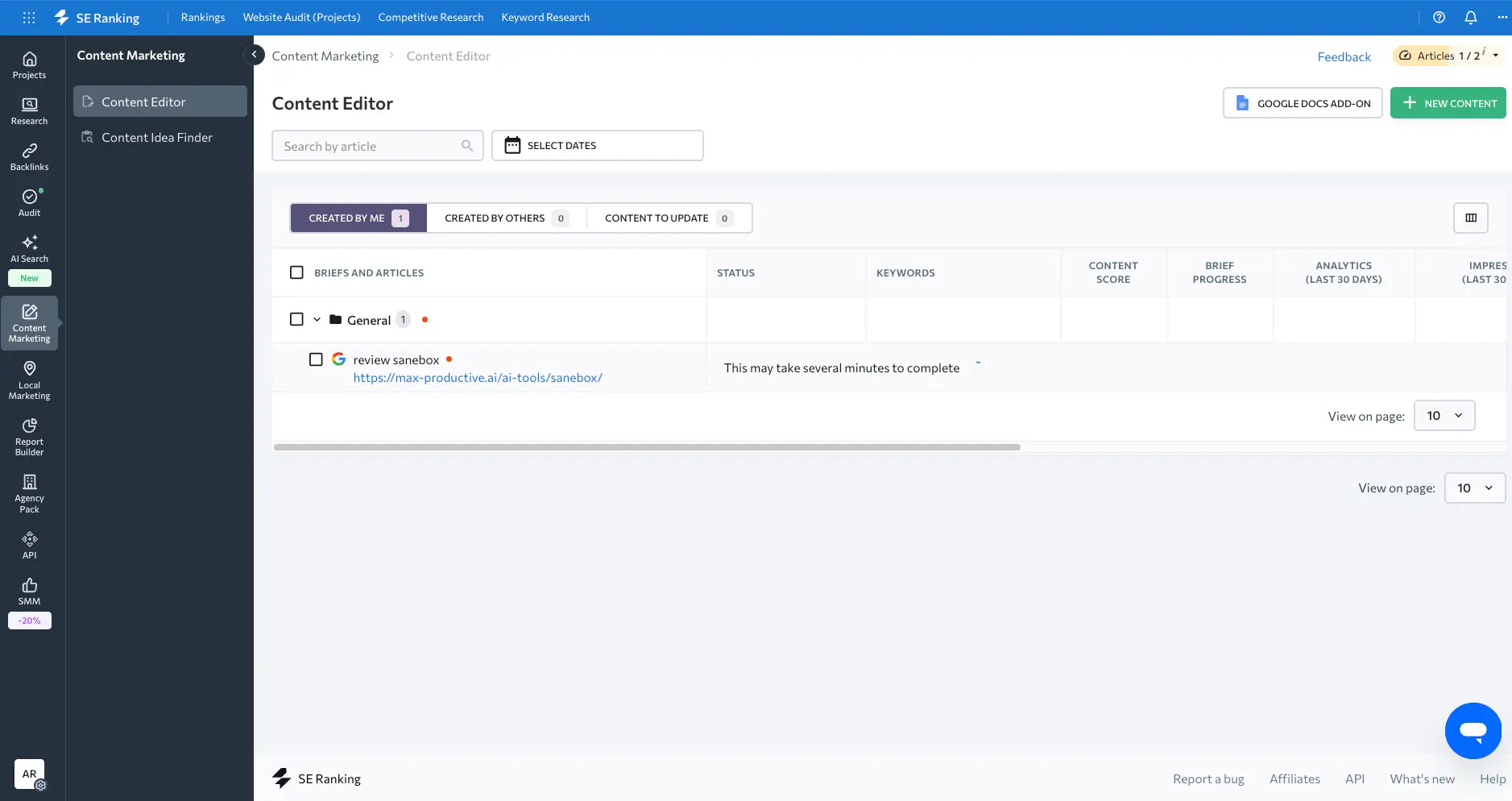
The Content Marketing module gives you a Content Idea Finder for topic research and a Content Editor that builds a brief around a target keyword, scores your draft against the top-ranking pages, and tracks the page's impressions and clicks after publishing. I started a brief for one of my own review pages and it took a few minutes to process, which is fine. It's a competent editor. It isn't Surfer SEO or Clearscope, and if content optimisation is the main job you'll still want one of those (our SE Ranking vs Surfer SEO comparison goes into that). Note the article counter top right: this module is metered, and on the trial you get two.
How SE Ranking Works
From an empty project to a client-ready report, in four steps.
Create a Project and Connect Your Data
Add a domain, pick the search engines and locations you care about, and connect Google Analytics 4 and Search Console (Matomo works too). SE Ranking pulls in your existing traffic and keyword data so the overview isn't empty on day one. Agencies will do this ten or thirty times, once per client. That's the moment the project count on each plan stops being an abstract number.
Add Keywords and AI Prompts
Load the keywords you want tracked, grouped by topic or page, with a target URL for each. Then, in the AI Search section, add the prompts your customers actually type into ChatGPT or Perplexity and choose which engines to monitor. This second list is the new habit to build. Most people find it strange at first, because prompts are sentences rather than two-word queries, and the trick is to write them the way a real person would ask.
Audit, Research, Compare
Run the Website Audit and work through the issues it finds. This is where SE Ranking beats a lot of pricier tools: each issue comes with an explanation of why it matters and how to fix it, not just a red flag. Use Competitive Research to see which keywords rivals rank for and you don't, Backlink Checker to compare link profiles, and Keyword Research to fill the gaps. Worth noting: these are separate modules, so expect some tab-hopping compared with Ahrefs' Site Explorer, where most of it lives on one screen.
Report and Act
Report Builder turns all of it into scheduled, white-labelled PDFs, or you push the data to Looker Studio through the connector. The AI Search reports feed in as well, so the "are we in ChatGPT?" question gets a slide of its own. If you've set up MCP, you can skip the dashboard entirely for quick checks and just ask Claude or Cursor what changed this week.
SEO and GEO in the Same Project
The reason to run AI tracking inside SE Ranking rather than a standalone tool is that it sits next to your organic data. You can see a page that ranks fifth in Google and never appears in AI Overviews, then open the Sources report to find out which pages the AI does cite for that topic. Dedicated trackers like RankPrompt cover more engines, but they can't show you the organic side of the same story.
Local SEO Note
Rank tracking goes down to ZIP code level, with Local Pack and Google Ads positions alongside organic results. Multi-location businesses and franchises get more precision here than most tools offer at this price. The full Local Marketing module (listings management, reviews) is a separate add-on.
Key Features
What comes with the plan, and what's sold on top of it.
Rank Tracker
Daily positions on Google desktop and mobile, Bing, Yahoo and YouTube, with SERP features, Local Pack and ads positions, and ZIP-level targeting. Still the feature SE Ranking is best known for, and still the one reviewers describe as accurate. Some users report delayed updates. Nothing in my project looked off, though a few days is not a long test.
AI Search Toolkit
Prompt tracking across ChatGPT, Gemini, Perplexity, AI Overviews and AI Mode, with mention and link presence, a competitor list for each answer, cached answer text, and a Sources report showing which pages get cited. This is the reason the rating went up this year. It's priced as an add-on to the main plans, which I'd rather it weren't.
Website Audit
Over 110 technical checks, a Health Score, Core Web Vitals, JavaScript rendering and scheduled recrawls. What sets it apart is the wording: every issue explains what's wrong and how to fix it, which makes the report something you can hand to a developer or a junior without a translation layer.
Keyword & Competitive Research
Difficulty, volume, CPC, intent and monthly history back to February 2020, plus bulk analysis. Competitive Research adds domain overviews, keyword gaps, traffic estimates and share of voice. Good data, spread across too many screens. The keyword grouper is a separate tool again, and I lost count of how many tabs I had open by the end.
Backlink Checker & Monitor
Domain Trust and Page Trust scores, a backlink gap tool, and a monitor that alerts you when links appear or disappear. Fine for most small and mid-sized sites. It is not Ahrefs. The index is smaller, and there's no outreach or link-building workflow attached, so link builders will keep a second tool.
Content Marketing
Content Idea Finder for topics and a Content Editor that briefs, scores and tracks articles, with a Google Docs add-on for writers. Handy if you want everything under one login. Surfer SEO and Clearscope go deeper on optimisation, and the module is metered by article count.
Report Builder & White Label
Scheduled reports with your own branding, a Looker Studio connector and AI-written summaries. Agencies rate this as one of SE Ranking's strongest areas, and having used the Semrush equivalent, I'd agree it's easier. The white-label domain and client seats sit in the Agency Pack add-on.
Data API & MCP
REST API for rankings, backlinks, audits and AI search data, and an MCP server with connectors for Claude, Claude Code, Cursor and Gemini. The MCP setup is the smoothest I've seen from an SEO suite. Both run on the Data API, which is a paid add-on.
Two things to keep in mind. First, the add-on column is longer than the marketing suggests: AI Search, Content Marketing, Local Marketing, Agency Pack and API access are all priced separately, and the real monthly bill for an agency using most of them is a long way from the headline. Second, the platform has grown by bolting on modules rather than rebuilding around one view, so the data is good but the navigation asks more of you than Ahrefs does. At this price I can live with both. Just go in knowing.
See which features come with each plan:
Check SE Ranking's pricing →Plans from $129/mo • 20% off on annual billingSE Ranking Pricing
Two published plans, an Enterprise tier, and an add-on list you should read before choosing.
Core
- ✓ 10 projects
- ✓ 2,000 keywords tracked daily
- ✓ 1 user seat
- ✓ Rank tracking, audit, keyword & backlink research
- ✓ Competitive research & reporting
- ✗ AI Search, API, Agency Pack sold separately
Growth
- ✓ 30 projects
- ✓ 5,000 keywords tracked daily
- ✓ 3 user seats
- ✓ Everything in Core
- ✓ Higher limits across research tools
- ✓ Add-ons available at plan rates
Enterprise
- ✓ Custom projects and keyword limits
- ✓ Custom seats
- ✓ Everything in Growth
- ✓ Tailored add-on bundles
- ✓ Dedicated support
- ✓ Contact sales for a quote
Free trial: 14 days with 10 projects, 750 keywords a day and 20 AI prompts a day. No credit card needed to explore the core tools
Add-ons: AI Search tracking from roughly $71–89/mo depending on plan, Agency Pack +$69/mo, Data API (needed for MCP) +$45/mo. Content Marketing and Local Marketing are also priced separately
Pricing last verified September 2026. Visit SE Ranking for current rates.
Is It Worth the Money?
Spread the annual Core price across its keyword allowance and you're paying about five cents per keyword per month, tracked every day, with audits, backlinks and research thrown in. A freelancer billing one client a month for an SEO report covers the plan several times over. The maths gets tighter once you add AI Search and the API, so decide on those add-ons before you pick a tier, not after.
The add-ons are where the "budget tool" reputation starts to fray. Core on its own is a strong deal. Core plus AI Search plus API for MCP lands somewhere around $220 to $260 a month on monthly billing, and an agency adding the Agency Pack is past $300. Long-term users have watched base prices rise several times since 2020, and they aren't wrong that the gap to the premium tools has narrowed. It hasn't closed, though, and the annual discount does most of the work in keeping SE Ranking ahead.
Against the competition, the numbers still favour SE Ranking. Semrush's SEO & AI Search plans start at $139 a month and its AI Visibility Toolkit is another $99 per domain, so the comparable bundle is $238 before annual discounts. Ahrefs has a limited $29 Starter, but the plan most people actually need, Standard, is $249, and Brand Radar for AI visibility starts at $199 on top. Search Atlas undercuts everyone at $99 for its Starter plan, but full five-engine AI coverage only arrives at the $399 Pro tier. If you want the classic suite and AI tracking from one vendor, SE Ranking is the cheapest way to get both. If you only want AI tracking, a specialist like Rankscale starts at $20 and covers more engines.
Detailed Pros & Cons
The full picture, including the parts SE Ranking's own site plays down.
✓ Pros
For rank tracking, audits, keyword and competitor research and reporting, SE Ranking costs a clear step less than Semrush or Ahrefs and does the same jobs to a standard most small agencies and freelancers won't outgrow. That has been true for years and it's still true, add-on creep and all.
Plenty of tools now tell you whether ChatGPT mentioned you. Fewer show you the competitor list for each answer, keep a cached copy of the answer text, and list the third-party pages the engine cited. The Sources report in particular turns AI visibility from a vanity metric into an outreach list, and having it next to your organic data is the point of doing it inside a suite.
One-click OAuth for Claude and Cursor, a CLI setup for Claude Code, a Gemini option, and a plain endpoint for anything else. Most SEO platforms either don't have an MCP server yet or bury it in developer docs. SE Ranking put it on a page with big Connect buttons. It needs the API add-on, but the experience itself is the best I've seen in this category.
Every check comes with a why and a how. That makes the audit useful for beginners, and it also makes it easy to brief a developer without rewriting the report. Independent reviewers single this out, and it's the first thing I'd tell a beginner to run.
White-label scheduled reports, a Looker Studio connector, and neighbourhood-level rank tracking with Local Pack positions. Agencies with multi-location clients get more here than the price suggests, and the reporting is simpler to set up than Semrush's.
Ratings across the main software review platforms sit around 4.7 out of 5 from well over a thousand reviews, with ease of use, support and data accuracy the recurring themes. The learning curve is gentler than the premium tools, which matters if you're the only SEO in the building.
✗ Cons
Ahrefs has the largest backlink index on the market and Semrush isn't far behind. SE Ranking's is adequate for most sites but you'll notice the gap on large domains, competitive niches and any serious link-building programme. There's no outreach workflow either. If links are your job, plan to keep Ahrefs.
AI Search, Content Marketing, Local Marketing, Agency Pack and the Data API all cost extra. Individually each is reasonable. Together they can nearly double the plan price, and the AI Search add-on is the one almost everyone reading this will want. I'd rather see a base prompt allowance folded into Core and Growth.
Keyword research, keyword grouping, competitive research and backlinks each live in their own module with their own layout. It works, but a task Ahrefs handles in Site Explorer takes three or four screens here. New users notice it less; people switching from a premium tool notice it a lot.
A steady minority of users report delayed position updates, the occasional wrong ranking, and audit scans that stall. Most describe it as intermittent rather than constant, and my own project has behaved so far, but it comes up often enough across public feedback to mention. Spot-check against Search Console for the first few weeks.
Long-term customers point to several base-price rises since 2020. Core is still cheaper than the equivalent Semrush or Ahrefs plan, but "half the price" has become "a step down the price list", and that changes the calculation for anyone comparing on cost alone.
The briefs and content scores are fine for a suite, and the Google Docs add-on is a nice touch, but the module is metered by article and the optimisation depth doesn't match Surfer SEO or Clearscope. Buy SE Ranking for tracking and research, not as your content optimisation tool.
SE Ranking vs Alternatives
How it compares with the SEO suites and AI visibility tools most people shortlist alongside it.
| Feature | Reviewed SE Ranking | Semrush | Ahrefs | Search Atlas | Rankscale |
|---|---|---|---|---|---|
| Entry Plan (monthly) | $129/mo | $139/mo | $29/mo (limited) / $249 Standard | $99/mo | $20/mo |
| AI Search Tracking | 5 engines, add-on ~$71–89/mo | AI Visibility Toolkit, $99/mo per domain | Brand Radar, $199+/mo | 5 engines from $399 Pro tier | 17+ engines on every plan |
| Backlink Data | Mid-sized index | Very large | Largest on the market | Mid-sized | ✗ None |
| MCP / AI Assistant Access | ✓ Claude, Cursor, Gemini (API add-on) | ✓ MCP available | ✓ MCP available | ✓ MCP server | API on Growth tier |
| Standout Strength | Value + AI search in one suite | Broadest marketing toolset | Backlink depth | OTTO auto-fix agent | Widest AI engine coverage |
| Best For | Small/mid agencies, freelancers | Teams wanting SEO, PPC and social together | Link builders, technical SEOs | Agencies wanting automated fixes | AI visibility only |
SE Ranking vs Semrush: The Short Version
This is the comparison most readers are really making. Semrush has bigger databases, a broader suite (PPC, social, content, market intelligence) and a mature AI Visibility Toolkit. SE Ranking has most of the SEO half of that at a lower price, a lighter interface, and AI search tracking that costs less to switch on. On the combined bill, Semrush Starter plus AI Visibility is $238 a month before discounts; SE Ranking Core plus its AI add-on sits around $200 to $218. So the question is whether you'll use the parts of Semrush that SE Ranking doesn't have. If you run paid campaigns and social from the same tool, probably. If you're an SEO shop or a solo marketer, probably not, and the savings buy you the MCP add-on with change to spare.
Which Tool Is Right For You?
SE Ranking
ReviewedBest for: Small and mid-sized agencies, freelancers and in-house marketers who want the full SEO toolkit and AI search tracking from one vendor without paying premium-tier prices. Come for the audit and the reporting, stay for the AI Sources report and the MCP connectors. Take the trial, and put the AI Search add-on in the budget from day one.

Semrush
Closest RivalBest for: Teams that want SEO, PPC, social and content tools under one login and can absorb the cost. Semrush's databases are larger, its toolset is the broadest in the category, and the AI Visibility Toolkit is credible, but it's priced per domain on top of a plan that already starts higher than SE Ranking. Our Semrush vs Search Atlas comparison looks at how it holds up against the newer automation-first suites.
Ahrefs
Backlink DepthBest for: Link builders and technical SEOs who need the largest backlink index available and a single Site Explorer view for most research. The $29 Starter is too limited for real work, and Standard, the one you'd end up on, costs roughly double SE Ranking Core. Brand Radar covers AI visibility but adds $199 or more a month, which makes Ahrefs the expensive way to answer the ChatGPT question.

Surfer SEO
Content OptimisationBest for: Writers and content teams whose main job is optimising pages rather than tracking them. Surfer's Content Editor is the strongest in the category and its AI Tracker add-on covers AI visibility, but it does no rank tracking, audits or backlink work, so most people pair it with a suite like SE Ranking. See our SE Ranking vs Surfer SEO comparison →

Search Atlas
AutomationBest for: Agencies that want an AI agent (OTTO) to implement on-page fixes automatically rather than a tool that only reports them. The Starter plan is cheaper than SE Ranking at $99, but it has no AI search tracking, and five-engine coverage only arrives at the $399 Pro tier. Users also report per-site add-on fees and some crawler issues on JavaScript-heavy sites.

Rankscale
AI Visibility OnlyBest for: Brands that only want AI search tracking and want it across as many engines as possible for as little as possible. Rankscale monitors 17-plus engines on every plan from $20 a month, far more than SE Ranking's five. It does nothing else: no rankings, audits or backlinks, and the credit-based billing needs some planning so you don't run dry mid-month.
Frequently Asked Questions
Should You Try SE Ranking?
SE Ranking is a very good SEO suite that happens to be cheaper than the two tools it's usually compared with, and in 2026 it has the most practical AI search tracking of any all-in-one platform I've used. The rank tracker and audit are dependable, the reporting is built for agencies, and the AI Results Tracker with its competitor and sources reports turns "are we in ChatGPT?" into a list of pages to go after. Add MCP connectors that put all of that inside Claude or Cursor, and it fits the way I actually work now.
The reservations are real. The backlink index won't satisfy a link builder. The add-ons stack up, and the one you'll want most, AI Search, is among them. The modules don't talk to each other as neatly as Ahrefs' single view, and a minority of users see rank data hiccups. None of that stops it earning a 4.5. For small and mid-sized agencies, freelancers and in-house marketers who need the full toolkit plus AI visibility at a price that leaves room for a content tool, SE Ranking is one of the strongest options around in 2026.
Our Recommendation
Start the free trial with a real project, not a test domain. Load your actual keyword list, write ten prompts the way your customers would ask them, and let the AI Results Tracker run for the full two weeks so the Sources report has something to show. If the audit and tracking hold up, subscribe annually to keep the 20% discount, and price the AI Search add-on into the decision from the start. Link builders should keep Ahrefs alongside it; content teams should budget for Surfer SEO or Clearscope rather than leaning on the Content Editor.