

Semrush
The all-in-one SEO platform with the industry's deepest keyword and backlink data — now tracking your brand across ChatGPT, Google AI Overviews, and five other AI engines.
Try Semrush →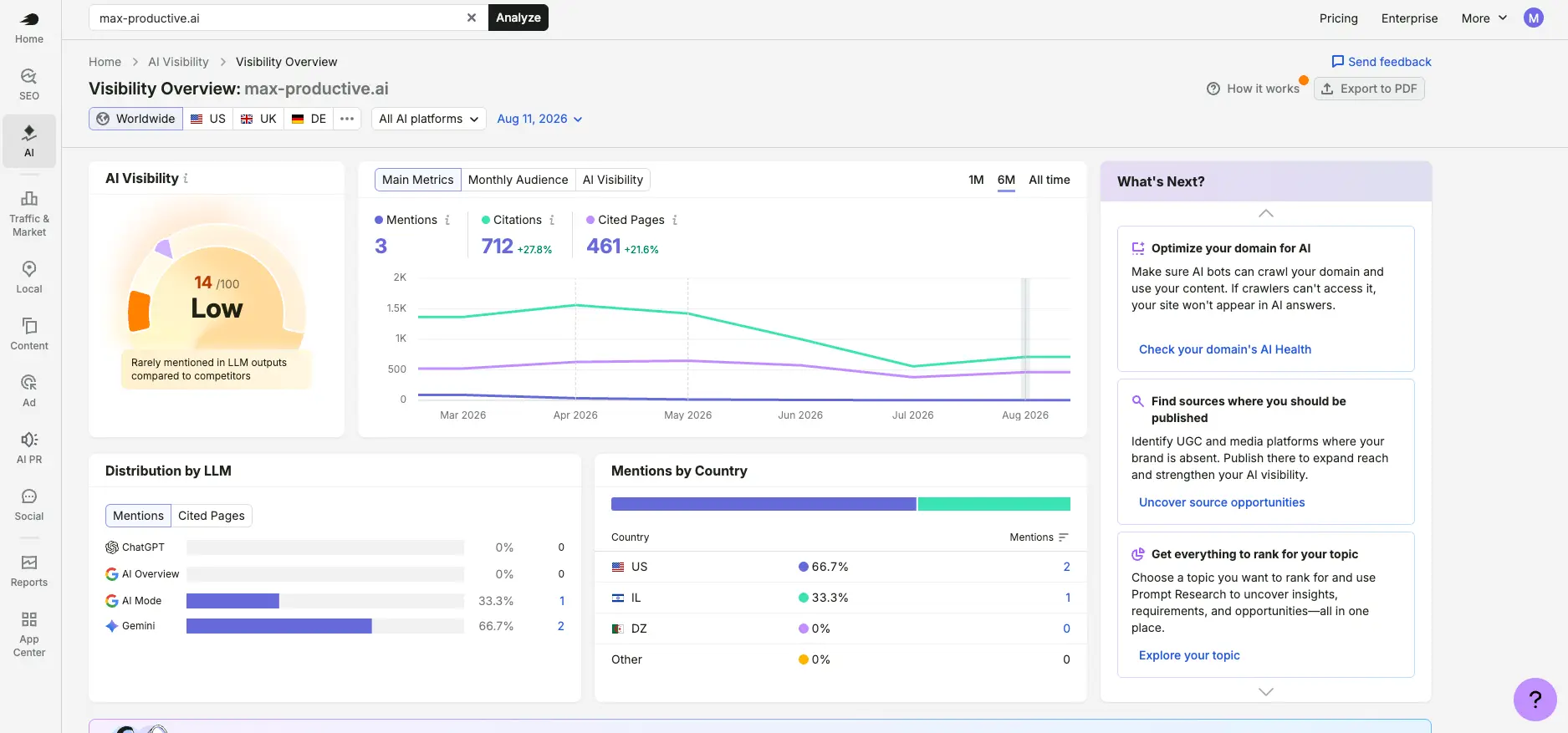
The Category Default for SEO —
and Now for AI Visibility Too
As of August 2026, Semrush is still the deepest dataset you can buy in SEO software — nearly 28 billion keywords and tens of trillions of indexed links — and it's now ahead of every legacy competitor on AI search, tracking brand mentions across seven engines from ChatGPT to Google AI Mode. We run it on this site, and the AI Visibility Toolkit is the closest thing we've used to a real answer for "do LLMs mention us?" It's expensive, the tiers gate features aggressively, and the interface takes weeks to feel natural. But if you'll actually use the breadth, nothing else in the category matches it.
✓ What We Love
- Unrivaled keyword + backlink data among mainstream suites
- AI Visibility Toolkit watches every major AI engine, prompt by prompt
- Official MCP server pipes live data into ChatGPT and Claude
- Free plan and free AI checker to start without paying
! Could Be Better
- Meaningful AI tracking costs extra on classic plans
- Pro → Guru jump (~79% more) just to unlock content tools
- Billing and cancellation complaints are a real pattern
What Is Semrush?
What the platform covers in 2026, what changed with the Adobe deal, and who it's built for.
Semrush is a cloud-based digital marketing platform built around one of the largest datasets in the industry: nearly 28 billion keywords across 140+ country markets, a backlink index of 43 trillion links spanning roughly 390 million referring domains, and — since the AI search push began — a library of 289 million+ AI prompts and responses. It launched as an SEO tool back in 2008 and has since grown into more than fifty tools organized into toolkits covering keyword research, competitor intelligence, technical audits, content, PPC research, and AI visibility.
The biggest structural change in the product's history landed this spring. Adobe completed its $1.9 billion all-cash acquisition of Semrush on April 28, 2026 — announced in November 2025 at $12 per share (a 77% premium), approved by shareholders in February, and closed inside the projected window. Semrush now sits within Adobe's Experience Cloud as its brand visibility platform, with planned hooks into Adobe Experience Manager, Adobe Analytics, and the Adobe LLM Optimizer. The practical read for buyers: more financial stability and deeper enterprise integration ahead. The thing to watch: whether Adobe's enterprise pricing instincts eventually reach tiers that are already premium.
So where does it sit against the rest of our SEO tools lineup? What separates Semrush from suites like SE Ranking or Search Atlas is raw data scale — no competitor except Ahrefs plays in the same league, and Ahrefs only on links. What separates it from content specialists like Surfer SEO or Clearscope is that content optimization is one toolkit among many here, not the whole product.
Our Testing
We run Semrush on max-productive.ai itself, and every screenshot on this page comes from our own account — including the numbers that don't flatter us, like our 14/100 AI Visibility Score and Authority Score of 26. That low AI score is exactly why the toolkit earns its keep: it shows where we're absent from LLM answers and which sources to target to fix it. No demo data, no vendor press kit.
One terminology warning before you compare this review with older ones: Semrush's AI features have been renamed more than once. The AI Visibility Toolkit was called the AI SEO Toolkit (and before that, AI Overview Tracker) until a February 2026 rebrand, and the AI features are spread across several products rather than one unified tool. If a 2025 review describes something that seems to no longer exist, it probably just changed names.
Who Is Semrush Best For?
Agencies managing multiple clients, in-house SEO and content teams, and marketing professionals who will put the full toolkit to work — competitor research, technical audits, rank tracking, content briefs, and AI visibility in one place. It's the wrong buy for solo creators who'll use two tools out of 55, or teams that only need AI-answer tracking; both groups pay for depth they'll never touch.
Inside Our Semrush Account
Real screenshots from the platform running on this site — AI visibility first, then the classic SEO toolkits.
AI Visibility Overview
The headline dashboard: how often LLMs mention and cite your brand
This is our real dashboard, and it's brutally honest with us: a visibility score of just 14, "rarely mentioned in LLM outputs compared to competitors." Painful to see, which is the point. The chart splits mentions, citations, and cited pages over six months, filterable by country and AI platform. The Gemini-heavy distribution told us something we couldn't have guessed: two-thirds of our brand mentions come from a single engine.
Topics & Sources
Which topics you appear in, and which sources feed the answers
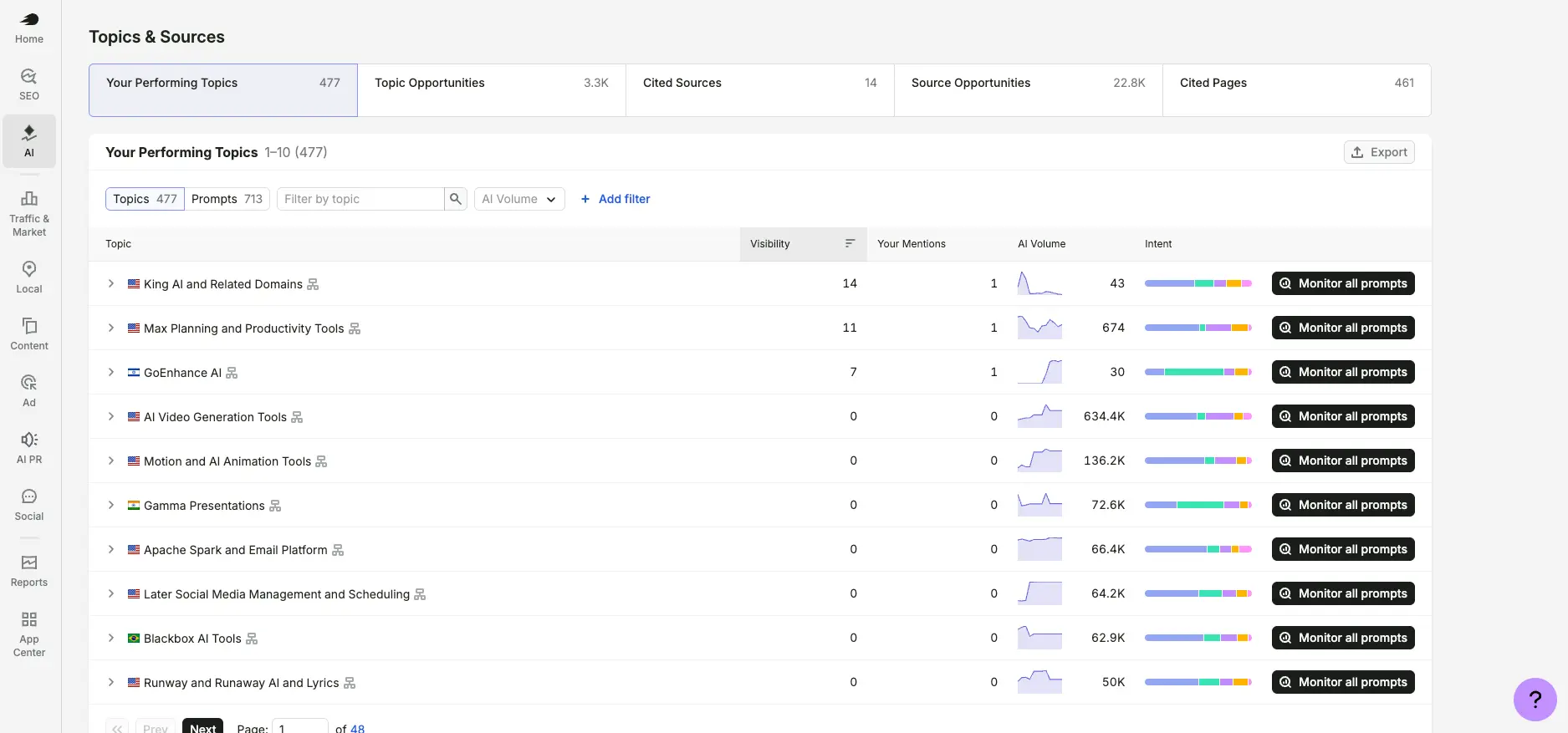
Here's where the toolkit turns from reporting into strategy. Each topic gets an AI Volume figure — how frequently people ask LLMs about it — next to your visibility and mention counts. Seeing "AI Video Generation Tools" at 634.4K AI Volume with zero mentions for us is a content roadmap in one row. The Source Opportunities tab lists the specific sites LLMs cite in your topics, which feeds directly into outreach.
Prompt-Level Analysis
The exact AI response, the brands mentioned, and the sources behind it
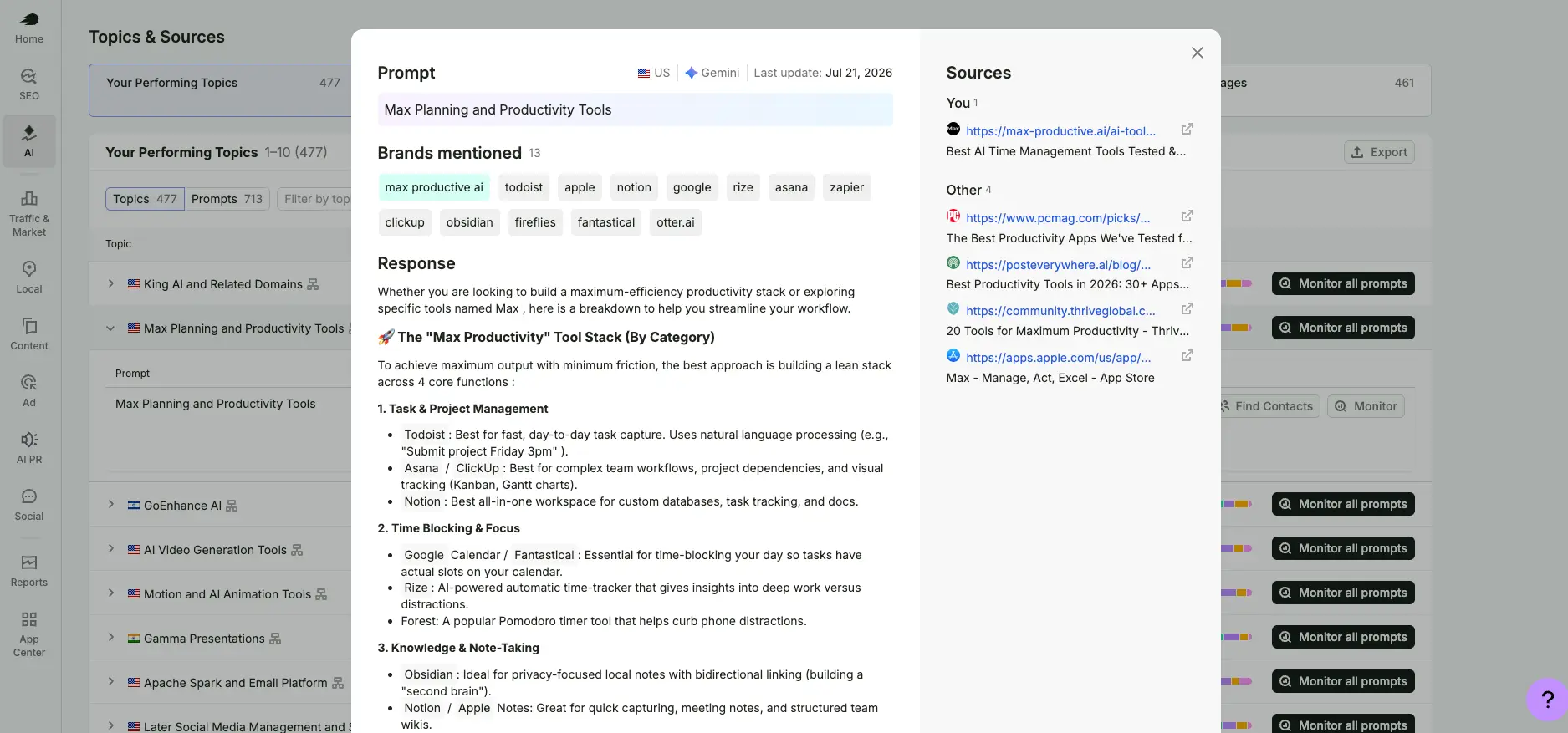
Drill into any prompt and you get the complete AI response, every brand it named, and the sources panel splitting citations into "You" and "Other" — the part we use most. In this example, Gemini cited one of our own pages alongside PCMag and the App Store. That source list is actionable: it tells you whether to fix your own content or pitch the third-party pages doing the citing.
AI PR: Media Visibility
Find the media outlets LLMs trust, then pitch them
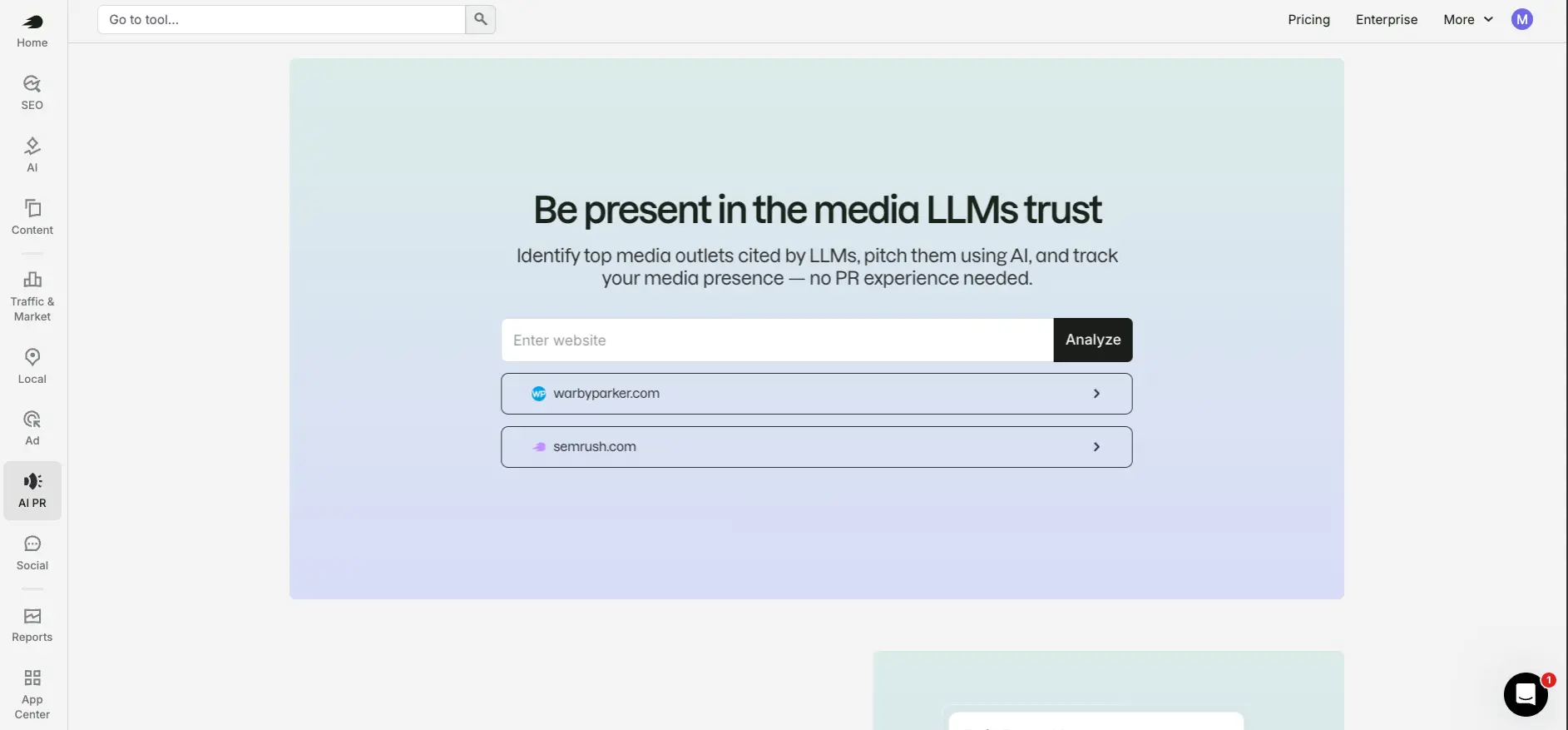
A newer addition that follows logically from the citation data: if LLMs keep citing certain outlets in your niche, being covered by those outlets is how you enter the answers. AI PR identifies them and helps draft pitches. We haven't run a full campaign through it yet, so treat this one as a walkthrough rather than a verdict. But the premise is sound, and it's a workflow no dedicated tracker we've reviewed offers.
Organic Rankings
The classic view: keywords, positions, and traffic estimates
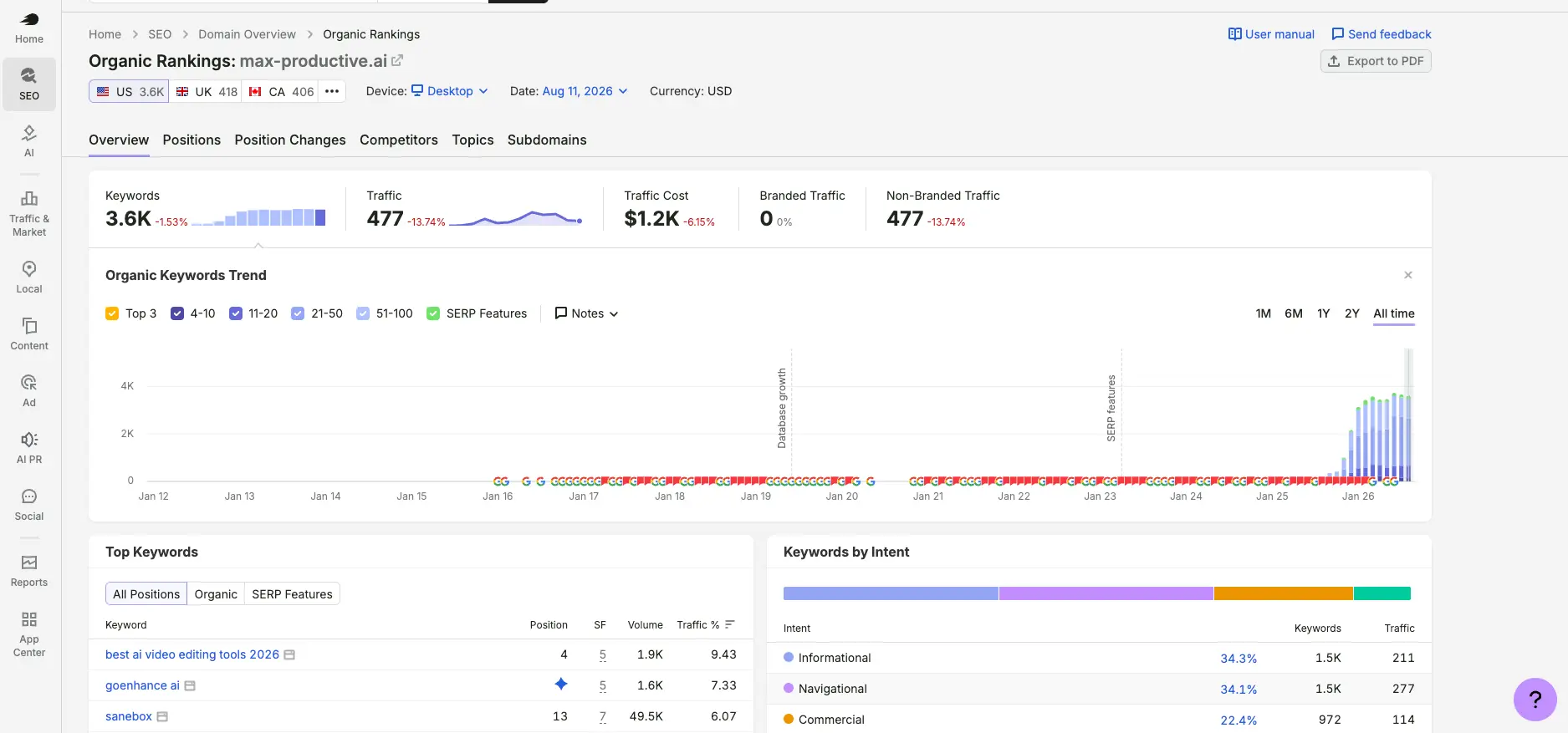
The bread and butter. Our site ranks for 3.6K keywords in the US, and this view lists them one by one — down to "best ai video editing tools 2026" sitting at position 4 with 1.9K monthly searches. The intent breakdown (34% informational, 22% commercial for us) is one of the most useful charts here for content planning. One honest caveat we cover in the cons: the traffic estimates for small sites run well below reality.
Want to see what the data says about your own site?
Try Semrush →Free plan • 10 lookups per day, no payment requiredBacklink Analytics
Authority Score, referring domains, and link growth over time
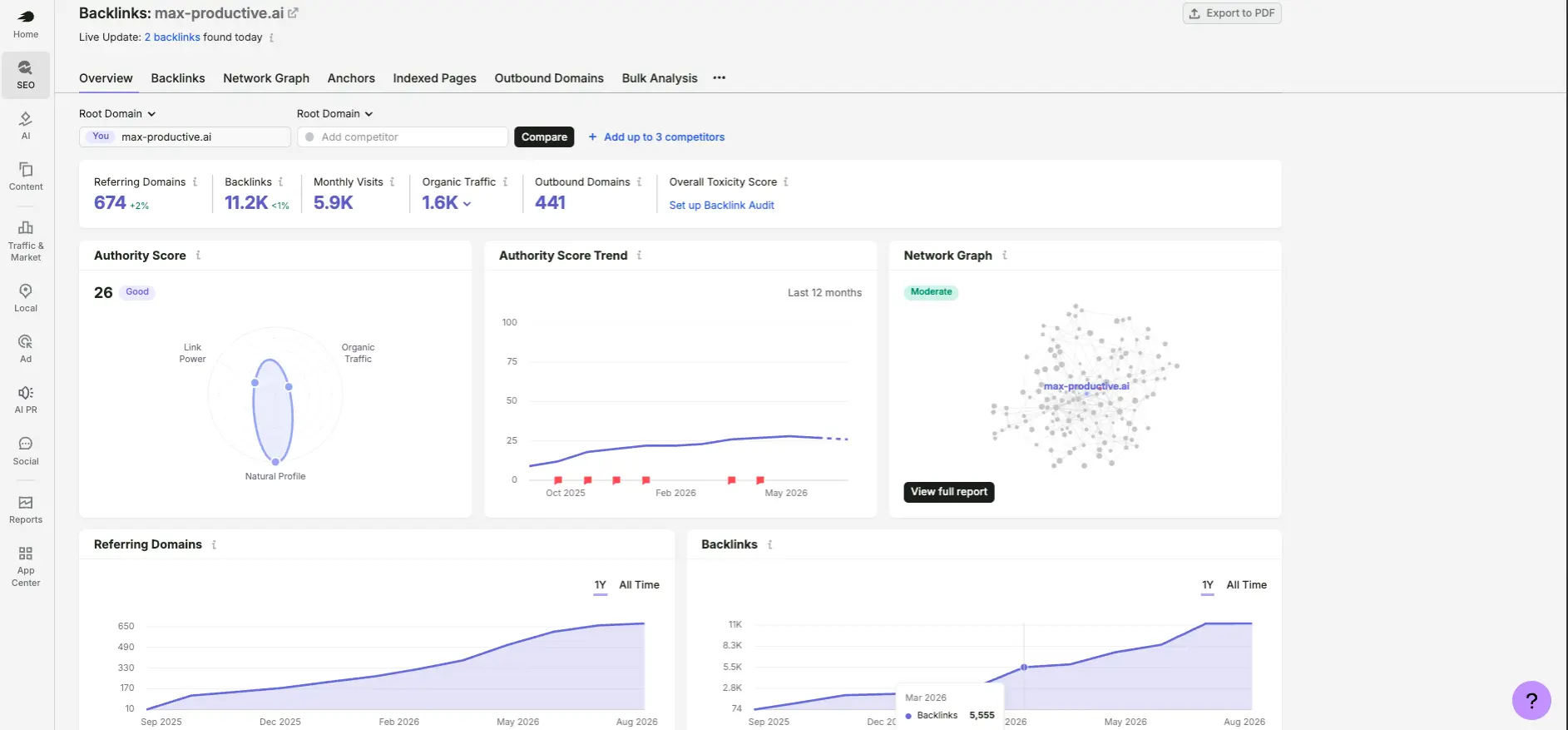
Our profile: an Authority Score of 26, rated "Good", with referring domains up 2% and 11.2K total backlinks. The trend charts going back a year make link-building progress visible in a way monthly spreadsheets never did, and the toxicity scoring flags anything worth auditing. Worth noting: in head-to-head tests, Ahrefs still edges Semrush on link index freshness — more on that in the cons.
Site Audit with AI Search Health
Technical checks, now including whether AI crawlers can read you
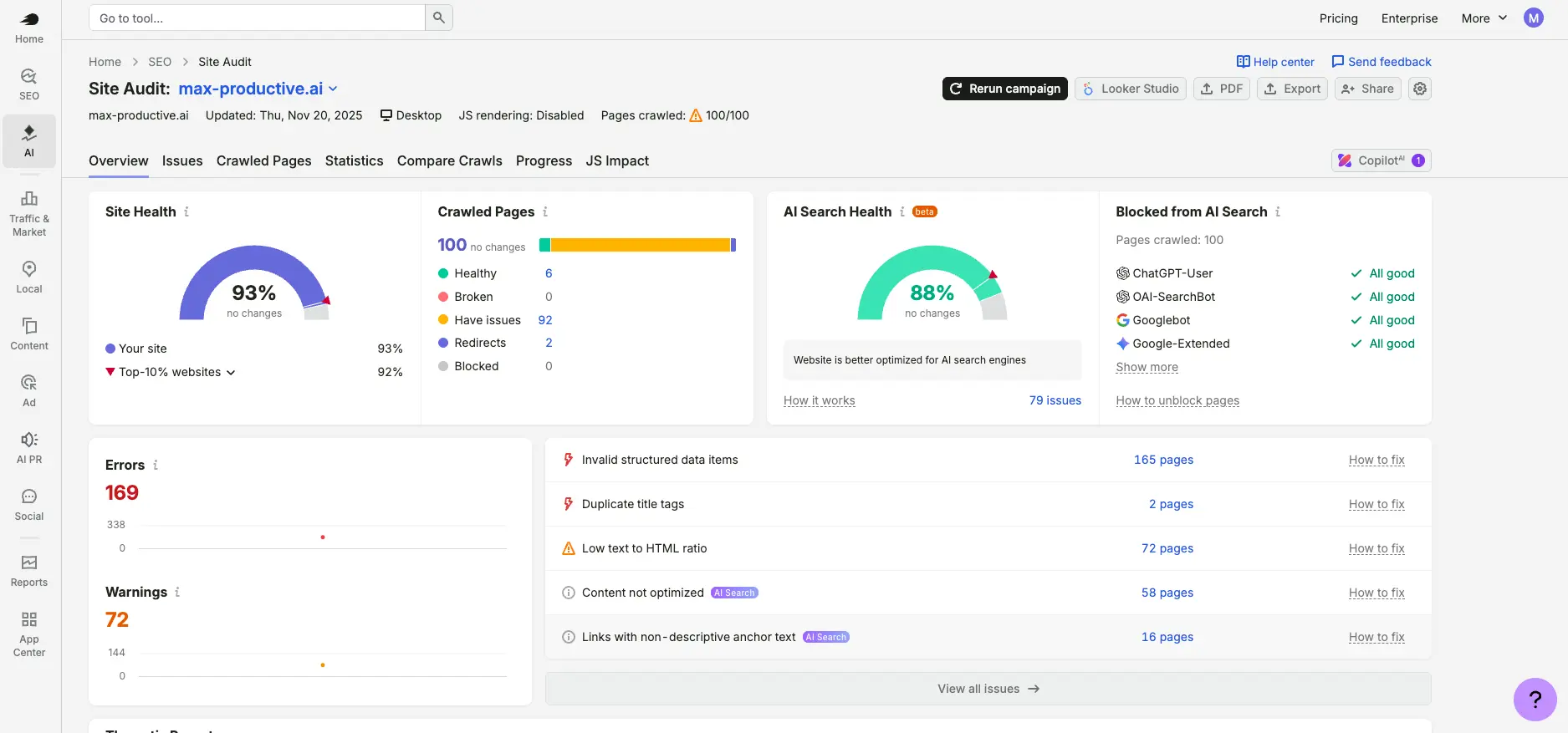
The audit crawls 130+ technical checks and rolls them into one health score; ours sits at 93%, a point above the top-10% benchmark. The new and useful part is the AI Search Health panel: it verifies that ChatGPT-User, OAI-SearchBot, Googlebot, and Google-Extended can all access your pages, then flags AI-specific issues like content not optimized for AI answers and non-descriptive anchor text. If AI crawlers can't read you, no amount of AEO work matters.
SEO Content Template
Keyword-driven briefs and draft generation
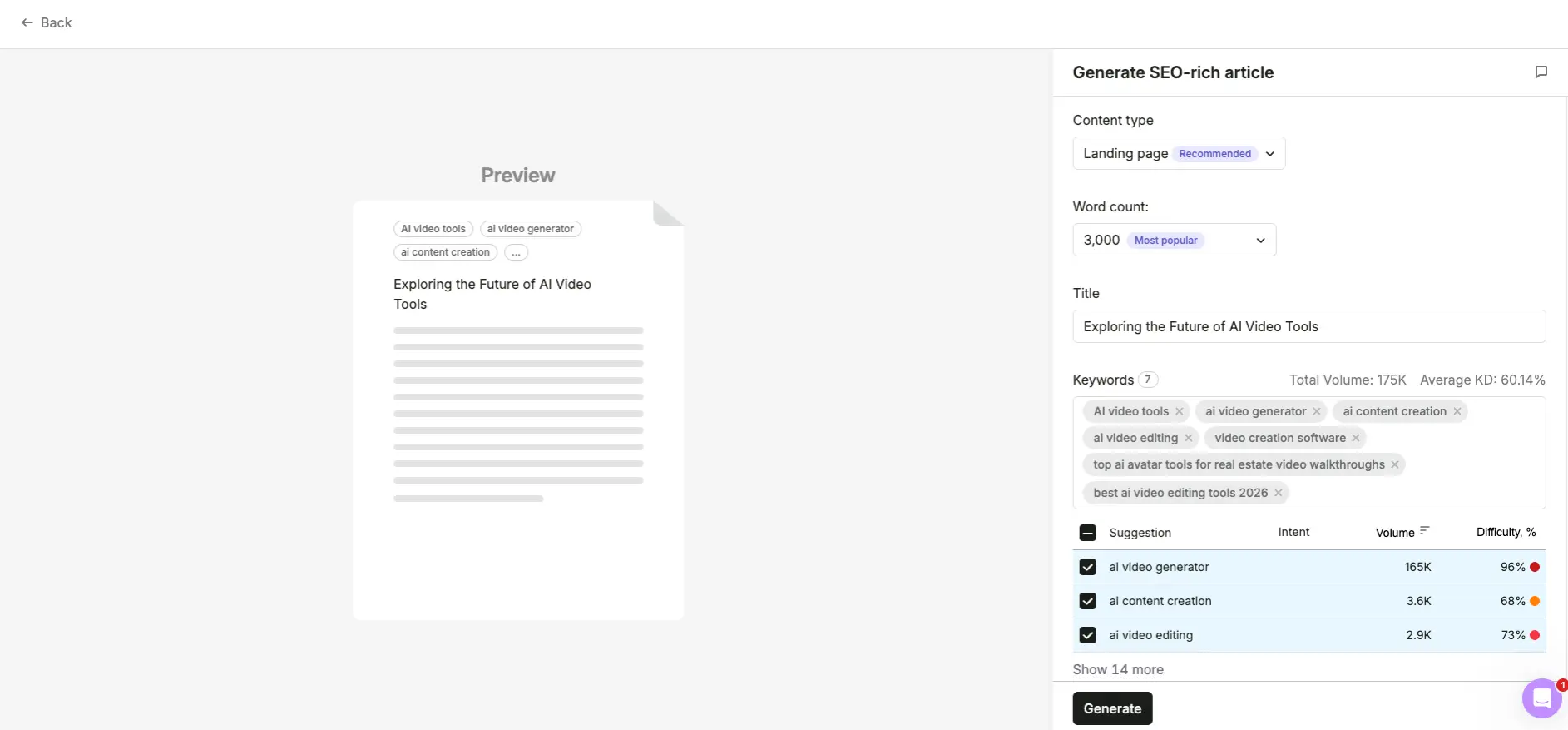
Pick a content type, feed it target keywords (it suggests related terms with volume and difficulty; 175K combined volume in our test setup), and it generates a structured draft. Is the output publish-ready? No, and you shouldn't want it to be. It's a strong first-draft-plus-brief machine that a human editor then makes worth reading. Used that way, it fits into a content workflow well.
Content Optimizer
Score your draft against what's ranking — for search and AI
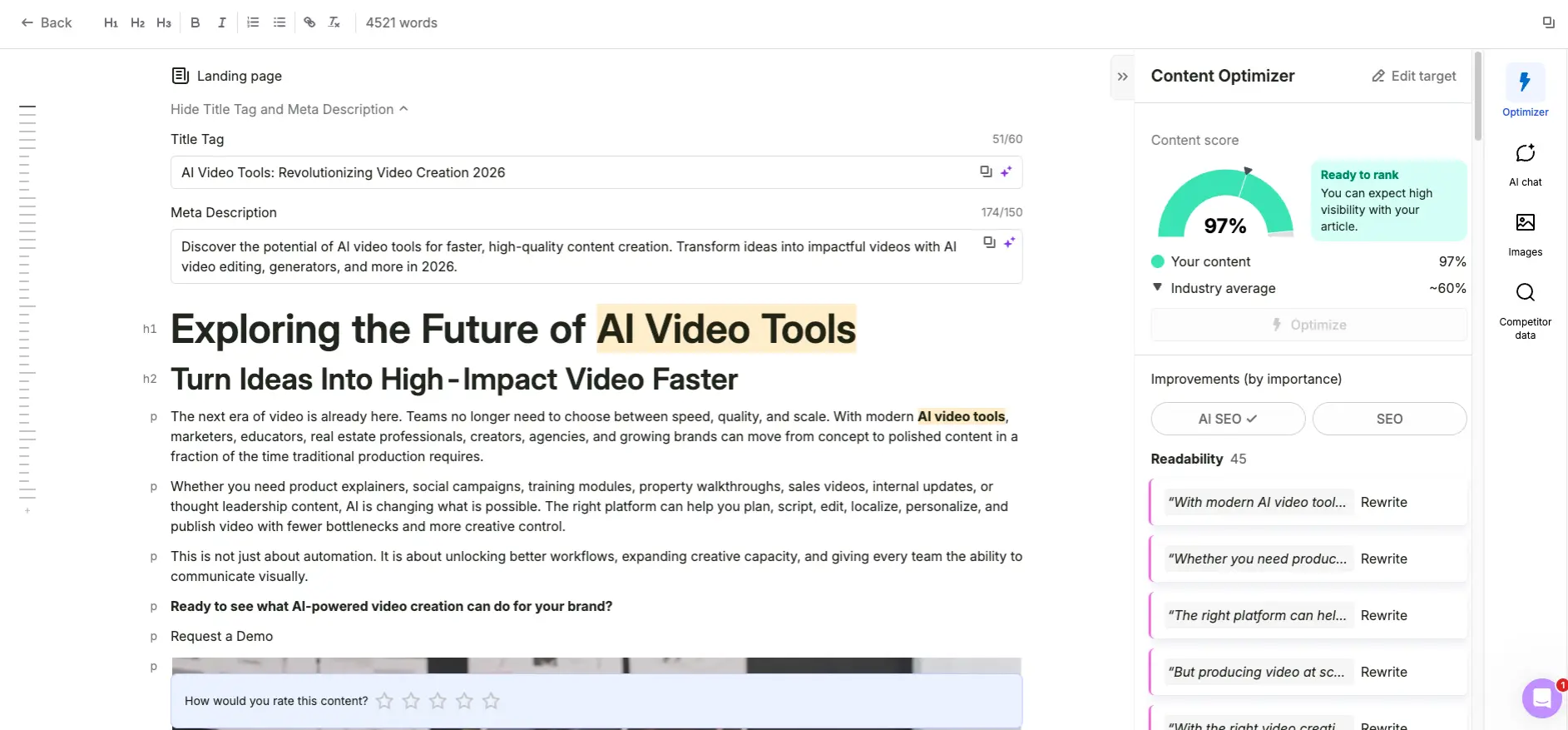
The optimizer scores drafts in real time: the test draft here hit 97% against a ~60% industry average. Improvements come split into classic SEO and AI SEO lists, a distinction Surfer only recently started making. Title tag and meta description checks with character counters are built in. If content optimization is your entire job, Surfer's editor is still more refined; if it's one of ten jobs, this is more than enough.
App Center
The add-on marketplace — useful, but watch the extra costs
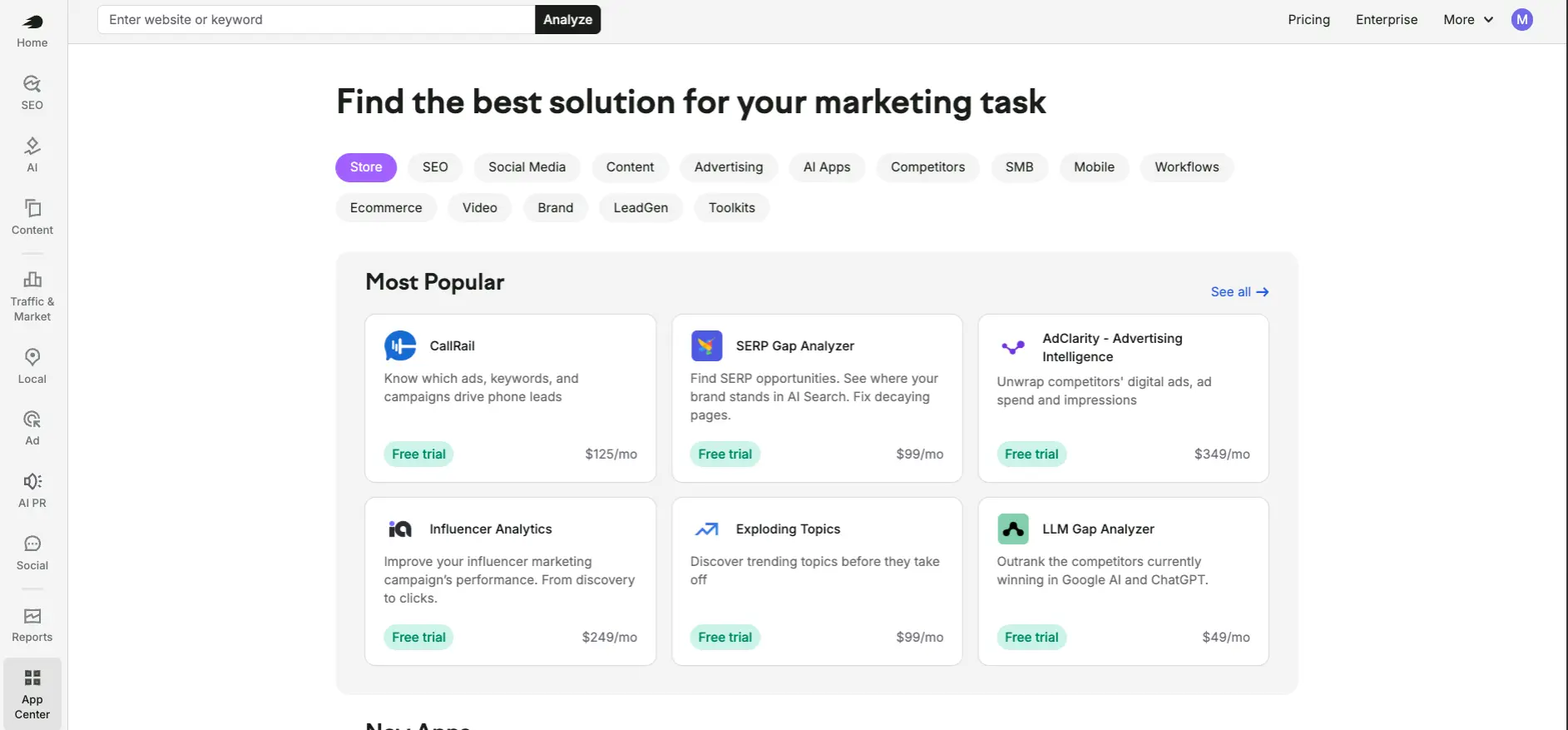
The App Center extends the platform with specialist apps — an LLM Gap Analyzer at $49/mo, SERP Gap Analyzer at $99/mo, AdClarity for ad intelligence at $349/mo, and dozens more, most with free trials. Here's the thing: these bill on top of your subscription, which is how the entry plan quietly becomes a $300 stack. Treat the App Center as optional extras to add deliberately, not as part of the advertised package.
How Semrush Works
The workflow that keeps the toolkits manageable: one project, four loops.
Create a Project and Connect Your Domain
Everything hangs off a project. Add your domain and Semrush spins up the project-level tools — Site Audit, Position Tracking, backlink monitoring — with optional Google Analytics and Search Console connections for first-party data alongside Semrush's estimates. Setup takes minutes; understanding everything the project dashboard now shows you takes longer. Start with two or three tools and resist opening every tab on day one.
Audit and Fix
Run Site Audit and work the prioritized issue list: it checks crawlability, Core Web Vitals, structured data, duplicate content, orphan pages, and a hundred-plus items total, each with a "how to fix" explainer. The 2026 addition is the AI Search Health layer, which confirms AI crawlers can access your content and surfaces AI-specific issues. This is the least glamorous loop and the one with the most reliable payoff.
Research Keywords and Competitors
The Keyword Magic Tool is the front door: seed term in, thousands of related keywords out, each with volume, difficulty, intent, and CPC. A 2026 update added Personal Keyword Difficulty, which scores how hard a keyword is for your domain specifically rather than in the abstract — a small change that makes prioritization noticeably more realistic. From there, Organic Research and Keyword Gap show you what competitors rank for that you don't.
Track Rankings — and AI Answers
Position Tracking updates daily with device- and location-level granularity. From the Guru tier, it flags when a tracked keyword triggers a Google AI Overview and whether your domain is cited in it. For the full picture across ChatGPT, Perplexity, Claude, Gemini, Copilot, and Google AI Mode, you'll need the AI Visibility Toolkit or a Semrush One plan; that's where the prompt-level tracking from our screenshots lives.
The MCP Server: Semrush Inside Your AI Assistant
Semrush ships an official MCP (Model Context Protocol) server, meaning you can query its keyword, backlink, and AI-visibility data in plain language from inside ChatGPT, Claude, Gemini, Perplexity, Cursor, or VS Code. Ask "which keywords did we lose last month?" mid-conversation and get live data back. Among the suites we've reviewed, this first-party integration is unique. The catch: it requires Semrush One Starter ($199/month) or an API tier.
Budget Real Onboarding Time
Honestly, the learning curve is the tax you pay for everything the platform tries to do. It took us a few weeks of regular use before navigating the toolkits felt automatic, and independent reviews tell the same story. The toolkit grouping helps once it clicks. Plan for that ramp instead of judging the platform on day two.
Key Features
The tools that matter most across the classic SEO stack and the AI layer.
Keyword Magic Tool
The industry's largest keyword database, filterable by volume, difficulty, intent, SERP features, and question format across 140+ markets. Personal Keyword Difficulty (added 2026) scores difficulty relative to your own domain's authority — the difference between "this keyword is hard" and "this keyword is hard for you."
Site Audit + AI Search Health
130+ technical checks rolled into a single health score with prioritized fixes. The beta AI Search Health layer verifies AI crawler access (ChatGPT-User, OAI-SearchBot, Google-Extended) and flags content that isn't structured for AI answers — a check most audit tools don't run yet.
Backlink Analytics
The largest link index in the category: Authority Score, anchor-text distribution, toxicity flags, and Backlink Gap benchmarking against up to four competitors.
Position Tracking
Daily rank updates with device- and location-level splits, multi-location tracking on higher tiers, and — from Guru — an AI Overview tab that captures the Overview text and checks whether your domain is cited in it. Google-only on that tab, but refreshed daily.
AI Visibility Toolkit
Prompt-based tracking across all the major AI answer engines, a 0–100 visibility score, Prompt Research showing the exact queries that trigger citations, and competitor cited-vs-not breakdowns. Independent hands-on testing rated it 9.4/10 — the only AI tracker tightly integrated with a full SEO suite. Priced separately: ~$99–$249/mo, or bundled into Semrush One.
Content Marketing Toolkit
Topic Research, SEO Content Template, SEO Writing Assistant, ContentShake AI, and the Content Optimizer with separate SEO and AI SEO scoring. Solid for brief-to-draft workflows — though it's gated behind the Guru tier, which is one of our bigger gripes with the pricing.
MCP Server
Query live Semrush data from inside ChatGPT, Claude, Gemini, Perplexity, Cursor, and VS Code using natural language. If your team already works AI-first, it changes how often you open the Semrush interface at all. Requires Semrush One Starter or API access.
App Center
A marketplace of specialist add-ons — SERP gap analysis, ad intelligence, influencer analytics, an LLM Gap Analyzer — each with its own trial and its own monthly bill. Useful when you need a specific capability; a budget trap if you subscribe casually.
Beyond the headliners, the platform covers PPC and advertising research (keyword CPC data, competitor ad copy history), local SEO with listing management, social media scheduling, and Traffic Analytics for estimating any site's traffic sources. And there's a free entry path most competitors don't offer: the free plan's 10 daily lookups plus the free AI Search Visibility Checker (three checks a day) give you a real look at the dataset before spending anything.
Curious what the dataset shows for your domain and your competitors?
Try Semrush →Free AI Search Visibility Checker • 3 checks per daySemrush Pricing Plans
Two tracks: classic SEO plans, and Semrush One bundles that fold AI visibility in natively.
Semrush pricing in 2026 takes more explaining than it should. The classic plans (Pro, Guru, Business) cover the SEO toolkits, with meaningful AI tracking sold separately as the AI Visibility Toolkit add-on. The newer Semrush One tiers ($199–$549/month) bundle SEO and AI visibility together, add the MCP server, and are usually the cleaner buy if AI tracking is part of why you're here. The three most relevant entry points:
Free
- ✓ 10 keyword/domain lookups per day
- ✓ Taste of Keyword Overview & Domain Overview
- ✓ Free AI Search Visibility Checker (3/day)
- ✓ No payment details required
- ✓ Good enough to judge data quality
Pro
- ✓ 5 projects, 500 tracked keywords
- ✓ Full keyword & competitor research
- ✓ Site Audit + Backlink Analytics
- ✓ Daily Position Tracking
- ✗ No Content Toolkit or AI Overview tab
Guru
- ✓ 15 projects, 1,500 tracked keywords
- ✓ Content Marketing Toolkit unlocked
- ✓ AI Overview tab in Position Tracking
- ✓ Historical data & multi-location tracking
- ✓ The tier most content teams end up needing
Annual billing saves roughly 16–17% on every tier.
Pricing last verified August 2026. Visit Semrush for current rates.
Is It Worth the Money?
The math depends entirely on usage. A content team stacking Surfer ($99), a dedicated AI tracker ($49–99), and a separate backlink tool already spends near Semrush's entry price for shallower data. A solo blogger who lives in two of those tools is overpaying — that's who the free plan and cheaper suites exist for.
For context against the rest of our SEO roster: SE Ranking's $129 Core plan includes AI tracking that Semrush charges extra for — its whole pitch is near-Semrush functionality at 40–50% lower total cost. Search Atlas starts at $99, but AI visibility needs its Growth tier at double that. Surfer SEO advertises entry pricing around $49–59, though reviewers put a fully-featured setup closer to $180–220/month. And dedicated trackers like Rankscale get you AI monitoring alone from $99 for a functional tier. Semrush costs the most and delivers the most — the question is whether you need the most.
Detailed Pros & Cons
What holds up after running Semrush on our own site, and what genuinely doesn't.
✓ Pros
Almost every feature on the platform inherits its value from the underlying dataset: the largest combined keyword-and-backlink corpus among mainstream suites, refreshed continuously. Volumes, difficulty scores, and competitor estimates get more trustworthy as the data behind them gets bigger, and nothing else on our SEO Tools list operates at this scale except Ahrefs, and only on links.
Seven engines, prompt-level responses, source attribution, and competitor cited-vs-not comparisons. Independent hands-on testing rated the toolkit 9.4/10 and called it the only AI tracker tightly integrated with a real SEO suite. Our own dashboard experience backs that up — the Topics & Sources report alone reshaped our content priorities.
Querying live keyword and visibility data from inside Claude or ChatGPT sounds like a gimmick until you've done it mid-workflow. Among legacy SEO vendors, Semrush shipped this first and most completely — a real edge for teams whose daily work already runs through AI assistants.
SEO, content, PPC research, competitive intelligence, local, social, and AI visibility under one login. For agencies juggling many clients, consolidating four subscriptions into one isn't just a cost story; it's fewer logins, fewer data discrepancies between tools, and one reporting layer for everything.
Daily updates, device and location splits, multi-location tracking, and the AI Overview tab that shows whether Google's AI answer cites you for tracked keywords. The daily cadence matters more than it sounds: weekly trackers hide volatility that daily data catches.
Ten lookups a day doesn't sound like much, but it's enough to judge the data against what you already know about your site — and the free AI checker adds a taste of the visibility tracking. Given the price of the paid tiers, don't skip that step.
✗ Cons
On classic plans, the full seven-engine tracking is a separate purchase at roughly $99–$249/month, on top of a subscription that already starts near $140. Compare SE Ranking, which bundles AI tracking into its $129 Core plan at no extra charge. Semrush's toolkit is deeper, but the pricing structure stings.
The jump from Pro to Guru costs about 79% more, and it's required just to unlock the Content Marketing Toolkit, historical data, and the AI Overview tab. API access sits behind the $499.95 Business tier. Too many of the good parts live one expensive step above wherever you are.
Dozens of tools means a lot of interface. Independent reviewers repeatedly describe it as overwhelming at first, and our own onboarding took weeks before the toolkit structure felt natural. If you need to be productive on day one with zero ramp, this will frustrate you.
There's a stark split in Semrush's ratings: strong marks from professional reviewers, but a Trustpilot rating in the 1.9–2.8 range across roughly 900–1,300 reviews, overwhelmingly about refunds and cancellation friction, not product quality. Read the cancellation terms before subscribing, set a calendar reminder before renewals, and think twice about annual contracts until you're sure.
Semrush estimates a few hundred monthly organic visits for this site; our analytics put the real figure many times higher. For small domains, treat traffic numbers as directional, not literal. Head-to-head tests also give Ahrefs the edge on backlink freshness and depth — relevant if link analysis is your primary job.
Several independent reviews score customer support low, citing slow responses and rigid handling of refund and account issues. For a product at this price, support should be a strength; by most accounts it isn't yet.
Semrush vs Alternatives
How it stacks up against the strongest tools in our SEO category.
The Semrush vs Ahrefs question comes up more than any other, and the honest answer is that they win different fights: Semrush on breadth (PPC, content, AI visibility, one platform for everything), Ahrefs on backlink data depth. Against the full-stack suites below, the trade-off is simpler: Semrush has the most data and the highest real cost.
| Feature | Reviewed Semrush | SE Ranking | Search Atlas | Surfer SEO |
|---|---|---|---|---|
| Starting Price | $139.95/mo | $129/mo | $99/mo | $49–59/mo |
| AI Visibility at Entry Price | Add-on or Guru+ | ✓ Included | Growth tier ($199) | AI Tracker from $99 tier |
| AI Engines Tracked | 7 | 4+ | Multiple LLMs (Growth+) | 1 at Standard, more on Pro |
| Backlink & Technical SEO | Unmatched data depth | Strong (120+ audit checks) | Strong + OTTO auto-fixes | None |
| Content Optimization | Included from Guru | Included | Included | Best-in-class editor |
| MCP / AI Assistant Access | ✓ Official server | Limited | ✓ Own MCP server | — |
| Best For | Agencies needing max data depth | Best-value all-in-one | Automated execution | Article-level optimization |
Which Tool Is Right For You?
Semrush
ReviewedBest for: Agencies and in-house teams that will use most of what they're paying for — competitor intelligence, technical audits, content briefs, PPC research, and AI visibility from one dataset that no rival except Ahrefs approaches in scale. If AI tracking is part of the draw, price the Semrush One bundle rather than stacking add-ons onto a classic plan.
Ahrefs
Backlink DepthBest for: Teams whose work centers on link analysis and link building. Ahrefs is generally rated stronger than Semrush on backlink data depth, freshness, and accuracy, with an interface many find easier to learn. It gives up ground on PPC research, content tooling, and AI visibility coverage — pick it when best-in-class link data outweighs all-in-one convenience.

SE Ranking
Best ValueBest for: SMBs and budget-conscious agencies wanting near-Semrush functionality at 40–50% lower total cost. The $129 Core plan bundles AI Overview, AI Mode, ChatGPT, and Perplexity tracking at no extra charge — the exact capability Semrush sells separately — plus daily rank tracking with accuracy that holds up in independent testing. The database is smaller; for most SMB use cases, it's enough.
Surfer SEO
Content FocusBest for: Content teams optimizing articles one at a time. Surfer's Content Editor and real-time NLP scoring remain the reference point for on-page work, ahead of Semrush's own optimizer in polish. But it's not a suite — no backlink analysis, no technical crawler — so it pairs with a platform like Semrush or SE Ranking rather than replacing one. Budget realistically: a fully-featured setup lands well above the headline price.

Search Atlas
AutomationBest for: Teams that want fixes implemented, not just diagnosed. Its OTTO SEO agent executes technical changes automatically — something no other tool in this table does — and AI visibility arrives on the Growth tier. One caution from 2026 hands-on testing: credit systems and per-site fees can push real costs above the advertised numbers, so verify your actual total. See our full Semrush vs Search Atlas comparison →

Rankscale
Budget AI TrackingBest for: Solo operators who only need AI-visibility monitoring, not a full SEO suite. Rankscale tracks 10+ engines — a wider named list than Semrush — with a functional tier at $99/month (skip the near-empty $20 Essentials plan). No backlink analysis, no rank tracking, credit-metered usage. If AI answers are your whole question, this answers it for a fraction of Semrush's total cost.
If dedicated AI-answer tracking is your whole use case, the specialist category runs deeper than one card can cover — Rankprompt, OmniSEO, and HubSpot AEO each take a different angle on it. We compared the whole field in our Peec AI alternatives guide.
Frequently Asked Questions
Should You Try Semrush?
Our verdict for August 2026: Semrush has earned its place as the category default. The dataset underneath it has no real rival for scale, the classic toolkits are mature, and the AI Visibility Toolkit is the most complete answer any established SEO vendor has shipped to the "do LLMs mention us?" question — we know, because we use it on this site to answer exactly that. Add the Adobe backing and the MCP server, and the platform's direction looks stronger than it has in years.
The reasons to hesitate are just as clear. Full AI tracking is an extra cost on classic plans, the tier gating pushes the real price well past the entry number, and the billing-complaint pattern on Trustpilot deserves your attention before you hand over card details, especially for annual contracts. This is a professional tool at a professional price, and it rewards teams that spread across its toolkits and penalizes everyone else.
Our Recommendation
Start on the free plan and run your own domain through Keyword Overview, Site Audit, and the free AI checker — that costs nothing and tells you whether the data quality justifies the price for your situation. If AI visibility is part of why you're buying, price Semrush One Starter against Pro plus the toolkit add-on; the bundle is usually the cleaner math. And whichever tier you pick, read the cancellation terms first. That's where most of the horror stories start, and it's entirely avoidable.