
Semrush vs Search Atlas (2026): Which AI-Powered SEO & LLM Visibility Platform Should You Choose?
One tracks AI visibility with enterprise-grade analytics. The other automates SEO implementation with OTTO. Here's how to choose the right platform for your workflow.
Choose Semrush
If you need the deepest AI visibility analytics, 26.4B keyword database, and enterprise-grade reporting for strategic decision-making.
Choose Search Atlas
If you want automated SEO implementation via OTTO, broader LLM tracking (ChatGPT, Claude, Perplexity), and cost-effective multi-domain management.
| Priority | Best Choice | Starting Price |
|---|---|---|
| Deepest data & enterprise reporting | Semrush One | $199/mo |
| AI automation & GEO implementation | Search Atlas Growth | $199/mo |
| Multi-domain AI visibility (5+ sites) | Search Atlas Pro | $399/mo |
| AI Overviews & competitive intelligence | Semrush AI Toolkit | $99/mo/domain |
AI-powered search is no longer a future trend—it's reshaping how people find information right now. Google AI Overviews appear in a growing share of search results, ChatGPT has become a go-to research tool for millions, and Perplexity AI is gaining traction among professionals. If your SEO tool only tracks traditional rankings, you're missing a significant piece of the discovery puzzle.
The core trade-off between Semrush and Search Atlas comes down to philosophy: Semrush is the AI visibility analytics powerhouse—it tells you everything, and you implement. Search Atlas is the AI visibility execution engine—it tracks LLMs AND fixes your site automatically through OTTO.
After exploring both platforms, here's the truth: neither is universally "better." The right choice depends entirely on your team structure, budget, and whether you need data or automation. This comparison breaks down exactly what each tool does, how they differ, and which one fits your workflow.
Why AI Visibility & LLM Tracking Define SEO Success in 2026
The search landscape has fundamentally shifted. AI-powered search experiences aren't coming—they're already here, and they're reshaping how users discover information and make decisions.
Google AI Overviews now appear in a significant portion of search results, with early studies suggesting notable CTR impact in competitive niches. ChatGPT has grown to serve hundreds of millions of weekly active users and continues expanding rapidly. Perplexity AI has emerged as a preferred research tool for professionals seeking in-depth answers.
Brands appearing in AI-generated answers are seeing increased brand recall and engagement compared to traditional SERP positions. This shift is the new reality that both Semrush and Search Atlas are racing to address.
What GEO (Generative Engine Optimization) Actually Means
GEO—Generative Engine Optimization—represents a fundamental shift from traditional SEO. Instead of optimizing for ranking positions in search results, GEO focuses on being cited within AI-generated answers.
The core components include entity optimization to establish clear knowledge graph presence, building authority signals from sources that LLMs trust, prompt matching to align content with actual user questions, and semantic depth that covers topics comprehensively rather than just targeting keywords.
Traditional SEO tools fail at GEO because they don't track where LLMs cite your brand in generated answers. This is precisely the gap that both Semrush and Search Atlas are addressing—but with very different approaches.
What Is Semrush? The AI Visibility Analytics Powerhouse
Semrush has established itself as the most comprehensive SEO data platform in the industry. With a 26.4B keyword database updated daily, 43T backlinks with the fastest refresh rate, and 808M+ domains tracked across 190+ countries, Semrush provides the deepest dataset available for SEO professionals.
In October 2025, Semrush launched Semrush One, bundling their core SEO toolkit with the AI Visibility Toolkit into unified subscription plans. This positions them as the go-to platform for brands that need both traditional SEO intelligence and AI search visibility in one place.

Semrush AI Visibility Toolkit Features
AI Visibility Score Dashboard provides real-time score tracking with competitor benchmarks, month-over-month visibility trends, and sentiment analysis of AI mentions. The composite 0-100 metric measures your brand's presence across all major LLMs.
Prompt Research Interface lets you track up to 25 custom prompts on the base plan, with 300 AI visibility checks per day. The system suggests prompts based on competitor gaps and provides seasonal prompt trend analysis.
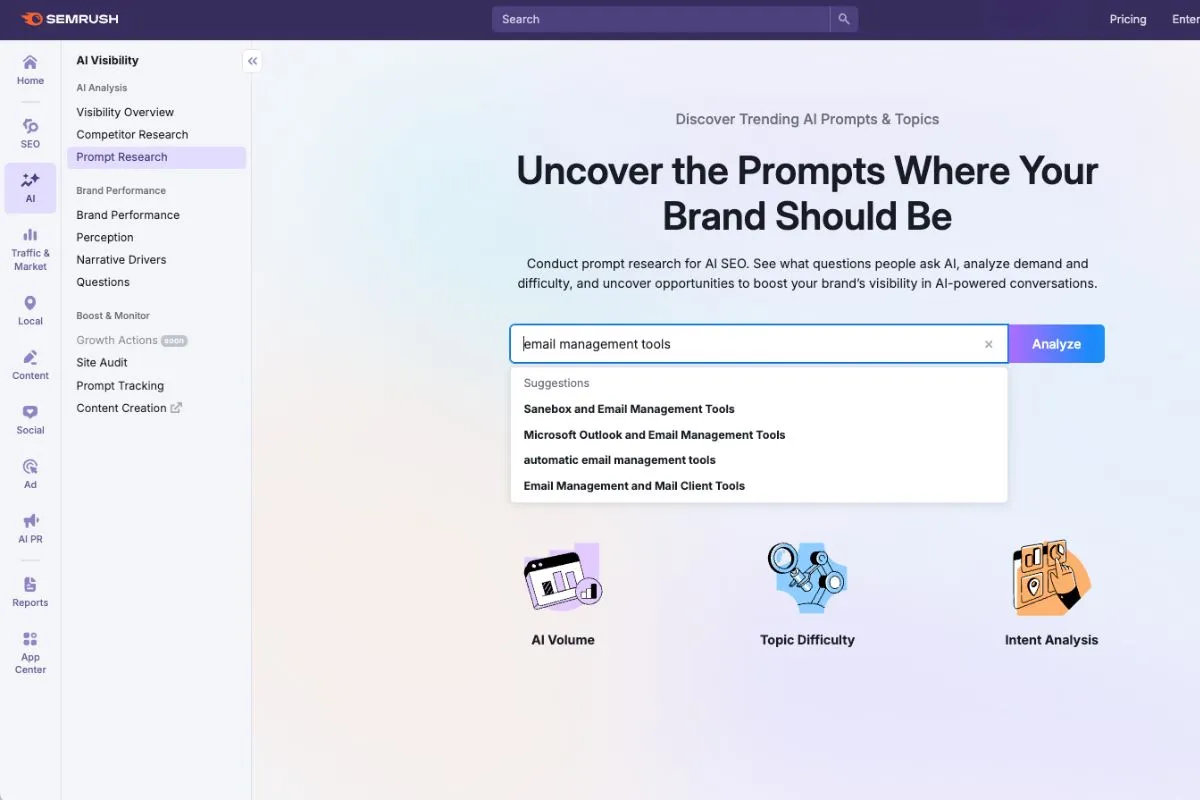
Competitor AI Intelligence reveals which prompts trigger competitor citations, identifies gaps where rivals appear but you don't, and provides citation source analysis showing which domains LLMs trust for specific topics.

Business Drivers Analysis breaks down key factors driving AI visibility by frequency, comparing your brand against competitors across specific business attributes and purchase considerations.

Semrush Best For
Semrush excels for enterprises needing massive data for strategic decisions, full-service agencies managing SEO, PPC, content, and social campaigns, data science teams requiring API access and custom reporting, and brands where Google AI Overviews visibility is mission-critical.
Semrush Key Limitations
The primary limitation is the implementation gap—Semrush tells you what to fix, but you must implement manually. The per-domain AI visibility pricing ($99/mo per domain) scales quickly for agencies. The 45+ tools can overwhelm new users, and LLM coverage focuses primarily on Google AI and ChatGPT with limited Claude/Perplexity tracking.
14-day free trial includes AI Visibility Toolkit + SEO Pro features
What Is Search Atlas? The AI Execution Engine
Search Atlas positions itself as an all-in-one AI-powered SEO automation platform built for agencies and brands that want to implement, not just analyze. The platform unifies 25+ SEO tools with LLM visibility tracking and—most importantly—OTTO, their AI agent that automatically executes SEO optimizations.
Founded by Manick Bhan, Search Atlas has rapidly expanded its feature set, with the bold tagline "Cancel Ahrefs and Semrush" reflecting their ambition to consolidate multiple tools into one platform with automation at its core.

OTTO SEO: The Game-Changer
OTTO is what truly differentiates Search Atlas from every other SEO platform. It's a pixel-based implementation system that works on any CMS—WordPress, Shopify, custom builds—deploying optimizations in seconds rather than weeks.
The system uses client-side JavaScript to implement changes in real-time after your approval. Title tags, meta descriptions, schema markup, internal linking, broken link fixes, canonical tags—OTTO handles all of it automatically. And crucially, it includes a one-click rollback feature if anything breaks.
Search Atlas LLM Visibility Features
Search Atlas tracks brand visibility across more LLMs than any competitor: ChatGPT, Gemini, Claude, Perplexity, SearchGPT, Microsoft Copilot, and Grok. This breadth matters because your audience isn't using just one AI platform.

The LLM Visibility Dashboard provides cross-platform visibility scores, query-level performance metrics including position, sentiment, and citation share, competitor comparison across all tracked LLMs, and topic clustering showing which themes drive AI citations.

GEO Actions & Automation connects LLM insights directly to OTTO implementation. When competitor visibility exceeds yours by more than 25% for a given query, OTTO suggests and can automatically deploy actions—content optimization, entity additions, schema markup, internal linking.

Search Atlas Best For
Search Atlas excels for SEO agencies wanting to automate 70-90% of manual work, GEO/AEO pioneers optimizing for ChatGPT/Perplexity discovery, local SEO shops managing 10-100+ GBP profiles, and SaaS/Shopify stores needing fast implementation without developer resources.
Search Atlas Key Limitations
The platform has a smaller dataset (5.2B keywords vs Semrush's 26.4B), which matters for long-tail niche research. Some users report UI bugs and variable support response times. OTTO can potentially break layouts if configured incorrectly, requiring oversight. Enterprise features like API access are more limited compared to Semrush.
7-day free trial includes OTTO automation + LLM visibility
Head-to-Head Feature Comparison
AI/LLM Visibility Comparison
| Feature | Semrush | Search Atlas | Winner |
|---|---|---|---|
| Prompt Database | 158M+ queries, monthly refresh | Growing dataset, daily API calls | Semrush |
| LLMs Tracked | Google AI, ChatGPT, Gemini, Perplexity | ChatGPT, Gemini, Claude, Perplexity, SearchGPT, Copilot, Grok | Search Atlas |
| AI Overviews | Deep integration, CTR tracking | Basic appearance tracking | Semrush |
| Custom Prompts | 25 (base), 100 (Enterprise) | Unlimited | Search Atlas |
| GEO Workflow | Manual implementation | Automated via OTTO | Search Atlas |
| Update Frequency | Weekly scores, monthly prompts | Daily live data | Search Atlas |
| Sentiment Analysis | ✅ Yes | ✅ Yes | Tie |
| Share of Voice | Enterprise feature | All plans | Search Atlas |
Automation & Execution Comparison
| Task | Semrush Approach | Search Atlas OTTO | Time Savings |
|---|---|---|---|
| Technical Fixes | Recommendations only | Auto-implement after approval | 90% faster |
| Content Optimization | AI suggestions | Auto-optimize + AI write | 80% faster |
| GBP Management | Semi-automated | Full automation | 95% faster |
| Internal Linking | Manual suggestions | Auto-deploy | 85% faster |
| Schema Markup | Audit only | Auto-generate & deploy | 90% faster |
Data Quality & Scale Comparison
| Dataset | Semrush | Search Atlas | Gap Impact |
|---|---|---|---|
| Keywords | 26.4B | 5.2B | Significant for long-tail niches |
| Backlinks | 43T | 100T | Minimal impact for most sites |
| Domains | 808M | 500M | Minor for mid-market sites |
| Historical Data | 10+ years | 2-3 years | Major for trend analysis |
| API Limits | 10,000 calls/day (Guru) | 1,000 calls/day (Pro) | Significant for large agencies |
Pricing & Total Cost of Ownership
Semrush Pricing Breakdown
Core SEO Plans:
| Plan | Monthly | Annual (17% off) | Projects | Keywords |
|---|---|---|---|---|
| Pro | $139.95/mo | ~$116/mo | 5 | 500 |
| Guru | $249.95/mo | ~$208/mo | 15 | 1,500 |
| Business | $499.95/mo | ~$416/mo | 40 | 5,000 |
AI Visibility Toolkit: $99/mo per domain with 25 custom prompts, 300 daily checks, and 100 AI Search Check pages.
Semrush One Bundles (SEO + AI Visibility combined):
| Plan | Price | What's Included |
|---|---|---|
| Starter | $199/mo | Pro + AI Toolkit for 1 domain |
| Pro+ | $299/mo | Guru + AI Toolkit for 1 domain + .Trends |
| Advanced | $549/mo | Business + AI Toolkit for 3 domains + full suite |
Search Atlas Pricing Breakdown
| Plan | Price | OTTO SEO | Users | Key Features |
|---|---|---|---|---|
| Starter | $99/mo | 1 project | 2 | LLM visibility, basic OTTO, unlimited keywords |
| Growth | $199/mo | 2 projects | 3 | Advanced OTTO, white-label reports |
| Pro | $399/mo | 4 projects | 5 | Full white-label, higher quotas |
| Enterprise | Custom | Unlimited | Custom | API access, dedicated support |
Important: Additional OTTO SEO activations can be added for $99/mo per site, dropping to $59/mo at volume.
Real Cost Comparison by Use Case
1 domain: Semrush One ($199/mo) vs Search Atlas Starter ($99/mo)
5 domains: Semrush ($199 + 4×$99 = $595/mo) vs Search Atlas Growth ($199/mo)
10 domains: Semrush ($199 + 9×$99 = $1,090/mo) vs Search Atlas Pro ($399/mo)
Winner: Search Atlas provides 65%+ savings for multi-domain portfolios.
Pros and Cons
Semrush
Pros
- Largest keyword database (26.4B keywords)
- 158M+ prompt database for AI visibility
- Deep AI Overviews integration with CTR tracking
- 10+ years of historical data for trend analysis
- All-in-one platform (SEO + PPC + Content + Social)
- Enterprise-grade API access (10,000 calls/day)
- 24/7 live chat support with fast response
- Established brand recognition for client proposals
- 14-day free trial with full features
Cons
- No automated implementation—requires manual work
- AI Visibility costs $99/mo per domain (scales quickly)
- Limited Claude/Perplexity tracking
- 45+ tools create steep learning curve
- White-label only on Business plan ($499+/mo)
- 2-4 week implementation lag for recommendations
Search Atlas
Pros
- OTTO can significantly reduce manual SEO work (agencies report up to 70-90% reduction)
- Tracks more LLMs (ChatGPT, Claude, Perplexity, Grok, Copilot)
- Daily live data vs monthly refresh
- Unlimited custom prompt tracking (all plans)
- Cost-effective for multi-domain management
- Full white-label dashboards on Pro plan ($399/mo)
- Changes stay live even after cancellation (with pixel)
- Instant implementation—days vs weeks
- Strong local SEO with GBP automation
Cons
- Smaller keyword database (5.2B vs 26.4B)
- Only 2-3 years of historical data
- UI bugs reported by some users
- Support response times can vary
- OTTO requires oversight—can break layouts if misconfigured
- Limited API access vs Semrush enterprise
- Shorter 7-day free trial
Who Should Choose Each Platform?
Choose Semrush If You Are...
Enterprise SEO Director at Fortune 500: You need 10-year historical data, API integration with BI tools, and executive reporting. You're tracking AI visibility across 50+ brand domains and measuring impact on $50M+ organic revenue. Stack: Semrush Business ($499/mo) + Enterprise AIO (custom pricing).
Full-Service Agency VP of Operations: You need white-label reports, multi-channel campaign management, and data for client upsells. You're proposing AI visibility services to 20 clients using Semrush's brand recognition. Stack: Semrush Guru ($249/mo) + AI Visibility for top 5 clients ($495/mo).
SaaS Growth Marketing Lead: You need competitive intelligence, content gap analysis, and trend forecasting. You're identifying AI Overviews opportunities before competitors to reduce CAC by 30%. Stack: Semrush One Pro+ ($299/mo).
Choose Search Atlas If You Are...
SEO Agency Owner (10-30 clients): You need automation to scale without hiring, white-label dashboards, and LLM tracking. You're managing 25 client sites with a 2-person team using OTTO to achieve 300% increase in client capacity. Stack: Search Atlas Growth ($199/mo) + 2 OTTO seats.
Local SEO Specialist (50+ GBP Profiles): You need GBP automation, citation building, review management, and geogrid tracking. You're automating posts, replies, and optimizations across 50 locations, saving 50 hours/week. Stack: Search Atlas Pro ($399/mo).
GEO/AEO Content Strategist: You need LLM visibility tracking, entity optimization, and AI content generation. You're optimizing content specifically for ChatGPT/Perplexity citation, achieving first-page citations for 30% of target queries. Stack: Search Atlas Starter ($99/mo).
Getting Started: Implementation Guide
Getting Started with Semrush
Setting up Semrush is straightforward if you approach it methodically. Start by registering for the 14-day free trial and connecting your Google Search Console, Analytics, and Google Business Profile accounts. Add your main competitor domains for tracking and configure your custom prompts in the AI Visibility Toolkit.
Once connected, run your first AI Visibility Report—it takes about 30 seconds. Export AI Search Checks for your top-performing pages and identify where you're appearing (or missing) in AI Overviews. The competitive gap analysis will show you prompts where rivals appear but you don't.
From there, prioritize fixes by business impact. Assign tasks to your development and content teams, track implementation progress in Semrush Projects, and set up weekly AI visibility reviews to monitor changes. Start with high-traffic pages already showing in AI Overviews and focus on prompts with commercial intent first.
Getting Started with Search Atlas
Search Atlas is designed for quick deployment. Register for the 7-day free trial and add the OTTO pixel to your site header—it's a simple copy-paste that takes about five minutes. Connect your GSC, GA4, and Google Business Profile accounts, then configure your Knowledge Graph with your business information and social profiles.
Run your initial LLM Visibility scan across all platforms and review OTTO's technical audit, which checks over 100 points. You can approve your first batch of high-impact fixes immediately—OTTO deploys changes in real-time. Set up automated GBP posts and review replies if you're managing local SEO.
Once your initial optimizations are live, schedule AI content generation for your blog, configure white-label dashboards for clients if you're an agency, and set up visibility alerts to notify you when competitors outperform you on specific queries. The key is to review OTTO's suggested changes before enabling full automation to avoid any unexpected issues.
Can You Use Both Together?
Yes—and this hybrid approach is increasingly popular among advanced SEOs who want the best of both worlds.
Hybrid Stack Strategy:
Use Semrush for Strategy & Research: Leverage the 158M+ prompt database for AI visibility planning, generate client proposals with Semrush data (brand recognition matters), and use competitive intelligence for strategic decisions. Cost: $199/mo for core research.
Use Search Atlas for Execution & LLM Tracking: Install OTTO for automated implementation across all client sites, use LLM Visibility for cross-platform tracking (ChatGPT, Claude, Perplexity), and deploy GEO actions based on Semrush insights. Cost: $199/mo for Growth plan.
Workflow Example: Monday—use Semrush to identify AI Overviews opportunities for 5 clients. Tuesday—export technical recommendations from Semrush Site Audit. Wednesday—feed recommendations into Search Atlas OTTO for auto-implementation. Thursday—monitor LLM visibility changes in Search Atlas dashboard. Friday—report results to clients using Search Atlas white-label reports.
Cost-Benefit Analysis: Combined cost is $398/mo vs Semrush alone for 5 domains ($634/mo). You gain 50% faster implementation and 100% more LLM coverage while offering both AI Overviews tracking (Semrush) and cross-LLM optimization (Search Atlas).
Final Verdict: Semrush vs Search Atlas
| Deepest keyword database | Semrush |
| Most LLMs tracked | Search Atlas |
| AI Overviews integration | Semrush |
| Automated SEO implementation | Search Atlas |
| Multi-domain cost efficiency | Search Atlas |
| Historical data depth | Semrush |
| White-label dashboards | Search Atlas |
| Enterprise API access | Semrush |
| GBP/Local SEO automation | Search Atlas |
| Daily data updates | Search Atlas |
| Unlimited custom prompts | Search Atlas |
| Customer support reliability | Semrush |
The Hybrid Recommendation (For Most Agencies): Use Semrush One for 1-2 strategic clients where deep data justifies the cost. Use Search Atlas Growth for all other clients to maximize automation and profitability. This hybrid approach leverages Semrush's analytics for proposals and Search Atlas's execution for delivery.
Bottom line: Both are excellent, enterprise-ready platforms. The right choice depends entirely on your primary need:
- Choose Semrush for analytics depth — if you need the largest dataset, AI Overviews tracking, and enterprise reporting
- Choose Search Atlas for execution speed — if you want automation, broader LLM coverage, and cost-effective scaling
Frequently Asked Questions
Explore more SEO tools in our comprehensive directory. For individual platform deep-dives, read our full Semrush review or Search Atlas review. Also check out our SE Ranking vs Surfer SEO comparison for alternative AI search tools.