
Search Atlas
Search Atlas bundles keyword research, site audits, AI content, rank tracking and AI-search visibility into one subscription, then adds OTTO, an agent that implements the fixes instead of handing you a to-do list. This Search Atlas review covers what that looks like in practice, what it costs, and where Ahrefs or Semrush still win.
Try Search Atlas →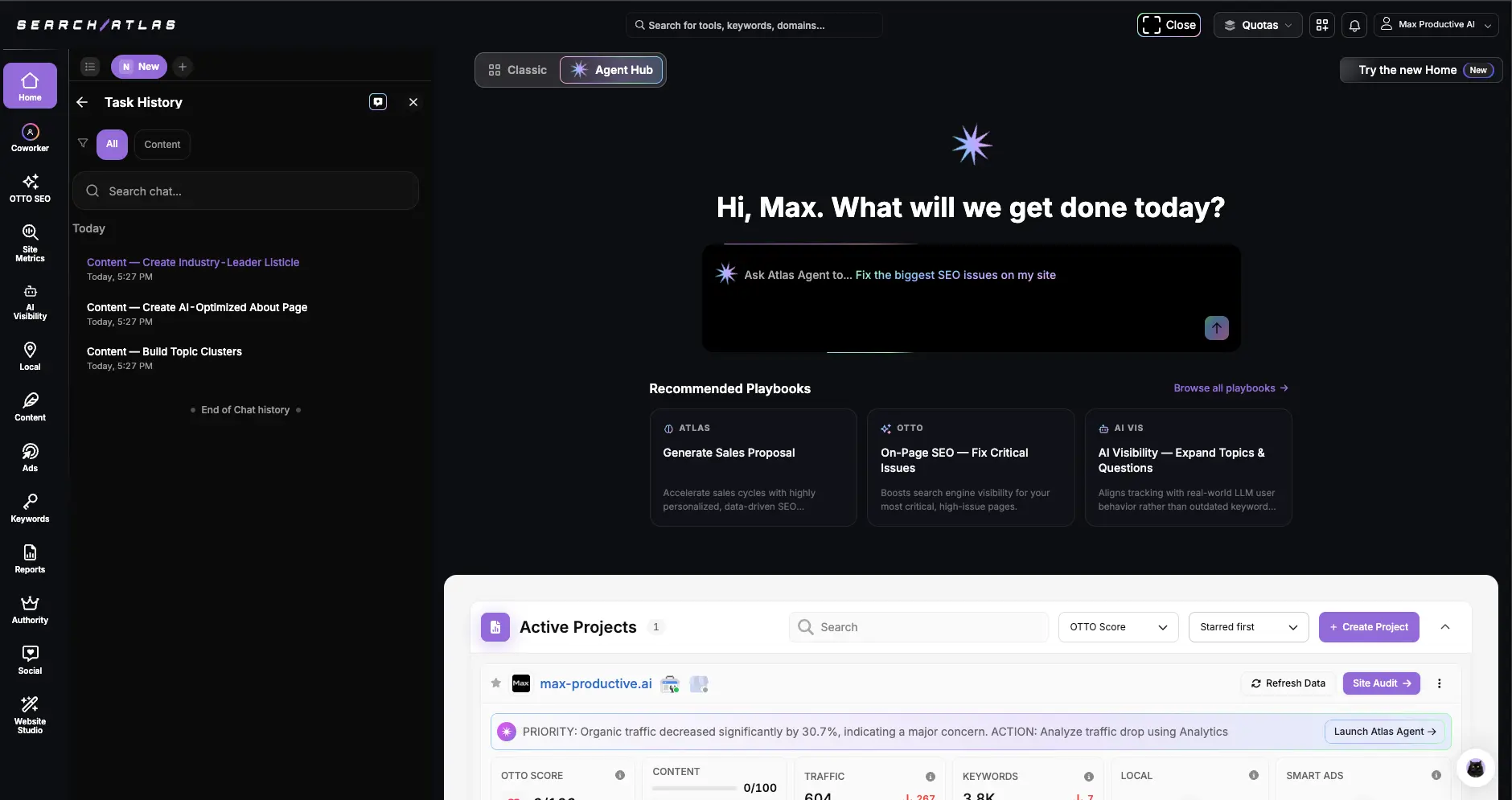
One Subscription That Researches,
Writes and Implements the Fixes
As of September 2026, Search Atlas is the tool I'd point a small team or agency to if they're tired of paying for four SEO subscriptions and still doing the implementation by hand. OTTO SEO writes the schema, fixes the meta tags and builds the internal links itself, and the new Agent Hub runs whole playbooks (topic clusters, content briefs, technical fixes) that wait for your approval before anything goes live. The data doesn't go as deep as Ahrefs or Semrush, AI visibility tracking starts at the $199 Growth plan, and OTTO works best with a human checking what it ships. For most sites, the trade is worth it.
✓ What We Love
- OTTO implements technical fixes rather than listing them
- Agent Hub playbooks with an approval step before anything goes live
- Keyword research, content, local, ads and AI visibility in one login
- A week of the full product to try, and Starter costs less than Semrush or Ahrefs Lite
! Could Be Better
- Ahrefs and Semrush still have the deeper keyword and link data
- AI visibility tracking isn't on the $99 Starter plan
- Lots of modules, so give yourself a week to find your way around
What Is Search Atlas?
An agency built it for its own clients first. That origin explains most of the design choices.
Search Atlas is an AI SEO platform that covers the whole job: keyword research, site audits, AI content, rank tracking, backlinks, local SEO, Google and Meta ads, and tracking of how your brand shows up in ChatGPT, Gemini, Google AI Mode, Copilot and Perplexity. The part that separates it from Semrush or Ahrefs is OTTO SEO, an agent that connects to your site and implements changes: schema markup, meta titles and descriptions, internal links, redirects. Other tools tell you what's wrong. This one fixes a good chunk of it.
It came out of LinkGraph, a New York SEO agency, and founder Manick Bhan built it to run his own client work before selling it as software. That history shows. White-label dashboards, client portals and per-site pricing are the things an agency owner wants, and the whole product is organized around projects rather than a single domain. The company puts its customer base at more than 30,000 businesses and 5,000-plus agencies, which is a long way from the small challenger it was two years ago.
The 2026 version has a second personality layered on top: Agent Hub. Instead of clicking through modules in the Classic view, you tell Atlas Agent what you want ("fix the biggest SEO issues on my site") or run a playbook, and it works across the connected tools, then asks you to approve the result. Coworker is the same agent living in Slack. Is it all finished? Not quite. Some playbooks need the website connection before they'll publish, and Microsoft Teams is still marked "coming soon". But the direction is clear, and it's the right one.
How We Evaluated Search Atlas
I set up a Search Atlas trial account under the Max Productive AI name, added max-productive.ai as a project, connected Google Search Console and ran the three onboarding playbooks (topic clusters, an AI-optimized About page and an industry listicle). I looked up keywords I write about, opened Content Genius, Coworker and Website Studio, and kept OTTO in review mode, so nothing was pushed to the live site. Pricing comes from the Search Atlas pricing page. The wider picture on support, reliability and billing comes from independent long-term reviews and public user feedback, not from a lab test, and I've said so wherever that applies.
So who is it for? Small marketing teams and agencies that want one login instead of Semrush plus Surfer SEO plus a separate AI-visibility tracker, and who have someone able to review what OTTO proposes. Solo site owners on the Starter plan get a lot for $99, with one caveat: AI visibility tracking begins at Growth. If your work is competitive backlink analysis, Ahrefs remains the deeper well. And if you'd rather hand the whole thing to a human team, Ranked AI is built for that.
What Changed Since Our Last Review
Quite a lot, which is why this page got a full rewrite rather than a date change. Since late 2025 Search Atlas has added Agent Hub and Atlas Agent playbooks, upgraded Content Genius to an Agent version with live scoring, launched Coworker for Slack and Telegram, added Website Studio, and extended AI Visibility to five engines on the Pro plan. The pricing tiers and credit quotas were reshuffled along the way, so if you priced it in 2025, look again.
See Search Atlas in Action
Six screens from my trial account, from the Agent Hub home to Website Studio.
Agent Hub Dashboard
Classic and Agent Hub views, recommended playbooks, and the active project panel
The home screen greets you by name and offers a prompt box. Below it sit three recommended playbooks, one from each family: an Atlas playbook (generate a sales proposal), an OTTO playbook (fix critical on-page issues) and an AI Visibility one (expand the topics and questions you track). Scroll down and the Active Projects panel shows the numbers for max-productive.ai: OTTO score, content score, traffic, keywords, local and smart ads. The priority alert above it had already spotted a traffic dip and offered to launch an agent to analyze it. I'd have preferred the Classic view as the default for a first visit, since it shows what the platform actually contains; Agent Hub assumes you already know what to ask for. One click switches between them, so it's a small complaint.
Atlas Agent Playbooks
Pick a goal, run a playbook, approve the output
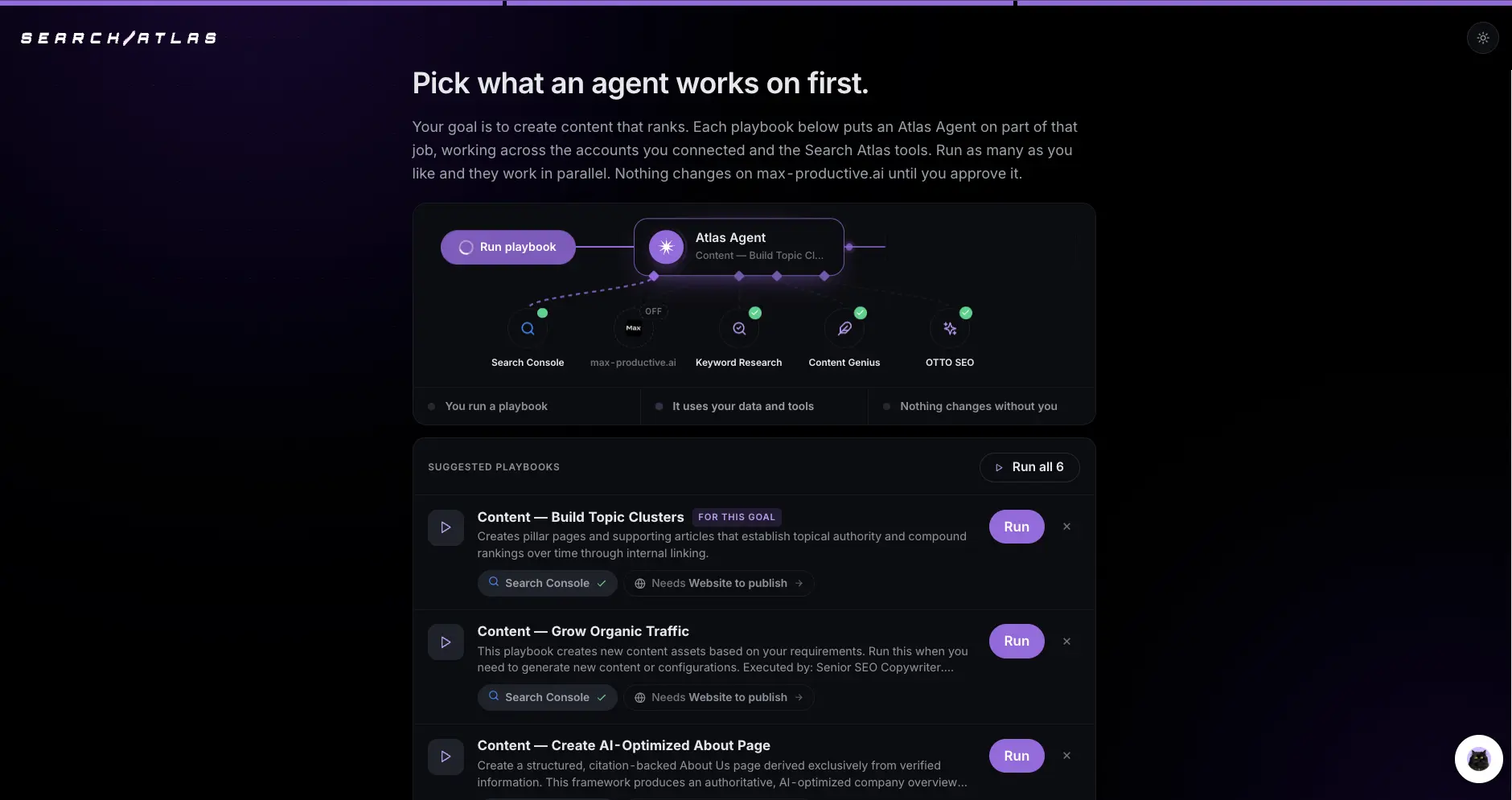
This is the screen that convinced me the agent idea is more than a chat box. It draws the flow: you run a playbook, Atlas Agent picks up the connected tools, and the output waits for you. I ran three. Build Topic Clusters produces pillar pages and supporting articles linked to each other. Grow Organic Traffic generates new content assets from a brief. Create AI-Optimized About Page drafts a citation-backed company page from verified information only. Two details matter here. The website toggle sat at OFF on my account until I chose to connect it, so nothing could be published by accident. And "Needs Website to publish" appears on every content playbook; the agent drafts without it, but won't ship. For software that can write to your site, that's how it should be.
Keyword Research Tool
Difficulty, volume, traffic potential and where the searches come from
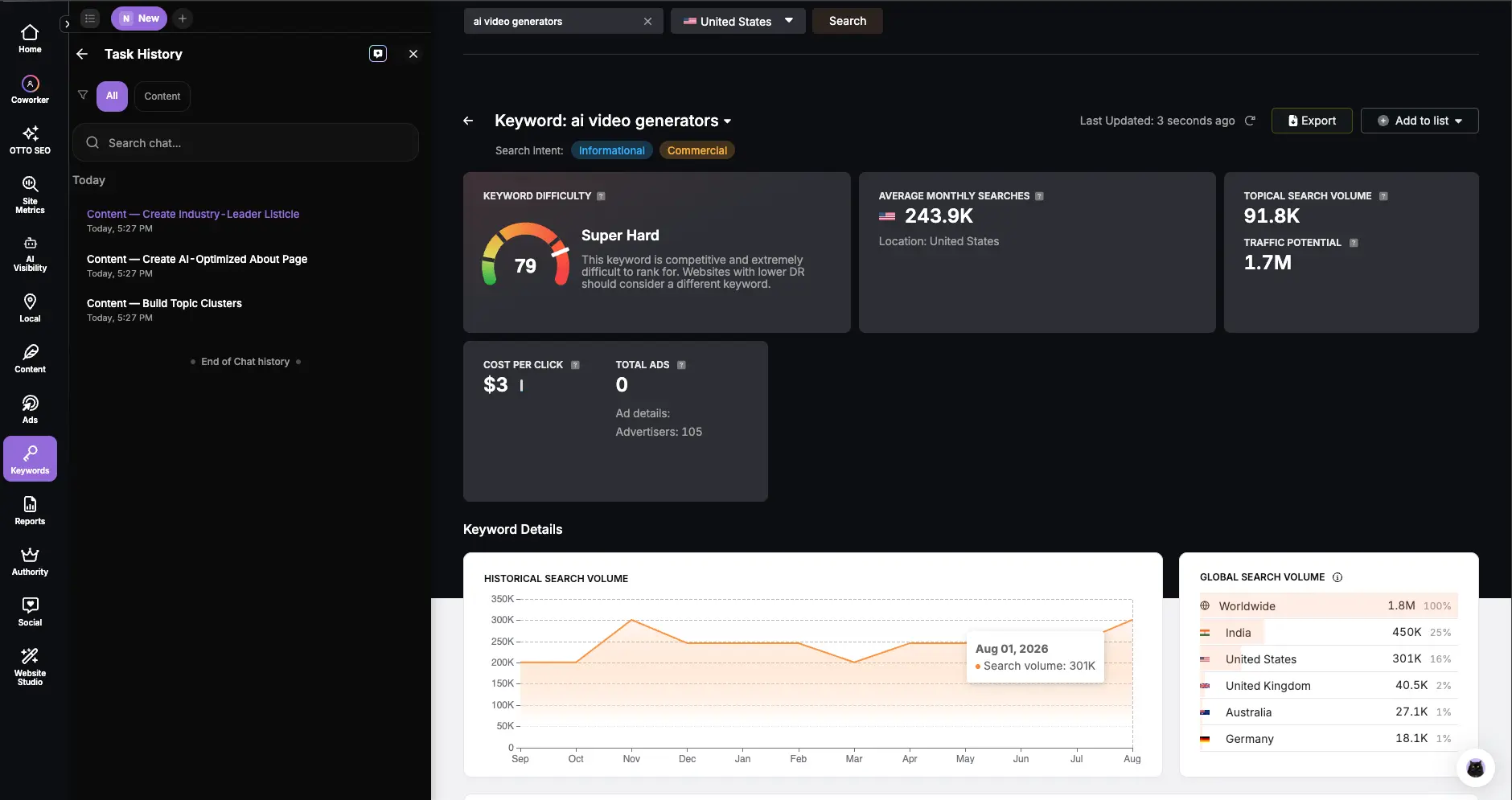
I searched "ai video generators", a term I write about often. Search Atlas scored it 79 for difficulty, labelled it Super Hard, and added a one-line explanation that sites with a lower domain rating should pick a different battle. Fair enough. The useful extras are topical search volume (the whole cluster, not just the head term), traffic potential, cost per click, the number of advertisers bidding, and a twelve-month volume chart with a hover for each month. The global breakdown was the surprise: a quarter of worldwide searches for this term come from India, which changes how I'd write the piece. The intent tags (informational and commercial) match what I see in the results page. The keyword database is smaller than Ahrefs', and you notice it on very long-tail queries, but for picking topics it does the job.
Want to run OTTO on your own site for a week?
Try Search Atlas →Free trial on every plan • Plans from $99/moContent Genius Writer
Brief the agent on a title or keyword and it drafts an SEO-optimized article
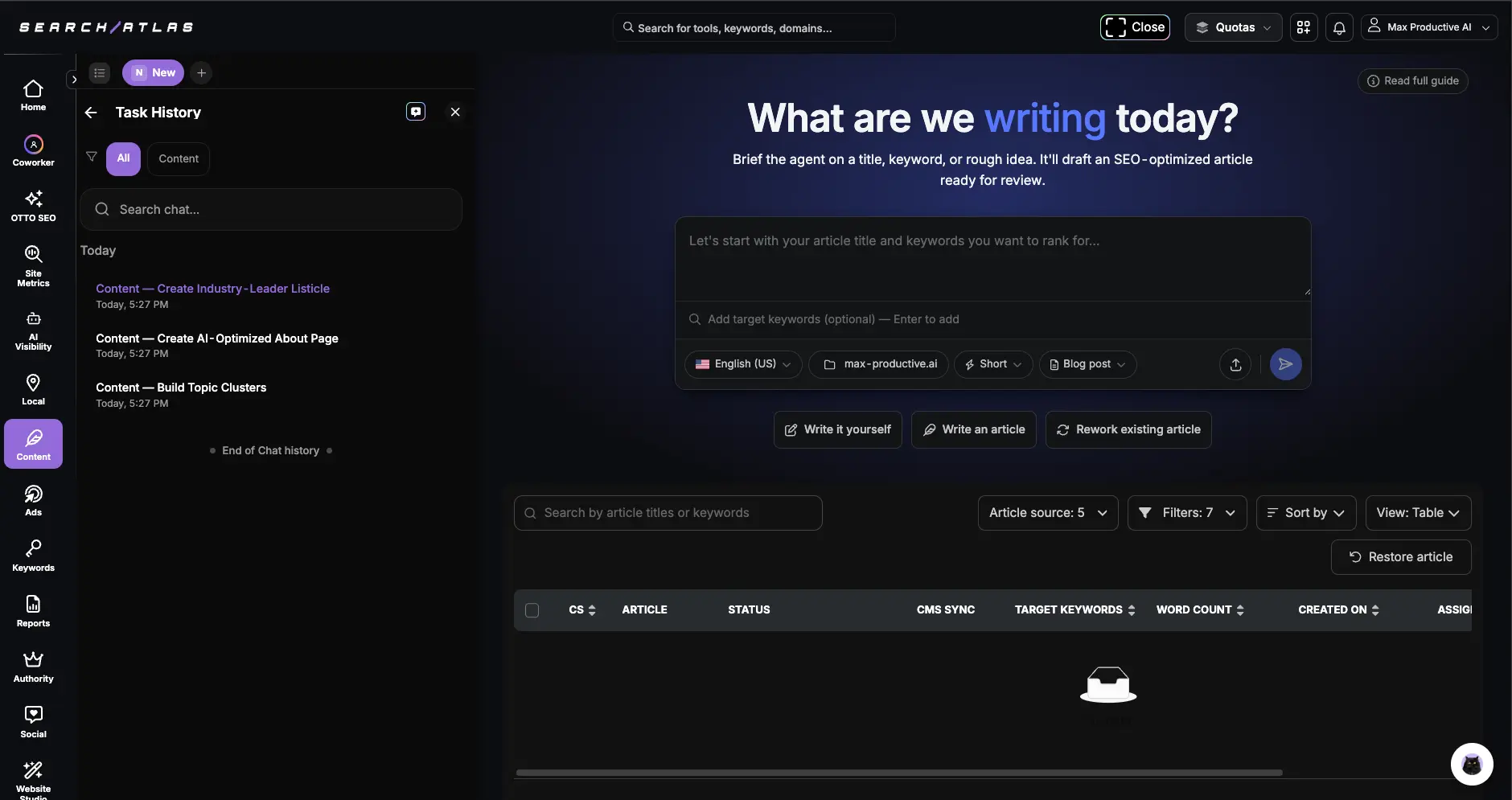
Content Genius opens like a chat: "What are we writing today?" You give it a title or keyword, add target keywords, pick the language, the project, a length (I left it on Short) and a content type such as blog post, then send. Three buttons cover the ways people actually work: write it yourself with live scoring, let the agent write the article, or rework an existing one. The table underneath tracks status, CMS sync, target keywords and word count for every draft, so it doubles as an editorial calendar. The December 2025 Agent upgrade added real-time scoring against the pages already ranking, which puts it in Surfer SEO and Clearscope territory without the extra subscription. Expect to edit what it produces, as with any AI writer. The scoring while you edit is the part I'd pay for.
Coworker Integration
Put the agent in Slack, with Teams and Telegram alongside
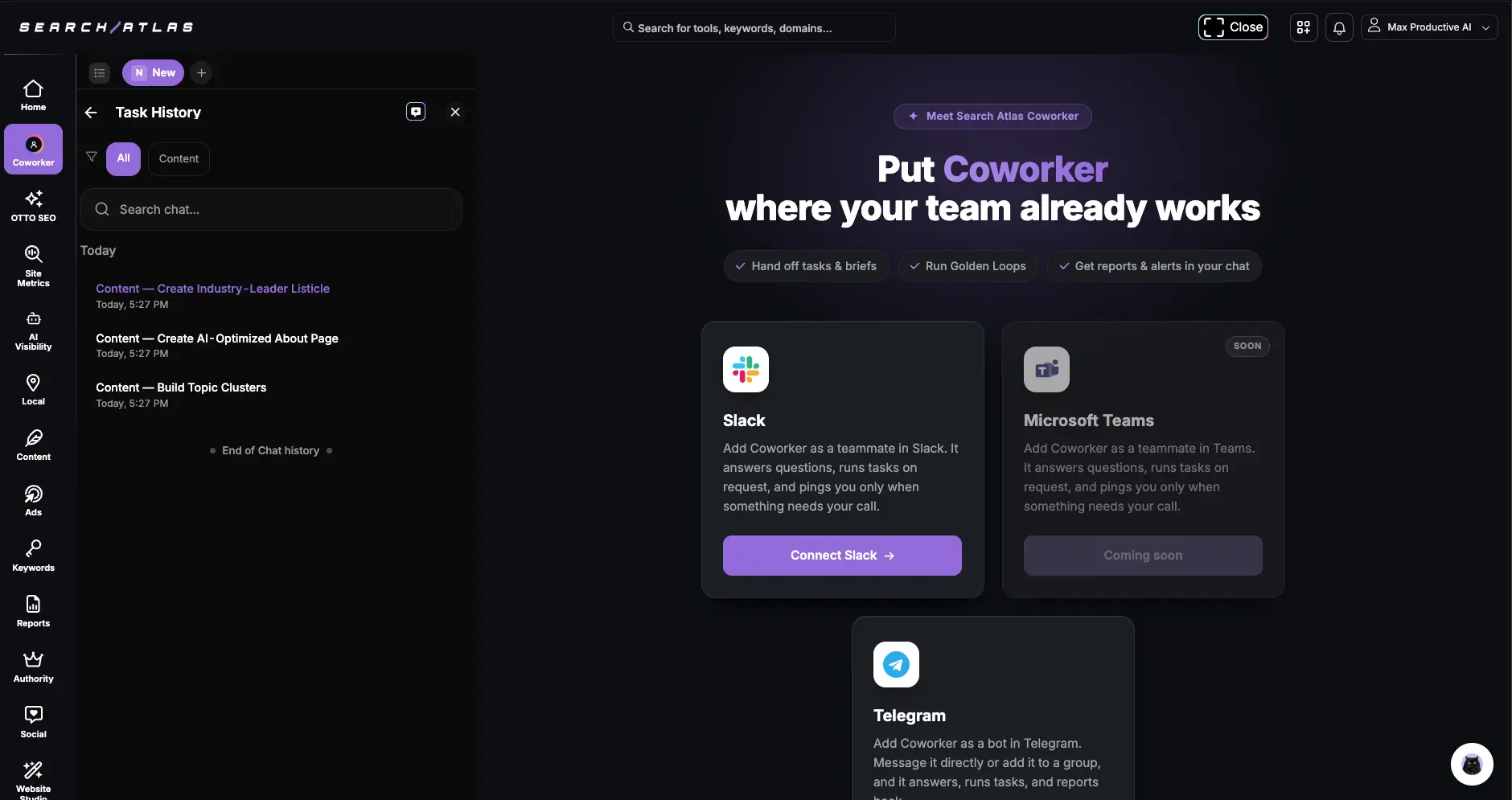
Coworker is Atlas Agent living inside your messaging app. Add it to Slack and you can hand off a brief, ask a question about a client's rankings, or run a Golden Loop, which is Search Atlas's name for a recurring routine (check rankings, draft the report, flag anything odd). It pings you only when something needs a decision. Telegram is available; Microsoft Teams shows a "Soon" badge. For an agency that already runs client channels in Slack, this is a smart place to put SEO reporting. For a solo operator it's a nice-to-have. I didn't wire it into my workspace for this review, so treat this as a description of the screen rather than a verdict on how it behaves day to day.
Website Studio
Describe a site, pick a brand, and it builds one
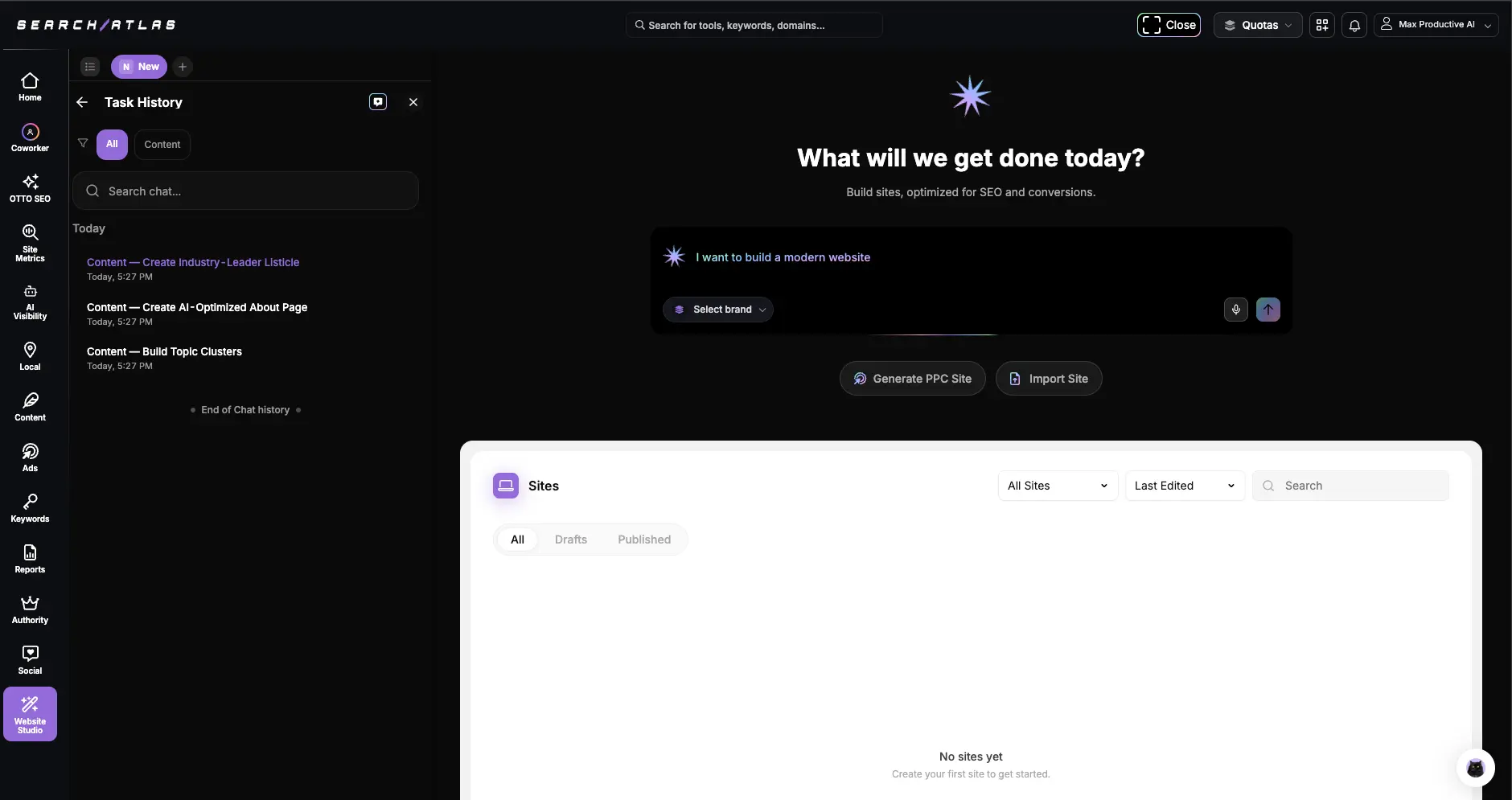
Website Studio is the newest module and, for an SEO platform, an odd one at first glance. You describe the site, choose a brand, and it generates pages built for search and conversions; the Generate PPC Site button makes landing pages to pair with the Smart Ads module. Mine still says "No sites yet" because I build on WordPress and had no reason to move. Where I can see it earning its place is an agency spinning up local-service sites or campaign pages without a developer. Judge it as a bonus, not a reason to buy.
How Search Atlas Works
The Search Atlas AI SEO workflow, from connecting a site to approving OTTO's first batch of fixes.
Connect a Project
Add your domain as a project, connect Google Search Console and Analytics, and install the OTTO connection on the site. OTTO works through a small script, so it can apply changes on most CMS platforms without anyone touching templates. Give the first crawl some time; site metrics, keyword rankings and the OTTO score fill in as it runs. The trial account walks you through this, and the "Needs Website" prompts stay visible until the connection is live.
Let OTTO Audit and Propose
OTTO crawls the site and lists what it would change: missing or duplicate meta titles, thin descriptions, schema, internal links, broken links. Each item comes with the suggested fix. In review mode you approve items one by one or in bulk; in autopilot they go live as they're found. Here's the thing: approving by hand takes twenty minutes a week and removes most of the risk. Use it, at least until you trust the suggestions on your kind of site.
Research and Write
Pick keywords with the research tool or let a playbook do the clustering. Content Genius drafts with live scoring against the top-ranking pages; Atlas Agent can take an entire goal (build a topic cluster) and come back with pillar and supporting pages. Nothing publishes until the website connection is on and you've approved it, which is the step that keeps the automation honest.
Track, Report, Repeat
Rank tracking and site metrics run daily. From Growth up, AI Visibility shows where your brand is cited in ChatGPT, Gemini, Copilot, Perplexity and Google AI Mode (three engines on Growth, all five on Pro). Pro and Agency add white-label reports and client portals, and Coworker can post the summary into Slack. This is where the one-login pitch pays off: the report covers research, content and fixes because the same platform did all three.
Approve or Autopilot?
OTTO can run fully automatic, and for meta tags across a large catalog site that's tempting. A handful of users have reported issues after leaving it unattended, such as a sitemap that needed regenerating or a page that slowed down. The new Agent Hub defaults to approval before anything ships, and that's the mode I'd recommend. Think of OTTO as a fast, tireless junior SEO who benefits from a second pair of eyes.
A Note on JavaScript
Many OTTO changes are applied through its script rather than written into your CMS. Google renders JavaScript, so it sees them. Some AI crawlers don't execute scripts, so for the handful of pages you most want cited in ChatGPT or Perplexity, mirror the key changes (title, description, schema) in the CMS itself. Ten minutes of work, and you get the best of both.
Key Features
What's in the box, and which plan unlocks it.
OTTO SEO Agent
The reason most people arrive here. Search Atlas OTTO SEO audits, then implements: schema, meta tags, internal links, redirects, alt text, with a review queue if you want one. Semrush and Ahrefs stop at the recommendation. This carries on. Search Atlas explains the model on its OTTO SEO page.
Atlas Agent & Playbooks
Goal-based automation. Choose "create content that ranks" and it runs topic clusters, briefs and drafts across Search Console, Keyword Research, Content Genius and OTTO, then waits for approval. Six playbooks can run in parallel. New enough that some still show "Needs Website to publish".
Content Genius Agent
AI drafting with live scoring against the top-ranking pages, plus a rework-existing-article mode. Comparable to Surfer SEO's editor, bundled in. Credits are consumed per article, so watch the quota on Starter.
Keyword Research & Rank Tracking
Difficulty, volume, topical volume, traffic potential, CPC, intent and a country split. Rank tracking is daily; Agency makes it unlimited. Is the database as deep as Ahrefs'? No, and it matters on the long tail. For everyday topic selection it's more than enough.
AI Visibility
Tracks brand mentions and citations in ChatGPT, Gemini, Google AI Mode, Copilot and Perplexity. Growth gets three engines, Pro all five. This is the practical side of what the industry now calls answer engine optimization (AEO) or generative engine optimization (GEO), and it's the module Semrush and Ahrefs sell as add-ons. Not included on Starter, which is my one gripe with the plan structure.
Local SEO & Smart Ads
GBP Galactic automates Google Business Profile posts and citations across locations. Smart Ads runs Google and Meta campaigns with AI-built landing pages from Website Studio. Ads automation starts at Growth.
Coworker for Slack
The agent inside Slack: assign tasks, run recurring Golden Loops, receive alerts and reports. Telegram works too; Teams is on the way. Best suited to agencies already living in Slack. Solo users can skip it without missing much.
White-Label & Client Portals
Branded dashboards and reports, client logins, API access, and $69 per extra site. This is the agency DNA showing. SE Ranking sells the equivalent as a paid Agency Pack; here it's part of the plan.
Two things to keep in mind. First, credits. Every plan comes with a monthly allowance of universal credits that Content Genius, AI visibility scans and agent runs draw on, from 50,000 on Starter to a million-plus on Agency, and extras cost $0.99 apiece. Check the Quotas indicator in the top bar before a big content push; a content-heavy agency will want to do the maths. Second, the backlink tools (Domain Power, Topical Dominance, a link index) and Website Studio round out the suite. Both do their job. Neither is why you'd buy, and if link research is central to your work you'll keep Ahrefs anyway.
Search Atlas Pricing
Four plans, no free tier, and a trial that gives you the full product for a week.
Starter
- ✓ 1 seat, 1 OTTO SEO project
- ✓ Keyword research, site audit & rank tracking
- ✓ Content Genius
- ✓ 50,000 credits/month
- ✓ 7-day free trial
- ✗ No AI visibility tracking
Growth
- ✓ 3 seats, 2 OTTO projects
- ✓ AI Visibility (3 engines)
- ✓ Smart Ads automation
- ✓ 120,000 credits/month
- ✓ Everything in Starter
- ✓ About 20% less on annual billing
Pro
- ✓ 5 seats, 4 OTTO projects
- ✓ AI Visibility, all 5 engines
- ✓ White-label dashboards & client portals
- ✓ API access
- ✓ 400,000 credits/month
- ✓ Everything in Growth
Annual billing: roughly 20% off, so Starter lands near $79/mo, Growth near $159/mo and Pro near $319/mo
Add-ons: extra managed sites $69/mo each on agency tiers; extra credits $0.99 each
Pricing last verified September 2026. Quotas have changed more than once this year, so visit Search Atlas for current terms.
Is It Worth the Money?
Semrush Pro ($139.95), Surfer SEO Standard ($99) and HubSpot AEO for AI visibility ($50) come to about $289 a month, and none of the three will implement a fix for you. Growth covers all of it for $199, with three seats. The comparison only breaks down if you need Ahrefs-grade backlink data, in which case you're adding a subscription rather than replacing one.
About the trial. A week of the full product, on every tier, is a fair deal, and better than Ahrefs, which dropped trials altogether in 2026. Use it on a real project: connect a site, let OTTO propose its first batch, run one playbook, and check the AI visibility report if you're on Growth or above. One piece of practical advice: put the renewal date in your calendar the day you sign up. Like most subscription software it renews automatically, and a few users have described friction when cancelling close to the deadline, so decide a day early and do it through the dashboard. Do that, and the trial is one of the better ones in this category.
Against the competition, the entry price is competitive. Semrush Pro is $139.95 before the AI Visibility Toolkit add-on, which is around $99 more. Ahrefs Lite is $129 for a single seat, with Brand Radar heading toward a paid add-on. SE Ranking Core is $129, or $103.20 on annual billing, and does include AI visibility, which makes it the closest value rival. Surfer Pro is $182 for content optimization alone. Search Atlas Starter at $99 undercuts all of them. The honest comparison point for AI-search work is Growth at $199, and even there you're paying less than Semrush plus its add-on for a tool that also does the implementing. Where it loses: there's no free plan at all, and Starter's single OTTO project means a second site pushes you up a tier.
Detailed Pros & Cons
The full picture, including a few things the pricing page doesn't mention.
✓ Pros
Every SEO suite produces an audit. OTTO produces the audit and then does the work: schema, meta tags, internal links, redirects. For a small team without a developer on call, that's the difference between a report that sits in a folder and fixes that ship this week.
The Agent Hub's "nothing changes without you" model is the right design for software that can write to a live site. Run six playbooks in parallel, review the output, publish what you like. It makes the automation usable by cautious people, and after twenty years of SEO tools promising to "just handle it", cautious is the sensible way to be.
Keyword research, site audit, content scoring, rank tracking, local SEO, ads and AI visibility. I've spent years bouncing between Semrush, Surfer and a separate rank tracker; having them in one place with one project structure saves real time, not just money.
ChatGPT, Gemini, Google AI Mode, Copilot and Perplexity on Pro, three of them on Growth. Semrush charges an add-on for this; Ahrefs' Brand Radar is free in beta but priced to change. Being native to the platform means the same keyword and content data feed the AI-search view.
White-label dashboards, client portals, per-site add-on pricing, multi-seat plans and Coworker in Slack. It was made inside an agency and it shows, in a good way.
Seven days of everything on every plan, and Starter at $99 costs less than Semrush Pro or Ahrefs Lite. Few all-in-one suites let you test the full product before paying, and fewer still at this price.
✗ Cons
Ahrefs and Semrush have been building their keyword and link indexes for well over a decade. Search Atlas's are smaller, and you notice it on long-tail keywords and on backlink coverage in competitive niches. Enough for most sites; not enough to retire Ahrefs if backlink research is the job.
The Starter plan skips the AI visibility module entirely, and Growth covers three of the five engines. If tracking ChatGPT and Perplexity citations is why you're here, budget for $199 or $399 rather than $99.
A dozen modules in the left rail, plus Agent Hub on top, and OTTO's audit lists everything it finds without ranking by severity. Beginners will feel it. Start from the playbooks, leave the Classic view alone for the first week, and it clicks.
OTTO makes changes on a live site, and a few users have reported hiccups after leaving it fully automatic. Review mode removes most of that risk. Many of its changes are also applied through a script that Google renders but some AI crawlers don't, so mirror the important ones in your CMS.
Ticket responses can take a few days at busy times, so don't plan a client launch around same-day answers. Renewals are automatic, as with most SaaS, and the smoothest experience comes from noting the date and deciding a day early. Neither is unusual for the category; both are good to know before you sign up.
Search Atlas vs Alternatives
How Search Atlas compares with the suites most people shortlist alongside it.
| Feature | Reviewed Search Atlas | Semrush | Ahrefs | SE Ranking | Surfer SEO |
|---|---|---|---|---|---|
| Entry Price | $99/mo | $139.95/mo | $129/mo (Lite) | $129/mo ($103.20 annual) | $49/mo (Discovery, annual) |
| Free Trial | 7 days, all plans | 7 days | None | 14 days | Money-back guarantee |
| Implements Fixes | ✓ OTTO SEO | ✗ Recommends | ✗ Recommends | ✗ Recommends | ✗ Content scoring only |
| AI Visibility | From Growth; 5 engines on Pro | Add-on (~$99/mo) | Brand Radar (beta, add-on planned) | Included on Core | AI Tracker add-on ($95/mo) |
| White-Label | Pro and Agency | Business plan | ✗ | Agency Pack add-on ($69/mo) | ✗ |
| Standout Strength | Execution + AI content in one | Breadth of SEO & PPC data | Backlink index | Value for money | Content editor |
| Best For | Teams that want fixes done; agencies | Multi-channel marketing teams | Backlink-heavy research | Solo SEOs, small agencies | Content teams with writers |
Search Atlas vs Ahrefs: The Short Version
This is the comparison I'm asked about most, and the two tools are less alike than the category suggests. Ahrefs is a research instrument: the largest, freshest backlink index in the business, an excellent Keywords Explorer, and a Site Audit that finds everything. It then hands you the list. Search Atlas finds less (its index is smaller) but does more with what it finds: OTTO implements the fixes, Content Genius writes the pages, and AI visibility tracking is built in rather than sold as a Brand Radar add-on. Price and access favour Search Atlas too: $99 against $129 for Ahrefs Lite, three seats on Growth against one on every Ahrefs tier, and a seven-day trial where Ahrefs now offers none. So: if backlink forensics and competitor research are the core of your work, Ahrefs, and you'll likely keep it even if you add Search Atlas. If you want the research and the execution in one place, Search Atlas. Plenty of agencies run both. For the Semrush side of the question, our Semrush vs Search Atlas comparison goes deeper.
Which Tool Is Right For You?
Search Atlas
ReviewedBest for: Small teams and agencies that want research, AI content and technical fixes in one subscription, with an approval step before anything touches the site. Growth at $199 is the plan most people should trial, because it's where AI visibility switches on. Let OTTO propose and approve by hand, and set a reminder before the trial ends.

Semrush
Closest RivalBest for: Marketing teams that will use most of the modules: SEO, PPC, content, social and competitive research from one of the deepest datasets available. It won't implement fixes, and AI visibility tracking is a paid add-on, so the true cost for AI-search work runs well above the $139.95 sticker.
Ahrefs
Data DepthBest for: Anyone whose work starts with backlinks. The index is the benchmark, Keywords Explorer is excellent, and Brand Radar adds AI visibility. No free trial in 2026, one seat per plan and no white-labeling make it a research tool rather than an agency platform, and many teams pair it with Search Atlas rather than choosing between them.

SE Ranking
Best ValueBest for: Solo SEOs and small agencies that want the core Semrush workflow plus AI visibility at $129, or $103.20 on annual billing, with a 14-day trial. It doesn't implement changes and white-label is a paid Agency Pack, but for pure research value it's the closest rival to Search Atlas Starter. See how it compares with Surfer SEO →

Surfer SEO
Content OptimizationBest for: Content teams with writers who want the best-known editor for scoring drafts against the results page. The advertised $49 tier is thin; the features people want sit on Pro at $182. No technical SEO, no execution and only light rank tracking, so it's a complement to Search Atlas rather than a replacement.

Alli AI
Also AutomatesBest for: Teams that want on-page automation without the rest of the suite. Alli applies meta, heading, schema and linking changes through a JavaScript layer, much like OTTO's script, and adds an Autopilot mode. Pricing has moved around this year (Business from $169 to $299 depending on when you look), and the changes stay in place only while you subscribe.

Rankprompt
Budget AI VisibilityBest for: Solo operators who only need the AI-search piece. From about $29 to $39 a month it monitors five to six engines, generates content and tracks competitor gaps, at a fraction of Search Atlas Growth. It's a young product with a thin review record, and it won't audit or fix your site.
Frequently Asked Questions
Should You Try Search Atlas?
Search Atlas is the SEO suite that does the work as well as the research, and in 2026 that's still rare. OTTO SEO takes the audit and implements it. Content Genius writes with the results page in view. The AI visibility module covers the engines people now search in. Agent Hub ties it together with playbooks that wait for your approval, which is the design decision that makes the automation trustworthy. For a small team or an agency running several sites, one login at $99 to $399 replaces a stack that costs more and still leaves the implementation to you.
The reservations are about depth and diligence rather than direction. Ahrefs and Semrush have the deeper data, and serious backlink work will still send you there. AI visibility only starts at Growth. There's a lot to learn, OTTO deserves a reviewer, and you'll want to note the renewal date. None of that changes the verdict. Judged on what it does for the money, Search Atlas is one of the strongest all-in-one SEO platforms you can buy right now.
Our Recommendation
Start the trial on Growth rather than Starter, because that's where AI visibility switches on and you'll want to see it. Connect one real site, let OTTO propose its first batch of fixes and approve them by hand, run the Build Topic Clusters playbook, and check the AI visibility report against what you already know about your brand. If the fixes are sound and the drafts are usable, go annual for the 20% saving. Put the renewal date in your calendar on day one.