
AI Cited 504 of Our Pages and Named Us Twice. Here's How to Check Your Brand
Does ChatGPT mention your brand? It can use your content without ever saying your name. When we checked our own site in a free Semrush account on October 1, 2026, AI engines used our pages as sources again and again but named Max Productive AI only twice, and ChatGPT didn't name us once. This guide covers what changed in ChatGPT this August, what our data shows, and a free 15-minute check for your own brand.
The short answer, as of October 2026: ChatGPT can mention your brand, but citing your page is not the same as naming you. A citation is a link in the sources. A mention is your name inside the answer, and that's the part people remember. On our own site, Semrush counted 504 cited pages and 2 brand mentions, both in Google's AI Mode. You can run the same check on your domain with a free Semrush account, then add ongoing tracking once the numbers matter to your business.
Free check: Semrush free account
The Semrush free account has an AI Search widget that shows your cited pages and brand mentions in ChatGPT, Google AI Overviews, AI Mode and Gemini. It's the fastest way to see whether AI engines use your content and whether they say your name. The trade: it's a snapshot, and the free plan limits how many reports you can run each day.
Weekly tracking: AI Visibility Toolkit
Semrush's AI Visibility Toolkit tracks your mentions, citations, sentiment and share of voice across ChatGPT, Perplexity, Gemini, Google AI Overviews and AI Mode, with Brand Performance reports updated weekly. It can now analyze a single subfolder or URL, not just your whole domain. The trade: it's a paid tool, so run the free check first and upgrade once you need to see a trend over time.
| Check | What It Tells You | Cost |
|---|---|---|
| Semrush free account | Cited pages and brand mentions for each AI engine | Free |
| Google Analytics 4 | Visits from ChatGPT, Claude, Gemini and other AI assistants | Free |
| Google Search Console | Real clicks from Google Search, a check on your analytics | Free |
| Semrush AI Visibility Toolkit | Weekly mentions, citations, sentiment and share of voice | Paid add-on, or included in Semrush One |
Data about our site comes from our own Semrush, Google Analytics and Search Console accounts. Semrush features and plans checked on Semrush's website and Knowledge Base in early October 2026.
Ask ChatGPT for the best tools in your category and look closely at the answer. You might find your own article in the sources, with a competitor's name in the text above it. That's the gap this article is about. AI engines read your pages, use your facts and link to you in small print, but the brand they name is often someone else's.
We run an AI tools review site, so we sit right in the middle of this. In August 2026, ChatGPT changed how it picks sources, and listicles and comparison pages, the kind of pages we publish, lost a large share of citations. So we pulled our own numbers, looked at what changed, and put together the free checks you can run on your own site today.
AI Citations vs Brand Mentions: Who Gets the Credit
When an AI engine answers a question, it can credit you in two ways. A citation is your URL in the list of sources, usually a small link or a numbered chip next to a sentence. A brand mention is your name written into the answer itself, as in "Max Productive AI rates Semrush 4.8 out of 5."
Both count, but they do different jobs. A citation creates a path to your site, but the reader still has to click it. A mention puts your name in front of everyone who reads the answer, clicks or not. For a brand, mentions build recall. For a publisher, citations bring the occasional visitor. The gap between the two is where many sites quietly lose credit.
Closing that gap is the heart of generative engine optimization (GEO), also called answer engine optimization (AEO): earning visibility inside AI-generated answers, not only in the regular search results below them.
What We Found on Our Own Site
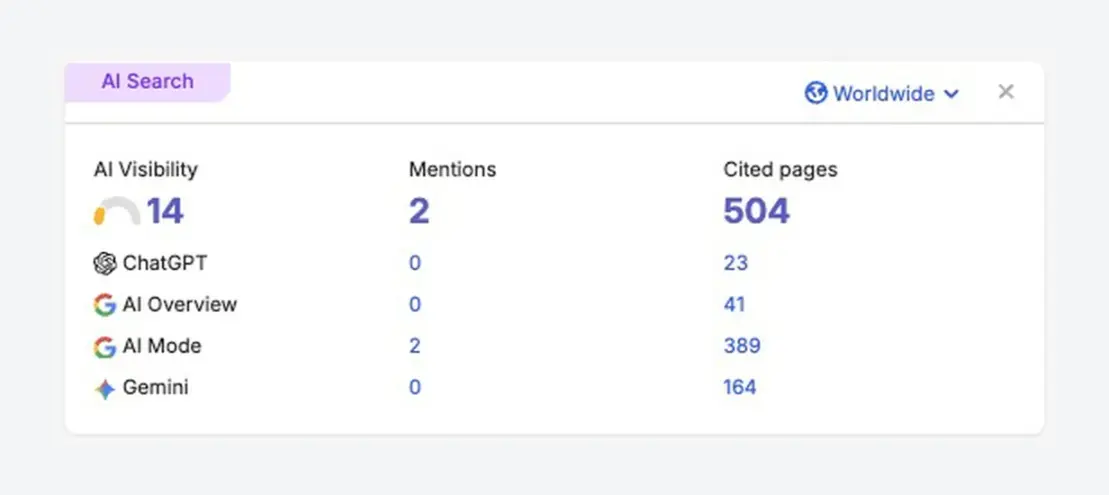
Semrush's free account includes an AI Search widget on the SEO dashboard. For max-productive.ai, it showed an AI Visibility score of 14 out of 100, 504 cited pages and just 2 brand mentions. The split by engine tells most of the story. The engine counts add up to more than 504 because a page cited by several engines is counted only once in the total.
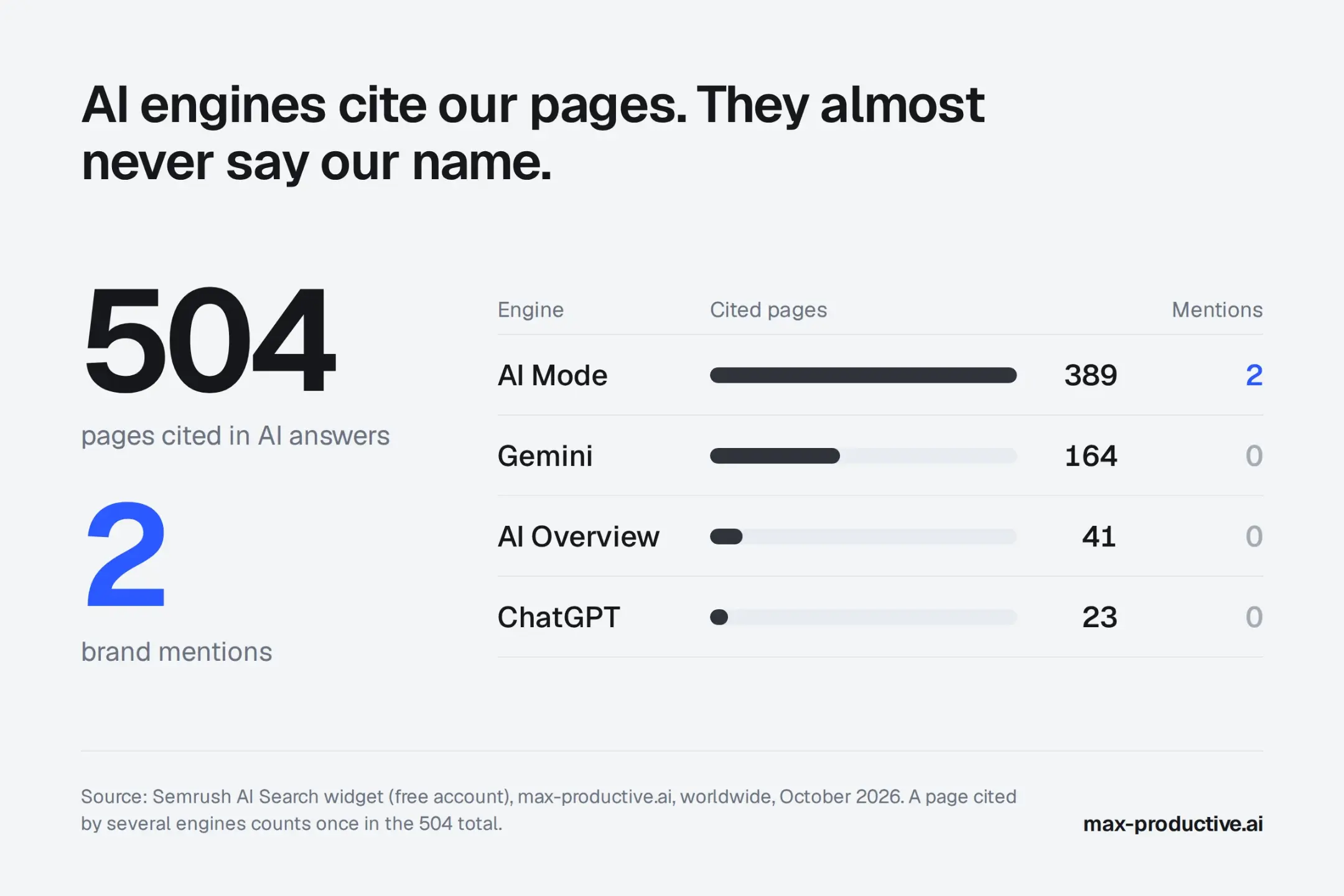
Google's AI Mode cited the most pages, 389, and it's the only engine that named us, twice. Gemini cited 164 pages, AI Overviews 41 and ChatGPT 23. None of those three said our name once. This is the widget itself, straight from our free account.
Our read on why: a review site is the evidence, not the answer. When someone asks which SEO tool to pick, the answer names Semrush, Ahrefs or SE Ranking, and our page is the proof behind it. AI engines take our pricing checks and feature notes, cite the page, and give the credit to the products. That's fair to the products, but it means a site like ours can supply a lot of answers and stay almost invisible in them.
If you publish reviews, comparisons or how-to guides, you may have a similar gap between citations and mentions. The quickest way to find out is to open a free Semrush account and look at the AI Search widget for your own domain.
What Changed in ChatGPT in August 2026
Our numbers make more sense with this summer's change in mind. On August 6, 2026, OpenAI announced that GPT-5.6 Luna would become the default model for ChatGPT's Free and Go users that week. From around August 8, independent trackers saw ChatGPT searching the web differently. The timing lines up, although OpenAI hasn't said the new model caused the change.
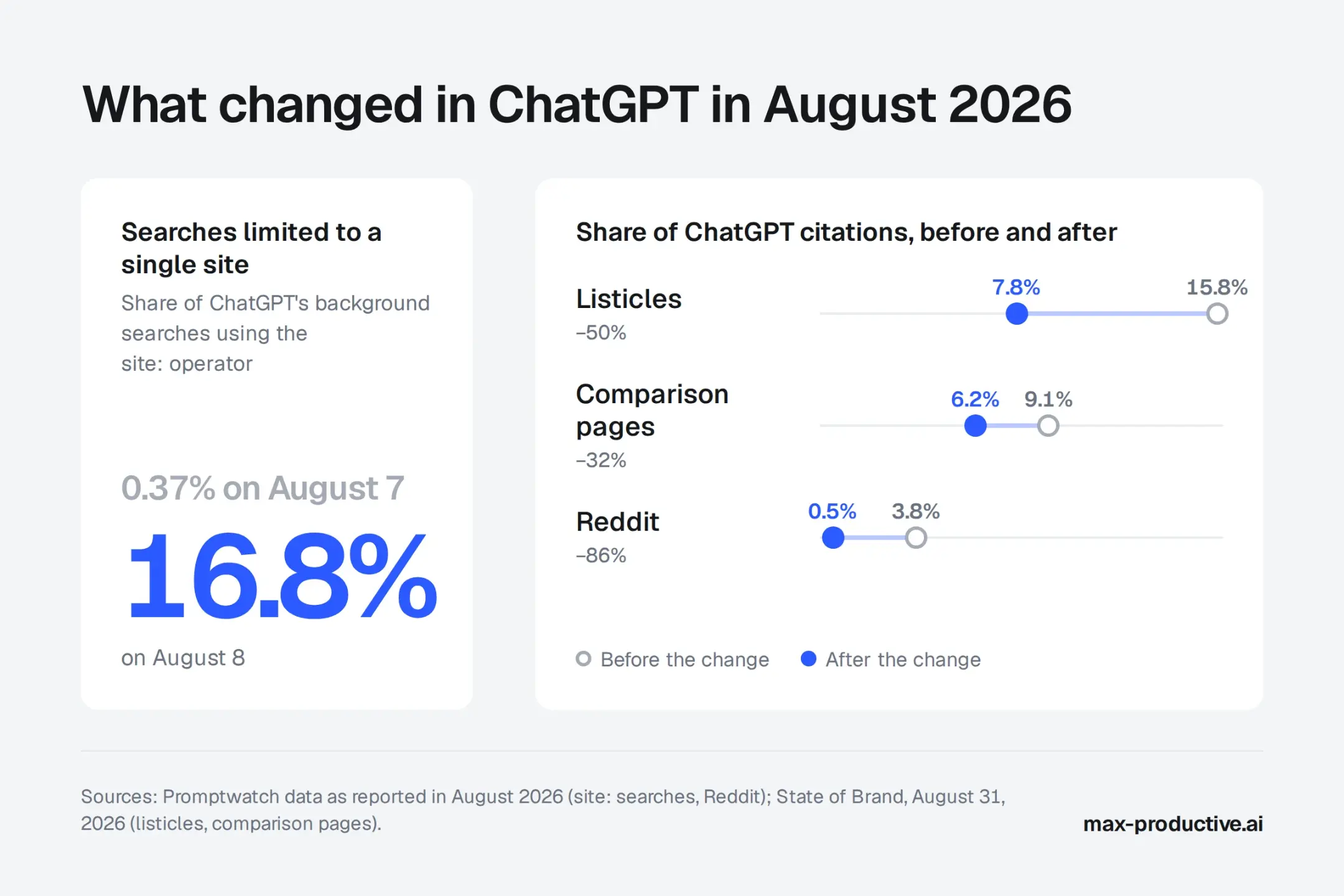
Two shifts stand out. First, ChatGPT started limiting many of its background searches to specific websites. Promptwatch data, reported by On-Page.ai on August 19, 2026, shows the share of those searches using the site: operator jumping from about 0.4% to nearly 17% on August 8. In practice, ChatGPT ran far more searches inside specific domains instead of broad web searches. The data shows that this behavior changed, not how ChatGPT chooses those domains.
Second, the sources it cites changed. In the same Promptwatch data, Reddit's share of ChatGPT citations fell from 3.83% to 0.52% in mid-August. State of Brand's August 31 report measured listicles falling from 15.77% of citations to 7.80%, and comparison pages from 9.08% to 6.17%. The same studies showed gains for first-party sources such as documentation, help centers and product pages. Qwairy's tracking points the same way, with institutional and official sources up 73% while forums and community content lost ground.
For brands, that's good news: first-party pages like yours now show up more often among ChatGPT's sources. For review sites and roundup publishers, it's a signal to adapt. Our pages are exactly the kind that lost share, which makes being named, not just cited, more important than ever. The models also keep changing. OpenAI introduced GPT-6.1 Sol on September 29, 2026, so citation patterns may move again, which is one more reason to follow trends rather than single snapshots.
ChatGPT Isn't Our Biggest AI Referrer
If you only check ChatGPT, you miss most of the picture. Over the 90 days to September 30, 2026, visits from AI assistants to our site split like this in Google Analytics 4.
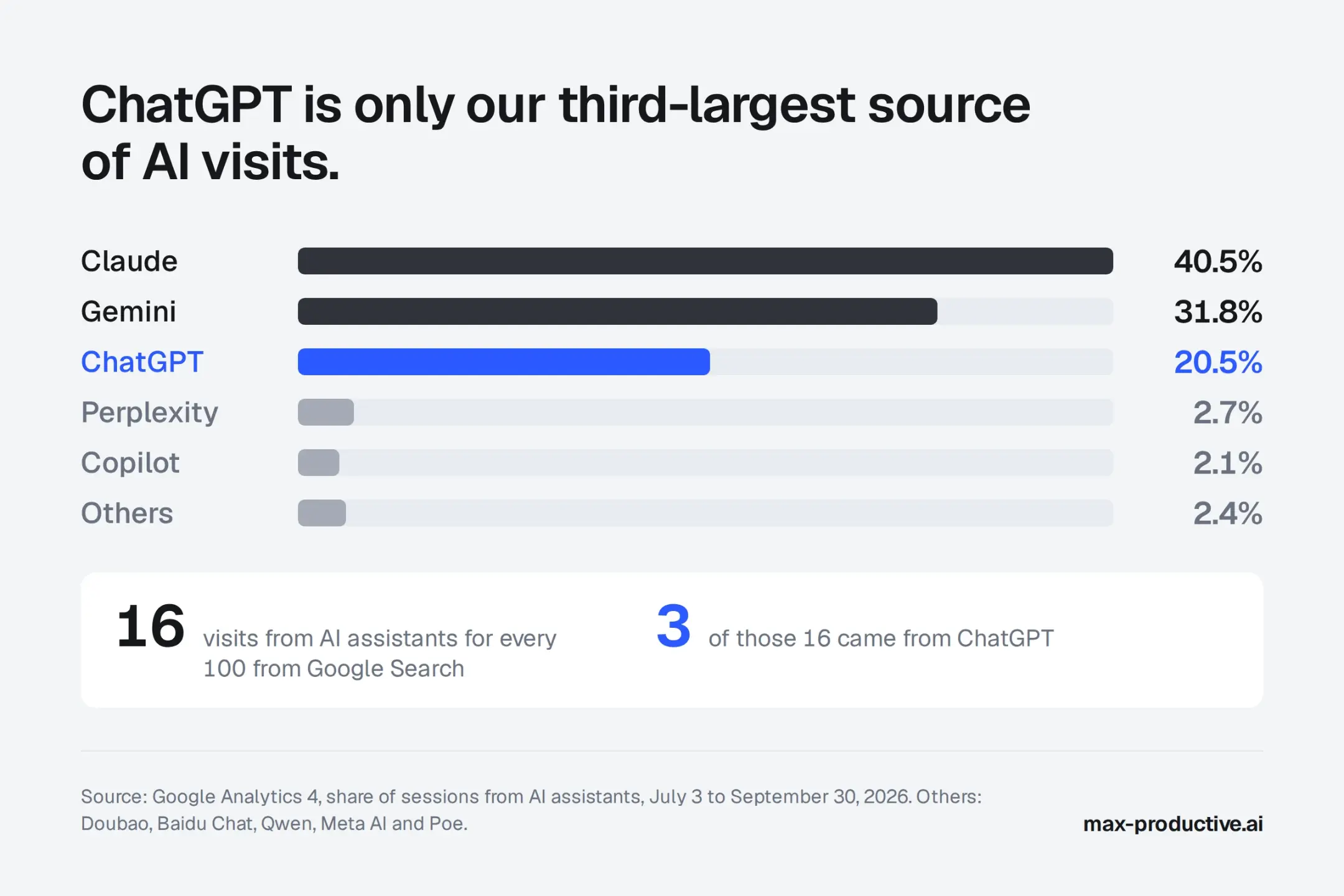
Claude sent 40.5% of our AI assistant visits, Gemini 31.8% and ChatGPT 20.5%. Perplexity, Copilot and the rest made up under 8% together. Claude sent roughly twice as many visits as ChatGPT, which probably reflects our readers: people researching AI tools tend to use more than one assistant.
Two ratios put this in context. For every 100 visits from Google Search, AI assistants sent about 16, and ChatGPT alone about 3. AI referrals are real, but for most sites they're still a small slice next to Google. That's one more reason to track mentions and citations alongside clicks: on their own, the clicks are too few to tell you much.
Why Analytics Alone Can't Tell You If AI Mentions You
We almost drew the wrong conclusion from our own analytics. From August to September 2026, Google Analytics showed active users up 48%. Over the same period, Search Console showed clicks from Google Search down 20%.
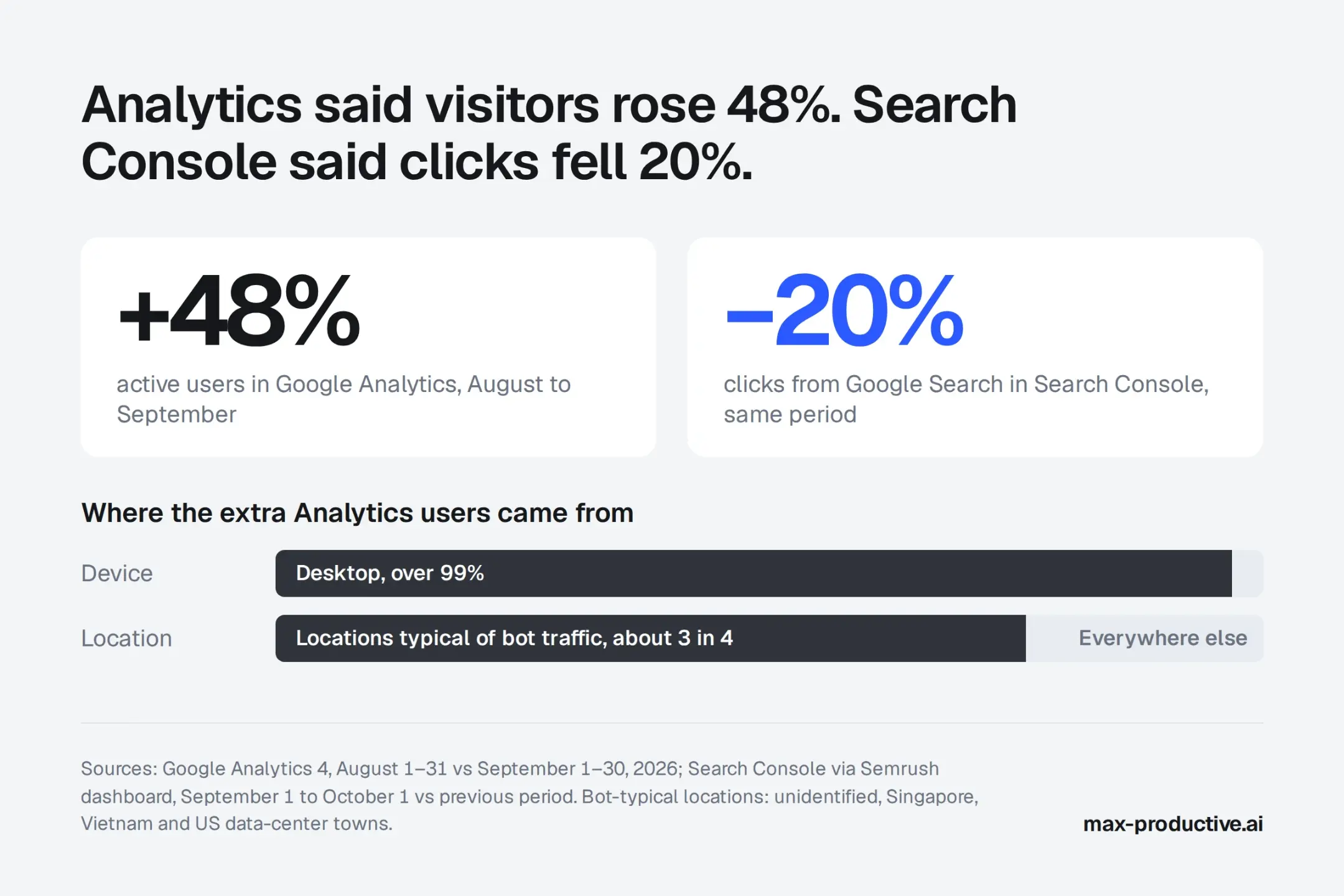
The two tools measure different things, so the gap alone doesn't prove much: Analytics counts visitors from every channel, while Search Console only counts clicks from Google Search. What made us suspicious was the pattern inside the growth. Desktop devices accounted for more than 99% of the extra users, and about three in four came from unidentified locations, Singapore, Vietnam or US data-center towns. That pattern is typical of automated traffic, although Analytics alone can't confirm it.
The lesson goes beyond our site. Not every visit in your analytics is a person, and analytics can't see the answers where your brand was used and nobody clicked. AI tracking gives you a consistent trend rather than a perfect count, and that's the right way to read it: pick one method, keep it the same every week, and judge the direction.
How to Check if ChatGPT Mentions Your Brand for Free
You can get a solid first answer in about 15 minutes with free tools. The chart below shows what each one covers, followed by the order we'd use them in.
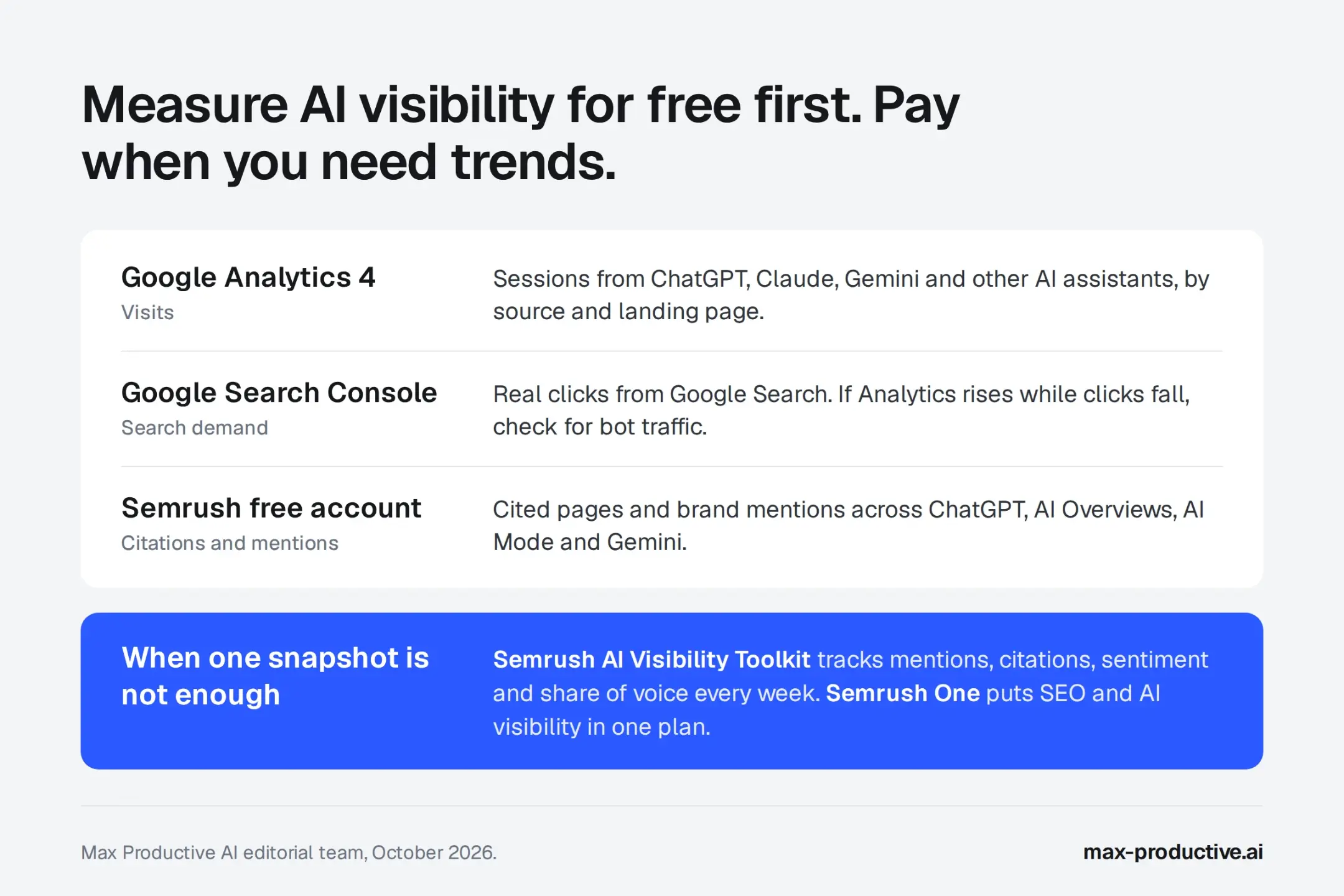
1. Open a free Semrush account and add your domain. Sign up for free, create a project for your site and open the SEO dashboard. The AI Search widget shows your AI Visibility score, your brand mentions and your cited pages for ChatGPT, AI Overviews, AI Mode and Gemini. If cited pages are high and mentions sit near zero, you have the same gap we do. You can also enter a competitor's domain in Domain Overview, which shows the same AI metrics for any site on the free plan.
2. Check AI visits in Google Analytics 4. Go to Reports, then Acquisition, then Traffic acquisition, and look for the AI Assistant channel, which Google added in May 2026. To split it by assistant, set the dimension to Session source / medium: ChatGPT visits show up as chatgpt.com / ai-assistant. It's the simplest way to track ChatGPT traffic in GA4. Add Landing page + query string as a secondary dimension to see which pages received those visits.
3. Compare with Search Console. Open the Performance report for the same dates. If Analytics shows growth that Search Console doesn't, check for bot traffic before you read anything into it.
4. Ask ChatGPT what your buyers ask. Write five to ten prompts a customer might use, like "best [your category] for small teams" or "[your brand] vs [competitor]." Run each one twice in a temporary chat, so your own history doesn't shape the answer, and note whether you're named in the text, only cited in the sources, or missing. Treat it as a spot check, not a score.
5. Write down your baseline. Keep your mentions, cited pages and AI visits in one place, with the date. Repeat the same checks next month. A trend over a few months tells you far more than any single result.
When to Track AI Visibility Every Week
Free checks are snapshots. If AI search affects your sales, or you report on it to clients, you need the same numbers tracked the same way every week. That's the job of Semrush's AI Visibility Toolkit.
It tracks your brand's mentions, citations, sentiment and share of voice across ChatGPT, Perplexity, Gemini, Google AI Overviews and AI Mode, and its Brand Performance reports update every week. It also shows which competitors appear in the answers where you don't, and Position Tracking can check your own list of prompts every day in ChatGPT and AI Mode, which automates step 4 above. Semrush recently added the option to analyze a single subdomain, subfolder or URL in the Visibility Overview report. For a site like ours, that means comparing how often AI cites our /blog/ articles against our /ai-tools/ reviews, then working on the weaker section.
There are two ways to get it. If you already pay for a Semrush SEO plan, you can add the AI Visibility Toolkit from $99 a month. If you're starting fresh, Semrush One bundles Semrush's SEO tools and the AI Visibility Toolkit in one subscription, starting at $199 a month for the Starter plan in October 2026. New users get a 7-day free trial, so you can run a full week of tracking before you pay. Our Semrush review covers the rest of the platform.
Semrush isn't the only option. SE Ranking (4.5) adds AI search tracking to a lower-priced SEO suite. If you only need AI visibility, dedicated trackers like Rank Prompt (4.4), Rankscale (4.2) and OmniSEO (4.2) follow your brand across AI engines, and HubSpot AEO (4.2) suits teams already working in HubSpot. Our Peec AI alternatives guide compares nine of these tools side by side. We rate Semrush highest overall, at 4.8, mainly because it keeps SEO and AI visibility data in one place.
How to Get Named, Not Just Cited
A citation means an AI answer used your page as a source. A mention means your brand made it into the answer itself. There's no guaranteed way to turn one into the other, so treat these habits as experiments and measure the results. The August data supports the advice on official pages most directly.
Put your brand inside the sentences worth quoting. AI engines lift short, self-contained statements. "Plans start at $29 a month" travels without you. "In our October 2026 test, Max Productive AI found..." carries your name along with the fact.
Publish data only you have. Your own tests, surveys or usage numbers are hard to repeat without saying where they came from. This article is our own attempt at exactly that.
Keep your official pages clear and current. Since August, ChatGPT leans on brands' own pages. State your pricing, features and policies plainly on your site, so AI doesn't pick them up from someone else's article about you.
Earn mentions on other sites. AI engines name brands they see named across many independent sources: reviews, community threads, industry articles and press coverage. Mentions elsewhere do more here than any tweak to your own pages.
Use one brand name everywhere. Pick one spelling and keep it the same on your site, your social profiles and your Organization schema. It makes it easier to connect your content to one brand.
Then measure again in a month, the same way, and see whether your mentions start to move.
Final Verdict — Does ChatGPT Mention Your Brand?
| Fastest free check | Semrush free account (cited pages and brand mentions for each AI engine) |
| AI visits to your site | Google Analytics 4 (sessions from ai-assistant sources) |
| A check on your traffic data | Google Search Console (real clicks from Google Search) |
| Weekly tracking and competitors | Semrush AI Visibility Toolkit, or Semrush One for SEO and AI together |
| A lower-priced SEO suite with AI tracking | SE Ranking |
| A dedicated AI visibility tracker | Rank Prompt or Rankscale |
| Getting named, not just cited | Original data, clear official pages and mentions on other sites |
Bottom line: AI engines can use your content without saying your name. On our own site, they cited hundreds of pages and named us twice, and ChatGPT didn't name us once. Since August 2026, ChatGPT has also been citing more first-party pages, so publishing clear facts about yourself and earning mentions elsewhere gives you the best chance of being named. Start with a free Semrush account to see your own numbers, check AI visits in Google Analytics, and move to weekly tracking once the trend matters to your business.