HubSpot AEO
Answer Engine Optimization platform that tracks how your brand shows up in ChatGPT, Gemini, and Perplexity — and uses your HubSpot CRM data to suggest the exact prompts your buyers actually ask AI search.
Try HubSpot AEO →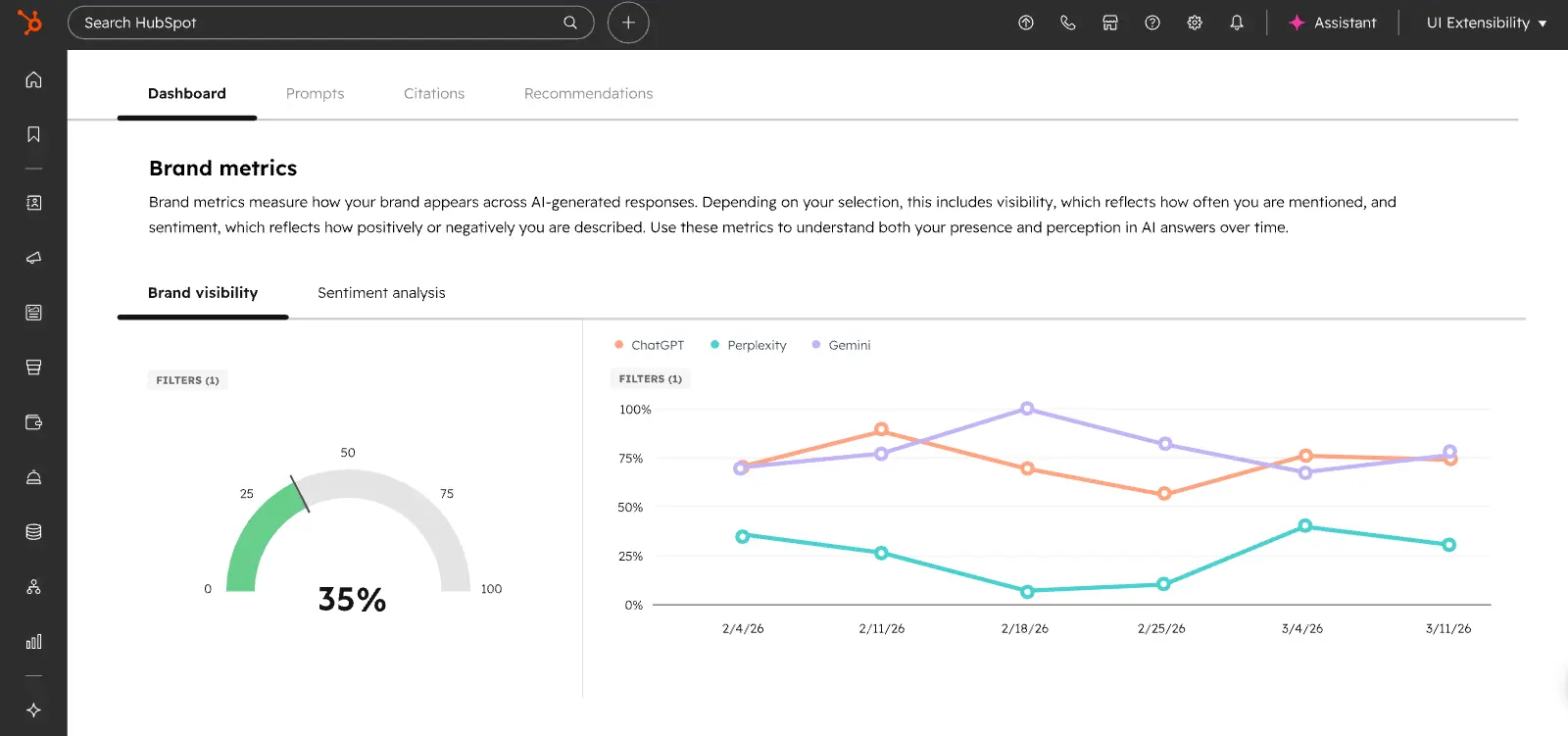
The First AEO Tool
Powered by Your Own CRM Data
HubSpot AEO does something no other AI visibility tool does: it connects directly to your CRM to figure out which prompts your buyers actually ask AI platforms — rather than making you guess. At $50/month standalone, or free inside Marketing Hub Pro, it's genuinely disruptive pricing for the AEO category. The ceiling is real — only 3 AI engines tracked, no Claude, no Copilot, and the content execution layer hasn't shipped yet — but as a day-one monitoring and recommendations tool, especially for existing HubSpot customers, it's one of the strongest value propositions on the market right now.
✓ What We Love
- CRM-powered prompts — no competitor offers this
- Free with Marketing Hub Pro or Enterprise
- 28-day free trial, no credit card
- Zero technical setup, works out of the box
! Could Be Better
- Only 3 AI engines — Claude and Copilot absent
- Content execution layer still on the roadmap
- Standalone plan loses CRM integration (its best feature)
What Is HubSpot AEO?
A new category of tool — Answer Engine Optimization — and HubSpot's first move into it.
HubSpot AEO is an Answer Engine Optimization platform that tracks how your brand appears inside AI-generated answers across ChatGPT, Gemini, and Perplexity. It was launched on April 14, 2026 at HubSpot's Spring 2026 Spotlight event, built on technology HubSpot acquired through its October 2025 acquisition of XFunnel, a 10-month-old Israeli AI visibility startup.
If that sounds like SEO rebranded for AI, it isn't quite. AEO is a meaningfully different discipline. Traditional SEO tools like Semrush, Ahrefs, or Surfer SEO focus on keyword rankings and blue-link positioning. AEO targets the AI-generated summaries that buyers increasingly rely on to research products — often without ever clicking through to a website. A visibility score in HubSpot AEO measures whether your brand is mentioned inside those AI answers, how often, in what context, and with what sentiment.
The timing isn't accidental. HubSpot reports that organic traffic for its customers fell 27% year-over-year in 2025–2026, while AI referral traffic tripled in the same window. AI-referred visitors convert at roughly 18% — about 10 times higher than Google organic. Gartner projects traditional search volume will drop 25% by end of 2026. If you're reading this and thinking "where are my buyers going?", the increasingly loud answer is: to ChatGPT, Perplexity, and Gemini first.
Who Is HubSpot AEO Best For?
Marketing teams already on HubSpot Marketing Hub Pro or Enterprise — for whom the tool is included at no extra cost and its CRM integration becomes a real competitive moat. B2B SaaS and digital-first brands where AI search drives buyer research. Content teams that want prioritized recommendations instead of raw dashboards. For anyone already paying HubSpot for Marketing Hub Pro, activating this is the closest thing to a free lunch the AEO category has offered.
What makes HubSpot AEO genuinely different from competitors like Rankscale, OmniSEO, or RankPrompt is one specific capability: CRM-powered prompt intelligence. Every other AEO tool on the market asks you to manually guess or research which prompts your buyers might be asking AI tools. HubSpot takes your actual HubSpot CRM data — buyer personas, deal stages, conversation themes from sales calls — and suggests prompts grounded in how your real customers think and talk. That matters more than it sounds. As Impulse Creative noted in a well-circulated critique of the launch, "a visibility score is only as meaningful as the buyer intelligence behind the prompts that generate it." Poor prompts produce misleading data regardless of how expensive the tool is. HubSpot is the first vendor to solve this at the root.
The catch? That CRM-powered feature only works if you're on Marketing Hub Pro or Enterprise. Buy the standalone $50/month plan and you lose it — at which point HubSpot AEO becomes a solid but fairly standard AI visibility monitor. Worth knowing upfront.
See HubSpot AEO in Action
Real screenshots from the platform showing the dashboard, prompt tracking, citation analysis, and recommendation workflow.
Brand Visibility Dashboard
Your at-a-glance score showing how often your brand appears in AI answers
The dashboard is the single most important screen in HubSpot AEO. The gauge on the left shows your current overall visibility score (how often your brand appears across tracked prompts), while the line chart breaks that performance down per engine over time — critical for spotting when, say, your ChatGPT visibility improves while Perplexity declines. The Sentiment Analysis toggle switches from "how often are you mentioned" to "how positively are you described", which is arguably the more important question for brand work.
Citation Composition Analysis
Which content formats and channels are driving AI citations in your category
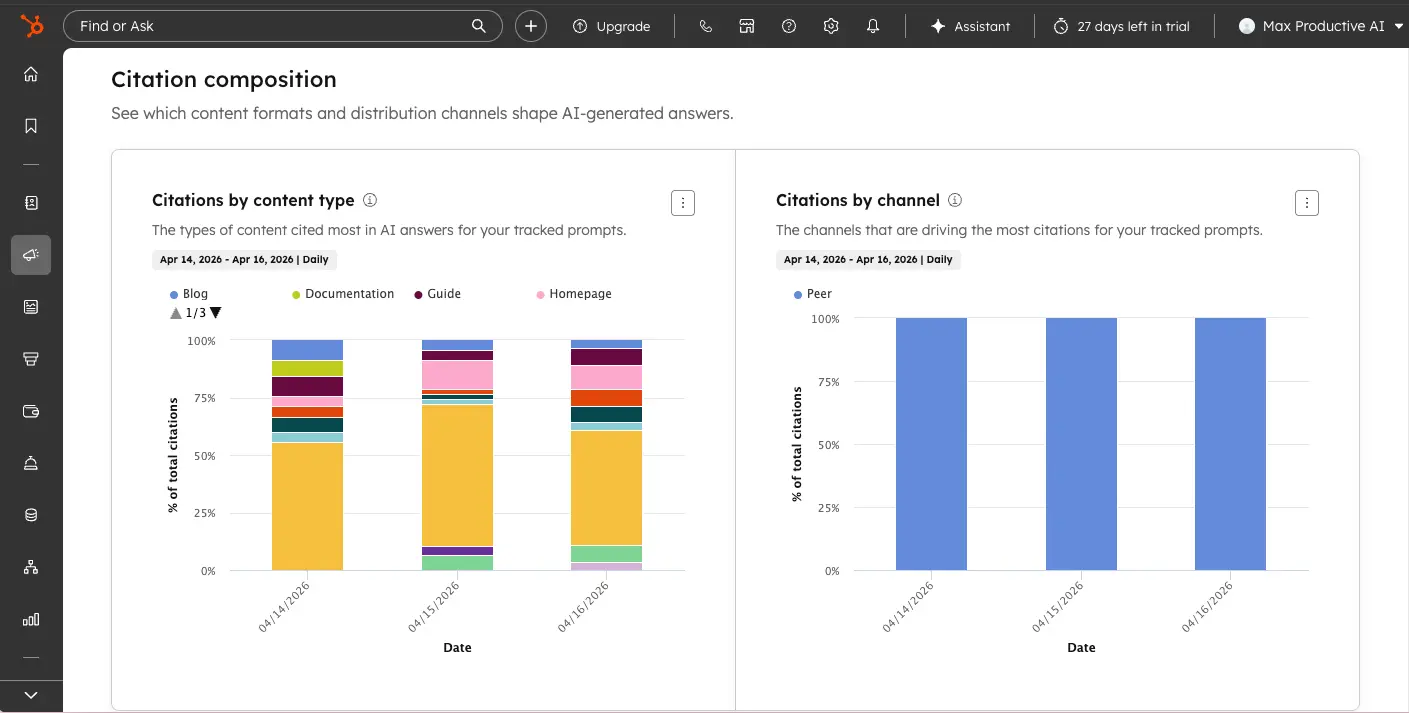
This is where the strategic thinking starts. Citation composition tells you what kind of content AI engines prefer to cite for the prompts you track. If the dominant bar is "Blog," you need more blog content. If it's "Documentation," your knowledge base or help center is your priority. The "Citations by channel" panel answers a related question: are AI answers pulling from your owned properties, peer sites, or third-party sources? Most teams are surprised to learn how much of their AI visibility is coming from places they don't own.
Prompts Tracking Interface
The full prompt list with per-engine answer visibility
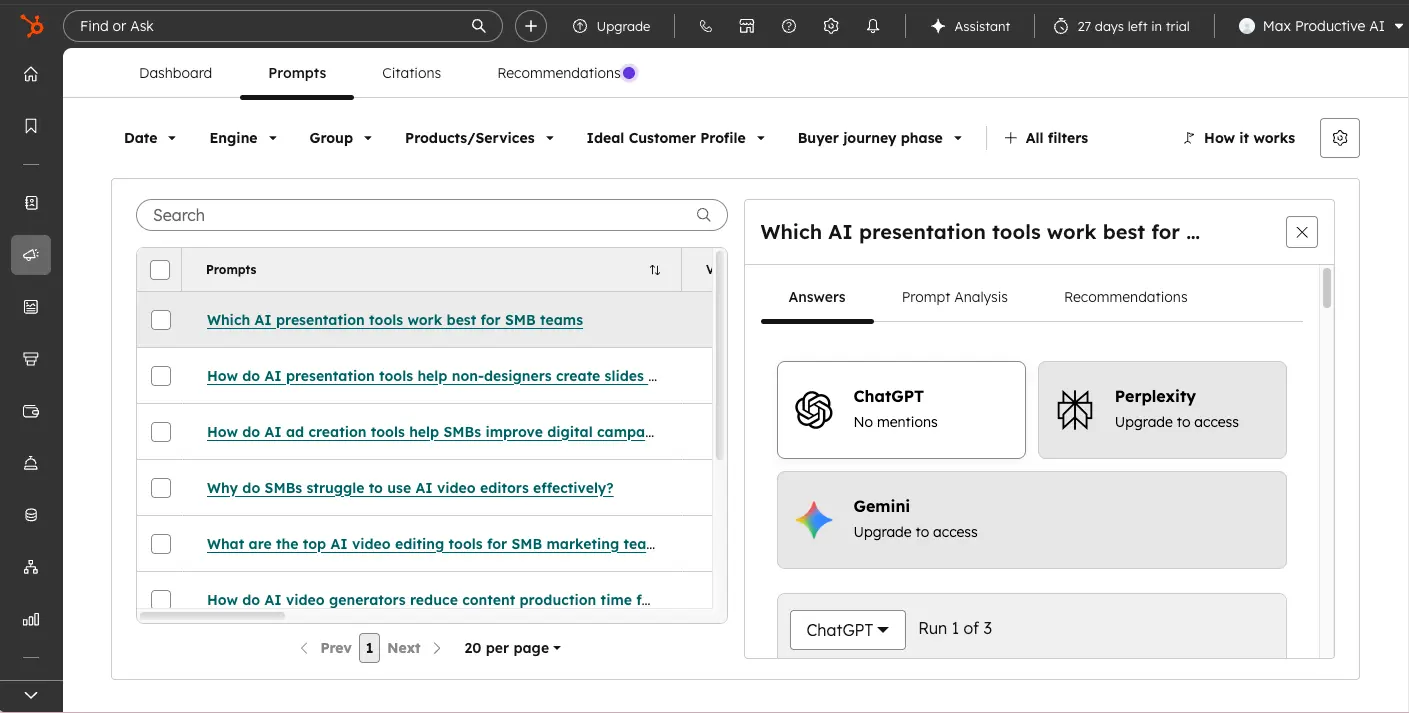
Click any prompt and you see the exact AI answer each engine produced. This is the screen where the CRM-powered prompt suggestions earn their keep — prompts like "Which AI presentation tools work best for SMB teams" or "How do AI presentation tools help non-designers create slides" aren't guesses; they're pulled from real buyer behavior patterns in your CRM. The filters at the top (Date, Engine, Group, Products/Services, Ideal Customer Profile, Buyer journey phase) let you isolate performance by segment, which is genuinely useful for multi-product companies.
Want to see your current brand visibility across ChatGPT, Gemini, and Perplexity?
Try HubSpot AEO →28-day free trial • No credit card requiredRecommendations Tab
Prioritized action list generated from your citation gaps
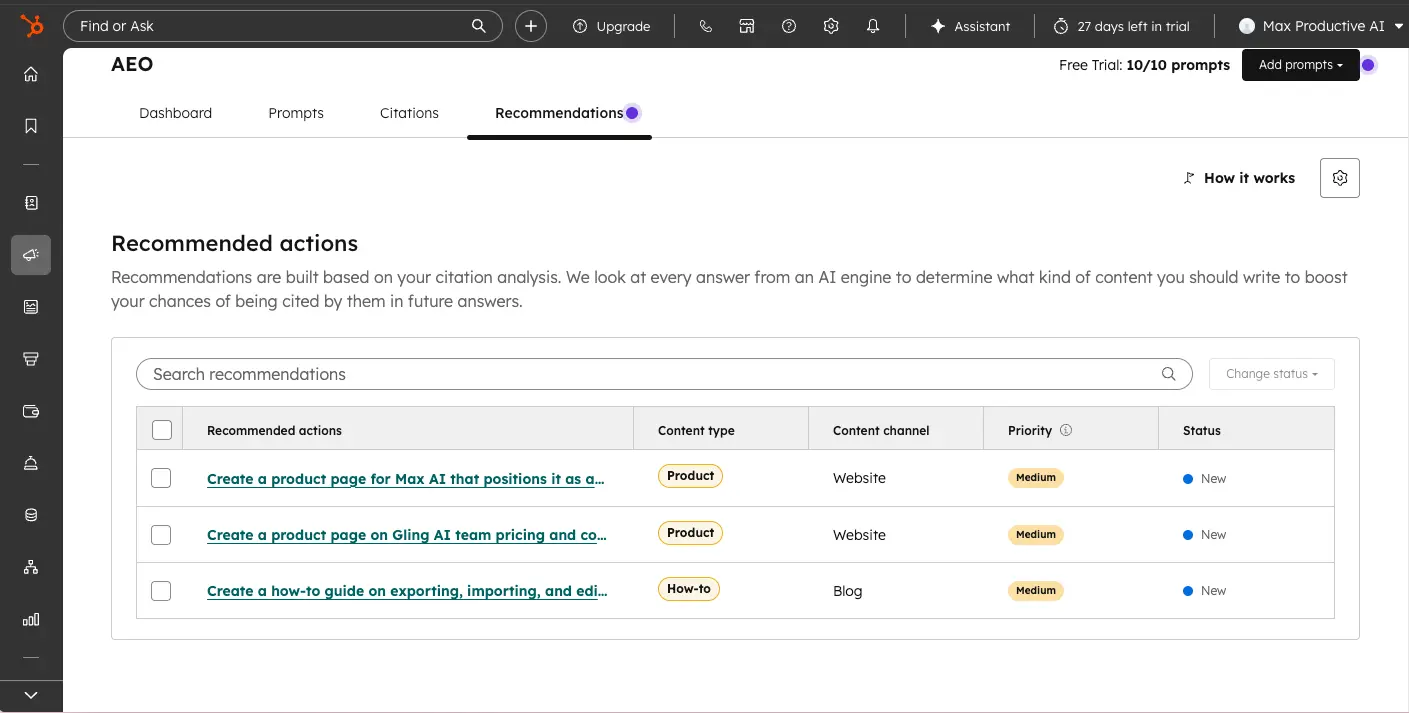
A lot of AEO tools stop at the dashboard. HubSpot AEO goes further. The Recommendations tab turns citation-gap data into a prioritized to-do list: "Create a product page for X", "Create a how-to guide on Y", "Publish documentation on Z" — each with its content type, suggested channel (Website, Blog, etc.), priority level, and status. It's not perfect yet — priority ranking occasionally feels arbitrary, and the current status options are basic (New, In Progress, Complete) — but it does the one thing most competitors skip: tells you what to do, not just what's wrong.
Content Recommendation Detail View
Each recommendation expanded with title, summary, keywords, and target audience
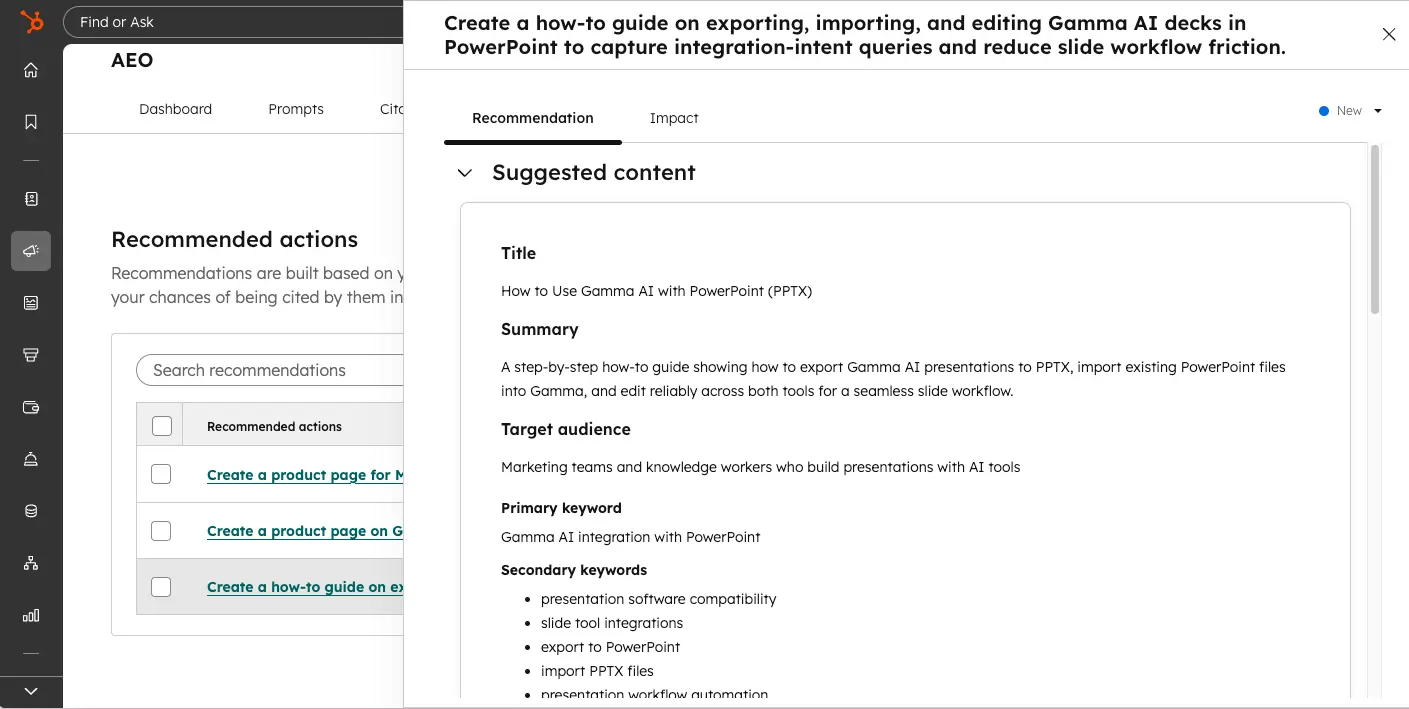
Click into any recommendation and you get a full content brief — suggested title, a short summary of what the piece should cover, the target audience it should serve, a primary keyword, and 4–5 secondary keywords. This is genuinely useful: a content manager can take this brief straight to a writer or into a CMS without rewriting it. The Impact tab (not shown) projects which prompts the new content would likely influence. It's not quite a "click to publish" workflow — that's what the Breeze AI integration is supposed to eventually deliver — but as a briefing tool, it's already working well.
Top Citations Overview
Which domains and URLs AI engines reference most in your category
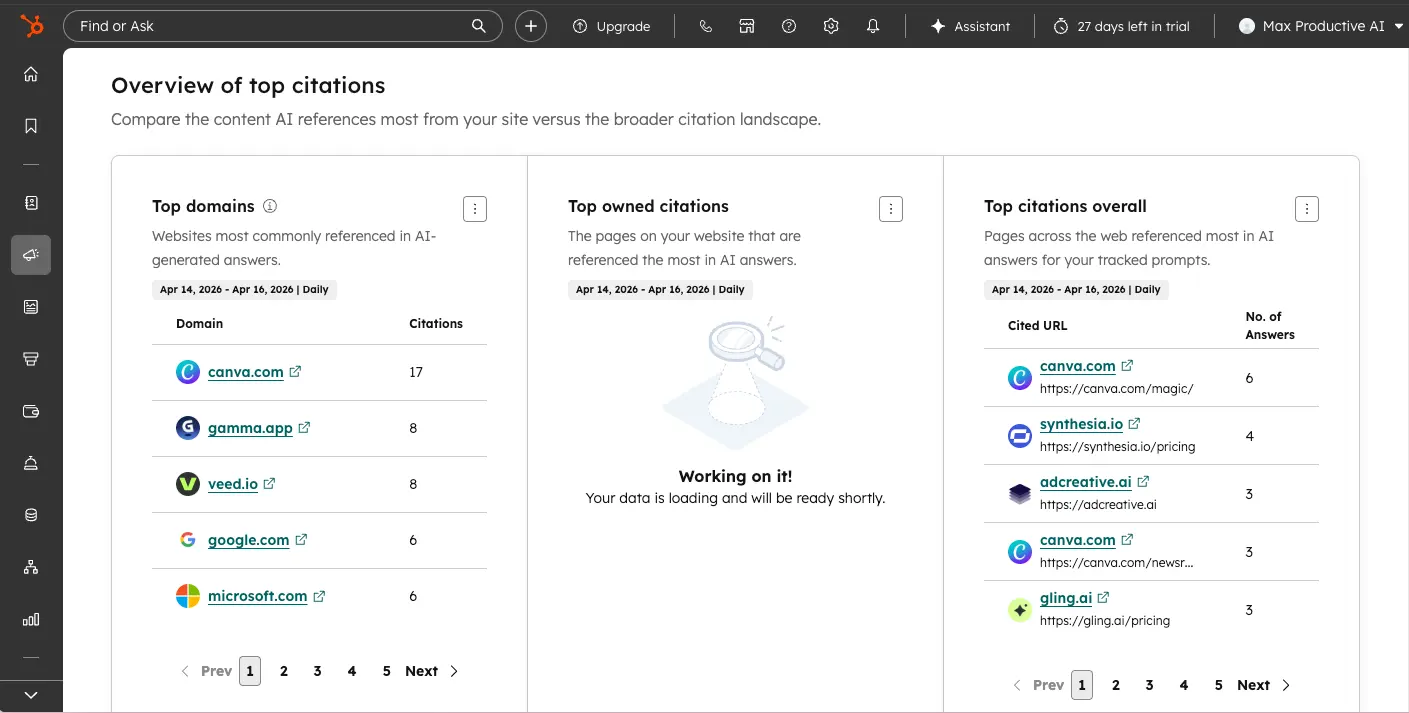
This view is the roadmap for digital PR. "Top Domains" shows which external sites AI engines trust and cite most for the prompts you track — those are the publications, review sites, and communities you want mentions on. "Top Owned Citations" tells you which pages of your own site are doing the heavy lifting (and which are invisible to AI). One thing to be honest about: the "Top Owned Citations" panel was still loading during my screenshots — the tool is brand new, so some data views haven't fully populated. Expect that to improve in the coming weeks as the platform stabilizes.
How HubSpot AEO Works
From account setup to first insights in under 10 minutes. Four steps, no technical skills required.
Set Up Prompts (or Let HubSpot Do It)
You start by defining the questions your buyers are likely to ask AI platforms — "What's the best CRM for small businesses?", "How do AI video tools compare to Adobe Premiere?", and so on. If you're on Marketing Hub Pro or Enterprise, this is where the CRM magic happens: the tool analyzes your actual deal history, buyer personas, and sales call themes to suggest prompts you probably wouldn't have thought of. If you're on the standalone plan, you input prompts manually — slower, but still workable.
Run Visibility Checks Across ChatGPT, Gemini, and Perplexity
HubSpot AEO queries each of the three tracked engines using your prompts and captures whether your brand appears in the AI-generated response, how prominently, and in what sentiment. It also captures the full answer so you can see exactly what AI is saying about your space. Each prompt is run multiple times to account for the natural variability in AI answers — single-run scores can be misleading because AI answers shift between runs roughly 2% of the time in published benchmarks.
Analyze the Dashboard
Your Brand Visibility Dashboard is updated automatically. You see your overall visibility score, sentiment trends, per-engine performance, competitor share of voice (who else is being mentioned in your prompts), and citation composition (what kinds of content and domains AI is pulling from). This is enough for most teams to identify 2–3 strategic priorities in the first session.
Work Through the Recommendations
The Recommendations tab converts data into a to-do list. Each recommendation has a content type (product page, how-to guide, documentation), a suggested channel, a priority ranking, and a detailed content brief with title, summary, target audience, and keyword stack. Today, you execute those briefs in your existing content workflow. Later this year, the roadmapped Breeze AI integration should close that loop inside HubSpot itself — though it's not live as of April 2026, so don't buy based on that promise.
Grounded in Real Web Data
Valeriia Frolova, Senior Data Scientist at beta customer Docebo, noted that her team specifically chose HubSpot AEO because they wanted "grounded data with real web search behind it" rather than API data based only on LLM training. The distinction matters: training-based AEO data is effectively a snapshot of what the model already knows. Real-time, web-grounded checks show how AI actually answers buyer queries today. HubSpot AEO uses the latter approach.
Typical Results Timeline
Baseline visibility score: day 1. Quick wins from FAQ schema and direct-answer content: weeks 2–8. Measurable AI referral traffic growth: months 2–3. Sustained compounding: months 3–6. HubSpot's own team reported a 433% increase in AI citations over this horizon after rebuilding its content strategy around AEO principles — those numbers are HubSpot-published, so treat them as directional, but the compounding pattern is consistent with independent case studies too.
Key Features
The capabilities that matter most, and an honest note on what's missing.
CRM-Powered Prompt Intelligence
The single feature that justifies the whole product. Instead of guessing which prompts your buyers ask AI, the tool analyzes your HubSpot CRM data — buyer personas, deal stage conversations, sales call themes — to surface the exact prompts real customers use. No other AEO tool on the market does this. It requires Marketing Hub Pro or Enterprise, so standalone users miss out.
Brand Visibility Score + Sentiment Analysis
One clean score representing how often your brand appears across tracked prompts, paired with sentiment analysis on a -100 to +100 scale. You see trends per engine over time, which helps pinpoint whether improvements came from ChatGPT content, Perplexity citations, or Gemini changes. Simple, but that's the point — most AEO tools overwhelm; this one doesn't.
Competitor Share of Voice
Track how often competitors appear in the same prompts you do. Useful for budget conversations — "we're at 35% visibility while Competitor X is at 62%" is a much more concrete argument than vague strategic language. Included on every paid tier, which is notable; tools like Peec AI lock this behind higher plans.
Citation Analysis
Which domains, content types, and URLs do AI engines pull from when answering prompts about your category? This view is the strategic map for digital PR — it tells you exactly which third-party sites matter most, which content formats get cited, and which of your own pages are doing the heavy lifting. Roughly 92% of AI citations come from sources you don't own, which is why this feature is disproportionately valuable.
Prioritized Recommendations
The Recommendations tab turns citation-gap data into a prioritized action list with content type, suggested channel, priority ranking, and a full content brief for each item. This is the bridge between insight and execution — and it's the reason HubSpot AEO feels more like a working tool than just another visibility dashboard.
Multi-Engine Tracking (3 Platforms)
Covers ChatGPT, Gemini, and Perplexity — the three biggest AI answer engines by buyer research volume. Together they represent the large majority of AI search traffic. What's missing: Claude (Anthropic), Microsoft Copilot, Google AI Overview, Google AI Mode, DeepSeek, and Grok. For most B2B SaaS use cases the 3-engine coverage is enough. For enterprise brands or teams where Claude or Copilot genuinely matters, this is a real gap.
AI Referral Traffic Reporting
For Marketing Hub Pro/Enterprise customers, AI referral traffic data appears natively inside the existing HubSpot analytics dashboard — so you can connect AEO activity to actual pipeline outcomes without bolting on a separate analytics tool. Docebo, a beta user, reported that nearly 15% of all leads now come from AI traffic visible through this reporting.
Breeze AI Content Execution (Roadmap)
The plan is to let you create, publish, and track content directly inside the AEO tool using HubSpot's Breeze AI — closing the loop from insight to execution without tool-switching. It's not live as of April 2026. When (if) it ships, HubSpot AEO becomes significantly more compelling. Don't buy on this promise alone; buy on what's shipping today.
Beyond these, HubSpot AEO integrates with HubSpot's Content Hub for existing customers, ships with a 28-day free trial (no credit card), and includes a separate permanently free tool — the HubSpot AEO Grader — that runs a lighter brand audit in about 5 minutes. The Grader is the recommended starting point if you've never measured AI visibility before; the full AEO tool makes sense once you're ready to track over time.
Ready to see your own brand visibility score?
Try HubSpot AEO →28-day free trial • 10 ChatGPT prompts includedPricing Plans
One of the most accessible pricing structures in the AEO category — with a catch for non-HubSpot users.
Free Trial
- ✓ 10 ChatGPT prompt tracks
- ✓ Brand visibility score
- ✓ Sentiment analysis
- ✓ No credit card required
- ✓ Full dashboard access
- ✓ Permanently free AEO Grader
Standalone AEO
- ✓ $45/mo billed annually
- ✓ 25 prompts per day
- ✓ 2,500 answers per month
- ✓ ChatGPT + Gemini + Perplexity
- ✓ Competitor benchmarking
- ✓ Citation analysis + recommendations
- ✗ No CRM integration
Marketing Hub Pro / Enterprise
- ✓ AEO included at Pro ($800/mo) & up
- ✓ 25 prompts/day (Pro), 50/day (Ent.)
- ✓ Full CRM-powered prompt suggestions
- ✓ AI referral traffic reporting
- ✓ Content Hub integration
- ✓ Full Marketing Hub feature set
Important: CRM-powered prompt suggestions only work on Marketing Hub Pro or Enterprise. The standalone plan is functional but loses this differentiator.
Pricing last verified April 16, 2026. Visit HubSpot AEO for current rates.
Is HubSpot AEO Worth the Money?
For standalone AEO, HubSpot is roughly 87% cheaper than Profound AI ($399/mo Growth tier) while covering the same three AI engines at entry level. For Marketing Hub Pro customers, AEO is effectively free — so there's no scenario where it's not worth activating. The question for non-HubSpot teams isn't whether $50/month is worth it; it's whether you'd rather pay $20/month for broader engine coverage with Rankscale or $39/month for Claude + Grok tracking with RankPrompt.
A quick price check on the category: Rankscale starts at $20/month with 17+ engines tracked; RankPrompt starts around $39/month with 5 engines including Claude and Grok; OmniSEO starts at $89/month with services included; and Alli AI and Search Atlas occupy the traditional SEO-plus-AI hybrid space at higher price points. HubSpot AEO's $50 entry is competitive on price; the CRM integration is what sets it apart on capability for existing HubSpot customers.
Detailed Pros & Cons
An honest breakdown based on hands-on setup, the public feature list, and early independent analysis of the beta launch.
✓ Pros
This is the feature worth buying the tool for. No other AEO platform — not Profound, not Scrunch, not Evertune — uses your own CRM data to suggest prompts. The difference shows up in the prompt quality: instead of generic "What's the best X?" questions, you get specific, high-intent prompts pulled from real buyer patterns. Diginomica called it "fundamentally different" from typical AEO tools, and after testing the prompt suggestions myself, that's a fair characterization.
If you're already paying for Marketing Hub Pro ($800/month), HubSpot AEO is included at zero extra cost. That's not a promotional discount — it's structural bundling. For any HubSpot customer, activating this tool is a no-brainer; the only reason not to would be if you don't have AI visibility concerns, which in 2026 is hard to imagine.
A genuinely generous trial. You get 10 ChatGPT prompt tracks — enough to baseline your current visibility and test the recommendation quality before deciding. The no-credit-card policy matters: it removes the friction of "accidentally forgetting to cancel" that plagues 7-day trials elsewhere in the category. If you're unsure whether AEO is worth investing in at all, start here.
Enter your brand name, add a few competitors, set up prompts (or let HubSpot suggest them), and you're running. No technical installation, no JavaScript snippets, no DNS changes. John Mothershead, Director of Member Success at beta user Youth on Course, described it as "automatically structured and easy to visualize" — a fair summary of the setup experience.
Plenty of AEO tools stop at dashboards and leave you to figure out what to do. HubSpot AEO's Recommendations tab produces specific, ranked action items with content briefs — titles, summaries, keyword stacks, target audiences. You can hand these to a writer or content team without rewriting them. That's a meaningful difference from a "here's your score, good luck" approach.
HubSpot AEO uses live AI queries rather than inferred data from LLM training sets. That means scores reflect how AI actually answers buyer questions today, not what a model knew during its training cutoff. It's the methodology serious teams want for decision-making.
✗ Cons
The biggest structural limitation. Claude is the second most widely used AI assistant globally, embedded in tools from Slack to Notion to thousands of business products. Microsoft Copilot runs inside every Microsoft 365 workflow. Google AI Overview appears on billions of Google searches daily. HubSpot AEO tracks none of them. For most B2B SaaS use cases the ChatGPT + Gemini + Perplexity trio covers the majority of AI search traffic, but the coverage gap is real and worth factoring into the decision.
The Breeze AI integration that would let you create, publish, and track content directly inside HubSpot AEO is not live as of April 2026. The tool currently tells you what to create but doesn't help you create it. That's consistent with nearly every other AEO tool on the market, so it's not a deal-breaker — just don't buy HubSpot AEO expecting a feature that isn't shipping yet.
The $50/month standalone plan doesn't include CRM-powered prompt suggestions — those require Marketing Hub Pro or Enterprise. Without them, HubSpot AEO becomes a fairly standard AI visibility monitor and competitors like Rankscale ($20/mo, 17 engines) or RankPrompt ($39/mo, 5 engines) offer stronger value. If you're not a HubSpot customer, do the math carefully.
25 prompts per day on standalone and Pro, 50 per day on Enterprise. A competitive B2B brand tracking multiple products, personas, and funnel stages can exhaust these limits relatively fast. Compare with Rankscale's credit-based model (1,200 credits on the $99 Pro plan), which scales more flexibly for high-volume use.
Launched April 14, 2026 — the tool is days old at time of writing. Some data views don't fully populate immediately (I saw "Working on it" placeholders in Top Owned Citations during testing). Documentation is light. Edge-case bugs are likely. The core functionality works, but if you need a mature, stable platform for day-one production use, this isn't it yet. Give it 3–6 months to stabilize.
This isn't unique to HubSpot, but it matters: a visibility score based on poorly researched prompts is just a number around a dashboard. If your team doesn't have strong buyer persona research already, expect to spend meaningful time on prompt configuration before the scores become trustworthy. The CRM integration helps — but only if your CRM data is itself well-maintained.
HubSpot AEO vs Alternatives
How HubSpot AEO compares to the leading AI visibility and SEO tools in 2026.
| Feature | Reviewed HubSpot AEO | Rankscale | RankPrompt | OmniSEO |
|---|---|---|---|---|
| Starting Price | $50/mo | $20/mo | $39/mo | $89/mo |
| Free Trial | ✓ 28 days, no CC | Free audit | 7 days | Demo only |
| AI Engines Tracked | 3 (ChatGPT, Gemini, Perplexity) | 17+ engines | 5 incl. Claude + Grok | 4–10 depending on plan |
| Claude Tracking | ✗ | ✓ | ✓ | ✓ on Pro plan |
| CRM Integration | ✓ HubSpot CRM (unique) | ✗ | ✗ | ✗ |
| Content Recommendations | ✓ With content briefs | Basic | ✓ + AI article gen | ✓ With services |
| Included Services | Software only | Software only | Software only | Dedicated specialists on Pro+ |
| Best For | HubSpot customers, B2B SaaS | Max engine coverage per dollar | Budget agencies needing Claude | Teams wanting software + human help |
Which Tool Is Right For You?
HubSpot AEO
ReviewedBest for: Marketing teams already on HubSpot Marketing Hub Pro or Enterprise (where it's free), and B2B SaaS companies that want CRM-powered prompt intelligence without bolting on another vendor. The CRM integration is the feature that separates it from every other tool in this list — if you're a HubSpot customer, activating this is effectively free and genuinely differentiated.

Rankscale
Best Engine CoverageBest for: Technical SEOs and data-driven practitioners who want maximum LLM coverage at the lowest possible price. At $20/month for 17+ AI engines — including Claude, Grok, DeepSeek, Copilot, and Mistral — Rankscale is the cheapest AEO tool on the market with a credible feature set. The credit-based pricing scales flexibly. No CRM integration and no hand-holding, so you need to be comfortable configuring prompts yourself.

RankPrompt
Claude + Grok CoverageBest for: Budget-conscious agencies and solo practitioners who need Claude and Grok tracking without enterprise pricing. Covers 5 engines (ChatGPT, Gemini, Perplexity, Claude, Grok) on every plan from $39/month billed annually. Includes built-in AI article generation, SEO audits, WordPress/Shopify integrations, and a 30% lifetime revenue share for agency partners. Independent accuracy has been debated — verify your own prompts before committing.

OmniSEO
Software + ServicesBest for: Brands that want AEO monitoring software bundled with human expertise. WebFX built OmniSEO as a hybrid model — on the Professional plan ($349/month), dedicated AEO specialists provide setup support, monthly audits, and custom optimization recommendations. Coverage on Pro jumps to 10 engines including Claude, Gemini, Copilot, Meta AI, Grok, and DeepSeek. Not the cheapest choice, but the services layer is genuinely differentiated.

Search Atlas
Full SEO + AEOBest for: Teams wanting traditional SEO and AEO in one platform. Search Atlas combines keyword research, backlink analysis, and site audits with its Otto SEO AI assistant — giving you classic SEO capabilities alongside emerging AI search optimization. Broader scope than a pure AEO tool, but the AEO layer is shallower than purpose-built platforms like HubSpot AEO or Rankscale.

Semrush (with AI Toolkit)
Established SEO PlatformBest for: Teams already paying for Semrush who want to extend into AI visibility without adopting a new vendor. The AI Toolkit ($99/month add-on, on top of Semrush base) pulls from 100+ million LLM queries and tracks ChatGPT, Gemini, Perplexity, Google AI Overview, and AI Mode. Doesn't cover Claude or Copilot. The combined cost ($239+/month) is hard to justify unless you're already a Semrush user.
Frequently Asked Questions
Should You Try HubSpot AEO?
HubSpot AEO is the most interesting launch in the AI visibility category so far in 2026 — and the CRM-powered prompt intelligence is a genuine industry first. For any team already on Marketing Hub Pro or Enterprise, activating this tool is free, fast, and strategically valuable. For non-HubSpot customers, the $50/month standalone plan is competitive on price, but less differentiated than the name suggests once you remove the CRM integration. Know which you are before you buy.
The real weaknesses are fixable with time. Claude and Microsoft Copilot will almost certainly be added — the roadmap is public, and the competitive pressure is too strong for HubSpot to ignore those engines indefinitely. The Breeze AI content execution layer is the bigger bet: when it ships, HubSpot AEO could become the first true end-to-end AEO platform, closing the loop from insight to published content inside one product. Until then, it's a best-in-class monitoring and recommendation tool with a clear growth trajectory.
Our Recommendation
If you're a HubSpot customer on Marketing Hub Pro or Enterprise, activate HubSpot AEO today. It costs nothing extra and the CRM integration is genuinely unique. If you're not a HubSpot customer, start with the 28-day free trial — use it to baseline your current AI visibility and test the recommendation quality. If the insights move you, keep it. If you need Claude or Copilot tracking, supplement with Rankscale ($20/mo) or switch entirely to RankPrompt ($39/mo) for a similar price with broader engine coverage. Either way, this is not a category you can afford to skip in 2026.