

Rankscale AI
Generative Engine Optimization (GEO) platform that tracks how your brand appears inside AI-generated answers. Monitor visibility across ChatGPT, Perplexity, Google AI Overviews, Gemini, Claude, and 17+ AI engines — from $20/month.
Try Rankscale AI →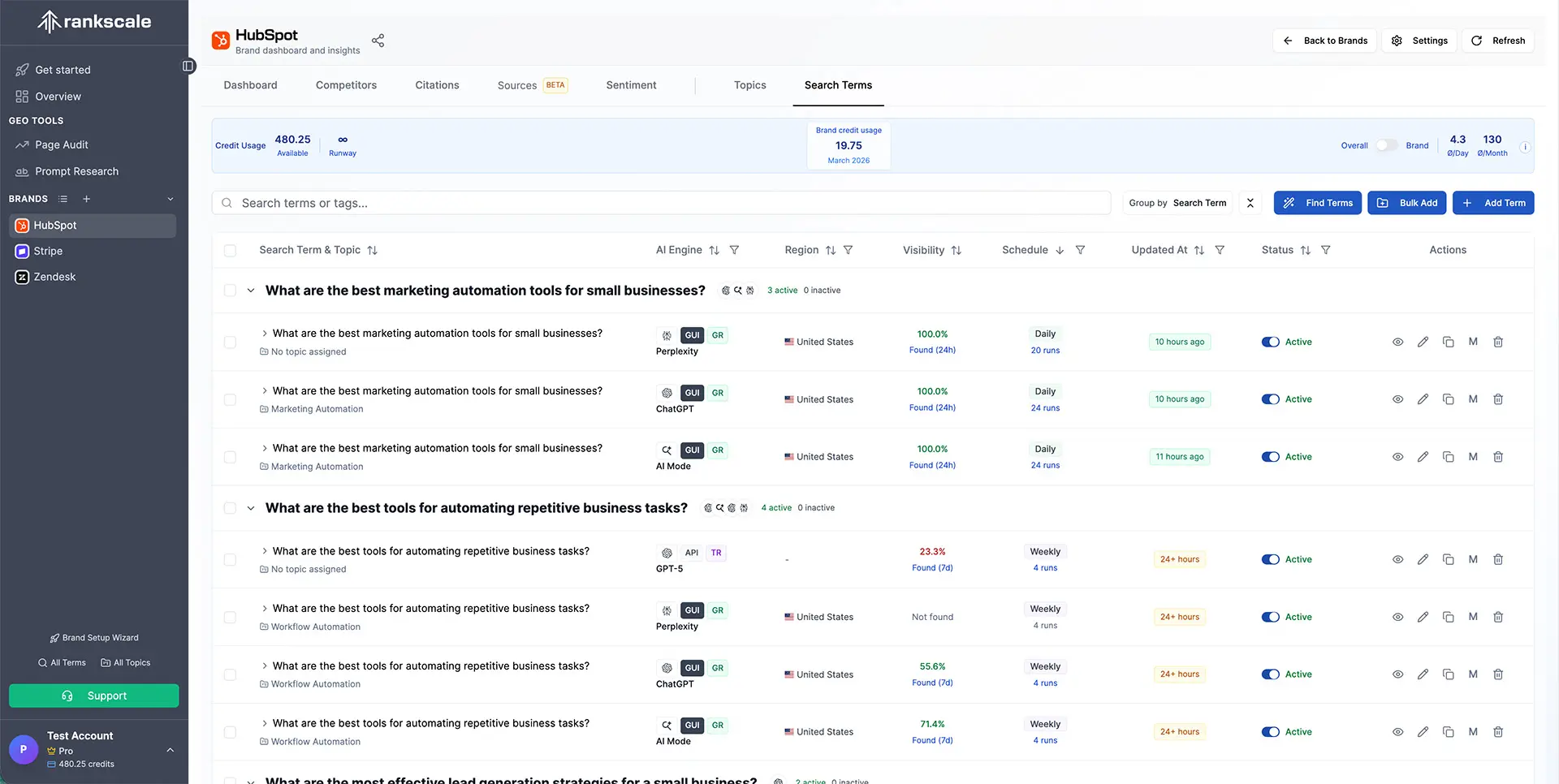
The Broadest AI Engine Coverage
at the Most Accessible Price
Rankscale AI solves a problem most SEO tools still ignore: tracking whether your brand actually shows up when people ask AI engines questions about your category. It covers 17+ AI platforms — including ChatGPT, Perplexity, Google AI Overviews, and Gemini — all from $20/month with no per-engine add-ons. That alone puts it ahead of competitors who gate engines behind expensive upgrades. The co-founder-led onboarding, Looker Studio integration, and new REST API make it genuinely agency-ready. It won't fix your content for you, and it can't tell you why a crawler skipped your page — but for understanding where your brand stands in the AI-first web, nothing else gives you this breadth at this price.
✓ What We Love
- 17+ AI engines on every plan — no add-on fees
- $20/month entry is the lowest in the GEO category
- Co-founder daily onboarding calls on all tiers
- Looker Studio + REST API for agency reporting
! Could Be Better
- No GA4 traffic or conversion attribution
- Credit burn at scale demands careful planning
- Diagnoses visibility gaps but doesn't execute fixes
What Is Rankscale AI?
Who built it, what it tracks, and why it matters for SEO teams in 2026.
Here's the shift most SEO professionals are still catching up to: AI search engines now answer millions of queries directly — without sending users to websites. When someone asks ChatGPT "what's the best CRM for small businesses?" or Perplexity "how do I improve my site speed?", the answer appears instantly inside the AI interface. Your brand is either mentioned in that answer, or it's invisible. Classic rank trackers can't measure this because they track blue-link positions, not mentions inside generated paragraphs.
Rankscale AI exists to close that gap. Founded in October 2024 by Mathias Ptacek and formally incorporated as Rankscale GmbH in Austria, the platform recreates the exact prompts users type into AI search engines, captures what those engines return, and builds a structured dataset showing when, where, and why a brand is — or isn't — referenced. It's one of the first tools purpose-built for what the industry now calls Generative Engine Optimization (GEO).
What makes it worth paying attention to? Two things. First, engine coverage: Rankscale tracks 17+ AI platforms including ChatGPT, Perplexity, Google AI Overviews, Google AI Mode, Gemini, Claude, DeepSeek, Grok, Copilot, and Mistral — all available from the $20/month entry plan. Most competitors cover 3–7 engines, and several charge per-engine add-ons that can double the real monthly cost. Second, the support model: co-founder Mathias Ptacek runs daily one-hour onboarding video calls accessible at every plan level. Multiple independent reviewers flag this as a genuine differentiator — you're getting technical depth directly from the person building the product, not a tier-1 support agent reading a script.
The enterprise client list adds credibility: Bosch, UBS, REWE, Dentsu, and WPP Media all use the platform. That's not typical for a tool starting at $20/month, and it suggests the data quality holds up at scale.
Who Is Rankscale AI Best For?
Digital marketing agencies managing multiple client brands who need competitive AI visibility reports and Looker Studio exports. In-house SEO/GEO teams at brands serious about AI search. Content strategists identifying which third-party domains need to cite their content. E-commerce brands tracking ChatGPT Shopping buybox presence. Less ideal for solo bloggers, teams needing direct traffic attribution, or anyone wanting automated content fixes in one tool.
Is it perfect? No — and we'll get into the real limitations later. It can't tell you whether an AI bot actually crawled your page (only what the engine outputted), it doesn't connect visibility to website sessions or revenue, and the credit model needs careful management at scale. But for the core use case — understanding and improving where your brand stands across the AI-generated web — it's the broadest and most accessible option available in April 2026.
See Rankscale AI in Action
Real screenshots from the platform showing the brand dashboard, citation analysis, page audits, and prompt research tools.
Brand Visibility Dashboard
Your central hub for AI visibility across all tracked engines
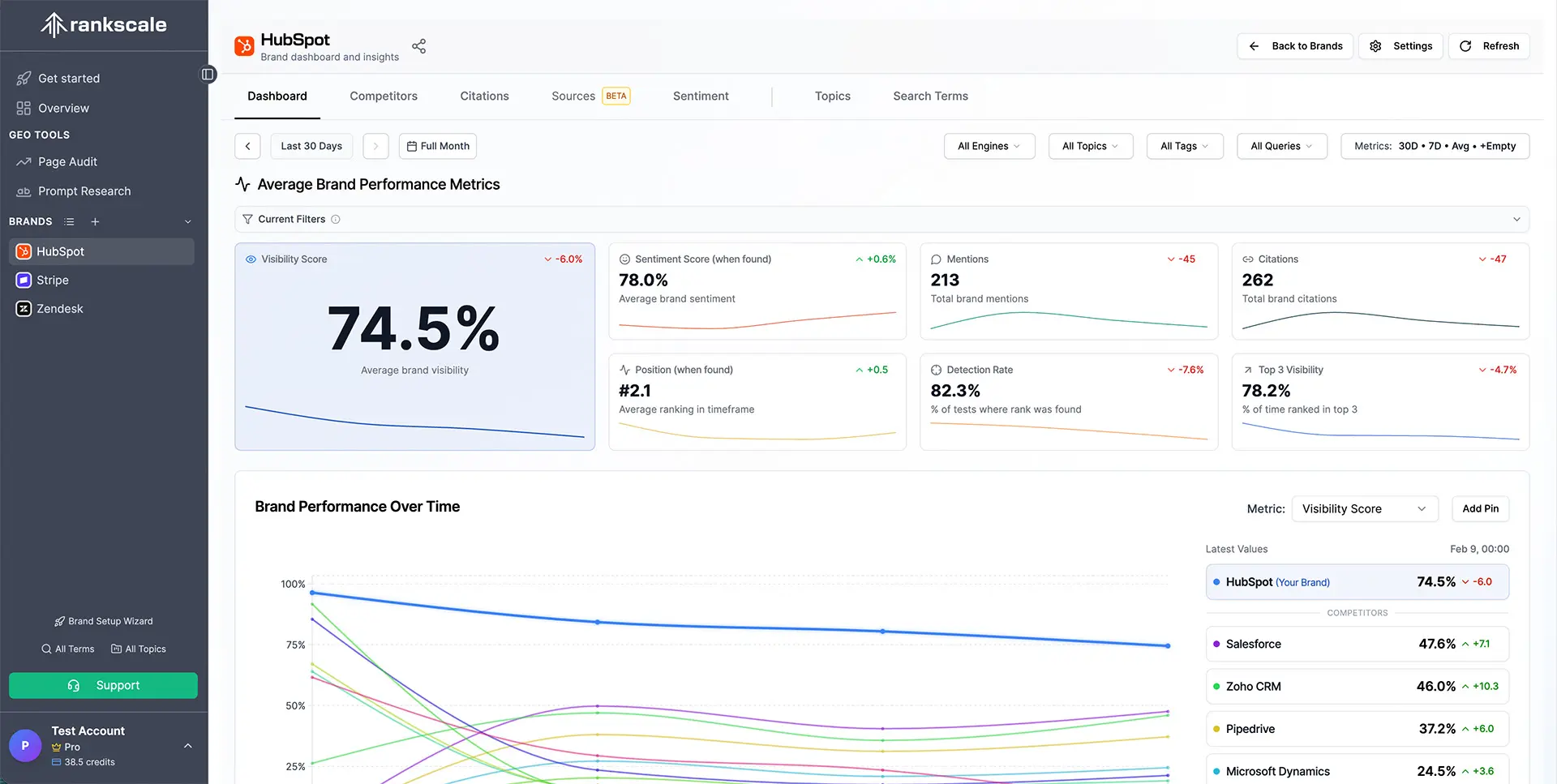
The dashboard aggregates your brand's AI presence into a single Visibility Score alongside sentiment, mentions, citations, position, detection rate, and top-3 visibility — all filterable by engine, topic, and date range. The "Brand Performance Over Time" graph below maps your visibility against competitors under identical prompt conditions. Here you can see HubSpot at 74.5% versus Salesforce (47.6%), Zoho CRM (46%), and Pipedrive (37.2%). That side-by-side view under controlled conditions is more reliable than checking competitors manually at different times.
Citation Analysis
Which external domains and URLs AI engines credit when mentioning your brand
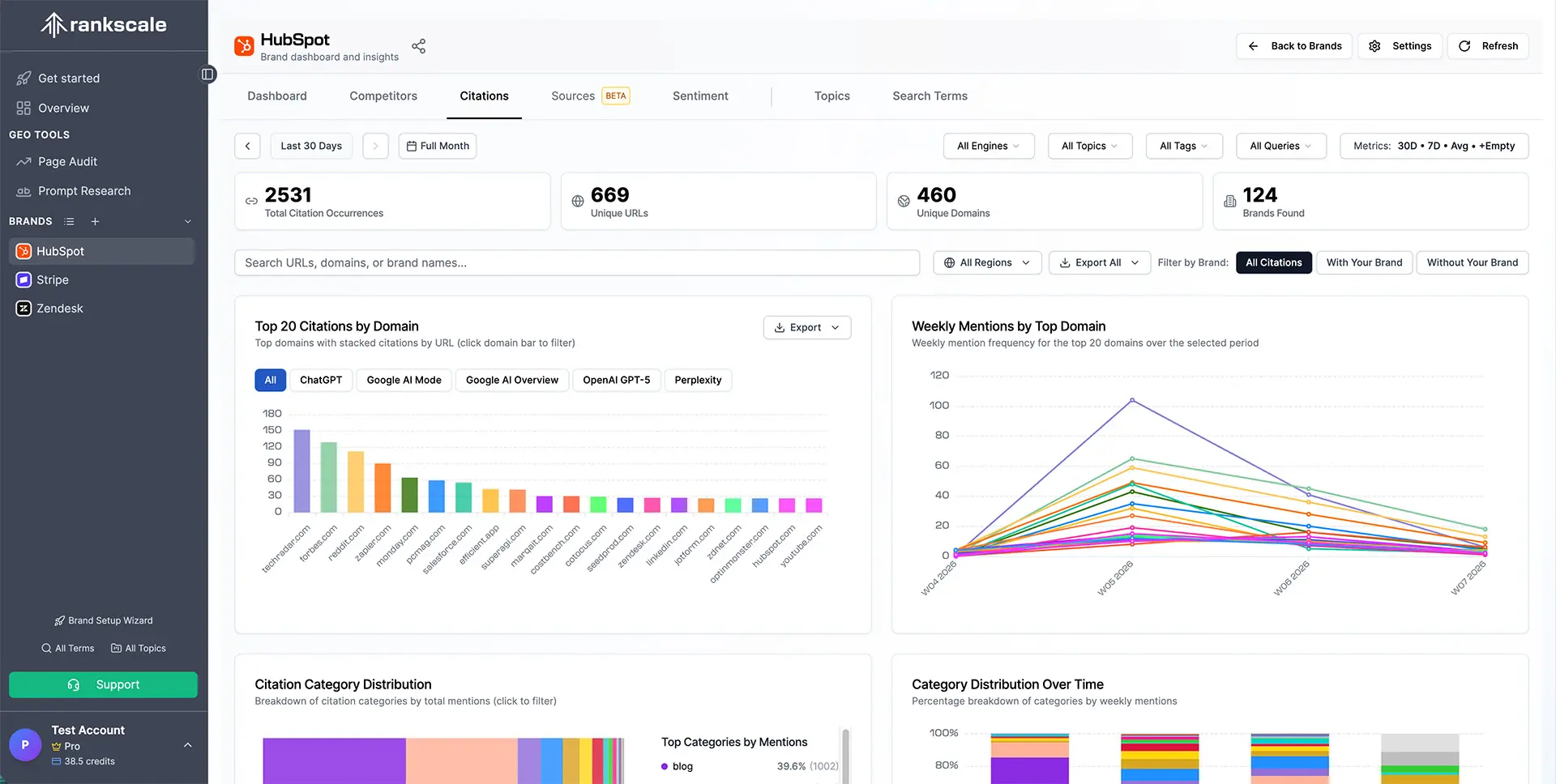
This is where Rankscale gets strategically interesting. The citation analysis reveals which external domains AI engines actually reference when answering questions about your category — and which competitors are being credited instead. In this example, techradar.com, forbes.com, and reddit.com dominate citations across ChatGPT and Perplexity. That insight directly informs your content placement strategy: if a specific domain drives AI citations in your space, getting your brand mentioned there becomes a priority.
Search Terms & AI Visibility Tracking
Monitor which prompts mention your brand across multiple AI engines simultaneously
Here's the operational core of the platform. Each prompt is tracked across the AI engines you choose — Perplexity, ChatGPT, AI Mode, and more — with visibility scores showing how consistently your brand appears. Worth noting: the same prompt can yield wildly different results across engines. "What are the best marketing automation tools?" shows 100% visibility on Perplexity and ChatGPT but only 23.3% on GPT-5 via API. That kind of engine-specific gap is exactly what you can't see without a tool like this.
Want to see how your brand performs across AI engines?
Try Rankscale AI →7-day free trial • Free no-registration website auditPage Audit — AI Crawlability Score
Check whether AI bots can actually access and read your content
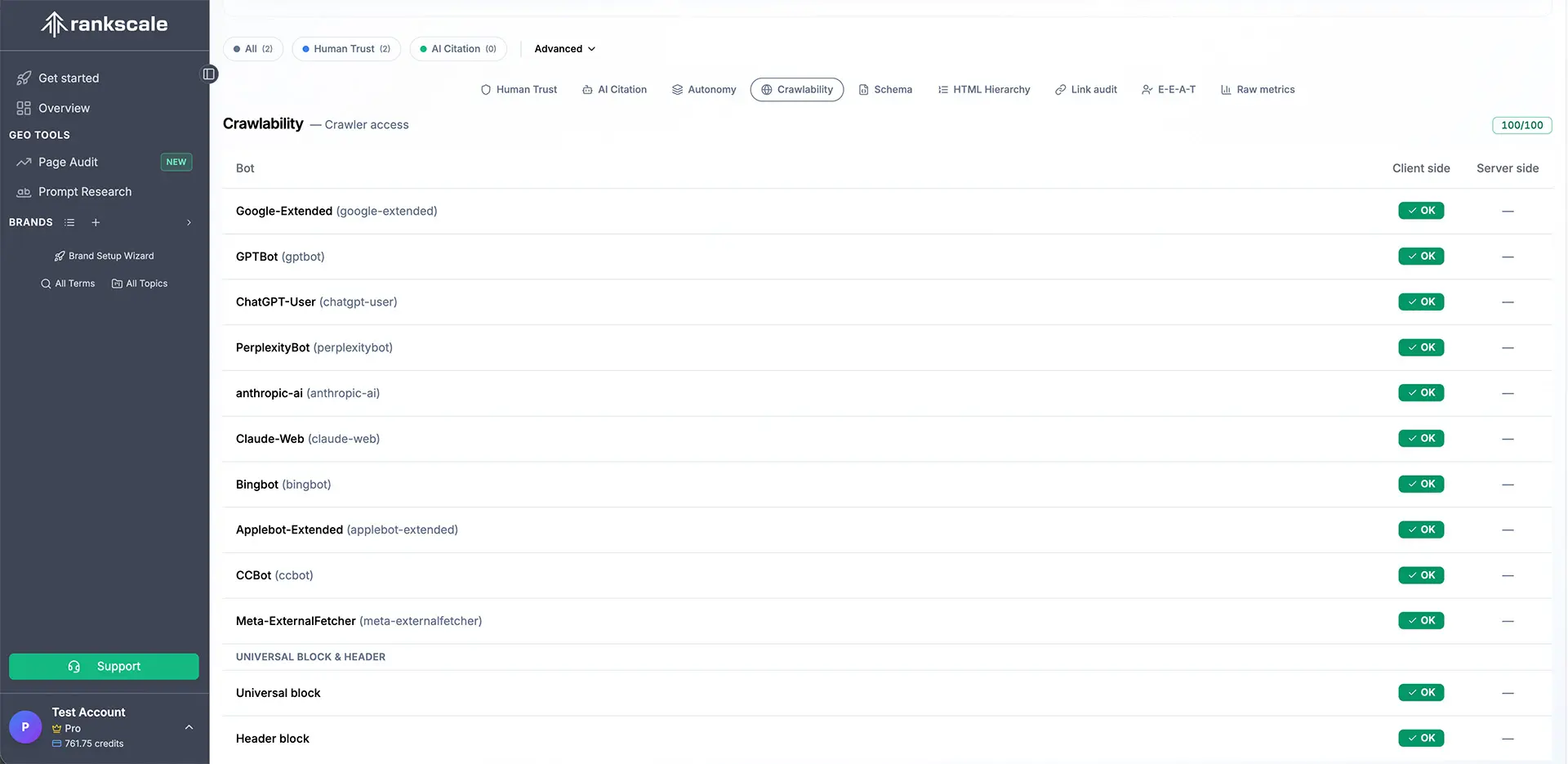
The Page Audit V2 evaluates your site against 200+ checkpoints including AI bot crawlability, schema markup, content structure, and authority signals. This specific crawlability tab is useful because many sites inadvertently block AI crawlers — Cloudflare treats GPTBot as a potential threat by default, and security configurations often block bots like PerplexityBot or ClaudeBot without the site owner realizing it. If AI engines can't crawl your content, no amount of content optimization will help.
Prompt Research — Intent & Volume
Discover which questions AI engines field most in your category
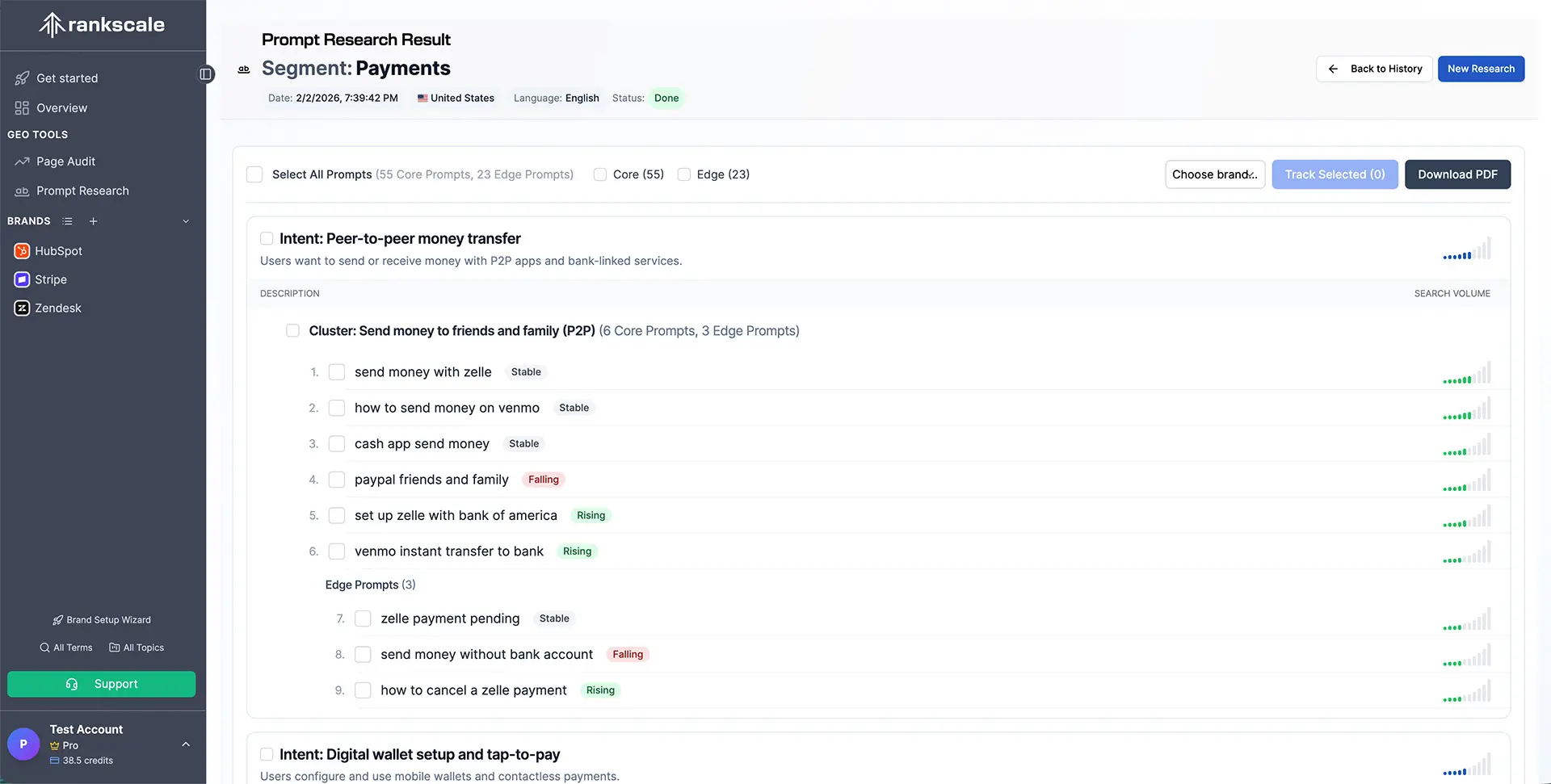
Prompt Research uses Rankscale's exclusively licensed Prompt Decoding methodology (developed by Hanns Kronenberg) to estimate which questions AI engines receive most frequently in your category — and whether those prompts are rising or falling in volume. In this Payments segment example, "send money with zelle" and "how to send money on venmo" are stable high-volume prompts, while "set up zelle with bank of america" is rising. This data feeds directly into content planning: optimize for the prompts that matter, not the ones you assume matter.
How Rankscale AI Works
From first audit to ongoing AI visibility monitoring — the workflow that makes GEO operational.
Run a Free AI Readiness Audit
Start on rankscale.ai by entering your website URL — no account required. The audit scans your site against 200+ checkpoints and returns an AI Readiness Score showing how well-positioned your content is for AI citation. You'll see which AI bots can crawl your pages, how your schema and metadata stack up, and where the obvious gaps are. Think of this as the diagnostic that tells you whether the tool is relevant for your situation before you commit.
Set Up Brand Tracking
Create an account (the 7-day trial gives full access) and configure your brand dashboard. Add the prompts you want to monitor — these are the actual questions your target audience asks AI engines, like "what's the best project management tool for agencies?" or "is HubSpot worth it for small businesses?". Select which engines to track (all 17+ are available) and set your monitoring cadence (daily, weekly, or monthly). Rankscale automatically identifies competitors from your tracked terms.
Analyze Visibility & Citations
Here's where the actual insight happens. For every tracked prompt, Rankscale captures the complete AI-generated response — not just whether your brand was mentioned, but its position, the sentiment around it, and critically, the citation source. That last part matters because it reveals which third-party websites AI engines trust enough to credit when discussing your category. If techradar.com drives 150 citations in your space and your brand isn't mentioned on techradar, that's an actionable gap. The competitor benchmarking runs under identical conditions — same prompt, same engine, same moment — so comparisons are apples-to-apples.
Implement Fixes & Monitor Trends
The Page Audit identifies specific content and technical issues tied to underperforming prompt sets. Fix them — update schema markup, improve content structure, earn citations on high-authority domains, unblock AI crawlers — then track how your Visibility Score responds over subsequent monitoring runs. One honest caveat here: AI engine outputs are inherently volatile. Models update constantly, and your scores can swing week-to-week without any content changes on your end. Trend lines over 30+ days are more meaningful than day-to-day fluctuations.
About Credit Management
The credit system is flexible but demands attention. Each prompt × engine × run consumes credits. Tracking one prompt across 5 engines weekly costs more than tracking it monthly across 1 engine. Before choosing a plan, model your actual monitoring footprint: how many prompts, across how many engines, at what cadence. The Essential plan's 120 credits (up to 480 AI responses) works for a small brand just starting out. Agencies tracking dozens of prompts across multiple clients should start at Pro (1,200 credits).
Key Features
What $20–$99/month actually gets you — and where the gaps are.
Brand Visibility Dashboard
The operational center of the platform. A single Visibility Score aggregates mention frequency, citation share, and positional prominence across all tracked engines. Manage multiple brands from one interface, slice data by engine, topic, or date range, and compare against competitors in real time. Clean and functional — though some independent reviewers note the dashboard depth has a learning curve for new users.
17+ AI Engine Coverage
ChatGPT, Perplexity, Google AI Overviews, AI Mode, Gemini, Claude, DeepSeek, Grok, Copilot, Mistral — plus model-level APIs like GPT-5, Gemini 3.0 Pro, and Sonar-Pro. All included on every plan, no add-ons. This is the single biggest differentiator: competitors like OmniSEO charge $349/month for 10 engines; Peec AI base plans cover only 3 engines with per-engine add-ons.
Competitor Benchmarking
Automatically identifies competitors from your tracked terms and compares KPIs under identical prompt conditions — same wording, same engine, same moment. Distinguishes between brands being referenced versus cited, which matters because AI systems often summarize from one brand while crediting another. The apples-to-apples comparison under controlled conditions is more statistically reliable than ad-hoc manual checking.
Citation Analysis
Discovers which external domains, articles, and URLs AI engines use when formulating answers about your category. This is strategically valuable — if you know that forbes.com and reddit.com drive the most citations in your vertical, you can focus content placement efforts there. You can filter by engine (ChatGPT citations differ from Perplexity citations), export data, and track citation trends weekly.
Page Audit V2 (200+ Checks)
Evaluates your site against 200+ checkpoints covering content structure, schema completeness, AI bot crawlability, authority signals, and metadata accuracy. Each recommendation maps to specific underperforming prompt sets — so you know exactly which fixes will impact which visibility gaps. The crawlability tab alone is worth running: you might discover your security setup blocks GPTBot or ClaudeBot without you knowing.
Prompt Research & Decoding
Uses an exclusively licensed Prompt Decoding methodology developed by Hanns Kronenberg — independently validated against the Harvard/OpenAI NBER Working Paper 34255. Estimates prompt search volume through semantic reconstruction, decodes user intent density, and identifies rising vs. falling question patterns. No other GEO tool offers a licensed, externally validated prompt volume methodology. That said, prompt volume estimation in AI search is inherently imprecise — treat the data as directional, not absolute.
Sentiment Analysis
Tracks whether brand mentions are positive, neutral, or negative across each engine and topic. Keyword-level sentiment themes help surface reputation risks early and identify positive narratives worth amplifying. It's a useful layer for PR teams monitoring brand perception in AI outputs — though keep in mind that sentiment can shift when models update, not just when public opinion changes.
240+ Countries & All Languages
Global reach with localizable insights by region and market. Track how AI engines respond to the same prompt in different geographies — critical for international brands where AI responses can vary significantly by country. The UI itself is English-only, though — a minor annoyance if your team works primarily in another language.
Beyond these core modules, Rankscale launched a ChatGPT Shopping Analysis feature in Q1 2026 that tracks product and merchant recommendations in ChatGPT's shopping results — relevant for e-commerce brands monitoring their AI-driven buybox presence. The Google Looker Studio native connector (available on Pro and above) lets agencies build automated client reports combining AI visibility data with other analytics sources. And the REST API, released April 2026, enables custom integrations and automated reporting pipelines for data-heavy teams.
All 17+ engines included on every plan:
Try Rankscale AI →7-day free trial • Free website audit without registrationPricing Plans
Credit-based model with the lowest entry point in the GEO category. All engines included on every tier.
Essential
- ✓ 120 credits (up to 480 AI responses)
- ✓ All 17+ AI engines included
- ✓ 10 web audits
- ✓ 2 brand dashboards
- ✓ 240+ countries & all languages
- ✓ Competitor benchmarking
Pro
- ✓ 1,200 credits (up to 4,800 AI responses)
- ✓ All 17+ AI engines included
- ✓ 50 web audits
- ✓ 25 brand dashboards
- ✓ Google Looker Studio connector
- ✓ Unlimited team seats + raw export
Enterprise
- ✓ 12,000 credits (up to 48,000 AI responses)
- ✓ All 17+ AI engines included
- ✓ 200 web audits
- ✓ 100 brand dashboards
- ✓ REST API access
- ✓ Priority support
Also available: Custom Agency plan (Q1 2026) for multi-client shared credits. Ad-hoc credit top-ups without upgrading tiers.
Pricing last verified April 2026. Visit Rankscale AI for current rates.
How Does This Compare?
For context: Otterly AI starts at $29/month but covers only 4 engines (Gemini and AI Mode cost extra). Peec AI's base plan ($89/month) includes only 3 engines — adding Claude, Gemini, and DeepSeek can push it past $200/month. SE Ranking at $119/month bundles 5 AI engines with a full traditional SEO suite. Rankscale's all-engines-included model at $20/month represents the strongest entry-level value in the GEO category.
Detailed Pros & Cons
An honest breakdown based on independent reviews, user feedback, and our research.
✓ Pros
17+ AI platforms — including GPT-5, Gemini 3.0, Google AI Mode, DeepSeek, Grok, and Mistral — all accessible from the $20 entry plan. No per-engine upsells. When most competitors gate engines behind add-ons or require $200+ plans to unlock full coverage, having everything included from day one is a meaningful advantage. You can actually compare how different engines treat your brand without budgeting for extras.
$20/month for 120 credits with full engine access. The next cheapest genuine entry point is Otterly AI at $29/month — but that covers only 4 engines with add-ons for more. At the mid-tier, Rankscale Pro ($99/month) gives you 25 brand dashboards and Looker Studio, where comparable offerings from AthenaHQ ($295/month) or Profound ($399/month) cost three to four times as much.
Mathias Ptacek runs daily one-hour onboarding video calls accessible to users on any plan, including Essential. Multiple independent reviewers call this out as a real differentiator. OMR Reviews gives Rankscale a 9.9/10 customer support score — the highest we've seen in the category. This level of access won't scale forever as the user base grows, but while it lasts, it's genuinely valuable.
The native Google Looker Studio connector (August 2025) and REST API (April 2026) let agencies build automated client reports combining AI visibility with other analytics sources. Starter templates for Looker Studio reduce setup friction. These integrations are available on the Pro plan — at $99/month, that's accessible for most agencies. Competitors like Peec AI and Otterly don't offer Looker Studio at all.
The exclusively licensed Prompt Decoding methodology was independently validated against the Harvard/OpenAI NBER Working Paper 34255. No other GEO tool offers an externally validated approach to prompt volume estimation. It's directional rather than precise — AI search query volumes are inherently harder to pin down than traditional keyword volumes — but having a data-backed framework is better than guessing.
New features ship multiple times per week. In Q1 2026 alone: Page Audit V2 (200+ checks), REST API, ChatGPT Shopping Analysis, shared credits for the Agency plan. The team tripled in size in January 2026. For a tool in an emerging category, shipping pace matters — the GEO landscape changes fast, and your tools need to keep up.
✗ Cons
This is the biggest gap. Rankscale shows you where your brand appears in AI answers but cannot connect that visibility to actual website sessions, leads, or revenue. There's no GA4 integration, no conversion tracking, no way to prove ROI in dollar terms to a client or CFO. Tools like AthenaHQ (GA4 + Shopify), SE Ranking (GA4 + GSC), and Rankprompt (GA4) offer this. Until Rankscale adds attribution, agencies will need to manually instrument GA4 with AI-specific UTM parameters as a workaround.
Rankscale shows what AI engines output — not what they crawled. When your brand disappears from an answer, you can't tell through Rankscale alone whether your page was blocked by an AI bot, simply outcompeted, or affected by a model update. You're seeing the symptom without the full diagnosis. For crawler accessibility issues specifically, a tool like Alli AI addresses the server-side rendering problem that makes JS-heavy sites invisible to AI crawlers.
The credit model is flexible — but flexibility means unpredictability if you're not careful. Tracking a single prompt across 5 engines weekly consumes far more credits than tracking it monthly across 1 engine. Heavy users can blow through their monthly budget mid-cycle without realizing it. Model your monitoring footprint before choosing a plan, and use ad-hoc top-ups rather than over-committing to a higher tier you might not need every month.
Rankscale identifies what to fix but won't fix it for you. No automated content rewrites, no one-click schema deployment, no AI-assisted copy suggestions. You'll need a separate content workflow — whether that's manual implementation, a tool like Surfer SEO for content optimization, or Search Atlas with its OTTO automation for technical fixes. This is a design choice, not an oversight — Rankscale focuses on intelligence rather than execution — but it means more manual work for your team.
Generative models update constantly and unpredictably. Your Visibility Score can swing 10-15% week-to-week even when you haven't changed anything on your site. This is an inherent limitation of all GEO tools, not unique to Rankscale, but it makes short-term trend analysis unreliable. Look at 30-day rolling averages, not daily snapshots, when reporting to stakeholders.
The platform UI is English-only — not an issue for most agencies, but notable for non-English-speaking teams. The absence of PDF dashboard exports is a recurring frustration in user reviews. Agencies that need polished PDF reports for clients will have to build them manually from Looker Studio or screen captures. These are polish issues, not dealbreakers, but they add friction to enterprise workflows.
Rankscale AI vs Alternatives
How Rankscale stacks up against GEO specialists and full-stack SEO platforms with AI visibility modules.
| Feature | Reviewed Rankscale AI | SE Ranking | Semrush | Surfer SEO |
|---|---|---|---|---|
| Starting Price | $20/mo | $119/mo (full SEO suite) | $99/mo add-on | $95/mo add-on |
| AI Engines | 17+ | 5 | 5 | 4 |
| All Engines on Entry Plan | ✓ Yes | ✓ Yes | ✓ Yes | ✓ Yes |
| Free Trial | ✓ 7 days | ✓ 14 days | ✗ No | ✗ No |
| GA4 Attribution | ✗ No | ✓ Yes | ✓ Yes | ✗ No |
| Looker Studio | ✓ Native | ✓ Native | ✗ No | ✗ No |
| Traditional SEO Suite | ✗ GEO only | ✓ Full suite | ✓ Full suite | Content optimization |
| Best For | GEO specialists, agencies | All-in-one SEO + AI | Existing Semrush users | Existing Surfer users |
Which Tool Is Right For You?
Rankscale AI
ReviewedBest for: Agencies and SEO teams who need the widest AI engine coverage at the most accessible price. The sweet spot is if your primary deliverable is AI visibility intelligence — competitive reports, citation analysis, and GEO strategy — rather than traditional SEO metrics. The 17+ engines from $20/month with no add-ons, Looker Studio integration, and co-founder-level support make it the strongest pure-play GEO entry point in 2026.

SE Ranking
Full SEO + AIBest for: Teams that need traditional SEO and AI visibility in one platform without managing two subscriptions. At $119/month, you get keyword tracking, backlinks, site audit, GA4, GSC, and Looker Studio alongside AI visibility across 5 engines. If you're already paying for a classic SEO tool, adding a standalone GEO platform duplicates costs. SE Ranking solves both — but covers 5 engines versus Rankscale's 17+.

Semrush
Market LeaderBest for: Existing Semrush Pro/Guru/Business users who want AI visibility without adopting a new platform. The AI Toolkit add-on ($99/month) brings 5 engines, 239M+ prompt database, and daily refresh — integrated with the keyword and backlink tools you already use. Not recommended as a primary GEO tool if you don't already have Semrush — the effective cost is $240+/month for AI visibility alone.

Surfer SEO
Content + AI TrackerBest for: Existing Surfer users who want to close the content-to-AI-visibility loop. The AI Tracker add-on ($95/month for 25 prompts) connects directly to Surfer's content editor, letting you see which content changes improve AI citation rates. However, it covers only 4 engines, offers limited historical data, and costs $95 for just 25 prompts — versus Rankscale's 120 credits across 17+ engines for $20.

Search Atlas
AI SEO AutomationBest for: Teams looking to replace Semrush + Surfer + Ahrefs with one platform. Search Atlas bundles SEO automation (OTTO), content tools, and basic AI visibility tracking (3 engines via QUEST) at $199/month. The AI tracking is the shallowest in this comparison, but if your primary need is SEO automation with AI visibility as a bonus rather than a core deliverable, it offers strong overall value.

Alli AI
Crawler AccessibilityBest for: Sites built on React, Vue, Angular, or other JS frameworks where AI crawlers can't read the content. Alli AI isn't a GEO tracker — it fixes whether AI bots can access your site via automated server-side rendering. An estimated 35%+ of enterprise sites inadvertently block AI crawlers. Use Alli AI to fix the crawlability problem, then use Rankscale to measure whether your AI citations improve. They're complementary, not competitive.

OmniSEO
WebFX-BackedBest for: Enterprise teams wanting a GEO tracker backed by WebFX/SEO.com — one of the world's largest SEO agencies. Professional plan ($349/month) covers 10 engines with placement recommendations. The critical drawback: the Essentials plan ($89/month) updates tracking only monthly, making it effectively useless for active optimization. At $349/month for 10 engines, Rankscale Pro at $99/month offers 17+ engines at roughly a quarter of the price.

Rankprompt
GA4 IncludedBest for: Budget-conscious teams needing GA4 attribution alongside AI visibility. At $49/month, Rankprompt tracks 6 engines (ChatGPT, Perplexity, AI Overviews, Claude, Gemini, Grok) with GA4/GSC integration, content generation, and outreach tools. The strongest value challenger to Rankscale at the entry tier — if GA4 attribution matters and you don't need 17+ engines, Rankprompt may be the smarter pick.

Ranked AI
AI Content + SEOBest for: Teams wanting AI-powered content creation combined with SEO tracking. Ranked AI focuses on automated content generation and keyword optimization rather than dedicated GEO monitoring. A different category than Rankscale — useful as a complementary content production tool rather than a direct alternative for AI visibility tracking.
Frequently Asked Questions
Should You Try Rankscale AI?
If your team, your clients, or your brand cares about how AI search engines talk about you — and in 2026, that should be most professionals in digital marketing — Rankscale AI is the most accessible starting point available. The combination of 17+ AI engines, $20/month entry pricing, and no per-engine add-ons puts it in a category of one at the entry-to-mid level. No other tool gives you this breadth at this price.
The limitations are genuine and worth weighing. No traffic attribution means you can't tie AI visibility to revenue without a manual workaround. No automated fixes means your team does the implementation work. And the credit model needs vigilance at scale. But for the core use case — understanding where your brand stands across the AI-generated web, benchmarking against competitors under identical conditions, and identifying the citation sources that drive AI mentions — Rankscale delivers more data per dollar than anything else in the category.
Our Recommendation
Start with the 7-day free trial on the Pro plan ($99/month) — the Looker Studio integration and 25 brand dashboards are worth evaluating even if you ultimately downgrade to Essential. Run the free website audit first to gauge your current AI Readiness Score. Then set up 5-10 key prompts in your category and track them across at least 3-4 engines. Within a week, you'll have a clear picture of whether the data is actionable for your use case. Low risk: if it doesn't add value, cancel before the trial ends.